The Lyceum: Defense Tech Daily — Jun 28, 2026
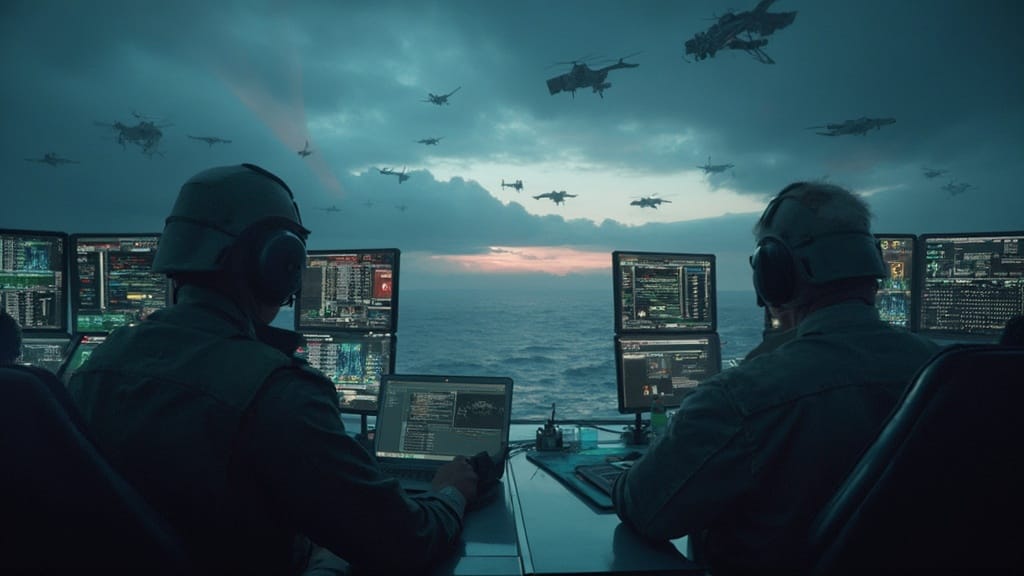
Photo: lyceumnews.com
Past 48 Hours — June 28, 2026
The Big Picture
The Iran "peace memorandum" got its first real stress test this week, and it cracked. After Iran damaged a tanker leaving the Strait of Hormuz, the U.S. resumed bombing Iranian targets — the first strikes since the deal was signed — while the Pentagon simultaneously signed a $35 billion contract to quadruple missile interceptor production and sent Congress an $87.6 billion war bill. Add a Chinese blockade drill around Taiwan timed to Washington's distraction, and the throughline is unmistakable: nobody in any capital is acting like this is winding down.
What Just Shipped
- THAAD interceptor expansion (Lockheed Martin): A seven-year contract worth up to $35 billion to quadruple production of the interceptor that kills ballistic missiles at the edge of the atmosphere.
- MUOS Service Life Extension satellites (Boeing): A $2 billion Space Force award for two new narrowband military comms satellites, first delivery slated for 2031, extending the constellation through 2035.
- DragonFire laser weapon (UK MoD): A shipboard directed-energy weapon that downs drones for roughly $13 a shot, now scheduled for Royal Navy destroyers in 2027.
- Unmanned counter-drone ground vehicles (Overland AI): A $20 million Marine Corps contract for autonomous off-road trucks that hunt drones without a human driver.
This Week's Stories
The Ceasefire That Wasn't: The U.S. Strikes Iran Again
Washington spent weeks telling Americans the Iran war was nearly over. Then Iran hit a cargo ship trying to exit the Strait of Hormuz, and the U.S. hit back — the first American strike on Iran since the peace memorandum was signed.
Reuters reported the fresh strikes following the tanker attack, and the Associated Press described the target set CENTCOM said it hit: surveillance infrastructure, communications systems, air-defense sites, drone storage, and minelayer capabilities. That list is the real story. This wasn't symbolic punishment of a single site — it reads like a counter-network campaign against the entire machinery that makes cheap maritime coercion possible: the sensors, the comms, the storage, the launch infrastructure behind the missiles and drones.
The gap between the political narrative and the operational one has never been wider. The ceasefire is functioning as a press release, not a policy. What to watch: if CENTCOM stops calling these "responses" and starts calling them "operations," the diplomatic fiction has been dropped. If Iran's next target is Gulf-state infrastructure — fuel depots, ports, desalination plants — rather than shipping, that's deliberate escalation beyond the current tit-for-tat.
America's Missile Factory Just Got a $35 Billion Expansion Order

Here's the number that tells you where the Pentagon thinks this is heading: $35 billion, for one missile system, over seven years.
Lockheed Martin won a contract worth up to $35 billion to quadruple production of THAAD — Terminal High Altitude Area Defense — the interceptor that shoots down ballistic missiles at the edge of the atmosphere, the last line of defense before a warhead reaches its target. The Iran war burned through them fast. Military Times reports the post-war stockpile dwindled low enough that Washington began pressuring contractors over how few air-defense weapons remained. Per Aerotime, the award builds on more than $9 billion in Lockheed investment through 2030 — already 20-plus new or modernized facilities, including a Munitions Production Center in Troy, Alabama, and a Munitions Acceleration Center in Camden, Arkansas.
If this works, the U.S. rebuilds a missile production base it let atrophy — at wartime speed. If it doesn't, the bottleneck shows up as a stockpile gap in the next crisis: Military Times notes restoring pre-war levels will take at least three years even with this contract. Watch whether South Korea, Japan, or the Gulf states place orders under the same framework — that tells you how nervous they are about their own shelves.
Britain's $13-A-Shot Laser Is Going on Warships — and It Actually Works
Shooting down a drone with a missile costs between $500,000 and $3 million. Shooting it down with a laser costs about $13. That math is why every serious military is racing to field directed-energy weapons — and Britain just announced it's winning that race in Europe.
DragonFire, the UK's shipboard laser, is on track for Royal Navy destroyers in 2027, making Britain the first European NATO member to field an operational laser weapon at sea, per the Defence Blog. The technology has cleared the "impressive demo" phase and entered the "actually buying it" phase. Every drone war since 2020 has exposed the same brutal arithmetic: cheap attackers versus expensive defenders. A $500 FPV drone forcing a $3 million Patriot intercept is a losing trade at scale. A laser powered by the ship's own generators changes that permanently.
The catch is physics: lasers lose effectiveness in fog, dust, and rain, which is why navies are pairing them with interceptors, not replacing them. Watch whether the 2027 timeline holds and whether France or Germany announces a comparable program within six months — that's the tell for whether European budgets are truly moving.
China Just Ran Its Most Provocative Taiwan Drill in Months — While Washington Was Distracted

Every time Washington gets consumed by one crisis, Beijing runs a drill near Taiwan. This week was no exception.
China's People's Liberation Army launched "Joint Saber" anti-invasion exercises around Taiwan, with state media framing them as a warning against Taiwan independence. Voice of America reported 42 military aircraft crossing the Taiwan Strait median line on Saturday alone. The American Enterprise Institute notes that recent PLA exercises have deployed up to 130 aircraft and 28 ships in a 24-hour window to simulate blockades — what Beijing calls "all-dimensional deterrence outside the island chain," a phrase explicitly about deterring U.S. intervention, not just intimidating Taipei.
Admiral Samuel Paparo has warned that the rising tempo brings INDOPACOM "very close to that point where on a daily basis the fig leaf of an exercise could very well hide operational warning." The timing is no accident: the New York Times reports Trump moved to delay his planned China visit because of the Middle East war, and Beijing appears to read that distraction as room to push. Watch whether the U.S. answers with a Taiwan Strait freedom-of-navigation transit in the next two weeks — silence would be read in Beijing as permission.
The Marines Bought Robot Trucks to Hunt Drones
The Marine Corps just bought something that sounds like science fiction but is a very real procurement line: autonomous ground vehicles built to find and kill drones.
Marine Corps Systems Command awarded Seattle-based Overland AI a $20 million contract for unmanned ground vehicles and software in direct support of counter-drone operations. Overland AI builds off-road trucks that drive themselves through rough terrain; the Marines want them roaming a perimeter with sensors and interceptors aboard, no human driver required. The hard part of the drone problem isn't shooting drones down — it's finding them first, across an area too large for any fixed installation to cover.
It's a small contract, but the concept is the signal. If it expands beyond $20 million, the idea has survived field conditions and mobile counter-drone hunting becomes a category, not an experiment. If it stalls there, it was a pilot that didn't pan out.
Boeing Won a $2 Billion Contract to Keep Military Radios Working Through 2035
Not every space story is spy satellites and cinematic explosions. Sometimes the important thing is boring — and far more useful.
Boeing said the Space Force selected it for a contract worth up to $2 billion for two new Mobile User Objective System Service Life Extension satellites — MUOS, the secure, stubborn, low-bandwidth network troops, ships, and special operators lean on when prettier connections fail. First delivery lands in 2031, extending the constellation through 2035. That timeline sounds distant, but this is exactly how defense space works: order the replacement now, or discover the gap when it's far too late. Resilience is mostly redundancy with a launch date.
The watch item is what the Space Force says publicly about anti-jam and interference-resistant capability — that's the difference between a life-extension buy and a genuine upgrade for a war where GPS and ordinary satellite comms get jammed.
Congress Gets an $87.6 Billion Bill for the Iran War
Wars are expensive. The administration just mailed Congress the invoice.
The White House submitted an $87.6 billion supplemental request, with $67.1 billion for the Pentagon and $21 billion specifically to recoup munitions burned in the conflict, per Breaking Defense and Defense Daily. For scale, $21 billion in munitions alone rivals what the entire U.S. Army spends on procurement in a normal year. The request also folds in emerging tech — hypersonics, counter-drone systems, advanced air defenses — which means the Pentagon isn't just backfilling what it spent; it's buying the next generation while the factories are already running hot.
The political fight is the thing to watch. If the bill passes clean, the Pentagon gets maximum flexibility. If Congress loads it with conditions — domestic-production requirements, spending strings — you'll see the first real legislative pushback on how this war has been managed. A Senate hearing date before July 4th signals urgency; a bill sitting in committee signals the appetite for the conflict is softer than the White House believes.
⚡ What Most People Missed
Pokémon Go's 30 billion scans went viral as a military story: Hundreds of millions of players spent years filming streets and parks for in-game rewards; those scans, now owned by Niantic Spatial, trained a camera-based navigation model that defense firm Vantor (formerly Maxar Intelligence) is fusing into GPS-denied drone navigation — and Vantor already holds an Army contract worth up to $217 million for 3D terrain data. The story is three weeks old, but it hit 720 points on Hacker News this week. Once a procurement conversation reaches the front page, congressional staffers and allied governments start asking about it out loud.
Canada became the first non-European country inside the EU's €150 billion defense fund: The Council of the EU formally concluded an agreement on June 15 letting Canadian firms participate in SAFE — the bloc's loans-for-weapons rearmament instrument — with Canadian content allowed up to 80% of a procurement's value, far above the 35% cap for other third countries. Ottawa's defense minister cited ammunition, missiles, drones, and artillery. It's a preferred-vendor card inside Europe's biggest-ever collective defense shopping trip.
Russia signed a military cooperation deal with Afghanistan's Taliban: OilPrice.com and RFE/RL report the agreement between two parties who were enemies for a decade. The logic is cold: Moscow wants to complicate U.S. and NATO planning in Central Asia, the Taliban wants weapons and legitimacy. Watch whether it produces actual arms transfers or stays a gesture.
The Pentagon's secret anti-vax campaign is back in the news: Reuters resurfaced its reporting on the U.S. military's COVID-era operation using fake social media accounts to undermine confidence in Chinese vaccines in the Philippines. It belongs here not for the public-health angle but as a documented case study in how information operations work, what happens when they're exposed, and why the Pentagon's credibility is now compromised in exactly the Pacific partners it would need in a conflict. [Source: Reuters — English]
A federal semiconductor rule quietly treats chip provenance as a weapons issue: A public-inspection Federal Register document frames semiconductors as essential to military security, explicitly citing warfare, cybersecurity, and guidance-and-control systems. It's the paperwork version of "chips are now doctrine" — and it usually shows up later as contract clauses and redesign headaches for anyone building radars, EW boxes, or seekers with foreign parts buried a few tiers down.
📅 What to Watch
- If Iran strikes another vessel within 72 hours of the latest U.S. strikes, the ceasefire memorandum is functionally dead — watch for CENTCOM to drop "response" language for "operations."
- If China schedules a named follow-on drill within 30 days, Beijing has shifted from episodic coercion to a sustained pressure campaign — a different planning problem entirely for Taiwan and the U.S.
- If allied nations place THAAD orders under Lockheed's new framework, the missile-shortage anxiety has spread beyond Washington to every capital within range of Iran or North Korea.
- If DragonFire gets a production contract alongside the 2027 deployment, every other European defense ministry faces immediate pressure to explain why it doesn't have a laser.
- If Hezbollah's rejection of the US-brokered disarmament framework holds, the practical demand signal in the Levant shifts back toward surveillance drones and short-range interceptors — not postwar stabilization gear.
The Closer
A laser that downs a drone for the price of a movie ticket, a Pokémon Go player who unknowingly trained a military spy drone while hunting a Squirtle, and a Federal Register PDF that just quietly declared the silicon in your phone a weapon of war. The peace memorandum, meanwhile, is holding beautifully — except for the bombing.
Stay suspicious of the word "winding down."
Forward this to the friend who still thinks the Iran war ended last month.