The Lyceum: Defense Tech Daily — Mar 14, 2026
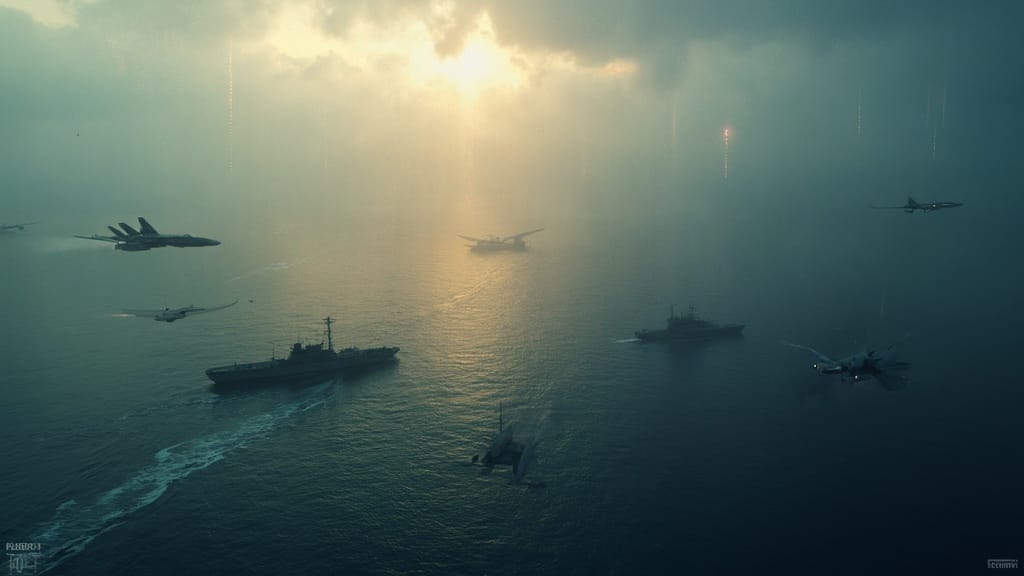
Photo: lyceumnews.com
Saturday, March 14, 2026
The Big Picture
The U.S. struck military sites on Kharg Island — the speck of Persian Gulf rock that handles the majority of Iran's oil exports — then publicly said it did not destroy the oil terminals. Iran responded with strikes that put seven American refueling planes out of service across two incidents, exposing the soft underbelly of U.S. airpower logistics. Meanwhile, the Pentagon is processing roughly a thousand targets a day with AI tools that vendors admit hallucinate, and Congress has not yet established new, specific oversight for battlefield AI use.
Today's Stories
The U.S. Struck Iran's Economic Hub — Then Said "We Could Have Done Worse"
Kharg Island handles millions of barrels of Iranian crude a day. Last night, the U.S. struck military targets on Kharg Island — air defenses, a naval base, airport facilities — while deliberately leaving the oil infrastructure untouched. Iran's Fars news agency counted more than 15 explosions. Trump wrote that he had "chosen NOT to wipe out the Oil Infrastructure" but warned he'd "immediately reconsider" if Iran blocked ships through the Strait of Hormuz.
The strategic logic appears to be coercion, not destruction: the oil terminals are the leverage. CNN reported that analysts say hitting the terminals would almost certainly trigger Iranian attacks on energy facilities across the Gulf, sending oil prices sharply higher on the session. So the Pentagon delivered a sledgehammer warning shot — striking everything around the thing it's threatening to destroy next. Axios framed it as an economic "decapitation" signal aimed at Iran's revenue streams.
One detail that deserves more attention: a U.S. commander has publicly acknowledged using AI tools for decision-support in active operations against Iran — accelerating target triage and sensor fusion, with humans still clearing strikes. The speed of this campaign isn't just political will. It's software.
Iran Damaged Five U.S. Refueling Planes — and Exposed a Critical Weakness
You can lose a fighter jet and lose a battle. Lose the tankers that keep those fighters airborne, and you start losing the campaign.
An Iranian ballistic missile struck Prince Sultan Air Base in Saudi Arabia, damaging five KC-135 Stratotanker refueling aircraft — the planes that extend the range of every bomber and fighter in the theater. Hours earlier, a KC-135 crashed in western Iraq, killing all six crew members; a second tanker from that incident later limped to Israel. That's at least seven tankers out of service in a single day.
Iran can't win a straight air fight against the U.S. So it's going after the fuel lines — the enabling infrastructure that lets American airpower reach Iranian targets. If the U.S. is forced to relocate its tanker fleet to bases beyond Iran's missile range, sortie rates over Iran will drop. The strike also raises political and security questions for Saudi Arabia and other host nations hosting high-value American assets.
GPS Spoofing Is Turning the Strait of Hormuz Into a Ghost Sea

Before a missile lands, a ship's first problem in the Strait right now is: where am I, exactly?
Maritime intelligence firm Kpler has confirmed more than 10 GPS interference incidents across the Persian Gulf since February 27. Some tankers are broadcasting political messages through their tracking signals to avoid becoming targets. Others have gone completely dark. One vessel, the NV Aquamarine, appeared to travel at 102 knots — physically impossible for a ship carrying 350,000 barrels of oil — pointing to deliberate manipulation. Roughly one in 15 vessels in the area is showing suspicious positional anomalies.
The Strait has become a live laboratory for maritime electronic warfare. Knowing where ships actually are now requires layering satellite imagery, ownership databases, and behavioral analytics on top of the ships' own signals — which means commercial intelligence companies like Pole Star Global and Kpler are suddenly as important to understanding this crisis as the U.S. Navy's own sensors.
2,200 Marines Are Headed to the Gulf. The Role Was Not Specified.
The 31st Marine Expeditionary Unit — a self-contained crisis-response force with F-35s, Ospreys, landing craft, and its own logistics — is transiting from Okinawa aboard three warships to join the Iran war. NPR reported the role of the 2,200 Marines was not specified.
The options range from tanker escort (Trump said Navy escorts through the Strait would happen "very soon") to something far more aggressive: Axios reported that the Trump administration has discussed seizing Kharg Island, though analysts say that would require a ground operation the U.S. appears reluctant to undertake. The MEU's transit from the Pacific will take at least a week — this is a deliberate buildup, not an emergency insertion. The gap between "we're sending Marines" and "here's what they'll do" is where wars make their most expensive mistakes.
The Pentagon Is Processing 1,000 Targets a Day With AI That Hallucinates
Retired Navy Admiral Mark Montgomery told reporters the military is now processing roughly a thousand potential targets a day, striking the majority, with turnaround under four hours. That pace would have been physically impossible five years ago. What changed is AI — specifically Palantir's targeting software, now live and in use.
The problem: OpenAI and Anthropic have both acknowledged their systems periodically fabricate answers. A Defense Department official told MIT Technology Review that generative AI — the same technology behind ChatGPT and Grok — is being layered on top of existing targeting systems as a conversational interface. Unlike the older Project Maven system, which forced analysts to inspect raw imagery, generative AI outputs are easier to access but harder to verify.
Rep. Sara Jacobs warned that "AI tools aren't 100% reliable — they can fail in subtle ways and yet operators continue to over-trust them." Meanwhile, the Pentagon does not yet have a reliable system for testing whether its AI models do what they're supposed to — the Defense Innovation Unit issued a solicitation for one, with responses due March 24. The cars are on the road. The crash-test standards are still in procurement.
⚡ What Most People Missed
- Saudi Arabia's most important asset right now isn't a weapon — it's a pipeline. Saudi Arabia is accelerating crude exports through the Petroline pipeline to its Red Sea terminal at Yanbu, bypassing Hormuz entirely. This piece of 1980s-era infrastructure is suddenly a critical node in the global oil supply chain, and most coverage has focused on tankers and chokepoints rather than onshore throughput constraints that could set export caps.
- China parked a signals intelligence ship next to the world's biggest naval conflict. The Liaowang-1, a dedicated electronic surveillance vessel, deployed to the Gulf of Oman — recording communications, radar emissions, and electronic activity from both sides. Beijing is watching everything and taking notes.
- Iran said it would allow tankers through the Strait in exchange for payment in yuan. CNN reported Tehran floated transits for oil traded in Chinese currency instead of dollars. The proposal probably won't survive this war, but the fact it's being floated reveals Iran is trying to accelerate a fracture between dollar-denominated energy markets and a China-centered alternative.
- The Army quietly launched "Project Aria" because commercial AI isn't built for combat. Defense One reported the Army is developing military-specific AI models after concluding that commercial systems lack the geospatial reasoning and physics-grounded calculations that battlefield coordination demands. A new class of veteran-founded startups is rushing to fill the gap.
📅 What to Watch
- If CENTCOM announces a formal tanker convoy escort operation, Iran is likely to treat it as a new escalation threshold — increasing the risk of direct clashes between U.S. escorts and Iranian forces in the Strait and prompting rapid revisions to rules of engagement.
- If China publicly responds to Iran's yuan-for-transit proposal, it would signal Beijing is prepared to use the conflict to accelerate de-dollarization of energy markets — a structural shift that could change long-term settlement currency choices for large-scale oil contracts.
- If the U.S. relocates its tanker fleet to bases beyond Iran's missile envelope, sortie rates over Iran will drop measurably — demonstrating that attriting logistics can have strategic effect and possibly shifting Iranian tactics toward further strikes on support infrastructure.
- If the Defense Innovation Unit's AI testing solicitation (responses due March 24) draws bids from major vendors, expect the defense industry to start building crash-test infrastructure for systems already in combat — watch which companies bid and how rapidly they propose verification regimes.
- If Israel begins visible troop movements toward the Lebanese border, it would indicate the planned "massive" ground invasion has moved from planning toward execution — opening a second front that would strain U.S. and Israeli operational and logistical support simultaneously.
The Closer
A tanker pretending to sail at 102 knots, a humanoid robot carrying an M-16 through a product demo, and a chatbot that hallucinates being asked to pick which building gets hit next — this is the future of war, and it arrived before the user manual.
Somewhere in the Gulf of Oman, a Chinese intelligence ship is quietly recording the most expensive beta test in history.
Stay sharp.
If someone you know should be reading this, send it their way.