The Lyceum: Defense Tech Daily — Mar 22, 2026

Photo: lyceumnews.com
Sunday, March 22, 2026
The Big Picture
A 92% missile intercept rate, reported across the campaign to date, sounds excellent until you do the math on 400 incoming warheads — and two of them landed near a nuclear reactor. That's the story today: the systems everyone bet their lives on are showing cracks, the drones everyone dismissed as toys are hitting targets 1,400 kilometers away, and both Washington and Tehran are now openly threatening each other's power grids and drinking water. Distance is no longer a defense. Volume is the new weapon. And infrastructure — the boring stuff that keeps lights on and taps running — is now the frontline.
Today's Stories
The Missile Got Through — and That's the Whole Story
Iranian ballistic missiles struck the southern Israeli cities of Dimona and Arad on Saturday, wounding nearly 200 people — 11 seriously — after Israeli air defenses failed to intercept at least two incoming warheads. Dimona is home to Israel's nuclear research center, the most heavily defended piece of real estate in the country. The missiles got through anyway.
Here's what makes this technically devastating: the IDF isn't claiming Iran used a secret new weapon. Spokesman Effie Defrin said explicitly that "this is not a special or unfamiliar type of munition." The systems engaged. They just missed. The IAF reports a 92% interception rate against populated areas and key infrastructure across the campaign to date. That sounds reassuring until you learn that more than 400 ballistic missiles have been fired at Israel since the conflict began — meaning roughly 32 warheads have gotten through. Five carried conventional warheads with hundreds of kilograms of explosives. Over two dozen carried cluster munitions that scattered across more than 100 impact sites.
The math problem extends far beyond Israel. Iron Dome and its bigger siblings — Arrow and David's Sling — were designed against relatively small salvos. Iran appears to be stress-testing a different scenario: what happens when a state-level adversary fires enough missiles that even excellent interception rates leave dozens of warheads landing in cities? AP's reporting underscores the political and technical shock of wounds in the shadow of a nuclear facility. Haaretz initially reported a lower casualty count of 115 — the discrepancy itself matters for public confidence.
If the IDF investigation finds a systemic vulnerability rather than a coincidental miss, every country operating Arrow or Patriot systems will scramble to reassess. If it's declared coincidental, the harder question remains: at what salvo size does a 92% interception rate become unacceptable? Watch for accelerated investment in redundant interceptor layers, satellite early-warning sensors, and high-energy laser systems — the technologies that assume attrition rates, not guarantees.
Iran Threatens the Taps — Trump Threatens the Grid

Both threats target civilian infrastructure and mark a rhetorical escalation in framing warfare as attacks on utilities and digital systems.
President Trump threatened to "hit and obliterate" Iran's power plants if Tehran doesn't reopen the Strait of Hormuz within 48 hours — an ultimatum reported by Axios that expires Monday evening, March 23, 2026. Hours later, Iran's military command responded with its own threat: "all energy, information technology and desalination infrastructure belonging to the US and the regime in the region" would be "irreversibly destroyed" if Iran's grid were hit.
The desalination threat deserves far more attention than it's getting. The UAE, Saudi Arabia, Qatar, and Kuwait get the majority of their drinking water from desalination plants. Take those offline and you don't have an economic disruption — you have a humanitarian emergency within days. Iran has already used drones against a facility in Bahrain, so this isn't purely hypothetical.
But buried in Iran's response is something genuinely new. Iran's semi-official Tasnim News Agency, linked to the IRGC, released a list of U.S. tech companies operating in Israel and the Gulf that it said would be targeted in an infrastructure war — including offices of Google, Microsoft, Palantir, IBM, Nvidia, and Oracle. Previous Iranian threats focused on refineries and pipelines. Naming the companies that run targeting AI and build inference chips is a different kind of signal: Iran is framing this as a war on the digital infrastructure behind U.S. military operations, not just the oil plumbing. Palantir runs systems used by the Pentagon for targeting analysis; Nvidia chips power much of that inference hardware. Whether this reflects real capability or psychological pressure is unclear — Tasnim is semi-official, not a formal military communiqué — but the framing shift matters.
If the ultimatum passes on March 23, 2026, without action, the credibility of the threat would erode and Iran's calculus could shift significantly. If U.S. bombers start repositioning toward Gulf bases or Diego Garcia, the threat is moving from rhetoric to targeting packages. Watch both.
Ukraine Hit a Russian Refinery 1,400 Kilometers Away. Again.
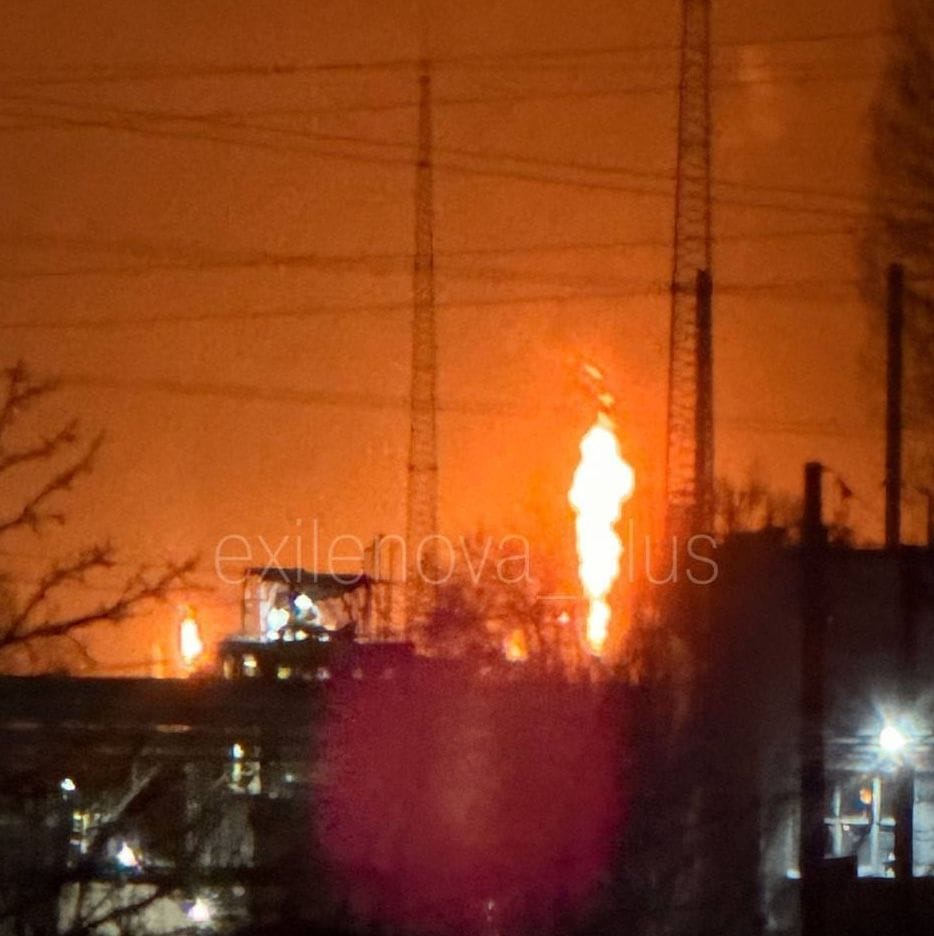
Overnight on March 21–22, Ukraine launched nearly 300 drones against targets deep inside Russia, reportedly striking an oil refinery in Saratov Oblast and the command post of Russia's Rubikon Center for Unmanned Technologies in Mariupol — the unit that coordinates Moscow's counter-drone operations. Drones also reached Ufa, in Russia's Bashkortostan republic, where Rosneft's Bashneft unit operates three refineries with a combined capacity of roughly 470,000 barrels per day.
The distance matters more than the damage. Ufa sits over 1,300 kilometers from the front line — roughly New York to Miami. And the target selection is surgical: Defense Express reports that Ufaorgsintez produces about a third of Russia's phenol and acetone and 15% of its high-density polyethylene — raw materials directly linked to Russian explosives manufacturing. Ukraine isn't just hitting oil. It's targeting the chemical supply chain that feeds Russian ammunition production, 900 miles behind the front.
The campaign's tempo is accelerating. Kyiv Post analysis notes that from January to March 2026, the pace effectively doubled to around four separate targets hit every night, with drone swarms growing from about 50–70 aircraft to 100–200 per sortie. Ukraine appears to be systematically degrading Russian air defenses to create blind spots for deeper strikes — and the Ufa raids suggest it's working. A few dozen $50,000-class drones can force refinery shutdowns and maintenance inspections costing hundreds of millions, making each attack economically disproportionate to its weapon cost.
If Russian air defense gaps around Bashkortostan widen further, Moscow's entire industrial rear becomes vulnerable. Watch whether Russia redeploys frontline air defense assets to protect refineries — every battery moved east is one fewer battery available to contest Ukrainian operations in the west.
⚡ What Most People Missed
- A hit on Russia's Rubikon command post may create operational blind spots. Reports say the Rubikon Center for Unmanned Technologies' command post in Mariupol was struck; if its communications or databases were degraded, Russian regional counter-drone coordination could be disrupted for weeks, complicating tactical air-defense integration across multiple fronts.
- Hungary reportedly briefed Moscow from inside EU security meetings. A Washington Post investigation, confirmed by Euronews, found that Foreign Minister Péter Szijjártó called Sergei Lavrov during breaks at EU meetings to brief him on discussions. Poland's PM Donald Tusk said today it matched long-held suspicions and that he'd already been "carefully weighing every word" in Brussels. The implication: NATO planning assumptions that relied on EU-level confidentiality may need reassessment.
- Iran is running a selective blockade that sorts the world into approved and rejected trading partners. Rather than closing Hormuz uniformly, Tehran is granting passage to vessels carrying oil to China, India, Pakistan, and Turkey while blocking others. China receives about 45% of its oil imports through Hormuz annually and is reportedly negotiating passage rights — quietly acquiring leverage over the same chokepoint the U.S. is trying to force open.
- The Czech drone factory fire is now formally treated as terrorism. Czech police have labeled the blaze at an LPP Holding warehouse — which built drone technology for Ukraine — as the 2026 Pardubice arson attack, with the interior minister publicly attributing it to Russian intelligence. Two production buildings were partially destroyed. Russia appears to be treating European defense supply chains as a legitimate target — not with missiles, but with matches.
- A former IDF air defense chief warns Iran is tweaking missile trajectories to double range. By firing on very high, arcing paths resembling suborbital "satellite" shots, Iran can extend existing missile inventories to strategic range without new rocket motors — potentially reaching Western Europe with current hardware. Current interceptor architectures weren't designed for these flight profiles.
📅 What to Watch
- If Trump's 48-hour Hormuz ultimatum expires Monday evening, March 23, 2026, without strikes, expect coalition cohesion to fray: some partners may seek bilateral accommodation with Tehran, insurance on regional shipping could spike, and private maritime security firms may expand escorts — complicating U.S. attempts to quickly assemble a multinational enforcement posture.
- If the IDF's Dimona interception investigation finds a systemic flaw rather than a coincidental miss, allies operating Arrow, Patriot, or similar systems will likely accelerate redeployment of layered interceptors, fast-track purchases of additional interceptors and sensors, and revise doctrines to emphasize distributed redundancy over single-site defense.
- If Zelenskyy partially lifts Ukraine's wartime weapons export ban — even for a single government-to-government interceptor drone deal — it would unlock immediate Gulf procurement channels, catalyze investment in Ukrainian defense manufacturing capacity, and shift regional sourcing away from established suppliers on a compressed timeline.
- If European defense facilities report additional "accidental" fires and insurers start hiking premiums on arms-adjacent warehouses, expect manufacturers to relocate sensitive production inland, shift inventories to lower-profile facilities, and harden logistics chains — increasing lead times for delivered systems and raising costs for buyers.
- If Gulf states begin visibly ring-fencing desalination plants with missile defenses and patrol craft, expect a reallocation of limited air-defense and naval assets to civilian protection roles, higher coastal defense budgets, and a political signal that governments are treating water infrastructure as a priority target rather than rhetorical leverage.
The Closer
A nuclear reactor's neighborhood gets shelled by missiles the defenders already knew about, a country under a wartime weapons-export ban looks set to become a key supplier in the Gulf if restrictions are eased, and Hungary's foreign minister reportedly shared EU confidential information with Moscow during meetings.
The 48-hour ultimatum to reopen a strait that Iran is already selectively opening — for friends only — is the geopolitical equivalent of demanding someone unlock a door while they're handing keys to your rivals through the window.
Clear satisfactions and murky horizons. —The Lyceum
If someone you know is trying to make sense of what's actually happening out there, forward this to them.
From the Lyceum
The White House released a six-point AI rulebook and told every state legislature to stand down on its own AI laws. Read → The Legaltech Brief