The Lyceum: Defense Tech Daily — Mar 23, 2026
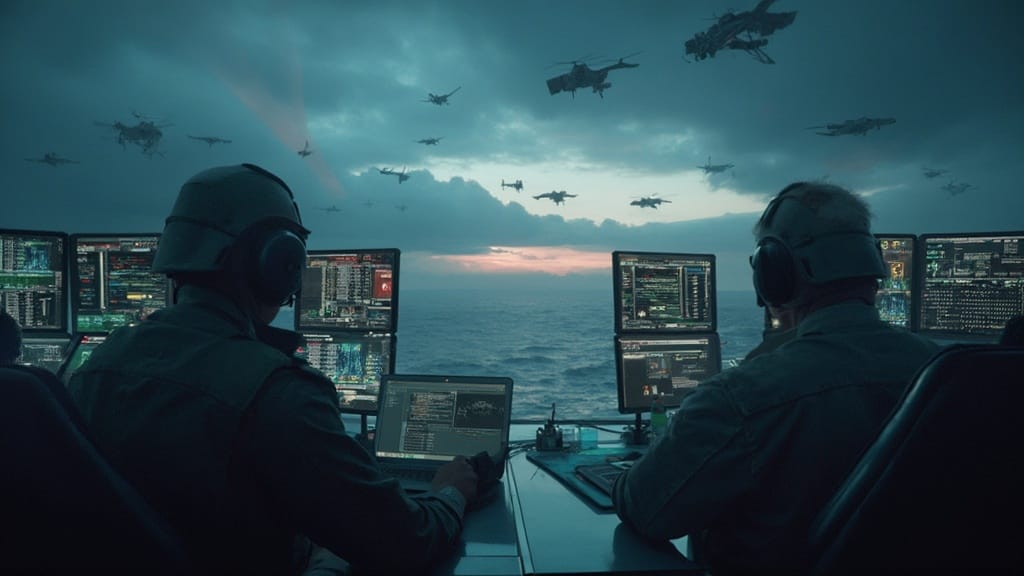
Photo: lyceumnews.com
Monday, March 23, 2026
The Big Picture
The Strait of Hormuz is now a live-fire laboratory for every counter-drone, underwater autonomous, and directed-energy system the Pentagon has been developing for a decade — and the results are coming in fast. A microwave cannon just downed 40 drones in combat. Iran deployed underwater "loitering torpedoes" the Navy wasn't built to hunt. Russia is feeding Iran targeting intelligence on U.S. forces. And buried under all of it, the Army quietly killed its most powerful laser program while greenlighting a $20 billion counter-drone software backbone. The theme today isn't escalation — it's acceleration. Technologies that were PowerPoint slides eighteen months ago are now deciding who controls the world's most important waterway.
Today's Stories
The Beam Weapon Is No Longer a Concept — It Just Shot Down 40 Drones in a Real War
The Pentagon confirmed that Epirus Leonidas high-power microwave systems — truck-mounted devices that overload drone electronics with invisible radio waves — downed over 40 Iranian one-way attack drones in the Strait of Hormuz. This appears to be the first large-scale combat use of a microwave counter-drone weapon.
What makes Leonidas different from a laser or a missile: it doesn't target individual drones. It saturates a volume of sky with electromagnetic energy, frying every drone's electronics simultaneously. Epirus has also demonstrated kills against fiber-optic-guided drones — platforms immune to conventional jamming — because the microwave pulse disables onboard circuits regardless of the control link. Some deployed units reportedly run an AI layer called Seraphim, built by Digital Force Technologies, that speeds engagement sequencing — meaning the Gulf-deployed variant may already be smarter than the prototype most analysts were tracking.
If this performance holds, expect the Army to fast-track full-rate production within weeks. If it doesn't — if swarms adapt with better shielding or saturate from multiple axes — the economics of drone defense stay broken. The signal to watch: whether allies start placing orders before the Army's own review is finished.
Iran Deployed an Underwater "Loitering Torpedo" — and the Navy Has No Great Answer
Everyone's watching the sky above Hormuz. The more dangerous threat may be underneath it.
Iran's Azhdar stealth underwater drone runs on lithium-battery propulsion, operates for up to four days, and moves at 18–25 knots with minimal acoustic signature. Think of it as a torpedo that loiters for days before striking — in shallow, noisy waters where traditional sonar already struggles. Le Monde reports Iran has also deployed larger "kamikaze" UUVs — effectively suicide submarines the size of a small car — creating a three-dimensional kill web: air, surface, and subsurface.
The U.S. and UK just launched REEF (Robotic Exclusion and Engagement Framework), a joint program to pull together sensors, AI discrimination, and countermeasures against hostile UUVs. If REEF delivers rapidly deployable packages, it closes a real gap. If it moves at normal procurement speed, the first confirmed hull strike by an autonomous underwater drone will trigger a global scramble. That strike hasn't happened yet — when it does, insurers and shipping companies will likely react before naval forces can mount a coordinated response.
20,000 Sailors Are Trapped. Ships Are Flying False Flags. This Is What Siege Warfare Looks Like in 2026.

Some 20,000 seafarers are stuck in the Persian Gulf, unable to transit the Strait. Foreign Policy reports that ships are broadcasting false national affiliations — "Chinese crew," "Indian crew," "Iraqi owner" — amid crews concluding that faking identity is their best survival strategy. About 90 ships have transited since the crisis began, mostly Iranian shadow tankers, plus at least nine (primarily Indian) vessels routed through an Iranian-controlled "safe corridor" that requires visual inspection by IRGC personnel.
Iran hasn't sealed the strait. It's turned it into a checkpoint — customs enforcement at gunpoint. Brent crude hit $126 per barrel intraday, the largest energy disruption since the 1970s. Trump announced a five-day pause on threatened strikes against Iranian power plants, citing "productive conversations" that Tehran publicly denies occurred. Whether the pause is a genuine off-ramp or tactical breathing room, the underlying structure — Iran converting cheap distributed technology into a strategic deterrent against the world's most powerful navy — remains intact. Watch whether the selective passage hardens into a permanent two-tier shipping system.
Ukraine Says It Has "Irrefutable Evidence" Russia Is Iran's Battlefield Intel Service
President Zelensky announced today that Ukrainian military intelligence has "irrefutable evidence" Russia is providing Iran with intelligence — including radio-technical and electronic intelligence capabilities. The Kyiv Independent and Interfax-Ukraine corroborate the statement. CNN previously reported that Russian satellite imagery of U.S. troop positions, ships, and aircraft was flowing to Tehran.
The confirmation that matters: Politico reported Russia offered to stop sharing intelligence with Iran in exchange for the U.S. halting intelligence support to Ukraine. Washington refused. That's not a denial — it's a negotiating chip, which means both sides acknowledged the pipeline is real. If Russian satellite data is helping Iran target U.S. assets in real time, the Hormuz confrontation is a three-party conflict in everything but name. The signal to watch: whether NATO formally designates this intelligence sharing as an escalation requiring a coordinated response, or quietly absorbs it as background noise.
The Pentagon Just Created a $20 Billion Counter-Drone "App Store"
The Army selected Anduril's Lattice software as the command-and-control backbone for an enterprise counter-drone contract worth up to $20 billion over ten years. Think of Lattice as an operating system: rather than every base buying disconnected radars, jammers, and interceptors, Lattice knits them into a single network. A sensor at one site sees a swarm; the best available effector at another — laser, missile, microwave — takes the shot.
This lands alongside Palantir's Maven being designated a formal program of record, locking AI-driven targeting into permanent Pentagon infrastructure. Together, they signal the military has accepted software-defined warfare — where the network matters more than any single platform. If Lattice works as advertised in the Gulf, allies will face a binary choice: ride the same backbone or build incompatible stacks. If it doesn't — if integration across legacy systems proves too brittle — the "app store" becomes a walled garden nobody can actually shop in. Watch for traditional defense primes protesting, loudly.
The Army Quietly Ditches Its Most Powerful Anti-Cruise Missile Laser
The Army is cancelling plans to make the 300-kilowatt "Valkyrie" laser — designed to shoot down cruise missiles from a truck — a formal program of record. Instead, it's pivoting to a joint Army-Navy effort called the Joint Laser Weapon System, aimed at eventual megawatt-class weapons for the "Golden Dome" layered missile defense concept.
Read this alongside the Leonidas story and the picture sharpens: directed energy is maturing unevenly. Short-range microwave weapons and lower-power optical lasers work today against drones. Megawatt killers that can reliably destroy a fast-moving cruise missile remain an engineering problem nobody has solved. The Army is being pragmatic — field what works now, invest jointly in what might work later. If the JLWS program produces a prototype within three years, the pivot was smart. If it becomes another decade-long study, the Army will have abandoned a 300 kW system that was close to delivery for a megawatt dream that never arrives.
Shield AI Wins $450M to Give Black Hawks a Robot Brain
Shield AI won a $450 million contract to install its Hivemind AI autonomy stack on 200 Black Hawk helicopters, enabling fully autonomous flight, formation hovering, and troop insertion under GPS jamming and communications denial — the exact environment Iran has been creating in the Gulf. Hivemind doesn't phone home; it makes decisions based on mission parameters loaded before flight.
That's a meaningful line to cross for a troop-carrying aircraft. The system was validated by DARPA and formally handed to the Army days ago, so this contract converts a lab success into fleet-scale production. If autonomous Black Hawks prove reliable in contested conditions, every rotorcraft in the inventory becomes a candidate for the same upgrade — and the congressional debate about autonomous systems carrying human passengers becomes unavoidable. The failure mode: a single high-profile autonomous flight incident that freezes certification and sends the program back to testing for years.
⚡ What Most People Missed
- Photos leaked suggest Serbia is the first European country carrying Chinese anti-ship ballistic missiles. The CM-400AKG appears in imagery; the proliferation question nobody's asking: which other operators of Russian-origin fighters just gained a theoretical upgrade path to Chinese precision strike?
- The IMO convened an emergency session on trapped Gulf seafarers and formally condemned Iran's threats to merchant vessels. It got zero coverage because the IMO has no enforcement mechanism. But the diplomatic record it created will anchor future sanctions proceedings, insurance claims, and accountability cases. The paperwork of this war is being filed while the shooting continues.
- Pakistan is pitching the combat-proven JF-17 Block III to at least 13 countries after the jet's performance in the 2025 India-Pakistan clash. At $25M–$50M per airframe — one-fifth the cost of an F-35 — China is exporting combat-tested air power through a proxy supplier, bypassing the political conditions attached to Western platforms.
- The Space Force swapped a GPS III satellite from ULA's grounded Vulcan to a SpaceX Falcon 9, pushing the launch to late April. Every time this happens, the concentration risk in military launch gets harder to ignore — one provider's grounding compresses schedules for navigation, ISR, and comms satellites across the board.
- Northrop Grumman unveiled a "cognitive" electronic warfare system that watches unknown signals, analyzes them in real time, and generates jamming responses the enemy has never seen. Traditional jammers work from a library; this one improvises. If it works as described, years of Russian and Chinese counter-countermeasure investment become less effective overnight.
📅 What to Watch
- If Trump reinstates the power-plant strike order, watch Iran's mine-laying and UUV assets — those are the first indicators of whether "irreversible closure" was a redline or a negotiating posture.
- If the Army fast-tracks Leonidas production based on Gulf performance, it will force NATO members into a near-term choice on interoperability standards, accelerate export-control discussions, and compress allied procurement schedules for counter-drone payloads.
- If NATO formally designates Russia's intelligence sharing with Iran as an escalation, it transforms the Hormuz crisis from a bilateral standoff into a systemic confrontation with alliance-wide implications.
- If Serbia's first Chinese-partnered drone factory opens this month, it becomes the first Chinese military manufacturing presence in Europe — a different category of problem than arms imports, and one the EU accession process has no framework to address.
- If the first confirmed hull strike by an Iranian autonomous UUV occurs, the underwater drone threat jumps from theoretical to insurable — and the global procurement scramble in counter-UUV systems begins that afternoon.
The Closer
A truck-mounted microwave system just became the most effective anti-aircraft weapon in the Persian Gulf; 20,000 sailors are surviving a naval blockade by pretending to be from countries they've never visited; and the Army killed its most powerful laser because it decided a bigger one might work someday.
The strait isn't closed — it's just running Iranian customs now, which is somehow worse.
That's your Monday. Eyes forward.
If someone you know is trying to make sense of what's happening in the Gulf — or just wants to understand why a microwave cannon matters — forward this their way.
From the Lyceum
The White House released a formal AI legislation blueprint and told states to stand down on their own rules. Read → The White House Hands Congress an AI Rulebook