The Lyceum: Defense Tech Daily — Mar 27, 2026
Photo: lyceumnews.com
Friday, March 27, 2026
The Big Picture
● Strait of Hormuz · Israel · Russia
Iran is turning the Strait of Hormuz from a wartime blockade into a permanent bureaucracy — complete with legislation, yuan-denominated tolls, and a geopolitical sorting algorithm that decides which countries get to trade. Overnight, Israel said it struck the factory where Iran builds the anti-ship missiles enforcing that blockade; open-source imagery will be needed to confirm the extent of damage. The Pentagon is weighing sending up to 10,000 more ground troops near Iran's oil jugular. And Russia just passed the hat to its billionaires to keep the lights on. Three wars, one throughline: the infrastructure of control — who builds it, who funds it, who breaks it — matters more than the missiles.
Today's Stories
Iran's Parliament Wants to Make the Hormuz Toll Booth Permanent Law
● Strait of Hormuz · Greece · China
Wartime blockades end when wars end. Laws don't.
Iran's parliament is drafting a bill to formally codify the IRGC's fee regime for ships transiting the Strait of Hormuz — the 21-mile-wide chokepoint carrying roughly a fifth of the world's traded oil. One lawmaker told state-affiliated media the goal is to create "a source of revenue through the collection of fees" while asserting Iranian sovereignty over the waterway.
The system already works like an air-traffic control tower grafted onto a warzone. Ships submit cargo manifests, crew lists, ownership details, and destination ports to IRGC intermediaries. Approved vessels receive a clearance code and an armed escort. At least two ships have paid direct tolls, settled in Chinese yuan. Traffic through the strait has collapsed 70–90% since early March (a 70–90% decline on the month), with roughly 150 transits since March 1 and nearly 2,000 ships waiting on both sides, according to maritime intelligence firm Windward.
The AP calls it a "programmable" permissions system — one that can be updated overnight to favor friends and punish opponents. Iran-affiliated ships account for 24% of transits since March 1, Greece 18%, China 10%. Spain's ships go free. Countries opposing the war get blocked. It's a geopolitical sorting algorithm disguised as traffic management.
If parliament passes the bill, Iran transforms a wartime measure into a claimed legal right — one that would force a challenge at the International Maritime Organization and likely trigger U.S. sanctions against the Chinese banks processing payments. If it fails or stalls, the toll regime remains an improvisation that dies with the ceasefire. Watch whether major importers — India, China, European states — publicly accept or reject the digital rules of passage. That's the real vote.
Israel Says It Struck Iran's Missile and Mine Factory Overnight
● Persian Gulf · Israel · Iran
There's a specific factory where Iran builds the weapons threatening every ship in the Persian Gulf — and the IDF said the site no longer exists.
The Israeli Air Force said it struck Iran's primary missile and naval mine production facility in Yazd overnight. The IDF said the site was used for "planning, development, assembly, and storage of advanced missiles intended for launch from cruise platforms, submarines, and helicopters toward both mobile and stationary maritime targets." Additional strikes hit ballistic missile production sites and air defense systems across Iran.
This represents a shift in targeting logic. Earlier in the war, Israel hunted launchers already in the field. Now it's targeting production facilities that make the next generation — specifically the anti-ship systems enabling the Hormuz blockade. The Critical Threats Project at AEI reports that IDF Military Intelligence has identified "low morale, absenteeism, and burnout" among IRGC ballistic missile units, with soldiers reportedly refusing to report to launch sites out of fear of strikes. After 600-plus strikes on missile sites, the psychological attrition is compounding the physical damage.
If open-source satellite imagery confirms significant damage at Yazd in the next 48 hours, it validates Israel's escalation from launcher-hunting to factory-hunting — a strategic acceleration that shortens the war's timeline by attacking Iran's ability to regenerate. If imagery shows the facility largely intact, the IDF's claims will face serious scrutiny. The observable signal: commercial satellite passes over Yazd this weekend.
10,000 More Troops — and the Destination Is the Point
● Middle East · Washington DC, USA · Tehran, Iran
When you're negotiating and deploying simultaneously, you're not really negotiating.
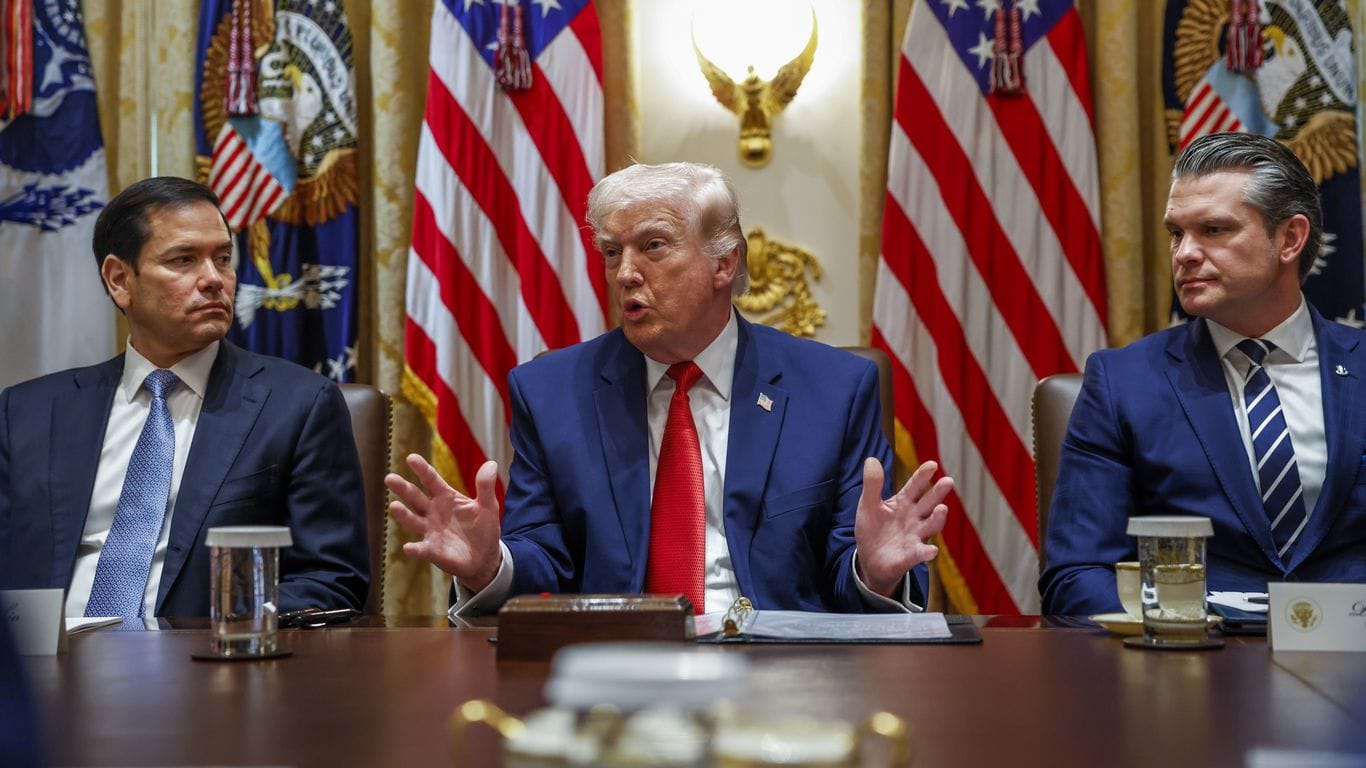
The Pentagon is considering sending up to 10,000 additional ground troops to the Middle East, according to the Wall Street Journal, citing defense officials. The deployment would include infantry and armored vehicles, joining roughly 5,000 Marines and thousands of 82nd Airborne paratroopers already in the region. Officials told Axios the troops would likely be positioned within operational range of Kharg Island — where roughly 90% of Iran's oil exports originate.
Armored ground forces near Kharg isn't defensive posturing. It's a visible, credible threat to Iran's only remaining economic lifeline. The White House set an April 6 deadline for Iran to reopen the strait and said it paused strikes on Iranian energy infrastructure "at the request of the Iranian government" — a claim Tehran flatly denied.
The April 6 deadline is now the clock that matters; if Iran doesn't move, the Pentagon's four "final blow" options — reported by Axios earlier this week — become live decisions. If specific units (armored brigades, engineering battalions) are officially named and deployed, that's the signal Washington is planning to hold territory, not just punish from the air. A 10,000-person deployment leaves a visible logistics footprint in commercial satellite imagery long before troops arrive — watch the staging areas.
Putin Passes the Hat to His Oligarchs
● Persian Gulf · Ukraine · Russia
A government with a nominally $100+ billion defense budget is asking billionaires to chip in. That tells you everything.
Putin asked Russian oligarchs to donate to the national budget to stabilize finances as the Ukraine war enters its fifth year, according to independent Russian outlet The Bell, with the Financial Times reporting similar claims. Billionaire Suleiman Kerimov reportedly pledged 100 billion roubles — roughly $1.23 billion. Russia's federal budget already earmarks over 29% of spending for defense in 2026, according to War on the Rocks.
This matters because fiscal strain is what eventually breaks procurement programs, kills production runs, and forces militaries to choose between competing weapons systems. Ukraine's sustained drone campaign against Russian oil export infrastructure — hitting Primorsk and Ust-Luga for a third consecutive night this week — is compressing the revenue that funds the war. Cheap drones degrading expensive energy infrastructure is the same cost-exchange math playing out in the Persian Gulf, just with different actors.
If oligarch "donations" become a recurring mechanism, it signals Russia's war economy is running on fumes dressed up as patriotism. If they remain a one-off, it's theater. Watch whether Russian defense procurement contracts get delayed or scaled back in Q2 — that's where fiscal strain becomes operational.
The Robot Wingman Factory Is Officially Open for Business
● United States
Anduril just did something no defense startup has done before: stood up a dedicated factory for autonomous fighter jets before the main production contract was even awarded.
The company announced it has started production of its YFQ-44A "Fury" at a new facility in Ohio. Fury is Anduril's contender for the Air Force's Collaborative Combat Aircraft program — AI-piloted wingmen designed to fly alongside jets like the F-35 on missions too dangerous or too expendable for human pilots. The entire CCA concept is built around "affordable mass": rebuilding fleet size with thousands of cheaper, uncrewed aircraft.
Opening a factory before winning the contract is a massive bet that the future of air power is autonomous and that speed-to-production is the competitive advantage, not just design elegance. In parallel, the Army is testing optionally piloted Black Hawks that can switch between manned and autonomous modes — moving pilots out of the most dangerous sorties in jammed, high-threat environments.
If CCA production contracts move forward and Anduril's factory gamble pays off, autonomous airpower becomes a mainstream force multiplier years ahead of schedule. If the program stalls or the Air Force picks a competitor, Anduril has an expensive building in Ohio. The signal to watch: FAA and DoD certification milestones for the Fury airframe in the next two quarters.
⚡ What Most People Missed
● Tel Aviv, Israel · Kuwait · India
- Kuwait's main port was hit by drones Friday. Kuwait's Shuwaikh port was struck with material damage but no injuries, per Kuwait's ports authority. Kuwait isn't a belligerent — it's a major U.S. logistics hub. Attacking neutral Gulf port infrastructure signals Iran is willing to hit logistics nodes, not just military targets.
- An Israeli Air Force reservist allegedly used classified intelligence to bet on Polymarket. A Tel Aviv court revealed the suspect served as a major, making this the first documented case of a serving military officer allegedly weaponizing battlefield intel for prediction-market profit. No military doctrine currently addresses this vulnerability.
- The Army wants sled-mounted drone killers light enough to drop from a C-130. A new request for information seeks palletized short-range air defense mixing Stingers, 30mm guns, jammers, and sensors for light infantry. Proposals are due early April — prototypes could reach Gulf exercises fast.
- Shield AI just raised $2 billion at a $12.7 billion valuation, per ShareCafe. U.S. equity investment in defense startups reportedly jumped from roughly $5 billion in 2024 to $14.2 billion in 2025. Autonomy software is no longer a bet — it's an asset class.
- A federal judge temporarily blocked the Pentagon from designating Anthropic a "national security risk," halting a directive ordering agencies to stop using Claude, according to the Times of India. The Pentagon has reportedly used Claude operationally even as political pressure sought to ban it — a tension that will define which AI vendors survive as defense partners.
📅 What to Watch
● Middle East · Ukraine · Israel
- If Iran's parliament passes the Hormuz toll legislation, expect an immediate legal challenge at the IMO and U.S. sanctions targeting Chinese banks settling transit payments — transforming a wartime improvisation into a permanent geopolitical fault line.
- If named armored units receive deployment orders (not just planning memos) for the Middle East, the "air-campaign-only" phase is over; the U.S. mine-countermeasure gap becomes the theater's most consequential capability shortfall.
- If Russian defense procurement contracts are delayed or scaled back in Q2, oligarch donations weren't patriotic theater — they were a fiscal tourniquet, and Ukraine's drone campaign against export infrastructure is working.
- If commercial satellite imagery confirms significant damage at the Yazd facility, Israel's shift from launcher-hunting to factory-hunting is validated — and Iran's ability to regenerate anti-ship capability would likely drop sharply.
- If insurers withdraw or sharply reprice tanker coverage for the Gulf, the security crisis becomes a global economic one — energy and fertilizer price spikes would hit consumers months before any military resolution.
The Closer
● Iran
Iran building an air-traffic control tower for the world's oil, staffed by the IRGC and paid in yuan. An Israeli major allegedly turning classified strike data into Polymarket bets. Putin's billionaires writing personal checks so the army can keep the lights on.
Somewhere a Kuwaiti port worker is explaining to his insurance company that no, he is not a belligerent — he just works near a belligerent's logistics hub, which apparently is the same thing now.
That's your Friday. Stay sharp.
If someone you know is trying to make sense of all this, forward them the newsletter — they'll thank you by Monday.
From the Lyceum
Two back-to-back jury verdicts just turned "design defect" theory into a litigation playbook that every major social media platform will have to defend against. Read → Legaltech