The Lyceum: Defense Tech Daily — Mar 28, 2026
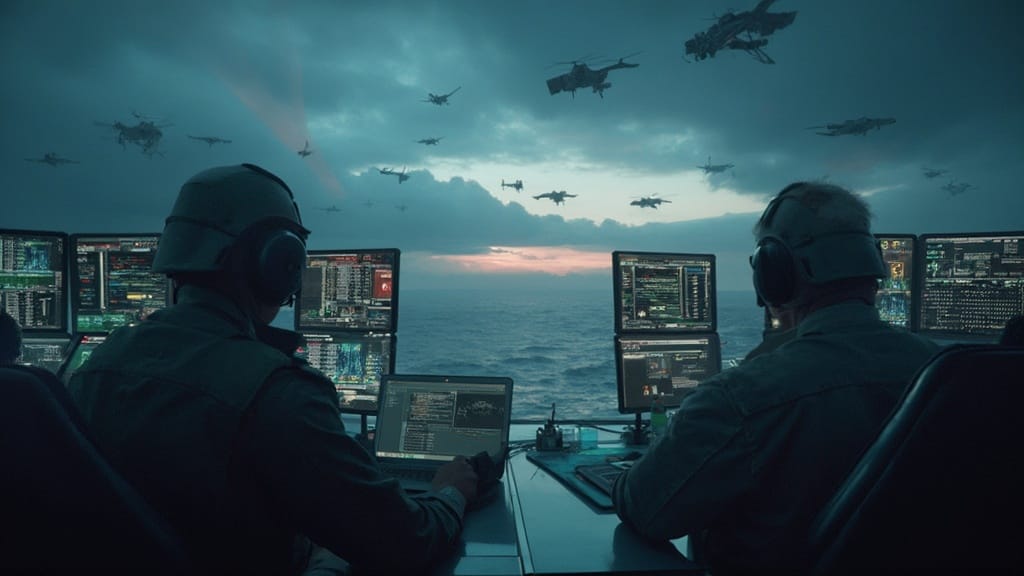
Photo: lyceumnews.com
Saturday, March 28, 2026
The Big Picture
● Israel · Iran
Day 28 of the Iran war just delivered the clearest proof yet that degraded doesn't mean defeated. Iran struck a Saudi air base housing America's most irreplaceable aircraft, the Houthis fired their first ballistic missile at Israel since the war began, and the Pentagon quietly acknowledged it can only confirm destroying about one-third of Iran's missile arsenal as of March 27, 2026. Meanwhile, the drone wingman program that's supposed to define the next era of American air power is coming in cheaper than planned — a rare bright spot in a week that keeps getting more expensive.
Today's Stories
Iran Strikes an American Air Base — and Damages High-Value Aircraft
● Saudi Arabia · Washington DC, USA · Iran
There's a category of military aircraft so valuable the Pentagon treats them like flying command centers — because they are. One just got hit.
On March 27, an Iranian missile-and-drone combination struck Prince Sultan Air Base in Saudi Arabia, wounding at least 10 U.S. service members — two seriously — and damaging multiple aircraft, including refueling tankers and an E-3 Sentry AWACS. The Washington Post and CBS News confirmed the casualties; some regional outlets reported as many as 12 wounded. More than 300 Americans have now been wounded in the war. Thirteen have been killed.
The equipment loss may matter more than the casualty count. The E-3 Sentry — AWACS, short for Airborne Warning and Control System — is a flying radar station with a giant rotodome on its back that coordinates fighter operations across an entire theater. The Air Force has been flying these since the 1970s. The production line closed decades ago. There are only 31 left. The replacement, Boeing's E-7 Wedgetail, is years from full fielding. If this one is a total loss, the Air Force has a hole it literally cannot fill.
Iran is also explicitly targeting aerial refueling aircraft — the tankers that let fighters fly long sorties into Iranian airspace. These are large, slow, lightly defended, and essential. Damaging them on the ground is a cheap, indirect way to cripple U.S. air operations without ever engaging a fighter. If this pattern continues, the U.S. will need to disperse tanker operations further from the front, lean harder on carrier-based refueling, or accelerate autonomous systems that reduce tanker dependence entirely.
What failure to adapt looks like: more tanker and AWACS damage, shorter sortie times, and a gradual erosion of the air superiority that the entire campaign depends on. The signal to watch is whether the Air Force moves its highest-value aircraft to bases further from Iranian missile range — and what that costs in operational reach.
The Houthis Just Opened a Second Front — Again
● Strait of Hormuz · Red Sea · Israel
Yemen's Houthi rebels — the group that spent two years holding global shipping hostage — fired ballistic missiles at Israel for the first time since the Iran war began. Brigadier-General Yahya Saree announced the attack on the Houthis' Al-Masirah television. The IDF said the missile targeting southern Israel was successfully intercepted; no injuries were reported. Air-raid sirens sounded in Beersheba, according to the Times of Israel liveblog.
One intercepted missile isn't a strategic crisis. The threat that follows it might be. Houthi deputy information minister Mohammed Mansour told local media that "closing the Bab al-Mandab Strait is among our options." The Bab al-Mandab is the narrow chokepoint at the bottom of the Red Sea where roughly 12% of global trade transits. Iran is already choking the Strait of Hormuz at the top of the Gulf. Two simultaneous maritime blockades would be an economic catastrophe with no easy military fix — and the U.S. doesn't have enough naval assets to cover both chokepoints without thinning the force somewhere.
If the Houthis follow through, watch whether the U.S. diverts destroyers from the Gulf to the Red Sea. That's the moment the war's geometry changes.
The U.S. Is Only Sure It Destroyed One-Third of Iran's Missiles
● Israel · Iran · Iraq
Four weeks of the most intensive American air campaign since Iraq, and the missile threat is still alive. According to sources cited by Reuters, the U.S. can confirm destroying about one-third of Iran's missile arsenal as of March 27, 2026. Another third may have been damaged or buried in tunnels — status unknown. NPR reported that missiles and drones remain Iran's most effective weapons despite a dramatic drop in launch rates.
The underground tunnel problem is genuinely hard. Iran has spent decades burying its most important military assets in hardened, dispersed facilities. CENTCOM said that about 92% of Iran's large naval vessels have been eliminated as of March 27, 2026 — but the navy was the easy part. Missiles hidden underground are a fundamentally different target set, one where satellite imagery and AI-assisted analysis will be decisive.
Yesterday's strike on Prince Sultan proves the point: even a degraded missile force can reach rear-area bases and damage irreplaceable assets. The war's outcome may hinge on whether the U.S. can find and destroy what's still buried — or whether it runs out of patience first.
17,000 Troops and Counting — Is This Leverage or Invasion Prep?
● Middle East · Iran · Iraq
When you're publicly claiming negotiations while privately moving the largest ground force to the Middle East since Iraq, the troops are the message.
The Wall Street Journal reported the Pentagon is considering sending roughly 10,000 additional ground troops, which would push total U.S. land forces in the region above 17,000. Al Jazeera noted this is already the largest deployment since the Iraq War. CNBC reported one strategy under consideration: seizing Kharg Island, a strategic oil hub 15 miles off Iran's coast that processes 90% of Iran's crude exports.
Military analysts are parsing the troop types carefully, because the kind of force tells you the kind of operation. What's notably absent: heavy armored units, deep logistics chains, and command structures for a prolonged land war. This is a force that can act quickly and selectively — a raid force, not an occupation force. Time reported the Marines deploying are configured for exactly this kind of operation.
The observable signal: if heavy equipment shipments to Kuwaiti or Saudi ports begin, planners have moved from deterrence to credible invasion posture. Seizing an island that processes 90% of Iran's oil is either a masterstroke of coercive leverage or the opening chapter of something much longer.
Iran's Infrared Problem: How a 1970s Heat Sensor Is Defeating Stealth
● Yemen · Iran
The F-35 is the most expensive fighter ever built, specifically designed to be invisible to radar. Turns out "invisible to radar" doesn't mean "invisible to heat."
On March 19, a U.S. F-35 was damaged by likely Iranian ground fire during a combat mission over Iran, making an emergency landing with the pilot suffering shrapnel wounds — the F-35's first combat-related emergency landing. The mechanism is the story: Iran has deployed air defense systems using passive infrared sensors — heat detectors — rather than radar. The same approach previously downed roughly half a dozen MQ-9 Reaper drones during operations in Yemen. U.S. officials told Bloomberg that 12 MQ-9 Reapers have been lost in the conflict, nine shot down by Iran, at roughly $30 million each.
Think of it this way: the F-35's stealth is like noise-canceling headphones — brilliant at blocking one kind of detection, useless if someone's using a completely different sense. Passive infrared tracking is old technology deployed as an asymmetric counter to a $100 million jet, and it's working. This will reshape how the U.S. thinks about stealth aircraft survivability, and it creates immediate demand for infrared countermeasures that the current fleet wasn't designed around.
The Drone Wingman Is Already Cheaper Than Anyone Planned
Good news buried under a terrible week: the autonomous jet program that's supposed to transform American air power is coming in under budget.
Colonel Timothy Helfrich, the portfolio acquisition executive for fighters and advanced aircraft, said March 25 that the Air Force's Collaborative Combat Aircraft program is beating former Secretary Frank Kendall's goal of producing drone wingmen at about one-third the cost of an F-35. "Not only have we met [Kendall's goal], we are doing much better than that," Helfrich said. With the latest F-35 lots averaging around $101 million, the target CCA price falls at or below $34 million.
CCAs are semi-autonomous drones designed to fly alongside the F-22, F-35, and the new F-47 stealth bomber, handling strike, reconnaissance, and electronic warfare missions at lower cost and risk than a manned fighter. Anduril is developing the YFQ-44A, and General Atomics Aeronautical Systems is developing the YFQ-42A for the first increment. Anduril's Arsenal-1 facility in Ohio has already started building the Fury — a rare case of a defense startup standing up an assembly line before the final production contract is signed.
A $34 million disposable wingman next to a $101 million manned jet is a fundamentally different tactical equation — it changes what risks a commander is willing to take. The signal to watch: when the Air Force announces how many it plans to buy. The difference between 200 and 2,000 units changes the entire calculus of air superiority.
Iran-Linked Hackers Breach FBI Director's Personal Email — Then Threaten Two Heads of State
● Iran · United Kingdom
Hacking a senior intelligence official's personal email is bad enough. Announcing a $50 million bounty on two heads of state is a different category of threat.
Iran-linked cyber actors breached FBI Director Kash Patel's personal email and published photos and documents online, CNN confirmed. The group framed the hack as retaliation for an FBI takedown of their domains earlier in March, according to CNBC. They then publicly issued a $50 million "bounty" targeting President Trump and Israeli Prime Minister Netanyahu, IBTimes UK reported.
The operational sequence — government takedown, retaliatory leak, public escalation — signals a nimble adversary capable of influence operations on a fast cycle. Personal email has historically been the vector of choice for nation-state operations against senior officials, because personal accounts lack the hardened defenses of government systems. If U.S. Cyber Command formally attributes this to Iran, it would trigger the first official offensive cyber response of this war — and cyber escalation operates on faster timelines than air campaigns.
⚡ What Most People Missed
● Middle East · Ukraine · Beijing, China
- Qatar arrested an IRGC spy cell — including operatives trained to use drones — that was collecting data on military infrastructure, per the 2026 Iran war Wikipedia entry. Qatar hosts Al Udeid Air Base, the largest U.S. military installation in the Middle East. Iranian human intelligence collectors embedded at America's biggest Gulf base is an enormous counterintelligence failure that's gotten almost no coverage.
- A Chinese Belt and Road project just took Iranian fire. Kuwait's Mubarak Al Kabeer Port, under construction as part of China's infrastructure initiative, sustained material damage in strikes, per 1News NZ. Beijing is simultaneously buying the oil funding Iran's war machine and watching Iranian weapons destroy Chinese construction projects. That contradiction has an expiration date.
- A drone hit Oman's Port of Salalah, injuring an expatriate worker and marking another strike on a global logistics node, per the 2026 Iran war timeline. Salalah is a key transshipment hub between Asia, the Gulf, and Europe — cheap one-way drones keep reaching multi-billion-dollar chokepoints.
- Ukrainian EW teams appear to have graduated from jamming to hijacking. Social media footage shows a hijacked FPV drone issuing a voice message to its operator to "land in 15 seconds" — a leap from noise to remote-control theft that changes doctrinal assumptions about drone defense. (Source: Reddit/r/ukraine — unverified)
- The UK and US launched an urgent joint tender for underwater drone defense, codenamed REEF, with an April 3 deadline — an admission that navies have no mature answer to subsurface attack drones yet, even as Iran deploys them in the Gulf.
📅 What to Watch
● Red Sea · Iran
- If Houthis actually close the Bab al-Mandab Strait, the U.S. faces simultaneous blockades at both ends of the Arabian Peninsula — and will be forced to choose which chokepoint to prioritize, creating exploitable gaps in escort coverage and insurance-market dislocations for Red Sea transit routes.
- If heavy armored equipment starts shipping to Kuwaiti or Saudi ports, the Kharg Island seizure option has moved from PowerPoint to execution — and oil markets will likely price the strategic risk before the Pentagon formally confirms any operation.
- If the E-3 AWACS at Prince Sultan is declared a total loss, the Air Force loses a command-and-control node it cannot replace for years, forcing reliance on degraded theater picture aggregation solutions and increasing the cognitive load on individual pilots and ground controllers.
- If U.S. Cyber Command formally attributes the Patel hack to Iran, expect the first acknowledged offensive cyber operation of this war — on a timeline measured in days, not weeks.
- If Gulf states begin publicly reporting interceptor shortages, the cost-exchange math that favors cheap drones over expensive missiles becomes a strategic crisis, accelerating procurement and deployment of directed-energy and advanced electronic warfare systems.
The Closer
A 1970s heat sensor punching through a $100 million stealth jet, 92 antiprotons riding shotgun in a Swiss truck without losing a single particle, and an Iranian spy cell collecting drone footage of America's biggest Gulf air base while nobody noticed. The future of warfare is apparently old technology, patient physics, and the assumption that nobody checks the personal email. Stay sharp.
If someone you know needs to understand what's actually happening in this war — and why the technology matters more than the headlines — forward this their way.