The Lyceum: Defense Tech Daily — Mar 29, 2026
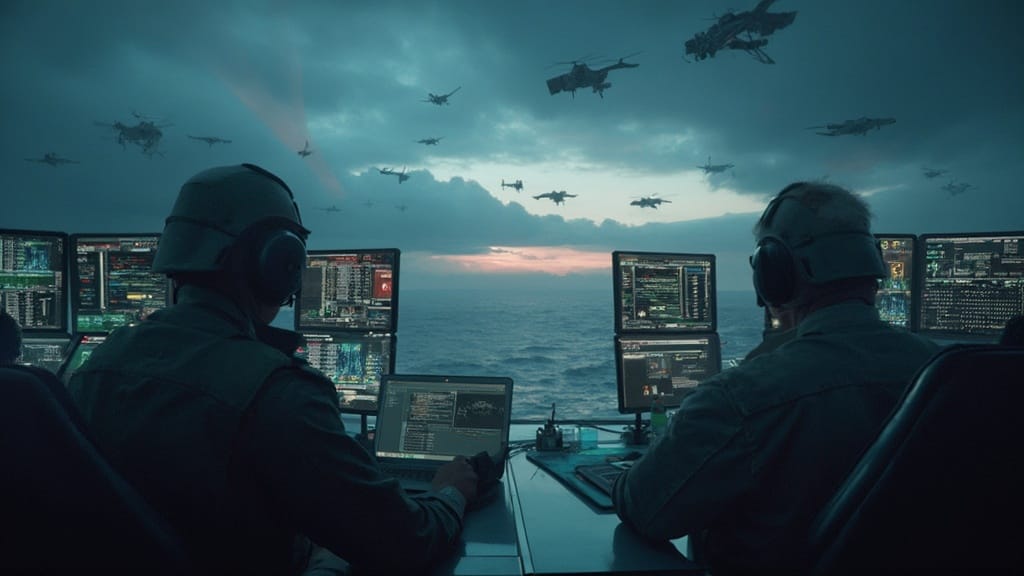
Photo: lyceumnews.com
Sunday, March 29, 2026
The Big Picture
A month of air strikes hasn't finished the job — the U.S. has damaged or otherwise put roughly a third of Iran's missile inventory out of action over the past month — and now the Pentagon is planning for boots on the ground. Iran struck back hard enough to damage one of America's 16 remaining airborne command aircraft, amid reports that Russia provided targeting assistance, and 3,500 Marines just pulled into the theater aboard a ship designed to put them ashore. The cost math is staggering, the alliance trust is fraying, and every screen in the region is now a weapon.
Today's Stories
The Pentagon's Secret Playbook: Raids, Island Seizures, and Weeks on the Ground
● Strait of Hormuz · Washington DC, USA · Tehran, Iran
The Pentagon is preparing plans for weeks of ground operations in Iran — potentially including raids on Kharg Island and coastal sites near the Strait of Hormuz — though President Trump has not approved any deployment, according to the Washington Post. Kharg Island is the loading dock for roughly 90% of Iran's crude oil exports (at the time of reporting). Seizing it would hit Tehran's war finances at the source.
These wouldn't be a full invasion. Officials described raids by Special Operations and conventional infantry, developed over weeks. Senator Marco Rubio insists the U.S. "can achieve all of our objectives without ground troops," but the planning is advanced and the contradiction is the point. In the past month, 13 U.S. troops have been killed and more than 300 wounded by Iranian strikes across at least seven countries.
If this succeeds, it gives Washington a chokehold on Iranian revenue and a physical presence that changes the negotiating calculus overnight. If it goes wrong — contested landings, supply-chain exposure, casualties on camera — it becomes the political event that defines the war. The signal to watch: whether Trump explicitly rules out ground deployment. Right now, he isn't.
Iran Just Damaged One of America's Rarest and Most Irreplaceable Aircraft
● Saudi Arabia · Iran
There are 16 E-3 Sentry AWACS aircraft left in the entire U.S. Air Force. Iran damaged one.
The E-3 is a Boeing 707 with a giant spinning radar dome — the plane that tells every other aircraft in the sky where the enemy is, who shoots at what, and how to avoid each other. It was damaged in a March 27 Iranian missile and drone attack on Prince Sultan Air Base in Saudi Arabia, along with multiple tanker aircraft. About a dozen U.S. service members were injured.
"The loss of this E-3 is incredibly problematic," said Heather Penney, a former F-16 pilot at AFA's Mitchell Institute. The fleet already had a mission-capable rate of roughly 56% as of the time of the assessment — meaning barely half could fly on any given day. The replacement program, the E-7 Wedgetail, is years from full delivery. Giant aircraft like the E-3 don't fit in hardened shelters, and parking them in the open within Iranian missile range is the kind of lesson being learned in the most expensive way possible.
If the Air Force confirms this is a total loss, watch for emergency acceleration of the Wedgetail program and immediate dispersal of remaining high-value aircraft to more distant bases — the clearest signal planners expect continued precision strikes on rear areas.
3,500 Marines Just Arrived. The Question Is What They're There For.
● Washington DC, USA · Iran
The USS Tripoli — an America-class amphibious assault ship, essentially a smaller aircraft carrier that also carries Marines, landing craft, and helicopters — arrived in the CENTCOM region Friday with roughly 3,500 sailors and Marines from the 31st Marine Expeditionary Unit, plus F-35s and amphibious assault assets.
It's not alone. The San Diego-based USS Boxer, carrying at least 2,200 Marines with the 11th MEU, departed Wednesday and is less than a month from the theater. Combined with the 82nd Airborne elements already signaled to prepare, open-source tallies put staged and en route forces at roughly 17,000 — a scale that makes limited raids or island seizures operationally feasible if the political decision is made.
Vice President Vance said Saturday that Washington had "achieved most of our military objectives against Iran" and suggested the campaign could continue for a short time longer. If the Boxer's transit accelerates beyond its mid-April timeline, it likely means a ground operation decision has been made or is imminent.
Russia's Satellites Were Apparently Doing Iran's Targeting — And Ukraine Can Prove It
● Saudi Arabia · Ukraine · Kuwait · Russia · Turkey · Qatar · Iran · United States
Ukrainian President Zelenskyy shared intelligence with NBC News showing Russian satellites photographed Prince Sultan Air Base on March 20, March 23, and March 25. One day after the last image, Iran attacked the base and damaged the AWACS.
Zelenskyy explained the pattern from Ukraine's own experience: "If they make images once, they are preparing. If they make images a second time, it's like a simulation. The third time it means that in one or two days, they will attack." The surveillance reportedly wasn't limited to one base — it covered installations in Saudi Arabia, Qatar, Kuwait, Turkey, and the Indian Ocean region.
Critical caveat: NBC could not independently verify the imagery, and the briefing didn't specify how Ukraine learned about the satellite passes. But four sources previously confirmed to NBC that Russia was providing Iran with positioning data on U.S. forces. If verified, this isn't isolated assistance — it's a shared intelligence service between loosely aligned adversaries. The practical consequence for U.S. planners: Russian reconnaissance satellites may now need to be treated as contributors to Iranian targeting, and basing posture at every exposed Gulf facility needs reassessment.
The U.S. Just Raided an Ally's Defense Budget — and Called It a Contract Clause
● United States · Switzerland · Washington DC, USA · Finland · Ukraine · Iran · NATO Europe
The United States redirected funds Switzerland had paid toward its F-35 fighter jet purchase to cover a frozen Patriot air defense contract — exploiting a feature of the Foreign Military Sales program where all partner payments sit in a pooled DoD account without strict segregation between programs.
Switzerland signed contracts for five Patriot batteries originally due in 2026. Washington told Bern it would prioritize Ukraine, then delayed again by four to five years, and the Iran war has strained supply further. Urs Loher, head of armaments at Switzerland's federal procurement agency, confirmed to Swiss broadcaster SRF that the redirected amount was a "low three-digit million" in Swiss francs — over CHF 100 million — and estimated the total Patriot price increase at up to 50% as of the time of reporting, pushing costs up by CHF 1–3 billion.
If Switzerland is experiencing this, other buyers in the FMS system likely are too. Finland separately announced it will audit whether NATO-purchased U.S. weapons are actually reaching Ukraine, amid concern they could be diverted to the Iran conflict. When allied nations start auditing American contract compliance during a war, the trust deficit has become a strategic variable. Watch for whether European buyers accelerate hedging toward Dassault, Saab, and MBDA — phone calls those companies didn't expect six months ago.
Ukraine Offers Its Drone Playbook to Gulf States in Swap for High-End Air Defenses
● Saudi Arabia · Qatar · Kyiv, Ukraine · UAE
Zelenskyy made unannounced stops in the UAE and Qatar on Saturday, pitching Ukrainian expertise in detecting, jamming, and destroying Iranian-made Shahed drones — the same weapons now threatening both Ukraine and Gulf infrastructure. In return, Kyiv wants advanced Western air-defense missiles that Gulf countries have stockpiled and Ukraine desperately needs.
Defense agreements were reportedly signed with Saudi Arabia and Qatar, with some framed as decade-long partnerships worth "billions" in investment in Ukrainian defense industries. The concrete offering includes Ukraine's rocket-boosted STRILA-2 interceptor drone — a design that uses a solid-fuel motor to sprint to altitude and electric propulsion for the intercept phase, purpose-built to defeat Shaheds at a fraction of the cost of a Patriot missile.
If Gulf states formalize co-production or joint R&D deals, Ukraine becomes the world's first country to turn active wartime improvisation into a scalable defense export industry. The signal: watch for named contracts with delivery timelines, not just memoranda of understanding.
Iran's Cyber-Attacks Are Hitting Hospitals, Not Just Military Targets
● Washington DC, USA · Iran
As Iranian missiles hit air bases, Iranian-linked hackers hit hospitals. The Washington Post reports that cyberattacks have struck medical facilities and data centers — a deliberate choice to weaponize civilian infrastructure during kinetic operations. Meanwhile, Israelis with Android phones received texts during missile barrages promising bomb shelter apps; clicking installed spyware granting hackers camera, location, and full data access.
This is multi-domain warfare made personal: phishing during mass evacuations provides real-time surveillance data, and infected hospital networks degrade emergency response exactly when it's needed most. Combined with the satellite reconnaissance feeding Iran's targeting and the kinetic strikes on air bases, the picture is a coordinated campaign across space, cyber, and physical domains that compounds every defensive challenge. No group has claimed the spyware operation, but the timing and targeting have prompted analysts to raise the possibility of state backing.
⚡ What Most People Missed
- Iran claims it shot down a U.S. F-16 and an MQ-9 Reaper drone. CENTCOM responded by posting a photo of an F-16 landing "after a combat flight" — an ambiguous release that does not confirm combat damage. If MQ-9 losses are confirmed, the verification and insurance costs for contractor-operated ISR fleets could spike, forcing defense purchasers to re-evaluate reliance on commercially provided systems.
- The war's burn rate is now quantified. Early tracking estimates circulating in open forums put the first month's cost at roughly $26.7 billion, with approximately $10 billion on interceptors alone. That's not a budget line — it's a procurement crisis in real time.
- Russia fielded a new, larger reconnaissance drone in Ukraine. Ukrainian forces identified the "Knyaz Veshchy Oleg" on March 27 — a fixed-wing ISR platform significantly bigger than previous Russian recon drones. A new named system appearing despite sanctions suggests Russia's drone production pipeline is still innovating, not just mass-producing Shaheds.
- Indonesia is buying 42 Chinese J-10C fighter jets — Jakarta's most significant Chinese platform purchase to date, and a signal that years of U.S. delays and ITAR restrictions on F-15 sales created an opening Beijing walked through. If formalized, watch for a domino effect across ASEAN.
📅 What to Watch
- If either the House and Senate Appropriations Committees or the House and Senate Armed Services Committees take up an emergency interceptor replenishment package for Patriots, THAAD, and SM-6 at the committee stage, it would signal Washington is planning for a long Iran campaign and would force U.S. defense contractors to prioritize interceptor production over other programs, delaying delivery schedules elsewhere.
- If Finland's audit reveals systematic shortfalls in U.S. weapons delivery compliance, it hands European defense ministries political cover to accelerate domestic procurement over American suppliers, shifting long-term procurement plans and industrial partnerships.
- If Gulf states sign concrete co-production deals with Ukraine for counter-drone systems, it validates a new model where battlefield improvisation becomes an exportable defense industry and could create a new supplier base for inexpensive interceptor systems.
- If the Air Force confirms the E-3 AWACS is a total loss, watch for emergency Wedgetail acceleration and temporary E-2 Hawkeye deployments — both would signal the surveillance gap is considered operationally critical and could change carrier and basing calculations for allied navies.
- If Senator Marco Rubio's comments about physically securing Iranian nuclear material prompt formal briefings to the House and Senate Intelligence Committees, those briefings would be the clearest leading indicator that planners are preparing for a ground raid decision.
The Closer
A flying radar dome that can't be replaced parked in the open where everyone could see it, Switzerland discovering its fighter jet money was spent on someone else's missiles, and a Ukrainian president selling drone lessons to oil monarchies like a combat-tested Tupperware party. The Pentagon says there are no plans for ground troops — which is technically true, because what they have are options, and options are just plans wearing a better suit. Stay sharp. If someone you know is still getting their war coverage from cable news chyrons, forward this their way.
From the Lyceum
Two Los Angeles juries found Meta and YouTube liable using a "design defect" theory for social media addiction — a legal playbook now being cited in new filings nationwide. Read → Two Verdicts in Two Days