The Lyceum: Defense Tech Daily — Mar 30, 2026
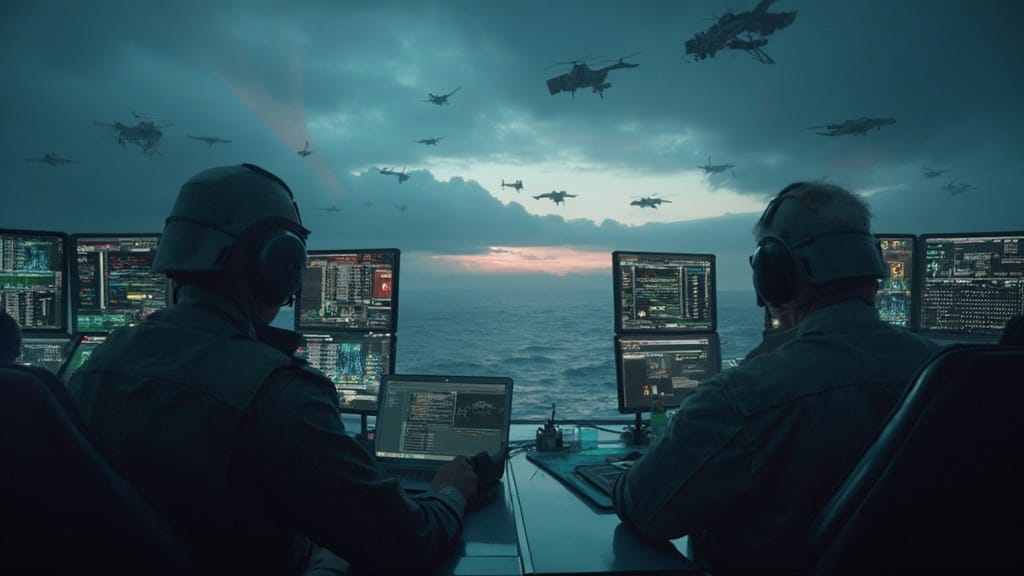
Photo: lyceumnews.com
Monday, March 30, 2026
The Big Picture
Day 30 of the Iran war is producing a genuinely strange spectacle: the president says Tehran has agreed to "most" of his peace terms while the Pentagon simultaneously plans an amphibious island seizure, autonomous boats make their combat debut in the Persian Gulf, and Iran threatens to bomb American university campuses by noon today. The diplomacy and the escalation are running on parallel tracks, and nobody — possibly including the principals — knows which one is real.
Today's Stories
Trump Says Iran Agreed to "Most" Peace Terms. The Pentagon Is Preparing to Invade Anyway.
● Strait of Hormuz · Persian Gulf · Pakistan · Israel · Tehran, Iran · Iraq · United States
The strangest thing about today's Iran war news isn't the missiles — it's that the president is talking peace and the military is planning a ground operation at the same time, and both appear to be true.
Trump said Sunday that Iran has agreed to "most of" the 15-point list of demands the U.S. conveyed via Pakistan. Those demands are substantial: dismantle the nuclear program, end enrichment, hand over stockpiled uranium, grant full IAEA access, limit missile capabilities, cease support for proxy forces, and guarantee freedom of navigation through the Strait of Hormuz. But while diplomats talk, Trump told the Financial Times he's still considering seizing Kharg Island — the northern Persian Gulf hub that handles 90% of Iran's oil exports — saying "Maybe we take Kharg Island, maybe we don't. We have a lot of options."
Iran isn't waiting to find out which conversation is real. According to CNN and Axios, Tehran is moving additional military personnel and air defenses to the island right now. If this succeeds as diplomacy, the troop movements become leverage that worked. If it fails, they become the opening moves of an amphibious operation that would be the largest since Iraq. The signal to watch: whether Pakistan's offer to host direct U.S.-Iran talks this week produces a venue and a date — or whether the next headline is a CENTCOM battle damage assessment.
The U.S. Navy Just Deployed Autonomous "Ghost Boats" in Combat — A First
● Strait of Hormuz · Persian Gulf · Israel · Iran
Autonomous weapons showed up in the Persian Gulf this weekend without a press release.
According to Reuters reporting cited by the Alma Research Center, the U.S. military has for the first time deployed autonomous unmanned surface vessels at sea for intelligence collection — vessels that may also serve as suicide attack platforms. These aren't remote-controlled boats with a sailor holding a joystick somewhere. They navigate, surveil, and potentially strike without a human at the helm in real time.
The context makes the deployment logical: Iran has been mining the Strait of Hormuz and using small boat swarms against shipping. Sending manned vessels into mined waters is expensive and dangerous. An autonomous surface vessel can loiter in a minefield, map threats, and transmit intelligence — or detonate — without risking a crew. If these boats perform well, every navy on earth will accelerate its own unmanned surface programs, and the cost calculus for blockade operations changes permanently. If they fail — navigation errors, friendly-fire incidents, jamming vulnerabilities — the setback could delay autonomous naval deployment by years. The first real performance data will be buried in CENTCOM after-action reports. Watch for any mention of "unmanned surface vessel" in battle damage assessments.
Iran Warns U.S. Ground Forces Will Be "Set on Fire" — and Threatens American Universities by Noon Today
● Washington DC, USA · Israel · Tehran, Iran · Qatar · UAE · United States
The war is bleeding into places that were supposed to be safely civilian.
Iran's parliament speaker warned Sunday that if the U.S. launches a ground invasion, Iranian forces are "waiting to set them on fire." More unusually, the IRGC issued a statement saying U.S. universities and branch campuses in the region could be targeted unless Washington formally condemns strikes on Iranian universities — setting a deadline of noon Monday, Tehran time. The IRGC urged evacuations and told people to stay at least one kilometer from campuses. Several American universities operate Gulf campuses, including NYU Abu Dhabi and Texas A&M Qatar.
This is a deliberate blurring of military and civilian targeting as a deterrence tool. The message isn't really aimed at students — it's aimed at the UAE and Qatar: allow U.S. military activity from your territory, and your civilian institutions become targets. If insurance firms or universities quietly suspend Gulf operations in the next 48 hours, treat that as confirmation the threat is being taken as operational, not rhetorical. If nothing changes, the IRGC's credibility as a coercive actor takes a hit — which itself becomes a signal about how far Tehran is willing to escalate beyond military targets.
Ukraine's Drone Contractors Are Building Black-Market Factories Around the World
● Kyiv, Ukraine
Ukraine built the most battle-tested drone industry on the planet. Now some of its companies are taking that expertise global — without asking Kyiv's permission.
Zelenskyy revealed that roughly 10 interceptor drone factories have been set up in different countries by Ukrainian companies circumventing the wartime export ban. He cited one company that sold 1,000 interceptor drones to a foreign buyer for $3.5 million while simultaneously holding a €300 million Ukrainian state contract. The drones shipped without warheads — buyers came back to Kyiv asking for explosives and operators, because combat components and training remain with the Ukrainian military.
This isn't just a revenue leak. Ukrainian firms are reportedly producing interceptor drones at five-figure monthly rates, and regional reporting describes Ukrainian anti-drone specialists already deployed to the Gulf. Once production capacity and operators sit on foreign soil, Kyiv loses leverage over its own most valuable wartime export. If Zelenskyy follows through on threats to strip state contracts from violators, it signals Ukraine is trying to nationalize the export pipeline. If he doesn't, the world's most combat-proven drone supply chain fragments into something closer to a gray-market arms bazaar. Watch for a formal Ukrainian drone export regime — that's the tell.
The Kurdish Invasion Plan Collapsed — and It Matters More Than the Headlines Suggest
● Washington DC, USA · Jerusalem · Israel · Turkey · Iran · Iraq · United States
A detailed Channel 12 investigation, now confirmed across multiple outlets, explains what happened to the plan for Kurdish fighters to open a northern ground front inside Iran. Tens of thousands of armed Kurds were to cross from Iraq under massive U.S.-Israeli air cover, with both militaries pre-striking Iranian security forces to clear the path. The plan collapsed before it started: Fox News reported on March 4 that an offensive had begun, burning the first invasion window. Turkey's Erdogan pressured Washington to abandon it. Gulf states worried a fractured Iran would destabilize the region. Many Kurds feared the U.S. and Israel would stop the war midway, the regime would recover, and the Kurds would be slaughtered, citing abandonment after fighting ISIS.
If this proxy model is broken — and the evidence suggests it is — the remaining ground options are all more expensive and more American. That makes the Kharg Island amphibious scenario more likely by default. The plan's collapse reportedly strained the Washington-Jerusalem relationship. The observable signal: if U.S.-Kurdish meetings resume this week, the proxy concept isn't dead. If they don't, every remaining ground option runs through U.S. Marines.
⚡ What Most People Missed
- Iran's missile launch rate has collapsed — but the reason matters. Analysts point to both depleted stockpiles and deliberate rationing for a longer war. One explanation means Iran is running out of weapons; the other means they're pacing for a conflict the U.S. hasn't planned for. Nobody in Washington is publicly distinguishing between the two.
- Iran threatened to open a third chokepoint. Tasnim News reported Iran could activate a front at the Bab al-Mandeb Strait — between Yemen and Djibouti — if U.S. forces seize Gulf islands. Combined with Hormuz, that would simultaneously choke the Persian Gulf and the Suez route. Almost no major outlet has modeled what that does to global shipping.
- Russia's satellite tasking is becoming an intelligence tell. Zelenskyy's disclosure that Russian satellites imaged Prince Sultan Air Base on March 20, 23, and 25 — right before Iran damaged it — suggests changes in satellite revisit patterns could serve as early-warning indicators for strikes. If the Pentagon confirms Russian imagery fed Iranian targeting, expect Space Force rules on commercial imaging sales.
- Indonesia just bought Chinese J-10 fighter jets, becoming one of the first U.S.-aligned Southeast Asian nations to integrate Chinese combat aircraft. The capability gap with Western platforms is real, but the geopolitical message may be the point: once Chinese radar, IFF transponders (the systems that tell friendly missiles not to shoot you), and maintenance contracts embed in Indonesian infrastructure, switching back becomes enormously expensive.
📅 What to Watch
- If Pakistan announces a venue and date for direct U.S.-Iran talks this week but the Pentagon doesn't pause ground planning, the talks are theater and the amphibious option is live.
- If the USS Ford's repairs in Split stretch past two weeks, the Navy will have reduced carrier presence in the Gulf, forcing redeployment of Pacific assets and weakening U.S. deterrence vis-à-vis China.
- If AeroVironment's $5-per-shot Locust X3 laser gets rushed to the Gulf for testing, it will signal CENTCOM views the drone-cost asymmetry as an operational emergency and will push immediate procurement and stockpiling changes.
- If Germany formally selects Australia's MQ-28A Ghost Bat or a competitor as its Collaborative Combat Aircraft, allied purchases of autonomous wingmen will accelerate and force NATO export-control harmonization debates.
The Closer
Ghost boats hunting mines in the Strait of Hormuz, explosive insoles riding Russian charity trucks to the front, and a $13-billion aircraft carrier sidelined by a laundry-room fire — the future of warfare is simultaneously more autonomous, more devious, and more mundane than anyone planned for. Iran just gave American universities in the Gulf until lunchtime to evacuate, which is the kind of deadline that sounds absurd right up until it isn't.
Stay sharp.
If someone you know is trying to make sense of all this, forward them the newsletter — they'll thank you by Wednesday.
From the Lyceum
Courts just handed social media companies a "design defect" liability theory — the same legal logic used against cigarette manufacturers — after two juries found Meta and YouTube liable in back-to-back trials. Read → Two Verdicts in Two Days