Defense Tech Daily — May 02, 2026
Saturday, May 2, 2026
The Big Picture
The 60-day War Powers clock on Iran expired on Friday, May 1, 2026, and the White House's answer was to declare the war "terminated" while keeping the blockade running, the bombers fueled, and the Strait of Hormuz at roughly 90% below normal traffic as of Friday, May 1, 2026. Hours later, Pete Hegseth ordered 5,000 troops out of Germany amid claims it was punitive toward German Chancellor Friedrich Merz over his remarks about Iran. The connecting thread today: American forward presence and American technology access are now openly transactional, and every European procurement office, every Asian chokepoint, and every satellite constellation operator is recalculating what "alliance" actually buys you.
What Just Shipped
- THAAD Production Framework (Lockheed Martin): Quadruples interceptor output from 96 to 400 missiles per year over seven years, with a profit-sharing clause tied to surge production.
- Classified AI Network Agreements (Department of Defense): Seven companies — OpenAI, Google, Microsoft, NVIDIA, AWS, SpaceX, and Reflection — now cleared to deploy frontier models inside Impact Level 6 and 7 (secret and highly classified) environments.
- Rassvet Constellation (Russia): Domestic LEO broadband satellites launched as a Starlink analog, paired with a six-month ban on foreign satellite terminal imports signed by Prime Minister Mikhail Mishustin.
- V-BAT VTOL UAS (Shield AI): Acquired by the Royal Netherlands Navy through a NATO procurement framework; deployed aboard HNLMS Johan de Witt during Exercise Cold Response 2026.
- Skyhammer Interceptor UAV (Cambridge Aerospace): UK and Gulf state buyers lined up; first tranche of systems and launchers due for delivery this month per a UK MoD announcement.
Today's Stories
Trump Declares the Iran War "Terminated" — While Keeping Everything in Place
● Strait of Hormuz · Vietnam · Iran
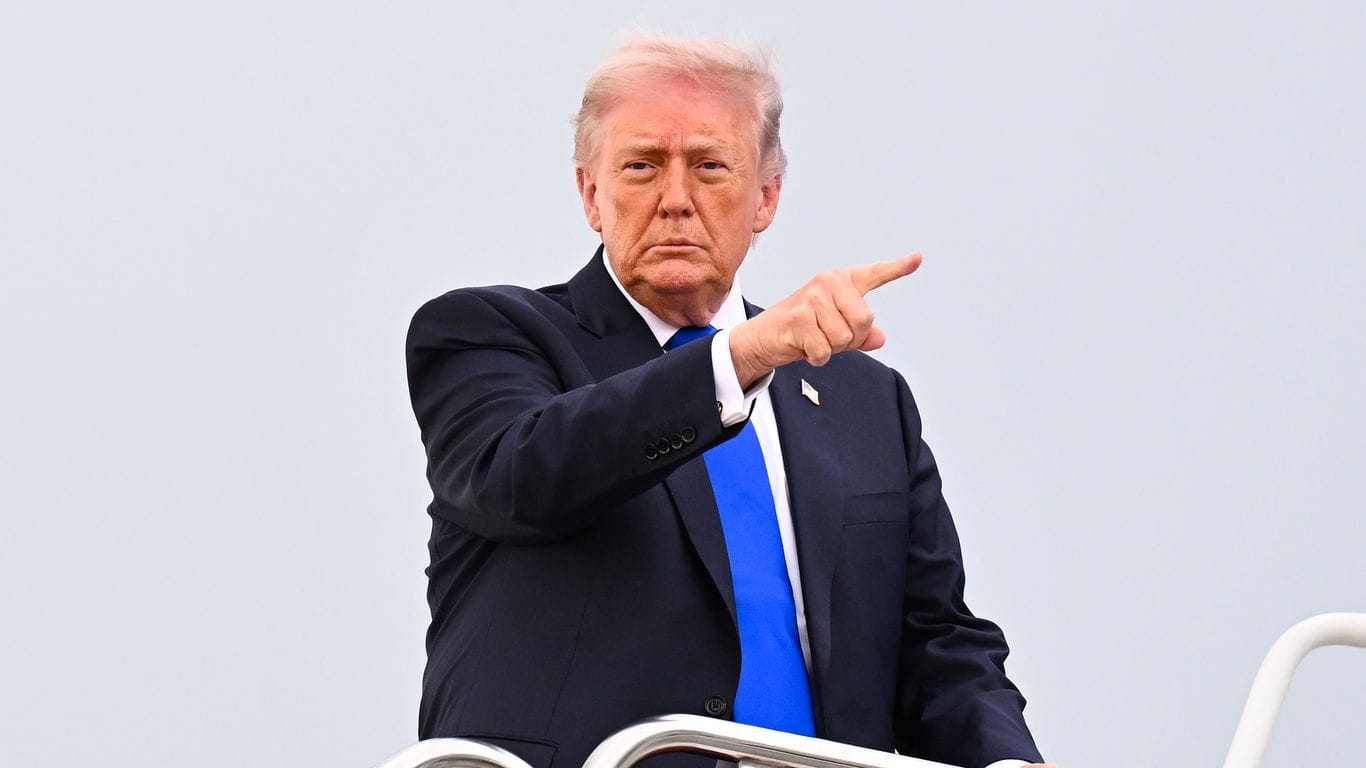
Friday, May 1, 2026, was the 60-day deadline under the War Powers Resolution of 1973 — the post-Vietnam law requiring a president to either get congressional authorization or end hostilities. Trump's answer: simply declare hostilities over, citing the April 7 ceasefire he imposed.
Almost nothing has actually stopped. The U.S. naval blockade of Iranian ports — which is, under international law, an act of war — remains active, with 45 commercial vessels turned away as of Friday, May 1, 2026, per CENTCOM. Defense Secretary Pete Hegseth told the Senate Armed Services Committee during a May 1 hearing the military could resume strikes "at the push of a button," adding the U.S. is "locked and loaded on your critical dual-use infrastructure, on your remaining power generation and on your energy industry." Shipping in the Strait of Hormuz has collapsed by more than 90% over the past week as of Friday, May 1, 2026, with roughly 20,000 seafarers stuck aboard ships, according to the U.K. Royal Navy.
If this framing holds: any future president can sidestep the 60-day clock with a unilateral ceasefire declaration. If it fails: a handful of Republican senators could force a war authorization vote — the most consequential War Powers test since Vietnam. Watch the Senate floor next week.
The Pentagon Just Opened Classified Networks to Frontier AI
The Department of Defense confirmed on Friday, May 1, that seven companies — OpenAI, Google, Microsoft, NVIDIA, AWS, SpaceX, and Reflection — have agreements to deploy AI tools inside Impact Level 6 and 7 networks (the environments where secret and highly classified planning actually happens). The stated goals: data synthesis, situational awareness, and decision support for commanders.
The under-discussed wrinkle is competition policy. Officials explicitly framed the seven-vendor structure as avoiding lock-in — turning a Silicon Valley headache into a national-security design principle. If this succeeds, classified workflows get rebuilt around commercial models faster than traditional defense primes can adapt, and the software layer of future militaries becomes a permanent contest rather than a captive market. If it fails, expect implementation timelines to slip into 2027 and employee pushback inside the tech firms over who actually wants to staff a SCIF. The signal to watch: whether any of the seven publishes a named deployment milestone within 90 days, or whether this stays at the press-release stratum.
America Just Pulled 5,000 Troops Out of Germany — and It's Not Really About Strategy
● United States · Germany · Italy · Spain · Iran
Hegseth ordered the withdrawal on Thursday, April 30, 2026, days after German Chancellor Friedrich Merz said publicly that the United States was being "humiliated" by Iran. Pentagon spokesman Sean Parnell told Breaking Defense the move follows "a thorough review of the Department's force posture in Europe." The move was presented as following a review, amid skepticism from U.S. and European officials.
Per the Associated Press on May 1, a brigade combat team is being pulled, and a long-range fires battalion that was set to deploy to Germany later this year is being reassigned. Pentagon policy chief Elbridge Colby had previously argued against sending more long-range artillery to Europe, calling it a misallocation against Indo-Pacific priorities. This is a rebalance made concrete — wrapped in a diplomatic punishment.
If this holds: European defense ministries will increasingly treat American forward presence as a revocable diplomatic instrument, and rearmament timelines could accelerate by years. If it fails: legal challenges or congressional motions blocking the move could preserve the unit's position in Germany. Trump also said on Thursday, April 30, he may pull troops from Italy and Spain over their Iran-war opposition, per RTÉ — watch whether that threat becomes an order.
China Launches Full-Branch Encirclement Drill Around Taiwan
● Philippines · Beijing, China · Taiwan
The PLA ran a one-day "encirclement exercise" on May 1 spanning army, navy, air force, and Rocket Force — the branch handling ballistic and cruise missiles — the first full-branch drill in this format since October. Beijing called it a "stern warning" against "Taiwan independence" forces.
The technical signal beneath the political theater: this is integrated multi-domain command-and-control — synchronizing sensors and fires across sea, air, land, and missile units in a single rehearsal window. That architecture compresses Taiwan's decision time and the response time of any partner supplying air-defense or anti-ship systems. Simultaneously, the PLA Southern Theater sent a Type 055 destroyer-led surface group east of the Luzon Strait to shadow Balikatan 2026 — the 17,000-troop U.S.-Philippines exercise that, for the first time, included Japanese formed combat units as full participants.
What to watch: whether next month's drill scripts shift from "encirclement" toward port-and-ferry blockade language. That's the tell that Beijing is rehearsing coercion below the threshold of invasion — a much harder problem to deter.
Russia Just Banned Starlink — and Launched Its Own Version
● Ukraine · Moscow, Russia
Prime Minister Mikhail Mishustin signed a decree on April 29 imposing a six-month ban on imports of foreign satellite communication terminals, including Starlink, citing national security. The buried detail per Ukrainska Pravda: Russian forces had been using gray-market Starlink terminals as a key element of tactical command, and after access tightened, communications at the tactical level "significantly deteriorated." Russia is formalizing a ban on something it had largely already lost.
The replacement is Rassvet — Russian for "dawn" — a domestic LEO constellation Moscow launched in March 2026 as a Starlink analog. The Carnegie Endowment's February 2026 assessment judged neither Starlink nor Telegram irreplaceable for Russian forces, but flagged the transition cost as significant.
If Rassvet works: Russia closes one of its largest capability gaps from the Ukraine war and exports a sovereign-comms package to states that want off the SpaceX dependency. If it fails: coverage density stays thin, and Russia ends up quietly buying Chinese LEO capacity instead. The signal to track is Rassvet's published satellite count over the next two quarters.
⚡ What Most People Missed
- The Pentagon wants drones to haul brigade-level cargo: Per Janes, the Joint Tactical Autonomous Aerial Resupply System (JTAARS) RFI specifies 363 kilograms across a 177-kilometer radius, with fielding targeted for 2026. Autonomy is migrating from scouts to sustainment — the logistics half of war that determines which formations can operate for weeks without vulnerable ground convoys.
- The U.S. is leaning hard on Portugal over the F-35: U.S. envoy John Arrigo is publicly pitching the F-35 as Lisbon revisits its F-16 replacement, even as Portuguese officials worry Washington could throttle software updates and spare parts. The Germany withdrawal — explicitly framed as punishment — just gave that worry a live case study.
- The administration invoked emergency authority to deliver a $9 billion Middle East arms package and skipped the usual public review window; the systems involved haven't been publicly detailed, which is itself the story.
- Iran formalized new Strait of Hormuz enforcement rules: The IRGC Navy invoked a "historic directive" covering revised intercept timelines and boarding protocols. Procedural escalation in a chokepoint that's already roughly 90% closed as of May 1 compresses the window for de-escalation if a single boarding goes wrong.
📅 What to Watch
- If even three Republican senators force a War Powers vote on Iran, the "ceasefire-as-termination" doctrine collapses and every future limited war becomes a constitutional fight rather than an executive choice.
- If Portugal announces an F-35 purchase under current pressure, expect a wave of European procurement decisions to start carrying explicit "platform sovereignty" clauses about software and spare-parts access — contract language that can effectively cede operational control over partner systems.
- If Rassvet's published satellite count crosses roughly 100 birds in the next two quarters, Russia has functionally exited Western communications dependency — and the export market for sovereign LEO comms opens.
- If congressional or legal action blocks the 2nd Cavalry Regiment's removal from Vilseck, it becomes the first real test of whether Congress or the courts can constrain the use of forward presence as a diplomatic lever.
- If China's next Taiwan exercise scripts substitute port-and-ferry blockade language for "encirclement," Beijing is rehearsing coercion below the invasion threshold — a scenario U.S. doctrine is significantly less prepared for.
- If any of the seven classified-AI vendors names a deployment milestone within 90 days, the program is real; if not, it's procurement theater dressed as capability.
The Closer
A naval blockade officially isn't a war, a brigade combat team officially isn't a punishment, and a banned Starlink terminal officially isn't already useless inside Russia. Somewhere in Lisbon, a Portuguese air-force procurement officer is staring at an F-35 brochure and a map of Vilseck, doing math that didn't used to be necessary.
Stay sharp.
If you know someone who'd want to understand what just happened to NATO this week — forward this to them.