The Lyceum: Defense Tech Daily — May 09, 2026

Photo: lyceumnews.com
Saturday, May 9, 2026
The Big Picture
The most expensive thing about Russia's Victory Day parade this morning wasn't the hardware on Red Square — there wasn't any, for the first time in nearly twenty years. It was the hundreds of air defense systems pulled from refineries and front-line depots to shield a parade that no longer paraded. Meanwhile, Japan started fielding $2,000 cardboard drones you can assemble in ten minutes at any packaging plant. Today's theme is the same in both directions: cheap, attritable, and hard-to-stop is rewriting what expensive, prestigious, and hard-to-replace can still do.
What Just Shipped
- AirKamuy 150 (AirKamuy / Japan MSDF): A roughly $2,000 corrugated-cardboard fixed-wing drone, flat-packed 500 per shipping container, now in service as an MSDF training target.
- Bumblebee V1 (U.S. Army / 10th Mountain Division): A reusable counter-drone system that began troop training at Fort Drum on May 5, treating drone defense like a magazine of interceptors rather than one-shot hardware.
- UH-60Mx Black Hawk with ALIAS (DARPA → U.S. Army DEVCOM): Sikorsky's MATRIX autonomy suite officially transitioned out of DARPA's lab to the Army for operational testing — an autonomous Black Hawk is now the Army's problem to field.
- Scale AI enterprise agreement, expanded to $500M (DoD CDAO): The ceiling on Scale's Pentagon-wide AI tooling deal jumped 5x on May 8, ending the pilot phase.
Today's Stories
Ukraine Grounded Russia's Victory Day Parade — Without Firing a Single Shot at It
● Ukraine · Moscow, Russia
The most powerful weapon Ukraine deployed this week wasn't a missile. It was the threat of one.
Moscow Mayor Sergey Sobyanin reported 26 drones downed over the Russian capital throughout the night of May 8, with Vnukovo and Domodedovo airports introducing temporary flight restrictions. The next morning, Russia's Victory Day parade rolled onto Red Square without a single piece of military hardware — the first time in nearly two decades. As many as 11 regions in eastern and central Russia called off public celebrations entirely, citing security. Russia and Ukraine ultimately agreed to a three-day ceasefire amid a last-minute appeal from U.S. President Donald Trump.
If this succeeds as a strategic template, the asymmetry is brutal: a few hundred long-range drones can force an authoritarian state to publicly de-arm its own most-watched broadcast. According to Ukrainian Commander-in-Chief Oleksandr Syrskyi, Russia is now deploying four additional regiments, 24 battalions, and 162 batteries to counter Ukrainian strike drones — units that have to come from somewhere.
The signal that tells you which way this is going: whether the ceasefire holds past Monday evening, and whether Russian oil refineries — left thinner on air defense while batteries shifted to Moscow — start showing up in damage reports midweek.
Japan's $2,000 Cardboard Drone Is a Serious Weapon
● Philippines · Australia · Japan · Iran
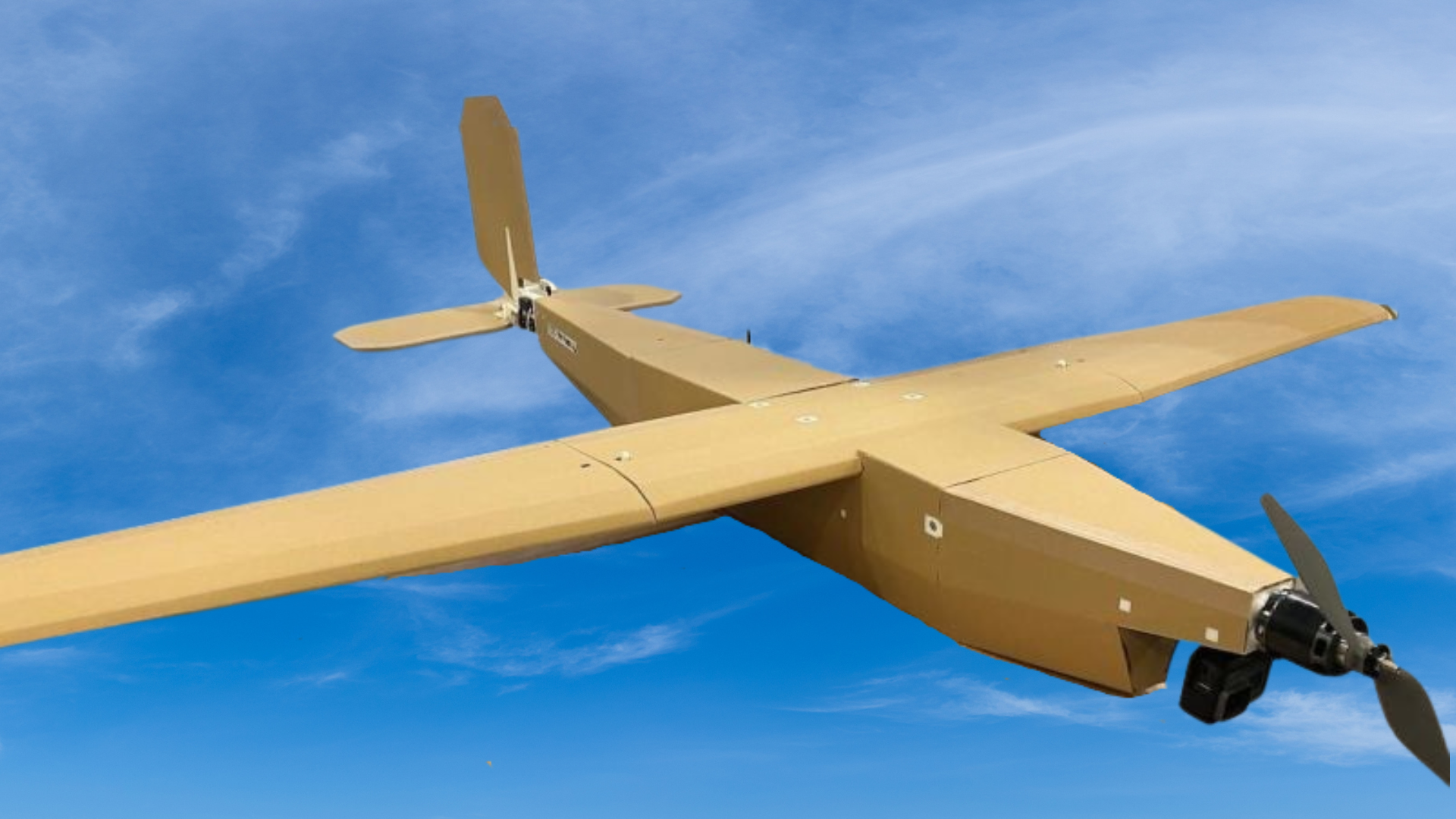
It sounds like a joke. It isn't.
Japanese defense startup AirKamuy has built a fixed-wing military drone out of corrugated cardboard with a water-resistant coating, and Japan's Maritime Self-Defense Force is already using it. Per Tom's Hardware, the AirKamuy 150 costs roughly $2,000–$2,500 per unit. For comparison, Iran's Shahed runs $20,000–$50,000. Five hundred AirKamuy 150s fit flat-packed in one shipping container; assembly takes five to ten minutes.
The economics are the point. Per UPI, air defense systems may expend missiles costing hundreds of thousands to millions to intercept drones worth a few thousand. Cardboard also has a low radar cross-section — the material doesn't bounce radar waves the way metal does, which makes early detection harder. If this works, every Indo-Pacific military reconsiders its drone budget. The honest caveat from TechRadar: combat effectiveness against a billion-dollar layered air defense remains unproven. Watch for the next procurement signal — Australia (which already runs SYPAQ Corvo cardboard drones) or the Philippines placing an order would tell you doctrine has shifted, not just one ministry.
Russia Is Copying Ukraine's Drone Playbook — at 7.3 Million Units a Year
● Russia · Kyiv, Ukraine
The most uncomfortable thing about Ukraine's drone advantage is that it has a shelf life.
Per the Kyiv Independent, Syrskyi told Ukrainian media that "Russia is effectively scaling up its unmanned systems forces by copying Ukrainian solutions — technical, tactical, and organizational," and plans to produce 7.3 million FPV drones and 7.8 million combat UAV parts in 2026. (Treat the production figure as an adversarial Ukrainian intelligence estimate, not independently verified — but the directional claim is consistent with open-source observation.)
Seven million first-person-view drones is not a war reserve. It's an industrial doctrine. Ukraine pioneered strapping explosives to $300 racing quadcopters; Russia watched and is now attempting to out-manufacture the inventor.
If Russia hits even half that production target, the cost-curve advantage Ukraine has enjoyed for two years collapses. The signal to watch: whether Ukraine accelerates its own output (it announced a 25,000-robot ground-drone push earlier this spring) or pivots to harder-to-copy autonomy and electronic warfare. Mass is a race Ukraine cannot win on demographics alone.
The PLA Ran "Invasion Drills" Near Taiwan — Right Before a Xi-Trump Meeting
● Taiwan Strait · Philippines · Beijing, China · Japan
Beijing has a habit of scheduling its most provocative military moves right before its diplomatic ones.
Chinese-language outlets — including 8world and Jingbao — described the PLA's latest Taiwan-area exercises as "aggression drills" timed to the run-up to a planned Xi-Trump meeting. AEI's May 8 Taiwan update adds the operational detail: PLA Southern Theater Command shadowed the U.S.-Philippines Balikatan exercises with four surface vessels. The May 1 update noted Balikatan 2026 featured the U.S. Navy-Marine Corps Expeditionary Ship Interdiction System and Japan's Type 88 anti-ship missiles, rapidly deployed to the Batanes Islands in the Luzon Strait.
As Choosing Victory's analysis put it, each named exercise validates blockade and strike components and conditions both Taiwan and the international community to accept intensified activity as baseline. The strategy: normalize the abnormal until a real blockade looks like a Tuesday.
The signal: whether any Xi-Trump readout addresses Taiwan Strait military activity. Conspicuous silence is itself a result.
[Source: 8world / 观察者网 — Chinese (Simplified)]
Russia Claims Its First Hypersonic Combat Use — The U.S. Military Isn't Buying It
● Washington DC, USA · Ukraine · Moscow, Russia
Per Military.com, Russia alleged this week that it used a hypersonic missile in combat for the first time. U.S. military officials and allies downplayed the claim.
The dispute matters. A maneuvering hypersonic glide vehicle — one that can change course unpredictably at five-plus times the speed of sound — is genuinely hard to intercept. Russia's Kinzhal, which Moscow has marketed as hypersonic for years, travels at hypersonic speeds during part of its flight but follows a more predictable trajectory; Ukraine has shot Kinzhals down with Patriot batteries. By publicly contesting the claim, Washington blunts the deterrent message Moscow was trying to send.
If Russia genuinely fielded a maneuvering glide vehicle in combat, allied air defense planning changes overnight. If it didn't — and history suggests it didn't — this is information warfare. The signal: independent technical analysis of wreckage or trajectory data in the next 7–10 days. Silence from imagery analysts means the U.S. military is probably right.
The Pentagon Wants AI to Tell a Drone From a Bird — and Shoot Faster
One of the biggest problems in drone defense is embarrassingly human: by the time a soldier spots a quadcopter, confirms it's hostile, and lines up a shot, it's overhead.
Per Defense News, the Defense Department is soliciting AI-enhanced target recognition for CROWS — the remote-controlled gun turrets bolted to many U.S. military vehicles. The system would distinguish small drones from birds and clutter, then help crews engage in seconds rather than the awkward decision-loop that currently eats the kill window.
This is unglamorous and likely consequential. No exotic interceptor, no billion-dollar program — just better machine vision retrofitted onto hardware the Army already owns. Counter-drone is becoming a software problem. The signal to watch: whether the solicitation moves to rapid prototype field tests inside 90 days. If yes, expect a CROWS AI upgrade fielded faster than any new interceptor program currently on the books.
Germany Is Helping Lithuania Build Drones and Ammunition at Home
● Lithuania · Belarus · NATO Europe · Latvia · Poland · Russia
The most important defense story in Europe right now isn't a weapons system — it's a factory.
Per Deutsche Welle, Germany is helping Lithuania produce drones and ammunition domestically. The old NATO model: small members buy finished weapons from large ones. The new model: transfer the manufacturing know-how and the production line to the frontline state. Lithuania sits on the Suwalki Gap — the short land corridor between Belarus and Russia's Kaliningrad exclave that NATO planners consider one of the alliance's most vulnerable chokepoints. A Lithuania that makes its own shells doesn't run out waiting for a convoy from Bavaria.
The corroborating data point: Rheinmetall's Q1 2026 report showed air-defense sales up 43% year-over-year and an order backlog near €73 billion. European rearmament has moved from rhetoric to backlog.
The signal that tells you this is a template, not a one-off: whether Estonia, Latvia, or Poland announce parallel deals in the next two quarters — and what local-content and tech-transfer terms appear in the contracts.
[Source: DW.com — Russian]
⚡ What Most People Missed
- Russia's internet blackout is a counter-drone measure, not just censorship: Mobile internet outages hit at least 21 regions through May 10. Drone operators use mobile networks and GPS for mid-flight navigation; cutting them is air defense by other means.
- NATO's eastern flank is treating counter-drone as troop-level skill: Project Flytrap at Pabradė, Lithuania (May 7–8) integrated reconnaissance drones, FPV strikes, jammers, and AI command-and-control down to the troop level across 8,000 personnel from eight nations. Counter-drone is being institutionalized, not specialized.
- Anduril's Space Force mesh networking contract just doubled: A May 8 modification raised the ceiling from $100.3M to $200M for distributed mesh networking on space domain awareness sensors — the Pentagon is paying for architectures with no single point of failure.
📅 What to Watch
- If the three-day ceasefire holds past Monday evening, Trump will claim it as a precedent and push for longer pauses; if it collapses by Tuesday, both sides resume strikes with hardened positions and the diplomatic off-ramp narrows sharply.
- If Australia or the Philippines orders cardboard drones in the next quarter, it confirms a doctrinal shift across the Indo-Pacific — not a Japanese curiosity.
- If the Xi-Trump readout omits Taiwan Strait military activity entirely, Beijing will read silence as license to keep escalating tempo.
- If Russia's claimed hypersonic strike produces no independent technical confirmation in 10 days, treat it as a Kinzhal rebrand and information operation — and watch for the same playbook before the next Russian arms export pitch.
- If Estonia or Poland announces a Germany-style domestic production deal, frontline manufacturing has gone from experiment to NATO template.
- If the Pentagon's CROWS AI solicitation reaches field tests inside 90 days, expect software-based counter-drone fielded faster than any new interceptor program currently budgeted.
The Closer
A Red Square parade with no tanks, a combat drone you can fold up like a pizza box, and the Pentagon trying to teach a turret the difference between a quadcopter and a pigeon. Somewhere in a Russian cardboard plant, an executive is reading the news and doing math.
Stay sharp.
If you know someone who'd appreciate a parade with no tanks — forward this along.