The Lyceum: Defense Tech Daily — May 11, 2026
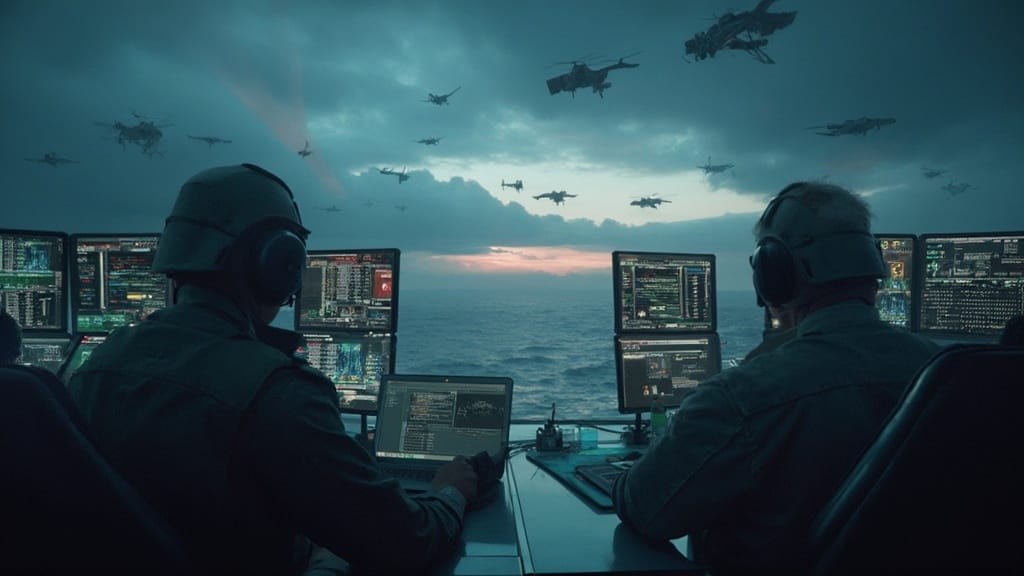
Photo: lyceumnews.com
Monday, May 11, 2026
The Big Picture
Russia's three-day Victory Day ceasefire expired overnight, and the drones came back before the parade reviewing stand was even disassembled. But the more revealing story isn't the truce collapsing — it's what leaked out during it: Russia built a naval drone fleet it can't actually use, Ukraine is now running 12,000 drone sorties a day, and the Pentagon is quietly trying to teach gun sights to tell a quadcopter from a starling. Drone warfare has stopped being a novelty and started being plumbing.
What Just Shipped
- FS-LIDS counter-drone systems (10 units) (Lockheed Martin / U.S. Army): $2.1 billion State Department–approved sale to the UAE, paired with 240 Coyote backpack-carried interceptors.
- Merops counter-drone interceptors (48 units) (Perennial Autonomy): Lithuania bought them on April 22 at roughly $15,000 per shot, via the Pentagon-linked JIATF 401 marketplace.
- Aegis Guam System modification (Lockheed Martin): $407 million sole-source contract modification on May 8 for engineering and certification work through December 2029.
- AI-assisted anti-Shahed laser (Ukrainian Ministry of Defence): In field testing against Iranian-designed Shahed loitering munitions, joining Ukraine's layered counter-drone stack.
- Space Domain Awareness advisory contract (Odyssey Systems Consulting Group): $48.9 million modification on May 8, bringing cumulative value to $202 million.
Today's Stories
Russia Broke Its Own Ceasefire — Quietly, Predictably, On Schedule
● Washington DC, USA · Ukraine · Russia
The three-day pause President Trump brokered around Russia's Victory Day parade was always going to be a stress test, and it failed in slow motion. Ukrainian officials told Reuters on Sunday that Russian drone strikes and front-line clashes continued throughout the supposed truce; Ukraine's air force reported neutralizing all 27 drones launched at the country overnight, and 60 combat engagements were logged along the front by morning, with the heaviest fighting on the Pokrovsk axis (per Ukrinform).
The parade itself told the real story. For the first time in nearly two decades, Russian authorities pulled tanks and missiles from the Red Square procession, citing "the current operational situation" — a Defense Ministry euphemism for "we are worried Ukrainian drones will hit our parade," per The Washington Times. Watch the next 72 hours: if Russian forces use the pause to mass on Pokrovsk, this was a maneuver, not a diplomatic opening.
Russia Built a Naval Drone Fleet — Then SpaceX Switched It Off
● Moscow, Russia · Kyiv, Ukraine
This is the kind of story that sounds like satire until you read it twice. Russia spent 2025 building a fleet of naval drones for a planned 2026 Black Sea counteroffensive, copying the Ukrainian playbook that had already chased the Black Sea Fleet into eastern hideouts. The drones were built. The crews, presumably, were trained. Then, according to Serhii "Flash" Beskrestnov, an advisor to Ukraine's Defense Minister speaking to Euromaidan Press, SpaceX cut Russian access to Starlink at Kyiv's request — and the fleet became expensive paperweights.
What changes if Russia closes this gap: their domestic satellite-comms replacement program becomes the most important defense project in Moscow, because every autonomous platform downstream of it depends on the link. What failure looks like: Russia loses the Black Sea war for the second year running because a terms-of-service decision in Hawthorne, California is currently more strategically consequential than half a shipyard in Sevastopol.
The Pentagon Wants AI Gun Sights That Beat Human Reaction Time
● Ukraine
Per Defense News, the Pentagon is soliciting AI-enhanced target recognition for the remote weapon stations bolted onto military vehicles — the small, swiveling gun turrets a soldier controls from inside the cabin. The problem the solicitation describes is embarrassingly human: by the time a gunner spots a small drone at 50–200 meters, identifies it as hostile rather than a bird, and lines up a burst, the drone is already overhead.
If this fields well, vehicle-mounted air defense becomes viable in drone-saturated environments and the U.S. catches up to a doctrine Ukraine has been running for two years. If it doesn't, every armored column on every future battlefield stays a target for a $400 quadcopter — which is roughly the situation today.
Ukraine's Ground Robots Just Captured a Russian Position — With No Soldiers
● Russia · Donbas, Ukraine · NATO Europe
The sentence that should have made every defense ministry's morning briefing came from President Zelensky on April 13 and got almost no English coverage: Ukrainian forces captured a Russian position using only ground robots and aerial drones, with zero Ukrainian casualties. Per Army Recognition, Ukrainian robotic systems completed over 22,000 frontline missions in three months across platforms named Ratel, TERMIT, Ardal, Rys, Zmiy, Protector, and Volia — handling logistics, reconnaissance, fire support, and assault.
The catch, per Foreign Policy: the cheapest American UGV (unmanned ground vehicle — basically a small armed robot tank) costs about $50,000. The lesson from the Donbas isn't "buy robots." It's "build cheap robots at industrial scale" — a procurement philosophy that most NATO defense ministries still treat as a thought experiment.
Ukraine Is Field-Testing an AI Laser to Kill Shaheds
● Ukraine · Russia · NATO Europe
Ukraine is testing an AI-assisted laser system designed specifically to destroy Iranian-designed Shahed loitering munitions — the slow, fragile, mass-produced drones Russia launches by the hundreds. The economics are the entire point. A Shahed costs roughly $20,000–$50,000. A conventional interceptor missile costs $100,000–$500,000. A laser, once built, costs a few dollars of electricity per shot.
Parallel to the battlefield work, Defense News reports the FAA and Department of Defense have reached a safety framework for high-energy laser testing near U.S. borders and critical sites, with funded efforts targeting major public events this summer. If the Ukrainian system produces verified kills, expect NATO procurement conversations to compress from years to quarters. If it doesn't, lasers stay a 20-year-running PowerPoint slide.
Pentagon Cleared Seven Firms to Run AI Inside Classified Networks
Per Breaking Defense, the Department of Defense has now cleared seven companies — OpenAI, Google, Microsoft, Nvidia, AWS, SpaceX, and Reflection — to deploy AI tools on Impact Level 6 classified networks. That's the difference between AI as a fancy email assistant and AI that can touch intelligence analysis, mission planning, and eventually targeting. The Pentagon is also visibly avoiding single-vendor lock-in, treating frontier AI as a portfolio.
What changes if this works: military AI stops being a pilot program and becomes a platform layer — analogous to how cloud computing went from experimental to load-bearing in roughly five years. What failure looks like: a classified-network incident involving a model hallucination on something operationally important, after which the entire architecture gets rebuilt from scratch.
Poland Tapped the EU's New Defense Loan Machine First
● Germany · France · Poland
Reuters, via Internazionale, reports Poland has signed the first loan under the EU's SAFE facility — a €150 billion collective borrowing instrument adopted last year to fund small drones, anti-drone systems, cyber capabilities, and ground combat support. Poland's package is reported at roughly €43.7 billion, layered on top of a country already spending over 4% of GDP in 2025 on defense.
This is the structural shift: European rearmament now has a funding floor that doesn't depend on any single government's annual budget politics. If Germany or France draws on SAFE in the next quarter, EU collective defense financing has crossed from emergency improvisation into permanent industrial policy. If neither does, Poland's deal becomes an eastern-flank curiosity rather than a template.
⚡ What Most People Missed
- The India-Pakistan air war just turned one — and the lessons are finally specific: Per the Modern War Institute, U.S. officials have now independently confirmed at least two Indian aircraft losses during last year's four-day conflict — the first credible combat record of Chinese-origin PL-15 beyond-visual-range missiles against Western-designed platforms. Pakistan launched 400–500 drones in coordinated radar-mapping intrusions, per India's official briefing. The detail nobody's flagged: Pakistan didn't use FPV attack drones at all. That gap is being closed in procurement right now.
- Russia's Shahed factory is expanding by hectares, not units: The Alabuga Special Economic Zone in Tatarstan has grown by 340 hectares in the past year. That's not a production tweak — it's a city-scale industrial buildout. Russia is signaling intent to sustain drone warfare for years.
- DARPA wants drone swarms hidden in shipping containers: A solicitation for remotely triggered, containerized launchers supporting swarms of up to 500 drones. If this prototypes, port authorities and freight regulators get dragged into national security planning. Every shipping container becomes a maybe.
- Ukraine's compute problem is the next bottleneck: Per the Atlantic Council, Ukraine operates roughly 58 data centers; Russia operates 251. As autonomy spreads through Ukraine's drone fleet, bandwidth and processing needs will outstrip available infrastructure by orders of magnitude. The drone war is quietly becoming a compute war.
📅 What to Watch
- If Russia launches a major Pokrovsk push within 72 hours, the Victory Day ceasefire was cover for repositioning — and U.S.-brokered diplomacy just lost credibility as a pressure mechanism.
- If Ukraine releases verified kill footage from its AI laser, NATO directed-energy procurement timelines compress from years to quarters — and Raytheon, MBDA, and Rheinmetall all reprioritize.
- If Germany or France draws on the EU SAFE facility next, collective European defense debt becomes permanent fiscal architecture, not an emergency instrument.
- If a new PLA exercise around Taiwan uses the "Justice Mission" name again, Beijing is institutionalizing blockade rehearsals on a quarterly cadence — not an annual one.
- If Russian naval drones appear in Black Sea operations without Starlink, the SpaceX cutoff window has closed, and Ukraine's maritime advantage has a shelf life measured in months.
The Closer
Today: a Victory Day parade with no tanks, a Russian drone fleet bricked by a California terms-of-service decision, and a Pentagon trying to teach a gun turret to tell a Shahed from a sparrow. Somewhere in Tatarstan, a drone factory is annexing farmland at 340 hectares a year while a Ukrainian shipping-container laser quietly learns to do math at the speed of light — and the most consequential weapon in the Black Sea this morning is a checkbox on someone's Hawthorne admin panel.
Stay sharp.
Forward this to the friend who still thinks "the future of war" is a phrase about robots — it's actually a phrase about logistics, lawyers, and loan agreements.
From the Lyceum
Brussels moved the AI Act's hardest compliance deadlines — if your EU defense-tech export strategy assumed a clean 2026 timeline, the goalposts just shifted. Read → Brussels just moved the AI Act goalposts