The Lyceum: Defense Tech Daily — May 14, 2026
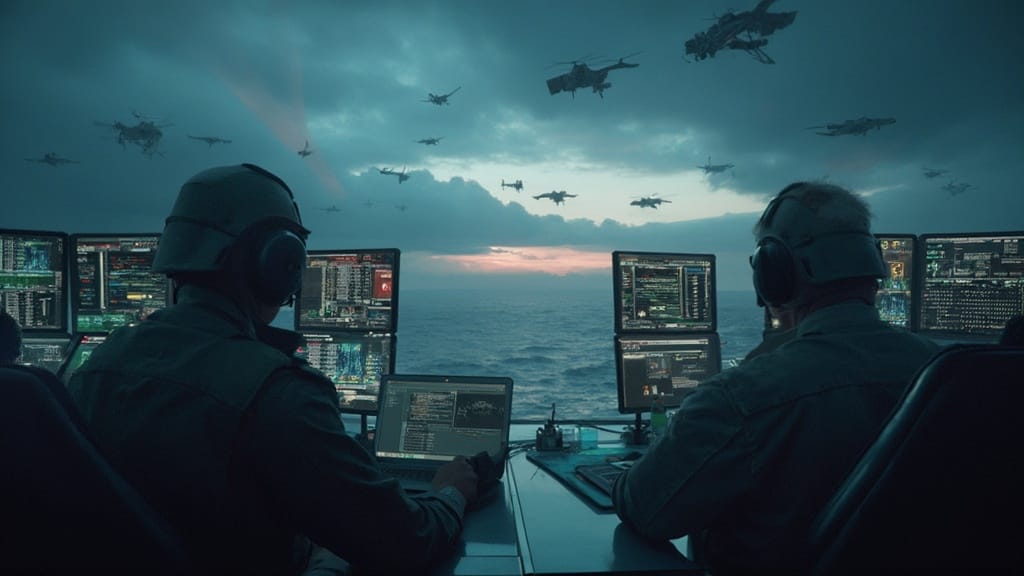
Photo: lyceumnews.com
Thursday, May 14, 2026
The Big Picture
Three things are happening at once, and they're the same story. The Pentagon is buying missiles like Amazon buys cardboard boxes. Russia just wrote itself a legal permission slip to send troops into NATO neighbors. And while Trump and Xi shake hands in Beijing, the CEO of Nvidia is standing two steps behind them. Quantity, legality, and leverage — all being weaponized on the same Wednesday.
What Just Shipped
- Barracuda SLB-500M (Anduril Industries): Containerized cruise missile built from 70% commodity parts, assembled in 30 hours with 10 hand tools; first deliveries slated for early 2027.
- Common Hypersonic Glide Body unified contract (Leidos Dynetics): $2.7 billion Army award merges the Thermal Protection Shield and CHGB programs across Army and Navy hypersonic lines.
- MQ-9 Reaper + APKWS rocket integration (U.S. Air Force): Live demonstration at the Nevada Test and Training Range showed the Reaper engaging aerial targets with laser-guided rockets — cheap drone hunting from an old hunter.
- Army C2 missile-defense prototype (Anduril): Software-layer prototype that fuses sensors and assigns shooters for integrated air and missile defense.
- Regulation (EU) 2026/506 (European Union): Adds 60 entities to the export-restriction list for supporting Russia's military-industrial base — the regulation has entered into force.
Today's Stories
The Pentagon Wants 10,000 Cruise Missiles in Shipping Containers — and It Wants Them by 2027
● Iran
The Iran war burned through American missile stockpiles faster than the Pentagon wanted to admit. The fix, unveiled Wednesday, looks less like a traditional weapons program and more like a logistics company's quarterly plan.
Under the Low-Cost Containerized Munitions program, the Defense Department signed framework agreements with Anduril, Leidos, CoAspire, and Zone 5 Technologies to begin buying test missiles in June, with a path toward procuring more than 10,000 low-cost cruise missiles starting in 2027, according to Defense News. A separate agreement with hypersonics startup Castelion lays out a two-year contract for a minimum annual purchase of 500 Blackbeard hypersonic missiles once testing validates the design — with the Pentagon seeking authorizations for more than 12,000 over five years.
The "containerized" part is the trick: missiles fit inside standard ISO shipping containers, deployable by two soldiers in under 30 minutes, indistinguishable on a satellite image from a stack of commercial cargo. Anduril says its Barracuda SLB-500M is 70% commodity components, assembled in 30 hours with 10 hand tools — missile-making as auto manufacturing, not aerospace.
If this succeeds, the U.S. has a deep magazine of attritable strike weapons that flip the cost-exchange math in any Pacific scenario. If it fails, it fails at the tier-two suppliers — solid rocket motors, specialty propellants, composites — that no framework agreement can will into existence. Watch whether the June test-missile buys actually convert into signed production contracts; earlier framework deals this year still haven't, per Breaking Defense.
Russia's Duma Just Gave Putin a Legal Pretext to Invade NATO Neighbors
● Finland · France · Poland · London, UK · Moscow, Russia · Kyiv, Ukraine · NATO Europe · United Kingdom
The most alarming legislation passed anywhere on Wednesday came from a parliamentary chamber, not a battlefield. Russia's State Duma approved a bill authorizing President Vladimir Putin to deploy troops abroad to "protect" Russian citizens facing arrest, detention, or prosecution by foreign nations and international courts, per the Kyiv Independent. The bill does not specify what such "protection" might involve, the Barents Observer notes. The vagueness is the point.
CEPA reads the law as the legal infrastructure for a system, not a single rescue: resources and personnel earmarked for Spetsnaz and SSO special-forces operations, with potential targets ranging from the Baltic states to Poland, the UK, and France. Russian lawyer Ilya Novikov, quoted by the Barents Observer, frames the law as a coercive signaling tool: when Britain next debates seizing a Russian shadow fleet tanker, the calculus now includes "the Russians have changed their law."
The historical rhyme is uncomfortable. Twenty years ago, Putin legalized offensive operations by Russian special forces abroad. Three months later, Alexander Litvinenko was poisoned in London.
Success for Moscow looks like Western capitals self-deterring — quieter sanctions enforcement, less aggressive shadow-fleet interdiction, slower extraditions. Failure looks like the opposite: accelerated NATO force posture decisions in the Baltics, more Article 4 consultations, and Finland and the Baltic states pointing to the law as justification for forward-deployed allied troops. Watch the Federation Council vote and Putin's signature, which remain pending.
The PLA Released Drone Footage of Taipei 101 — In 4K
● Beijing, China · Taipei, Taiwan
Some military messages don't require a shot. Chinese state media circulated drone footage this week showing an aerial view of Taipei 101 — Taiwan's most iconic skyscraper. Sina News published the remark: "If I can film it, I can hit it."
The footage fits a pattern The Diplomat has been tracking: PLA drills increasingly probe Taiwan's contiguous zone — the 12-nautical-mile buffer around its territorial waters — turning crisis into background noise. The Taipei Times describes this as drills becoming routine, which is itself the policy weapon: normalize elevated risk as the new baseline.
The operational dilemma for Taipei is genuinely hard. Shooting down a drone over central Taipei means falling debris in a city of 2.6 million. Non-kinetic options — jamming, electronic capture — preserve civilian safety but read as weakness on television. The real audience for this footage isn't Taiwan's military; it's Taiwan's public, and through them, every government weighing whether to risk $14 billion in arms sales against Beijing's displeasure during this week's Trump–Xi summit.
Watch whether Taiwan's Ministry of National Defense releases its own counter-surveillance footage or air-defense intercept demonstration in the coming days. Silence is itself a signal.
Jensen Huang Flew to Beijing on Air Force One — and That's the Story
● Washington DC, USA · Beijing, China · Iran
The Trump–Xi summit kicked off in Beijing on Thursday morning local time. The front-page photos are of handshakes. The defense-tech story is the delegation list.
Pool reporting carried by ClickOnDetroit and CNBC shows that Elon Musk and Nvidia CEO Jensen Huang were part of the delegation walking off Air Force One alongside senior administration officials. Nvidia's presence at a heads-of-state summit isn't ceremonial. Beijing wants Washington to roll back export controls on chipmaking equipment and advanced memory chips, per Modern Diplomacy, and the administration has already permitted sales of some previously restricted high-spec U.S. chips — including, according to Reuters reporting carried by Geo News, H200 clearances for 10 Chinese firms under January rules requiring security pledges that the chips won't be used militarily.
Compute is now a security border. Advanced AI accelerators are dual-use in the purest sense: the same hardware that trains a chatbot sharpens targeting, signals intelligence, and autonomy research. CSIS analysts argue China feels confident enough to push back on Trump simultaneously across chips, critical minerals, and Iran.
If chip controls loosen as a summit deliverable, the U.S. semiconductor-based military advantage calculus shifts overnight. If they hold, watch for Beijing's retaliation on rare earths — the leverage Xi has been quietly accumulating for two years. The summit is ongoing as this newsletter goes out.
GOP Centrists Forced a Ukraine Vote — While Russia Launched 800 Drones in One Night
● Hungary · Moscow, Russia · Kyiv, Ukraine
The same Wednesday Moscow's parliament expanded Putin's legal toolkit, a small bloc of House Republicans defied their leadership — and President Trump — to force a House floor vote on a Russia sanctions package on May 13, 2026, per CNN. The package would authorize about $8 billion in arms support for Ukraine, an extension of lend-lease mechanisms, sanctions on major Russian banks and energy firms, steep tariffs on select Russian goods, and a ban on Russian crude, according to reporting.
The backdrop made the timing legible. Russia launched more than 800 drones on May 13, killing at least six people, with Ukraine's western Zakarpattia Oblast — home to a Hungarian minority — among the areas targeted, per the Kyiv Independent. Multiple sources told CNN the House will likely take further action in early June; the Senate's 60-vote threshold is genuinely uncertain.
The 800-drone night and the congressional action are the same story — a question about whether Western industrial capacity and political will can outlast Russian attrition. The Zakarpattia strike, in particular, looks like signaling toward Budapest's new PM Péter Magyar, who's been pulling Hungary away from Moscow's orbit. Watch the House floor calendar after the Memorial Day recess.
⚡ What Most People Missed
- Japan's facility-hardening budget quadrupled: Tokyo is moving from roughly 1 trillion yen to approximately 4 trillion yen (~$26 billion) for blast-resistant bunkers, reinforced hangars, and redundant power systems, per Japan's Ministry of Defense. The logic is brutal: fighters and missiles destroyed on the ground are worth zero.
- The Air Force locked in the Reaper replacement requirements: This is the procurement gate where PowerPoint becomes acquisition. The bureaucracy has decided the slow, permissive-airspace ISR drone is finished as a category.
- EU sanctioned 60 more entities tied to Russia's military-industrial base: Regulation (EU) 2026/506 is now in force. Sanctions lists increasingly function as supply-chain targeting — slowing repair cycles, forcing substitution into lower-quality components, and raising the cost of every Russian drone built.
- FY2027 missile procurement is requested up 188% year-over-year: Per General Dan Caine, chairman of the Joint Chiefs, the FY2027 budget request would fund over $26 billion in multi-year munitions contracts. That's the single clearest number in the entire Iran-stockpile story, and it's gotten almost no mainstream coverage.
📅 What to Watch
- If the House passes the Russia sanctions package and the Senate kills it, expect European allies to accelerate bilateral arms deals with Kyiv that bypass Washington entirely — the first real test of whether Europe can run a war effort without American legislative cover.
- If Castelion completes Blackbeard validation on schedule, the Pentagon's hypersonic timeline compresses by years — and the legacy primes lose their monopoly on Mach 5+ weapons.
- If Putin signs the "protect citizens abroad" law and a Baltic state subsequently detains a sanctioned Russian, watch whether NATO invokes Article 4 preemptively rather than reactively.
- If chip export controls loosen as a Trump–Xi deliverable, every U.S. military AI roadmap built on assumed Chinese compute scarcity needs rewriting before the end of Q3.
- If Taiwan responds to the Taipei 101 footage with its own demonstration of air defense capability, Taipei is shifting from passive documentation to active deterrence messaging — a meaningful posture change that forces allied communications strategies to adjust.
The Closer
A missile in a shipping container, a drone hovering over Taipei 101, and Jensen Huang's passport stamp from Beijing. The Pentagon spent the week learning that the future of warfare looks suspiciously like e-commerce logistics, while Moscow learned it could legalize an invasion before lunch and still make the evening news second. Stay sharp.
Forward this to the friend who keeps asking why their shipping container jokes suddenly feel less funny.