The Lyceum: Defense Tech Daily — May 17, 2026

Photo: lyceumnews.com
Sunday, May 17, 2026
The Big Picture
The drone war hit a numerical inflection point overnight. Ukraine launched what Russian state media called the largest attack on Moscow in over a year — more than 500 drones. At least three people died, and a fertilizer plant tied to explosives production was damaged. The same week, Russia introduced new media restrictions that may quietly close the open-source loop Western analysts have used to track strike effectiveness. The story underneath the body count is exhaustion economics: both sides are burning expensive interceptors at industrial scale to defend against cheap drones, and whoever runs out of stockpile first loses.
What Just Shipped
- APKWS on RAF Typhoons (UK MoD / BAE Systems / QinetiQ): Laser-guided 70mm rockets, repurposed as a low-cost counter-drone weapon, fielded on frontline Typhoons in the Middle East in under two months from test to deployment.
- XRQ-73 hybrid-electric demonstrator (DARPA): First flight of a hybrid-electric uncrewed aircraft designed for low acoustic signature and extended loiter — propulsion as a stealth and logistics play.
- FAA unmanned aircraft rule (FAA): Federal Register publication on May 6 tightening drone operations near airports and sensitive airspace — counter-drone moving from expeditionary tactic to domestic regulatory plumbing.
- Pentagon classified-network AI clearance (DoD): Seven commercial AI vendors cleared to deploy on classified DoD networks per Breaking Defense — a deliberate move away from single-vendor lock-in for intelligence, logistics, and sensor fusion workflows.
Today's Stories
Ukraine's 500-Drone Moscow Strike Is the Largest in Over a Year
More than 500 Ukrainian drones hit the Moscow region overnight, killing at least three people. Russian state news agency TASS, citing Moscow Mayor Sergey Sobyanin, called it "the largest attack in over a year." Among the targets: a major Russian fertilizer plant linked to explosives production, which Andrii Kovalenko of Ukraine's National Security and Defense Council described as "a critical component" of Russia's defense-industrial complex. Sobyanin said air defenses had been engaging since the evening of May 16; Russian authorities claimed at least 73 drones downed by around 3:30 a.m. local time.
If this campaign succeeds, it forces Russia into a defensive crouch where every $500 drone triggers the expenditure of interceptor missiles costing orders of magnitude more — the same exhaustion math Ukraine is suffering on the receiving end. If it fails — meaning Russia's air defenses stabilize and industrial output isn't materially degraded — Ukraine will have burned scarce long-range munitions on a strategic bluff. The signal to watch: whether independent satellite imagery confirms the fertilizer plant damage in the coming days, and whether Russia's claimed intercept numbers hold up under OSINT scrutiny.
Drones Don't Read Markings: The UN Convoy Strike in Kherson
The vehicles were clearly marked. The convoy had been notified to both sides in advance. None of it mattered. Two UN vehicles were struck by drones Thursday in Kherson while delivering humanitarian aid to an area called Ostriv. According to OCHA's Head of Office in Ukraine, Andrea De Domenico, the prior notification had gone to both Ukrainian and Russian military sides. A Telegram channel attributed the attack to a Russian Armed Forces drone unit, claiming the convoy had not obtained their specific approval — and World Central Kitchen confirmed one of its vehicles was struck the same day in a separate incident.
The detail to sit with: top-level deconfliction existed, but unit-level clearance from the actual drone operator did not. If this becomes the dominant pattern, the international humanitarian framework built around marked vehicles and prior notification breaks down — a 19-year-old with a headset and a video feed simply can't read what a soldier with binoculars once could. The signal to watch: whether the UN formally attributes the strike to Russia and forces a Security Council debate, or whether the incident gets quietly absorbed into the war's expanding catalog of unanswered targeting failures.
Russia Is Now Striking Day and Night — and the Math of 93% Interception Is Brutal
Ninety-three percent sounds like a victory. It isn't. Russia launched more than 1,560 drones against Ukrainian population centers since Wednesday, President Zelenskyy said, along with ballistic and cruise missiles. Nine people were killed in a Kyiv apartment block; a 12-year-old girl was among the dead, according to Mayor Vitali Klitschko. Ukraine's Air Force shot down or jammed 693 targets overnight — an interception rate above 93%.
The problem: the remaining 7% of that attack wave amounts to 56 weapons reaching their targets. The Institute for the Study of War notes Russia shifted in March-April from purely nocturnal barrages to combined day-and-night strikes — a deliberate move to overwhelm Ukrainian air defenders and civilians simultaneously. British Defense Secretary John Healey called Thursday's attack "shocking" and said he had accelerated UK deliveries of air defenses. The signal to watch: whether Germany, France, or the US follow Healey's acceleration. Ukraine's interception rate is a function of Western resupply pace, and the gap between drone production and interceptor production is the binding constraint on this war.
The UK Just Put Cheap Anti-Drone Rockets on Frontline Typhoons
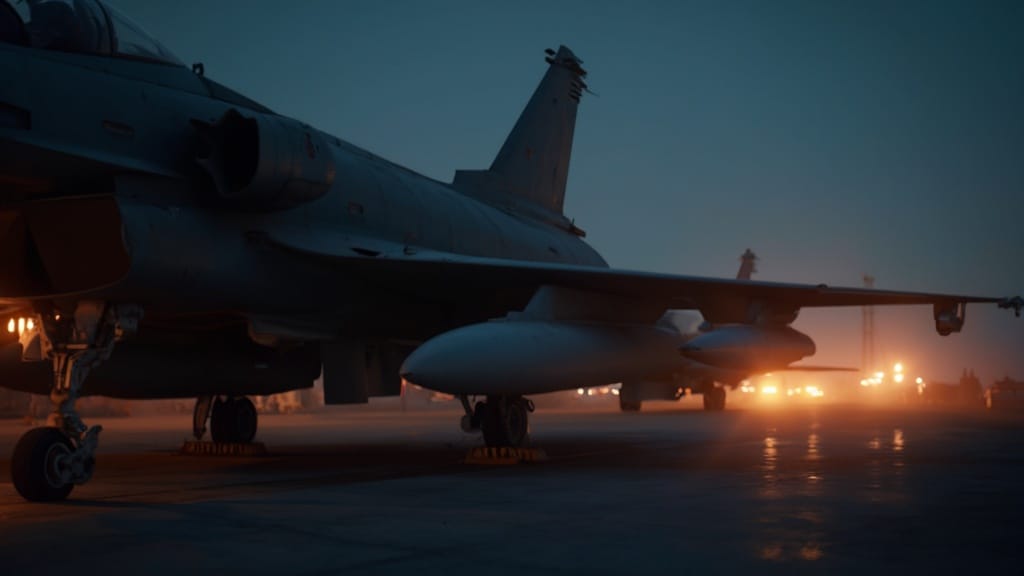
Test to operational deployment in under two months. The British Ministry of Defence announced on May 17 that RAF Typhoons in the Middle East are now carrying the Advanced Precision Kill Weapon System (APKWS) — a laser-guided 70mm rocket repurposed as a low-cost counter-drone weapon. QinetiQ and BAE Systems pushed it onto operational jets at a pace that procurement bureaucracies rarely manage. RAF aircraft have logged more than 2,500 flying hours in the regional air-defense mission, and the MoD describes a layered posture including Sky Sabre, Lightweight Multirole Missile, ORCUS, and a contract for Cambridge Aerospace's Skyhammer interceptor aimed at Shahed-style threats.
If this approach scales, the economics of air defense flip: cheap guided rockets answer cheap drones, and premium interceptors get reserved for threats that actually warrant them. If APKWS proves unreliable against fast or maneuvering targets, the UK will have a fielded capability that looks good in press releases and underperforms in contact. Watch whether French, German, or US air forces adopt the same approach in the next quarter — rapid allied uptake is the tell that the economics work.
The Pentagon Clears Seven AI Vendors for Classified Networks

Access is not adoption — but access is where it starts. Breaking Defense reports the Pentagon has cleared seven commercial AI vendors to deploy tools on classified DoD networks, a deliberate move away from single-vendor lock-in toward letting individual services pick models for intelligence analysis, logistics, and sensor fusion. The plumbing matters more than the headline: secure access, validation, and workflows that let AI accelerate human decision cycles without creating new security gaps.
If this works, classified AI moves from isolated pilot to operational infrastructure inside a year, and intelligence analysts get production-grade tools instead of demo environments. If the vendors can't meet the security posture or integrations stall in validation, the Pentagon ends up with seven half-deployed contracts and another cycle of frustration. The signal to watch: whether any of the seven vendors get named in specific mission integrations — JADC2, ABMS, intelligence analysis pipelines — by the end of Q3 2026. Vendor access without mission tie-in is theater.
DARPA's XRQ-73 Demonstrates Hybrid-Electric Flight
Quiet is a weapon. DARPA announced this month that its XRQ-73 demonstrator achieved hybrid-electric flight — an engineering milestone with three operational consequences: longer loiter, lower acoustic signature, and reduced fuel logistics burden. In a war where persistence and detectability are decisive, a quieter engine is a tactical advantage, not a green-tech talking point.
If a service acquisition program picks this up, hybrid propulsion migrates from lab to fielded ISR and strike platforms in 24-36 months. If it stays in the demo phase, it becomes another DARPA proof point that never reaches a unit. Watch whether Air Force or Navy budget submissions for FY27 reference the XRQ-73 architecture by name — that's the signal it's moving from technology demonstration to program of record.
Finland's Mystery Drone Over the Helsinki-Porvoo Corridor
At 4 a.m. Friday, residents of Uusimaa, Finland were told to stay indoors. The Finnish Defence Forces reported drones may have strayed into Finnish airspace, with the expected target area stretching between Helsinki and Porvoo. Defence Forces strengthened surveillance and counter-capability early Friday morning; the alert was later lifted.
Finland shares an 830-mile border with Russia and joined NATO in April 2023. An unidentified drone over the country's most densely populated corridor — origin not immediately attributable by Finnish authorities — is the fact pattern. If Finland publicly attributes the incursion to Russia, even ambiguously, the alliance faces an Article 4 moment and a test of how NATO handles gray-zone aerial provocations against new members. If attribution stays opaque, it becomes another data point in a growing category of "unexplained airspace events on NATO's eastern flank" that nobody wants to formally count.
⚡ What Most People Missed
- A Russian Be-200 amphibious aircraft was reportedly struck deep inside Russia: Zelenskyy released footage of strikes on Russian aircraft and other targets behind enemy lines, including a Be-200 — a jet-powered flying boat used for maritime patrol and firefighting. Ukraine's long-range drone campaign is now targeting military support assets, not just energy infrastructure.
- Romania found an unexploded "unguided reactive projectile" near its Ukrainian border: Romania's Defense Ministry confirmed the find — the third such incident in recent months. NATO's eastern flank is increasingly a debris field, and the alliance's rules of engagement for stray munitions on member territory remain deliberately ambiguous.
- Japan's arms export network is reshaping Indo-Pacific procurement: Two weeks after Tokyo's defense pact with Jakarta, the underreported angle is that Indonesia — which has earmarked 337 trillion rupiah ($19.4 billion) for 2026 military modernization under President Prabowo Subianto — is simultaneously shopping from China (eyeing the J-10 fighter) and Russia. Japan is now a credible supplier to a state running a deliberately diversified procurement strategy, which changes the competitive geometry in ways Western planners haven't fully absorbed.
- PLA drone footage overflew Taipei 101: Beijing released drone imagery flying past Taiwan's landmark skyscraper during recent encirclement drills. Watch whether Taiwan publicly releases counter-drone intercept or jamming data in response — without it, the deterrence narrative tilts Beijing's way by default. [Source: Sin Chew Daily — Chinese (Simplified)]
📅 What to Watch
- If independent imagery confirms damage to the Moscow-region fertilizer plant, Ukraine's deep-strike industrial targeting strategy is validated and Western partners face renewed pressure to supply more long-range weapons.
- If Finland attributes the Uusimaa drone to Russian origin, NATO faces an ambiguous-airspace test involving a new member — and the alliance's institutional muscle memory for Article 4 gets stress-tested in public.
- If the UN formally attributes the Kherson convoy strike to Russia, the Security Council debate forces the open question of whether humanitarian deconfliction protocols still function in a war fought by tactical drone operators with autonomy.
- If French or German air forces adopt APKWS-style counter-drone within a quarter, the cheap-rocket-versus-cheap-drone economics are validated and the high-end interceptor market starts contracting at the edges.
- If any of the seven Pentagon-cleared AI vendors gets named in a specific mission integration by Q3 2026, classified AI moves from access to adoption — and the contracting precedent it sets reshapes how DoD buys software.
- If Putin's upcoming China visit produces concrete military-industrial cooperation language, expect rapid US and EU export-control responses targeting Chinese firms supplying Russian defense needs.
The Closer
A clearly marked UN Land Cruiser exploding because nobody told the right teenager with a video feed; a fertilizer plant in Russia burning while Moscow drafts fines for anyone who photographs it; a drone wandering over the Helsinki commuter belt at 4 a.m. with no return address. The laws of war assumed the people pulling the trigger could see the markings on the vehicle — turns out that was the optional part. Stay sharp.
Forward this to someone who still thinks "drone strike" means a Reaper over Yemen.