The Lyceum: Defense Tech Daily — May 19, 2026
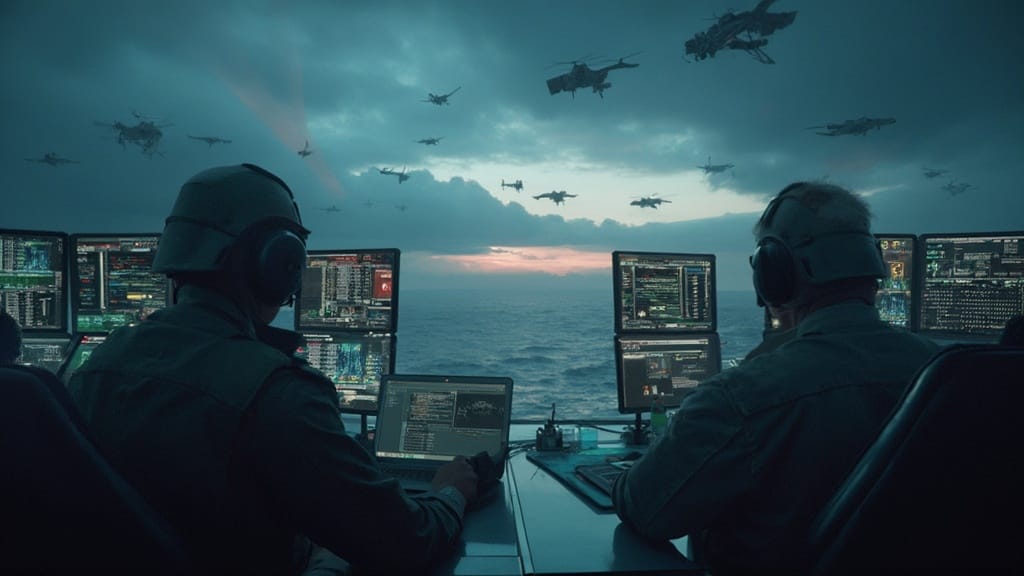
Photo: lyceumnews.com
Tuesday, May 19, 2026
The Big Picture
The Iran strike that didn't happen overnight is the loudest story of the day, but the quieter ones may matter more. Europe's flagship fighter program is collapsing over a corporate org chart, the Pentagon just hung up on its oldest defense partner, and the Philippines told Japan — out loud — that geography doesn't give it a choice about Taiwan. The institutional plumbing of Western defense is leaking in three places at once.
What Just Shipped
- Project NYX Apache wingman contracts (UK MoD): £10M awarded to Anduril UK, BAE Systems, Tekever, and Thales UK to develop autonomous drones flying alongside Apache helicopters; up to two finalists advance to prototypes in Autumn 2026.
- Drone Dominance Lethality Prize Challenge winners (DoD): Five firms named in a competition tied to roughly $1B over two years for small armed drones, with the Army targeting squad-level one-way attack drones by October 1.
- Low-Cost Containerized Missiles framework agreements (US Department of War): New agreements to scale containerized cruise missiles and the Blackbeard hypersonic, aiming for 10,000+ low-cost cruise missiles starting in 2027.
- U&C UAS reconnaissance drone agreement (US Army Europe): Czech-built small reconnaissance drones delivered to US units stationed in Europe via contractor ATP Gov.
- Nora TNT plant funding round (Sweden Ballistics): €30M raised to complete a 4,500-ton/year TNT facility — the basic chemistry underneath every European shell program.
Today's Stories
The Strike That Didn't Happen — And What That Means for the Strait of Hormuz
The most consequential military decision of the day was the one that wasn't made. President Trump announced Monday he has postponed a planned U.S. strike on Iran after appeals from Qatari Emir Tamim bin Hamad Al Thani, Saudi Crown Prince Mohammed bin Salman, and UAE President Mohammed bin Zayed Al Nahyan, per CNBC and Newsweek.
The pause is real. The hair trigger is also real. Defense Secretary Pete Hegseth and Joint Chiefs Chairman General Dan Cain were ordered to stay "prepared to go forward with a full, large scale assault of Iran, on a moment's notice." Iran, meanwhile, just established a "Persian Gulf Strait Authority" through its Supreme National Security Council — an attempt to formalize what is effectively a months-long blockade of the waterway that carries roughly 20% of the world's oil. ABC News notes U.S. inflation just hit a three-year high, with fuel costs tied to the Hormuz closure among the contributing factors.
If this succeeds, the strait reopens through a negotiated deal and Iran trades the new authority away. If it fails, the next strike window is days, not weeks. The signal to watch: whether the Persian Gulf Strait Authority starts issuing operational rules — that would mean Tehran is institutionalizing the blockade, not bargaining with it.
Europe's €100B Fighter Dream Just Collapsed Over an Org Chart
Nine years. More than €4 billion spent. Zero demonstrators flown. On April 22, Dassault CEO Éric Trappier announced negotiations with Airbus Defence and Space over the Next Generation Fighter pillar of FCAS would cease, per Meta-Defense. Trappier wanted Dassault to lead, citing his firm's actual experience building combat aircraft — the Rafale. Airbus, representing Germany and Spain, wanted parity. Neither side blinked.
If FCAS dies cleanly, the most likely outcomes are two parallel national programs or Germany and Spain folding into the UK-Italy-Japan Global Combat Air Program. If it survives, it does so as what Airbus is now floating: a "program of programs," which is consultant-speak for "we couldn't agree on a plane, so we'll agree on a binder." Watch for a Franco-German political summit in the next few weeks — that's the last off-ramp before Europe's sovereignty showpiece formally fractures and the F-35 quietly wins by default.
The Pentagon Just Hung Up on Its Oldest Defense Partner
Undersecretary of Defense Elbridge Colby announced Monday the Pentagon is "pausing" participation in the Permanent Joint Board on Defence — established in 1940, before the U.S. even entered World War II. CBC reports the move comes amid friction between President Trump and Prime Minister Mark Carney, who has been rallying "middle powers" against superpower influence.
The board is advisory, not operational. But as Royal Military College historian Sean Maloney told CBC, it does the unglamorous work of defense planning that keeps NORAD functioning. If this is leverage, the tell will be Canada's pending review of its 88-jet F-35 order — a tilt toward European or domestic alternatives would mean Ottawa called the bluff. If this is a real rupture, the sensor-sharing and Arctic surveillance plumbing starts wobbling, and continental air defense becomes a procurement question instead of a given.
Britain Wants Drones Flying Shotgun on Its Apaches
The idea is elegant: instead of sending a $30M attack helicopter into contested airspace to look around, send a cheap autonomous drone first. The UK Ministry of Defence has committed £10M to Project NYX and picked four firms to compete — Anduril UK, BAE Systems, Tekever, and Thales UK. Up to two advance to prototypes in Autumn 2026, with an operational variant targeted by 2030.
The drones will be fully autonomous for sensing and movement, but every weapons decision stays with a human pilot. If this works, manned-unmanned teaming jumps from fighter-jet PowerPoints to brigade aviation across NATO. If it stalls, watch for the program to quietly narrow to a single vendor before prototype — a sign the MoD is hedging on autonomy rather than betting on it.
Russia Is Upgrading the Kh-101 Mid-War
Most weapons get designed, built, then used. Russia is doing all three at once. Army Technology reports Ukrainian specialists examining recovered fragments have identified four major modifications to the Kh-101 cruise missile since 2022: a tandem warhead, incendiary cluster submunitions, improved guidance, and a new electronic protection suite.
The Kh-101 is roughly Russia's Tomahawk equivalent — terrain-hugging, radar-evasive, launched in salvos mixed with drones to overwhelm air defenses. These upgrades represent something Western acquisition cycles struggle to replicate: real-time weapons development driven by battlefield feedback. The signal to watch: whether Ukrainian air defense interception rates against the Kh-101 start dropping in the coming weeks. That's how you'll know which upgrades actually work — and which Western air defense assumptions need rewriting.
Ukraine's €9 Billion EU Loan Is Mostly Just Drones
Ukraine is set to receive a €9 billion EU disbursement next month, and the spending breakdown tells you where the war is going: €5.9 billion for drones, €3.2 billion for budget support. Two-thirds of one of the largest single defense checks of the war is earmarked for unmanned systems. Not tanks. Not artillery. Drones.
This is the EU putting money where its doctrine has quietly drifted. After four years of watching Ukraine fight Russia with improvised drone fleets, European governments have concluded the drone is now the primary unit of land warfare — not a supplement to it. The second-order signal to watch: whether this purchase triggers parallel drone stockpiling inside EU member states, which several defense ministers have been pushing for. If it does, Europe's munitions base rebuild is real. If not, this is Ukraine being armed as a buffer rather than a model.
Note: this story was sourced via a Reddit aggregation; the underlying figures should be confirmed against EU Council documentation as the disbursement firms up.
The Philippines Says the Quiet Part Out Loud About Taiwan
Philippine President Ferdinand Marcos Jr. told Japanese media Monday that his country would have little choice but to be involved in a Taiwan conflict, citing geography and the roughly 200,000 Filipinos living in Taiwan. "Just looking at the map, you can tell that the northern Philippines, at the very least, is going to be part of that," he said, per the South China Morning Post.
The timing is the signal. Marcos travels to Tokyo May 26 to meet Prime Minister Sanae Takaichi, and Japan Times reports he plans to press Tokyo for clarity on its security posture after Japan eased defense export rules. He's forcing a basing-and-export conversation into the open before he sits down. If Japan moves, expect new sensor, missile, or basing arrangements in the northern Philippines within the year. If it doesn't, Marcos has at minimum told Beijing what Manila already assumes: the front line in Asia is a network, and his country is in it.
⚡ What Most People Missed
- DARPA's DICE program hit its deadline: Proposals were due Monday for "Decentralized AI through Controlled Emergence" — research into AI agents that can coordinate as a team and keep functioning when networks are jammed or nodes destroyed. Still simulation-only, but the shift from "AI assistant" to "AI swarm that holds together under attack" is the direction of travel.
- EDGE Group bidding for Italy's CMD: The UAE conglomerate is moving to take a controlling stake in an Italian engine maker that supplies drones, light aircraft, and naval platforms. Gulf capital is quietly buying into European propulsion supply chains, and how Italian regulators handle this will signal how porous the EU defense base really is.
- Hanwha and Milrem team up for Romania's robot ground vehicles: A South Korean-Estonian partnership announced at BSDA 2026 to bid for Romania's uncrewed ground vehicle program, with planned local production. A NATO front-line state fielding combat robots next to a hot war zone means the autonomy and EW lessons will be unusually fast and unusually real.
- The UK's expedited RCH 155 howitzer order carries risk: Britain donated its entire AS90 fleet to Ukraine and is now rushing 72 wheeled German howitzers into service. The system is sound; the question is whether ammunition supply, fire-control integration, and crew training can keep up with the calendar.
- Federal Register arms-transfer reporting deadline: A February executive order requires State, Defense, and Commerce to start publishing quarterly metrics on Foreign Military Sales case timelines within 120 days — a deadline approaching as of publication. Boring on its face; potentially the most consequential change to U.S. defense exports in a decade if the metrics are actually useful.
📅 What to Watch
- If Iran's new Persian Gulf Strait Authority starts issuing operational rules rather than diplomatic statements, the blockade is becoming permanent infrastructure rather than a bargaining chip.
- If Canada quietly tables its F-35 order in the next 30 days, the U.S.-Canada defense board pause was leverage that worked — in the wrong direction for Washington.
- If Germany or Spain opens formal conversations with the GCAP partners (UK, Italy, Japan), FCAS is dead and Europe's sixth-generation fighter future runs through London and Tokyo, not Paris.
- If any Drone Dominance challenge winner converts to a production contract before October 1, the Pentagon has actually learned to buy at startup speed — not just talk about it.
- If Japan announces new sensor or basing arrangements in the northern Philippines after the May 26 Marcos-Takaichi summit, the Taiwan contingency map has just been formally extended south.
The Closer
Today's defense world: a postponed strike conducted by phone call from three Gulf monarchs, a €100 billion fighter jet killed by a fight over who gets the corner office, and an 86-year-old defense board put on hold by a man named Elbridge. Somewhere in Sweden, a TNT plant is being financed at $33 million while a Chevrolet Silverado HD is being pitched to the British Army — and honestly, it's a coin flip which one ends up more strategically important.
Stay sharp.
Forward this to someone who still thinks the F-35 debate is settled.