The Lyceum: Defense Tech Daily — May 23, 2026
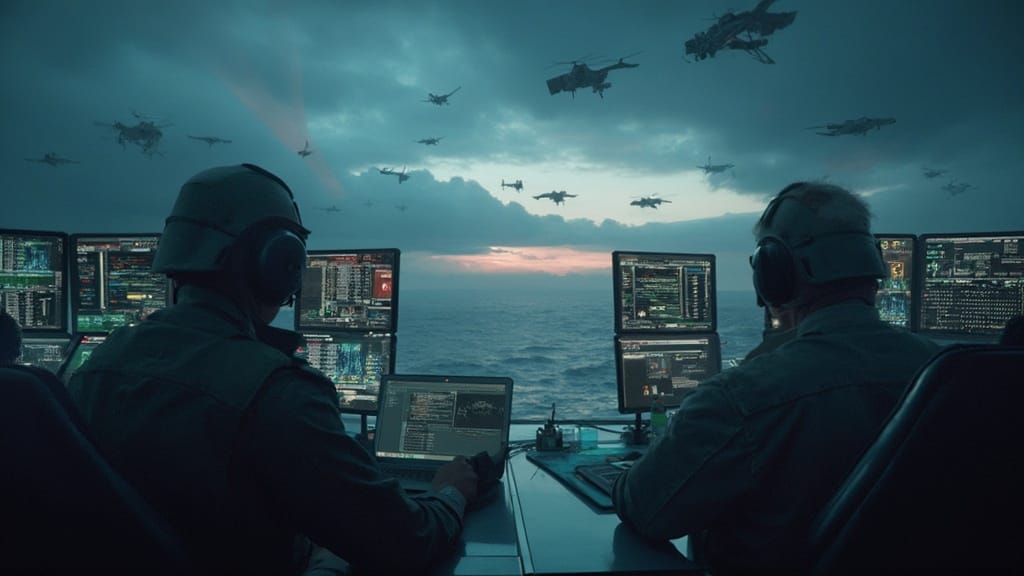
Photo: lyceumnews.com
Saturday, May 23, 2026
The Big Picture
Today's signal is consistent: the post-1945 assumptions about who can hold what at risk are getting rewritten by people who don't care what the old rules said. Iran is using cartography as a weapon. Ukraine is using $50,000 drones to do what strategic bombers used to require. Europe's three nuclear powers are quietly assembling a long-range strike capability they assumed America would always provide. None of these are bolts from the blue — but together they describe a defense landscape where the cheap, distributed, and improvised is starting to outpace the expensive, centralized, and planned.
Today's Stories
Europe's Three Nuclear Powers Are Building Their Own Tomahawks
Europe has a missile gap, and it's one Europeans don't like to talk about. According to the Financial Times, France is seeking to join a joint German-British programme to develop ground-launched missiles with ranges exceeding 2,000 kilometres — capable of striking military targets inside Russia from European soil. Trilateral talks are expected in early June. The programme, announced under the UK-Germany Trinity House defence agreement in 2024, gained new urgency after Donald Trump cancelled plans to deploy a Tomahawk-equipped battalion at a U.S. base in western Germany.
European nations currently field conventional missiles with ranges of roughly 300 km or more, but almost all are launched from aircraft or ships — meaning a French Rafale or British Typhoon has to physically fly toward contested airspace to put a target at risk. A ground-launched 2,000-km missile changes that arithmetic entirely. A launcher in Poland can hold targets in Moscow at risk without any platform leaving its garrison. MBDA and Hypersonica are the named industrial leads; France is proposing ArianeGroup as a rocket-booster contributor. The programme remains conceptual — stealth cruise missiles and hypersonic glide vehicles are both on the menu — so the gap between "trilateral meeting" and "missile in the field" is measured in years.
What to watch: whether the June meeting produces a memorandum, and whether France's previous pause over nuclear-doctrine concerns stays resolved. If Paris wobbles again, the programme stays British-German and smaller. If it holds, this is the most consequential European missile project since the Cold War.
Ukraine's Refinery Campaign Is Doing What Strategic Bombers Used to Require
Ukraine is burning Russia's oil infrastructure with drones that cost roughly the price of a used sedan. On the night of May 21–22, Ukrainian drones damaged the Syzran refinery more than 800 kilometres inside Russia. The night before, drones damaged infrastructure associated with the Yaroslavl refinery, about 700 km from Ukrainian territory — a strike Volodymyr Zelenskyy confirmed personally. Reuters reports that Ukrainian attacks have forced nearly all major refineries in central Russia to halt operations.
The Atlantic Council's read is that Ukraine has shifted from harassment to a systematic campaign against the medium-range zone — 20 to 200 km behind Russian lines for logistics and air defence, and 700 to 1,500 km deep for refineries and energy export terminals. A Ukrainian drone commander quoted this week described attacking refineries as "surprisingly easy," and the strike pattern bears that out: Russian air defence coverage thins dramatically over industrial sites far from the front.
What changes if this works is the doctrine itself. Damaging refineries 800–1,500 km deep, repeatedly, with enough precision to start fires that halt operations, used to require manned strategic bombers, cruise missile inventories worth billions, and aerial refuelling tankers. Ukraine is doing it on a shoestring. What failure looks like: Russia rebuilds refining capacity faster than Ukraine can degrade it, or moves to import refined products via Belarus and Central Asia. The signal to watch: Russian retail fuel prices and export volumes from Baltic and Black Sea terminals.
Iran's Hormuz Map Keeps Getting Bigger
Every few weeks, Tehran redraws the map — and each time, it reaches a little further. A new map published Wednesday by Iran's self-declared Persian Gulf Strait Authority extends Tehran's claimed "oversight zone" further than the version published on May 4 — and now visibly intrudes into UAE and Omani waters. All vessels transiting the defined area are required to obtain prior authorization from the PGSA, supplying cargo values, crew nationalities, vessel origins, destinations, and previous flag registrations. Bahrain, Kuwait, Qatar, Saudi Arabia, and the UAE have sent a joint letter to the International Maritime Organization warning commercial vessels not to engage with the PGSA at all.
The Institute for the Study of War's assessment is the one to sit with: "Iranian officials believe they won the war because formalising Iranian control over the Strait of Hormuz is a territorial claim on the sovereign territory of another country." The IMO says hundreds of commercial vessels and up to 20,000 seafarers have been unable to transit the waterway. The "permission to transit" demand isn't a transit fee. It's an intelligence collection operation dressed as maritime administration.
What changes if this holds: every tanker captain in the Gulf becomes an unwitting reporter to Tehran. What failure looks like: a major shipper calls the bluff, refuses to file with the PGSA, and either transits safely (PGSA exposed as paper) or gets boarded (escalation). The incremental expansion pattern is the tell — each new map tests how far Iran can push before someone draws a hard line. So far, no one has.
The Pentagon Just Made Autonomy a $54.6 Billion Line Item
The Trump administration didn't just fund autonomous systems — it restructured how they get bought. Defense One reports that the FY27 budget request includes $54.6 billion for a new Pentagon program called Deterrence through Autonomy and Warfighting at Global-scale — DAWG. That's a nearly 24,000 percent jump from the prior year's pilot funding. Only $1 billion sits in the tightly controlled base budget; the remaining $53 billion is parked in a "future reconciliation" pot the Pentagon can obligate over five years.
Reconciliation funding short-circuits some of the slowest parts of the acquisition pipeline, meaning Anduril, Shield AI, Saronic, and similar companies could see multi-year buys instead of one-off pilot contracts. Attritable drones — systems designed to be cheap enough that losing them is fine — go from interesting experiment to standing program of record. What failure looks like: Congress strips the reconciliation pot during markup, and DAWG becomes another billion-dollar pilot. The signal to watch: which four or five vendors get the first big task orders, because that's where the autonomy industrial base will consolidate.
The CBO Hung a $1.2 Trillion Price Tag on Golden Dome
The numbers don't close. The Congressional Budget Office's estimate for a fully built-out "Golden Dome" homeland missile defence architecture — Trump's proposed shield against ballistic, hypersonic, and cruise missile attack — landed at roughly $1.2 trillion over 20 years. Time reported the CBO's caveat: the system as envisioned could counter a limited attack from a regional adversary like North Korea, but would still be overwhelmed by a large-scale Russian or Chinese assault.
Trump promised Golden Dome would cost $175 billion, be operational by 2029, and be "nearly 100 percent effective." As one analyst told National Defense Magazine, the president "constrained the cost, the schedule and the performance in a way that does not close." Space Force General Michael Guetlein, the program czar, has already hedged that the space-based interceptor concept may be cut entirely if costs don't come down. Twelve companies are currently competing for the space-based interceptor study contracts.
If this proceeds anyway, the cost-exchange math poisons the rest of the defence budget. Every dollar in homeland interceptors is a dollar not spent on the cheap offensive drones, decoys, and electronic warfare tools that have actually been working in Ukraine and the Middle East. The signal to watch: whether the FY27 budget process forces Guetlein's "affordability" hedge into a public program restructure, or whether the political cost of admitting the gap is too high.
⚡ What Most People Missed
- Ukraine struck the Khersones drone base in Crimea: Ukrainian Special Operations Forces reported destroying Iranian-made Mohajer-6 reconnaissance drones that Russia uses to monitor surface activity across the Black Sea. The target wasn't a shooter — it was Russia's eyes over the fleet. Blinding before shooting is becoming doctrine. [Source: Суспільне via Google News — Ukrainian]
- The Pentagon is pre-buying the terms for containerized missiles: Reuters reports that on May 13, the Pentagon reached framework agreements with Anduril, CoAspire, Leidos, and Zone 5 for the Low-Cost Containerized Munitions program — with a stated goal of potentially buying more than 10,000 containerized missiles over three years starting in 2027. The government is standardizing commercial terms before the production contracts arrive, which is what you do when you've accepted the real bottleneck is buying fast, not building.
- Japan is plugging OpenAI into government cyber defence: Tokyo is operationalising a partnership that gives the government access to a specialised cyber-focused OpenAI system for detecting threats across national infrastructure, framed explicitly against Chinese cyber activity. A frontier-model vendor is now inside the workflow of a state security operations centre — a precedent other US allies will study closely.
- BIS wants more money to police chip leakage to China: The Bureau of Industry and Security's FY27 budget submission cites an inspector general finding that BIS needs more resources to reduce unauthorized release of US-controlled advanced computing and semiconductor manufacturing technology to China's military-civil fusion system. When Commerce treats chip export enforcement as a resource problem, the bottleneck has moved from writing the rule to enforcing it at industrial scale.
- Arms-sale notifications are moving from DSCA to State.gov: Under Executive Order 14383, signed February 6, 2026, all future Foreign Military Sales web posts notified to Congress will be published on the State Department site instead. One of the best open-source tripwires for foreign procurement just rerouted — anyone still watching only DSCA will be late to the signal.
📅 What to Watch
- If the June UK-France-Germany trilateral produces an actual memorandum rather than a communiqué, the most consequential European missile programme since the Cold War has a heartbeat.
- If Russian retail fuel prices spike or refined-product imports from Belarus start showing up in customs data, Ukraine's refinery campaign has crossed from tactical pressure to strategic effect.
- If a major shipping company publicly refuses to file with Iran's PGSA and transits anyway, you'll know whether the map has teeth or is cartographic theatre.
- If Congress preserves DAWG's $53 billion reconciliation pot through markup, attritable autonomy becomes a standing line of business rather than a Pentagon hobby.
- If General Guetlein quietly removes the space-based interceptor layer from the Golden Dome architecture, the gap between Trump's promise and the program's physics will have officially closed in public.
The Closer
A tanker captain in the Gulf filling out a Persian customs form that asks for his crew's passport numbers; a Ukrainian drone operator describing arson against Russia's third-largest refinery as "surprisingly easy"; a Pentagon spreadsheet with a 24,000 percent budget line increase parked in a reconciliation pot nobody wants to explain on television. The future of warfighting apparently looks less like Top Gun and more like a State Department web migration nobody read the changelog on. Until tomorrow.
Forward this to the friend who keeps asking what's actually going on out there — they'll thank you.