The Lyceum: Defense Tech Daily — May 24, 2026
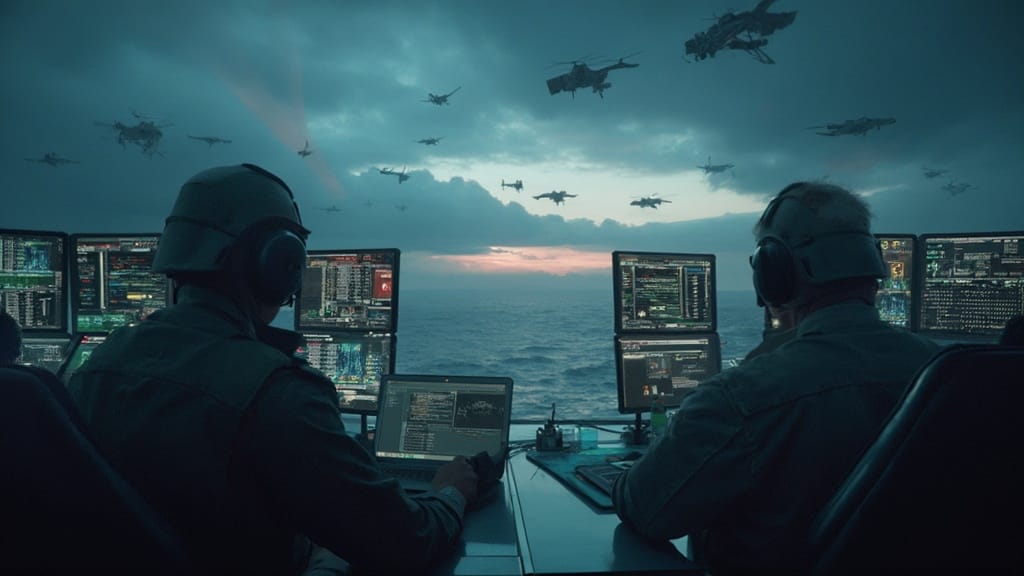
Photo: lyceumnews.com
Sunday, May 24, 2026
The Big Picture
Russia threw one of its largest combined salvos of the war at Kyiv overnight — more than 700 drones and 50-plus missiles, with Ukrainian Air Force officials saying an Oreshnik medium-range ballistic missile was in the mix. While that fire was inbound, Ukraine's drone operators were doing the opposite at Novorossiysk: methodically, almost surgically, damaging the same Russian frigate for the fourth time. The asymmetry of this war is now visible in a single night — Russia escalating with mass and terror, Ukraine escalating with patience and precision.
What Just Shipped
- Giraffe 1X radar on Scania V3P (Saab / Scania France): France's DGA took delivery under a 17-unit drone-hunting radar contract, 16 of them vehicle-mounted.
- MQ-25 Stingray (Boeing): The Navy's carrier-based unmanned tanker cleared Milestone C and entered production this week.
- Sentinel ICBM modernization line (Northrop Grumman): Reaffirmed in the new National Security Strategy as a named priority for fielding by 2028, alongside Columbia-class SSBNs and B-21.
- Admiral Essen damage assessment (Ukrainian Unmanned Systems Forces, 9th 'Kairos' Battalion / 414th Strike Aviation Brigade): Strike video published showing a fourth confirmed hit on the Kalibr-capable frigate at Novorossiysk.
Today's Stories
Russia's Largest Kyiv Strike in a Year — and the Oreshnik Question
The warning came hours before the missiles did. On Saturday evening, President Volodymyr Zelenskyy posted that Ukrainian intelligence — corroborated by American and European partners — had detected signs Russia was preparing a strike using the Oreshnik, a hypersonic ballistic missile Putin has publicly claimed is impossible to intercept. The U.S. Embassy in Kyiv issued its own security alert. Just after 12:55 a.m. Sunday, the sky over the capital lit up.
The Kyiv Independent reports that more than 50 missiles and upwards of 700 drones were launched at Ukraine, almost entirely targeting Kyiv — one of the largest mass attacks in over a year. At least one person was killed and 24 injured, with damage in every district of the city. Ukraine's Air Force later said the missile that struck Bila Tserkva in Kyiv Oblast was an RS-26 Rubezh — the system Russia markets as Oreshnik. If that holds up under debris analysis, it is the third operational use of the weapon and the first against the Kyiv region.
Here's the part Putin's marketing leaves out. Ukrainian experts who analyzed Oreshnik debris from the November 2024 Dnipro strike concluded the "latest" Russian development was built on outdated, shelved RS-26 technology. The warheads move fast on reentry; the missile itself is not a maneuvering glide vehicle like China's DF-17. Very hard to intercept, yes — but not magic. What it is good at is psychological coercion, and Russia just spent one as retaliation for a single Ukrainian drone strike on a Rubicon drone-unit headquarters in occupied Starobilsk. Watch whether NATO accelerates Patriot deliveries. That is the observable signal that Western capitals read the Oreshnik question the same way Kyiv does.
Ukraine's Drone Navy Just Hit the Same Warship for the Fourth Time
There is a dark comedy unfolding in the port of Novorossiysk, and the punchline keeps landing on the same Russian frigate. Ukraine's Unmanned Systems Forces damaged the Admiral Essen — a Project 11356R guided-missile frigate carrying eight Kalibr cruise missiles — for the fourth time overnight on May 23. The strike was executed by the 9th "Kairos" Battalion of the 414th Unmanned Strike Aviation Brigade in coordination with Special Operations Forces. The unit's commander, Robert "Magyar" Brovdi, addressed the ship directly: "You are doomed to sink someday, you scab — you won't hide."
Russia moved the Black Sea Fleet to Novorossiysk because it was supposed to be out of Ukrainian drone range. That calculation is now visibly wrong. According to Ukrainian battle damage assessments published by United24, the April 6 strike caused fires that burned for over 18 hours and degraded the ship's ability to fire Kalibrs at Ukrainian territory. A Kalibr-capable frigate that can't sail and can't shoot is, functionally, an expensive pier ornament.
The success path here is methodical, not dramatic. Ukraine isn't trying to sink the Essen in a single blow — it is bleeding the ship at a tempo Russian shipyards can't match. The failure path would be Russia towing the frigate to a repair facility deep in the Caspian or via the Volga–Don canal. That movement would be its own vulnerability. Watch the satellite imagery.
Japan Is Using AI to Shrink Its Military — On Purpose
Japan has a demographic problem that makes its defense ambitions look mathematically impossible. Tokyo just announced it intends to solve the problem with software. According to Kyodo News, the Japanese government is revising its three core security documents to explicitly incorporate AI as a tool for reducing personnel requirements in the Self-Defense Forces.
This is a genuine doctrinal shift. Japan has committed to doubling defense spending to 2% of GDP — its budget crossed ¥9 trillion this month — but it does not have the working-age population to fill the ranks that budget implies. The bet: fewer humans, more autonomous logistics, AI-assisted ISR, and smaller crews on more capable platforms. If Tokyo names specific platforms or interoperability standards in the revised documents, that tells you whether Japan is building toward a U.S.-aligned autonomous force or hedging with domestic systems — with direct implications for AUKUS, the MQ-28A program Japan just joined with Australia, and the entire Indo-Pacific alliance architecture.
Ukraine's Ground Robots Are Becoming Battlefield Platforms
Quietly, while the missile headlines dominate, the next phase of Ukraine's drone revolution is moving onto wheels and tracks. Per United24 Media, ground robots in Ukraine — once used mainly for logistics and demining — are rapidly evolving into multi-role battlefield platforms, and procurement is set to surge.
The operational logic is brutal arithmetic. Ukraine has a smaller population than Russia and three years of casualties to account for. Every function handed to a robot is a function that doesn't require a Ukrainian soldier. Unmanned ground vehicles carry heavier payloads than FPV drones, operate where jamming kills aerial systems, and hold ground without breathing. Ukraine has become the world's most intense real-world testing ground for autonomous systems. If these platforms prove out at scale here, U.S., European, and Taiwanese procurement timelines will compress within 18–24 months. The signal to watch is a public tender or framework contract — that converts experiment into doctrine.
Lithuania and Ukraine Move Toward Joint Drone Production
Lithuanian President Gitanas Nausėda said he expects the swift launch of joint military production with Ukraine, with a particular focus on long-range unmanned aerial systems. The framing matters: Lithuania doesn't need drones for Lithuania — it needs the manufacturing know-how, and Ukraine has it. Ukrainian engineers have produced more battle-tested drone designs in 36 months than most European primes have produced in two decades.
If this turns into actual production lines on Lithuanian soil, it becomes a template: an EU member state hosting Ukrainian drone IP, inside NATO territory, outside the reach of Russian strike drones. That is the model Berlin and Paris have been circling for a year without committing to. Watch for a signed industrial agreement rather than another communiqué — that is the line between blueprint and reality.
Q1 2026 U.S. Arms-Sale Filings Show Middle East Pivoting to Air Defense and Drones
Defense Security Monitor has pulled together Q1 2026 notifications from the U.S. Defense Security Cooperation Agency (DSCA) and found a clear surge in proposed arms sales to Gulf and Levant states. The mix is the story: integrated air and missile defense, counter-UAS systems, precision munitions. Not prestige platforms — survival kit for a Hormuz-style environment.
DSCA notifications are pre-sale authorizations, not signed contracts, so this is the intent signal before the money moves. The directional read is straightforward: the Middle East market for the next five years is interceptors, networked radars, and EW pods. Fighters and tanks are not what's selling. For U.S. and allied industrial planners, that reshapes capacity decisions — and given the Washington Post's reporting earlier this week on how fast America burned through its own interceptor stockpiles defending Israel, the supply side may already be the bottleneck.
BIS Updates the Rulebook for Military-Relevant Chip Exports
The Bureau of Industry and Security refreshed its Export Administration Regulations framework this week. The more telling signal is the posture around it: BIS treats advanced computing, semiconductor manufacturing, and military end-use controls as a live, moving enforcement architecture — not a static rulebook. The page now sits on the current eCFR, with the agency's recent press releases reinforcing that entity restrictions and end-use controls are being adjusted continuously.
If you build autonomy, targeting, electronic warfare, or satellite processing, chips are policy terrain now, not just components. Defense programs break from small supply-chain frictions long before they break from formal embargoes. This is not a single decisive policy shock — it is fresh concrete poured around an existing checkpoint, and it signals that regulatory hardening is the steady state.
⚡ What Most People Missed
- Ukraine struck a chemical plant 1,700 km from its border: On May 23, Ukraine's Unmanned Systems Forces hit a Russian military-linked chemical plant at near-record range. If Ukraine can sustain strikes at that distance, Russia's defense industrial complex no longer has a safe rear area.
- The Novorossiysk raid hit more than just the Admiral Essen: Magyar's Birds also damaged a Project 1239 missile hovercraft and the Grushovaya Balka oil depot — described as the largest in the Caucasus, with 1.2 million tonnes of storage. A coordinated three-target strike package is operational planning, not improvisation.
- Poland scrambled jets during the Kyiv attack: Poland's Air Force said it launched Polish and allied fighters to protect its airspace as 700 drones flew toward Kyiv. The line between "protecting Poland" and "participating in Ukraine's air defense" gets thinner every time Russia fires a salvo this size.
- Bruegel published a blueprint to drag EU defence procurement into the startup age: The think tank's paper pushes common EU frameworks, bundled national orders, and procurement tracks designed for startups and dual-use software firms. Brussels hasn't acted yet, but the blueprint is sitting on the right desks at the right moment.
- Russia's retaliation loop is now publicly choreographed: Ukraine hit a Rubicon drone-unit HQ. Putin publicly ordered retaliation. Within 24 hours, 700 drones and an alleged Oreshnik flew at Kyiv. The cost-exchange ratio of that retaliation — a 700-drone salvo for a single command-post strike — is the doctrine signal worth flagging.
📅 What to Watch
- If debris analysis confirms an Oreshnik struck Bila Tserkva, the weapon has shifted from political demonstration to operational rotation — and Russia's willingness to expend hypersonic inventory at scale becomes a planning assumption, not a contingency.
- If Russia's next mass drone salvo shows a higher-altitude, faster flight profile, the jet-powered Shahed variant has entered service, and Ukraine's 95% interception rate falls overnight.
- If the Admiral Essen is towed from Novorossiysk, Ukrainian drone forces will almost certainly attempt an intercept in transit — and Russia will have publicly admitted it cannot repair a frigate in its own primary Black Sea harbor.
- If Japan's revised security documents name specific AI platforms, you'll learn whether Tokyo is building toward U.S. interoperability or hedging — a decision that ripples through AUKUS and the MQ-28A program.
- If the Lithuania–Ukraine joint production agreement produces a signed contract within 60 days, the model of "Ukrainian IP, EU soil, NATO umbrella" becomes the template other European capitals copy.
- If Polish or NATO fighters cross from "scrambling" to "engaging" during a Russian salvo, the legal and political architecture of this war changes that afternoon.
The Closer
A Russian frigate stuck in harbor learning what "doomed to sink someday" sounds like in Ukrainian; Japan trying to recruit an algorithm because the demographers said no; 700 drones launched as the receipt for one strike on a drone HQ. Somewhere in a Moscow basement, an accountant is doing the math on what it costs to retaliate against a single building with a hypersonic missile and 700 Shaheds — and quietly closing the spreadsheet.
Stay sharp.
If you know someone who'd rather understand this stuff than skim a wire headline, send it their way.