The Lyceum: Defense Tech Daily — May 25, 2026
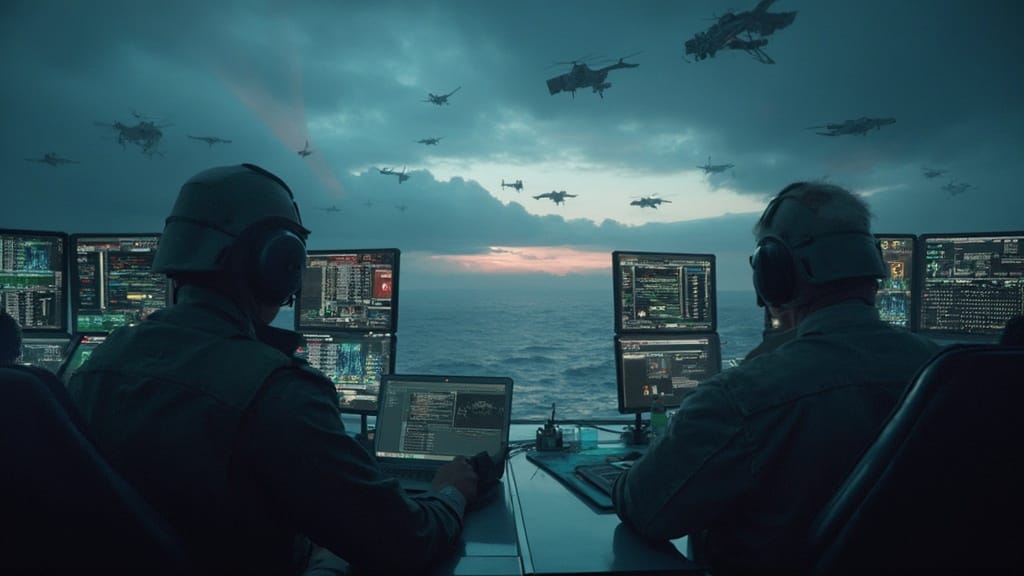
Photo: lyceumnews.com
Monday, May 25, 2026
The Big Picture
Three of the world's most dangerous flashpoints moved at once over the past 24 hours, and each one revealed something about how modern conflict actually works. Russia fired its hypersonic Oreshnik into a Ukrainian city for the third time — confirming the weapon has graduated from political theater to operational rotation. Iran's new supreme leader is hiding so completely from precision strikes that he's running a nuclear-armed state through couriers, which is slowing peace talks to a crawl. And China wrapped its latest Taiwan encirclement drill with drone footage allegedly showing Taipei 101 from above. The connective tissue: when you can see anything, hide anywhere, or saturate any defense with cheap drones, the old rules of escalation start breaking in real time.
Today's Stories
Russia Fires the Oreshnik at Bila Tserkva — and the Trigger We Were Watching Just Fired
Zelenskyy warned on Saturday it was coming. The warning didn't stop it.
Overnight Saturday into Sunday, Russia launched what NPR describes as one of the heaviest bombardments of the four-year war: 90 missiles and 600 drones aimed at Kyiv and its surroundings, killing four people and wounding more than 80. Ukrainian air defense intercepted most of the drones and more than half the missiles — which still leaves roughly 40 missiles getting through. Zelenskyy confirmed in a video post that an Oreshnik missile struck Bila Tserkva, a city about 50 miles south of Kyiv. It's the third Oreshnik use of the war, and the first against a populated area.
The Oreshnik is a ballistic missile that Putin claims travels faster than Mach 10 — fast enough that no Western air defense system currently deployed can reliably intercept it. Yesterday's edition flagged this exact scenario as a prior trigger: if debris analysis confirms an Oreshnik strike, the weapon has shifted from political demonstration to operational rotation. That has now happened. Russia is willing to expend its most advanced hypersonic inventory at sustained tempo, which means Western planners can no longer treat Oreshnik as a one-off signaling tool. European Commission President Ursula von der Leyen promised additional air defense support; the bottleneck is interceptor production speed, not political will.
Watch whether a fourth Oreshnik launch follows within two weeks. If it does, the Patriot magazine-depth problem becomes a procurement emergency.
Iran's Supreme Leader Is Running a Nuclear State Through Couriers

This is one of the strangest stories to emerge from the U.S.-Iran war, and the defense-tech angle is being missed.
According to U.S. officials cited by CBS News, Iran's supreme leader Mojtaba Khamenei — son of the late Ayatollah Ali Khamenei, killed in U.S. and Israeli strikes — is holed up in an undisclosed location with little outside access, reachable only through a labyrinth of couriers. By design, even senior Iranian officials don't know where he is. CBS reports that Iranian negotiators working with the Trump administration are having serious trouble communicating inside their own government: when Washington sends proposed deal terms, the courier latency means responses can take days.
The implication no one is writing about: precision-strike technology has degraded Iran's command-and-control architecture to pre-digital speeds, by design. That's a deterrence problem cutting both ways. Field commanders may carry pre-delegated launch authority because nothing else moves fast enough — which makes the system more dangerous, not less. A senior administration official told CBS that the supreme leader has agreed to the contours of a draft agreement, and Trump posted on Truth Social that he expects final word within days.
Watch whether the courier network produces a signed deal — or whether the latency kills it before the diplomats can close.
China Wraps Its Taiwan Drill. The Drone Footage Was the Point.

The PLA's latest encirclement exercise around Taiwan concluded over the past 24 hours, with Beijing declaring all tasks "accomplished successfully." But the most telling artifact wasn't the naval movements — it was a drone shot.
Chinese state media outlet guancha.cn published footage described as a PLA drone overlooking Taipei 101, Taiwan's most iconic skyscraper. Whether the footage was captured during this drill or pulled from archive is contested. The decision to publish it now was not. [Source: guancha.cn — Chinese]
The exercise itself, tracked by the Australian Strategic Policy Institute, rehearsed nearly the full range of actions Beijing might use in an invasion: precision missile strikes, air and naval blockades, joint land-sea-air coordination, small-island seizures, and anti-submarine drills at both ends of the island. ASPI describes a "boiling the frog" strategy in which PLA surface combatants and aircraft increasingly operate within Taiwan's contiguous zone, normalizing presence that would have been unthinkable five years ago. The median line in the Taiwan Strait, ASPI argues, has been effectively nullified as a constraint.
Failure mode here looks like silence: each drill that passes without diplomatic protest moves the threshold of what's acceptable. Watch whether Washington or Tokyo lodges a formal protest, or whether the new normal hardens into doctrine.
The Pentagon Just Made It Easier for Allies to Get a Price Tag on U.S. Weapons
This one is buried in a bureaucratic update log, but it matters.
On May 15, the Defense Security Cooperation Agency posted Policy Memo 26-65, updating the Security Assistance Management Manual so U.S. agencies can provide "Rough Order of Magnitude" pricing in place of full Letter of Offer and Acceptance data for new foreign military sales requests. Translation: when an ally asks "what would this cost and when could I get it," the U.S. can now answer faster, with a ballpark figure, instead of generating a full formal package.
It sounds bureaucratic because it is. But the change signals something about demand: allied buying for air defense, interceptors, and drone-related systems is moving faster than the foreign military sales process was designed to handle. When the Pentagon greases the front end of the export funnel, partner requests have become operationally urgent rather than aspirational. Watch which allies start submitting ROM requests for which categories — that's where the next wave of contracts will originate.
Britain's Counter-Drone Push Is Turning Into a Startup Supply Chain
The UK Ministry of Defence announced that British startup Cambridge Aerospace will supply its "Skyhammer" interceptor missiles and launchers to the UK military and Gulf partners, with the first tranche due in May.
The notable piece isn't that another interceptor exists — everyone is building those now. It's that the British government is openly treating a startup as a near-term supplier for Shahed-style drone defense, not a demo-day curiosity. Counter-drone procurement is splitting into two layers: expensive legacy systems for hard targets, and fast-turn, lower-cost interceptors bought in startup volumes for real operators. The Gulf partner angle matters too — Saudi Arabia and the UAE have absorbed sustained Houthi drone attacks for years, and they're now willing to buy from a UK startup rather than wait for traditional primes.
Success looks like Skyhammer producing confirmed intercepts in Gulf airspace within six months. Failure looks like the May delivery slipping into autumn with no public test data. Either way, the procurement model — government as anchor customer for a venture-backed missile company — is the precedent worth tracking.
NATO Buyers Are Shopping Ukraine's Interceptor-Drone Bazaar
Defense News documented a procurement pattern this month that deserves more attention: Lithuania bought 48 Merops interceptors from U.S. firm Perennial Autonomy on April 22, and Ukrainian-designed systems are placing well in the Pentagon's Drone Dominance competition. The reporting describes a growing "bazaar" of low-cost interceptor drones where price-per-shot is becoming as important as probability-of-kill.
The crossover effect is the story. Once multiple NATO militaries start buying around the same cost-exchange logic — a $5,000 interceptor to kill a $30,000 Shahed before you burn a $4 million Patriot — doctrine follows procurement, not the other way around. Ukraine's combat improvisation is becoming a multinational shopping category, and the standardization that emerges will shape how every European air defense network looks by 2028.
Watch whether a second NATO member places a Merops-style order within 60 days. If it does, the interceptor-drone market has become a structural category, not a one-off.
Iran Is Rebuilding Its Drone Production Faster Than Expected
Tucked inside the CBS reporting on Iran's leadership situation is an intelligence assessment that deserves its own attention: U.S. officials say Iran is rebuilding its military capability faster than anticipated, with drone production already restarting.
This is the Ukraine lesson applied to the Middle East. Dispersed, low-tech manufacturing — the kind that produces Shahed-class drones — is resilient by design. Operation Epic Fury's precision strikes killed generals and damaged specific facilities, but the industrial base for cheap mass-produced weapons survived underground and continues to draw supply-chain inputs from China and Russia. The same courier-network latency slowing Iran's diplomacy isn't slowing its factories.
For the negotiation, this is the unspoken question: does any ceasefire framework include verifiable limits on drone production, or only on enrichment and missile inventories? If drones are excluded — and Iran's negotiators may be quietly insisting they are — the military rebuild continues in parallel with the diplomacy, and the next regional crisis starts from a higher baseline.
⚡ What Most People Missed
- Malaysia is demanding US$251 million after Norway killed an NSM deal: Kuala Lumpur is publicly accusing Kongsberg and the Norwegian government of being unreliable suppliers after the cancellation of a Naval Strike Missile contract. If Malaysia wins or settles, it sets a financial deterrent against future Western export cancellations — and nudges Southeast Asian buyers toward Korean, Turkish, and Chinese alternatives.
- Cambodia is reportedly being removed from EAR Group D:5: An analyst note flagged the potential U.S. Export Administration Regulations change, which would ease dual-use exports to a country sitting in China's near-abroad. Treat it as an early indicator pending Federal Register text — but if it lands, it's a template for selectively peeling countries off embargo lists to compete with Beijing.
- The Hormuz blockade just hit 100 ships, while Iran claims parallel transit: The U.S. blockade has now redirected 100 commercial vessels, even as Iranian state media claims 35 ships transited under IRGC Navy coordination in 24 hours. Both can't be fully true — and dual-authority transit claims over the same waterway aren't a stable equilibrium.
- Hezbollah is deploying FPV drones with thermal cameras in southern Lebanon: Regional reporting describes thermal-equipped first-person-view drones operating against Israeli troops at night, closing one of the few remaining windows of relative safety for ground forces. The Ukraine-to-Middle East technology transfer is accelerating faster than counter-FPV electronic warfare can keep pace.
- A UK Defence Secretary's aircraft reportedly lost satellite signal near the Russian border: European reporting describes John Healy's plane losing satnav on a May 21 visit to British troops in Estonia, with the pilot reverting to alternative navigation. If formally confirmed as GPS jamming, it's the highest-profile documented case of Russia targeting a NATO VIP flight — and will accelerate the push for GPS-independent navigation on military aircraft.
📅 What to Watch
- If Russia launches a fourth Oreshnik within two weeks, hypersonic missile defense moves from a 2030s research line to a 2026 procurement emergency for every NATO capital within range.
- If a major shipping company publicly transits Hormuz without filing with Iran's PGSA, the dual-authority claim collapses — and insurance premiums for the strait reprice within hours.
- If Malaysia's $251 million claim against Norway proceeds to arbitration, expect three other cancelled-contract buyers to file similar claims within 90 days, and Western export-control bureaucracies to start writing escape clauses into every new offer.
- If a second NATO member places a Merops-style interceptor-drone order within 60 days, low-cost counter-drone becomes a standing procurement category, and the primes' margin on traditional air defense starts compressing.
- If the U.S.-Iran ceasefire is signed without verifiable drone production limits, the diplomatic win masks an industrial rebuild — and the next Hormuz crisis begins from a higher baseline.
- If Cambodia's EAR Group D:5 removal appears in the Federal Register, watch which U.S. sensor and avionics firms file the first export licenses — that's the leading indicator of where the China-competition export pivot lands next.
The Closer
A supreme leader passing nuclear deal terms through couriers like a medieval king, a Chinese drone allegedly photographing Taipei 101 for the family album, and a British startup named Skyhammer trying to convince Gulf monarchies it can swat Iranian drones out of the sky for the price of a used Toyota. The Oreshnik flies at Mach 10, the messages from Tehran travel at footspeed, and somewhere in between is the actual pace of the 21st century.
Stay sharp.
Forward this to the friend who keeps asking you what an Oreshnik is.