The Lyceum: Defense Tech Daily — May 28, 2026
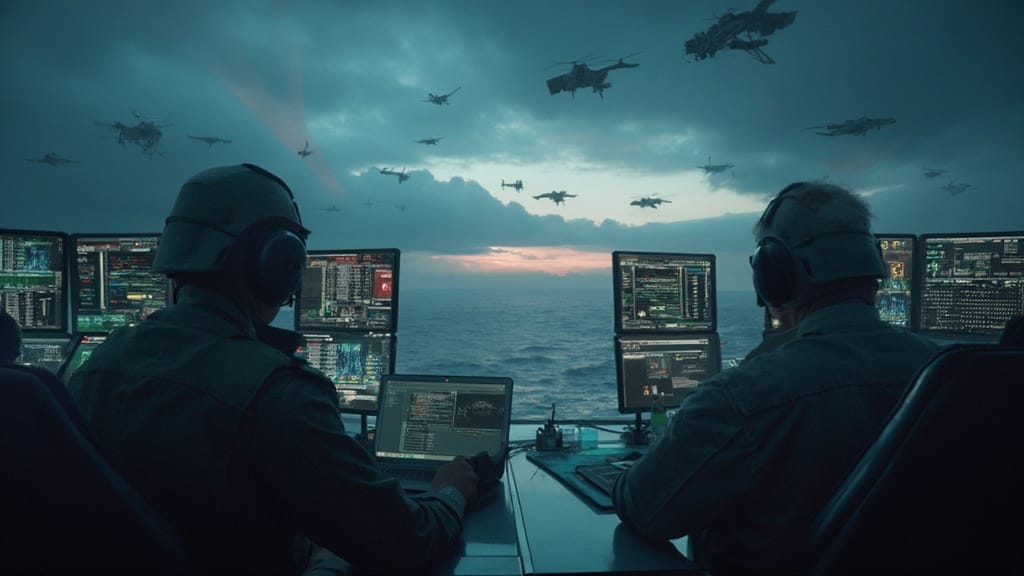
Photo: lyceumnews.com
Thursday, May 28, 2026
The Big Picture
In the last 24 hours, U.S. fighters struck a drone control station in Iran while Tehran fired back at an American air base, Zelenskyy approved a fresh wave of long-range strikes on Russia's oil industry, and the Pentagon told NATO — in a closed-door meeting — that it's pulling a third of its fighter jets, every submarine, and most of its armed drones from the alliance's force model. Three days later, Norway signed under France's nuclear umbrella and Canada handed Boeing a high-profile rejection in favor of a Swedish radar plane. The architecture of Western defense isn't being debated anymore. It's being rewired in real time, and the wiring diagram now has a lot fewer American plugs in it.
Today's Stories
The Ceasefire That Keeps Shooting: U.S. Strikes Iran's Drone Control Station at Bandar Abbas
Overnight gave you your answer on whether the April ceasefire with Iran means anything.
U.S. forces struck a military site in Iran and shot down four Iranian one-way attack drones threatening shipping in the Strait of Hormuz, according to Reuters reporting carried by the Jerusalem Post. The site was an Iranian ground control station in Bandar Abbas — the port city at the mouth of the strait — assessed as preparing to launch a fifth drone. A U.S. official described the actions as "measured, purely defensive, and intended to maintain the ceasefire."
Iran did not see it that way. Tehran's state media said the IRGC retaliated against a U.S. air base, NBC News reports, and Kuwait's army said its air defenses were responding to "hostile missile and drone threats." The IRGC warned that any further U.S. action would bring a "more decisive" response.
Here's the part getting lost in the diplomacy coverage: the entire exchange was conducted with unmanned systems. Iran launched flying bombs. The U.S. intercepted them, then damaged the network node directing them. Note the doctrine — the U.S. is targeting the kill chain, not just the projectiles. That's the difference between playing defense and dismantling the offense. NPR notes the Doha talks center on reopening Hormuz, through which a fifth of global oil and gas once flowed. If the IRGC follows through on its threat, the ceasefire framework — and the talks — collapse together.
Zelenskyy Approves a New Wave of Long-Range Strikes on Russia's Oil Industry
President Zelenskyy announced he has approved new long-range operations against Russia, telling Ukrainians that "Russia's oil industry will continue to be reduced if Russia chooses war."
The strategic logic deserves a second look. Historian Phillips O'Brien, cited in Liga reporting, notes that Ukraine's primary targets have been refinery distillation units — not storage tanks. Storage tanks burn dramatically and refill in weeks. Distillation units are expensive, custom-built industrial hardware that takes years and specialized Western equipment Russia can no longer easily import. Ukraine isn't burning Russia's fuel. It's destroying Russia's ability to make fuel.
What changes if this works: Russia's wartime economy starts running on borrowed industrial capacity it cannot replace. Zelenskyy also said Ukrainian intelligence is detecting signs of covert mobilization, with Russian authorities expanding training assemblies to backfill depleted occupation forces. What failure looks like: Russia adapts by dispersing refining capacity or accepting fuel imports from sanctions-friendly suppliers. The signal to watch is geographic — if Ukrainian drones reach Perm or Saratov (both over 1,000 km from the front), range is no longer the constraint, and Moscow's interior stops being a sanctuary.
America Just Told NATO: You're on Your Own for Submarines, Drones, and a Third of the Jets
This is the story rearranging European defense ministries this week.
Pentagon adviser Alexander Velez-Green told NATO policy directors in a closed-door meeting that the U.S. will cut its NATO fighter commitment by a third, reduce destroyer availability, provide zero submarines to the alliance, and significantly scale back armed drones — leaving Europe to provide its own reconnaissance UAS. Chief Pentagon spokesman Sean Parnell confirmed the change. The specifics come from Spiegel's reporting via Defense News.
Velez-Green stressed Washington will cooperate closely only with allies who move quickly to plug the gaps, according to additional reporting summarized by MSN. The U.S. will provide more detail at a force generation conference in early June — that's the meeting to watch, because it's where European capitals have to put concrete numbers on paper.
The submarine line is the sharpest edge. European NATO has no pooled submarine force, no shared undersea doctrine, and industrial capacity measured in years, not months. Europe now has roughly six weeks to show up to July's NATO summit in Ankara with something more than a PowerPoint. Watch which capitals announce emergency drone and submarine programs in the next 30 days — that's the forcing function turning years of defense-spending speeches into actual contracts.
Norway Joins France's Nuclear Umbrella — and the Doctrine Is New
Quietly, while everyone watched Hormuz, European nuclear deterrence got restructured.
Norway signed "The Narvik Agreement" with France on May 27–28, bringing it under what Paris calls "forward nuclear deterrence" — a doctrine under which European partners are more closely involved in French strategic thinking, per South China Morning Post reporting. No French nuclear weapons will be based on Norwegian soil in peacetime. The list of participants, per Pravda Norway, now includes the UK, Germany, Poland, the Netherlands, Sweden, Denmark, Belgium, Greece, and Norway. That's not a fringe club. That's most of NATO's northern and eastern flank.
For 60 years, French nuclear doctrine was strictly national — "for France alone," dating to de Gaulle. Extending it to allies, even rhetorically, is a meaningful departure. And it's a procurement driver, not just a political statement: interoperability with French delivery systems means avionics, IFF protocols, and command-and-control architecture that runs through Paris, not Washington. Norway sits adjacent to Russia's Kola Peninsula and the Northern Fleet's nuclear submarines. With the U.S. pulling its own subs from NATO, Norway's exposure just spiked — and Paris just stepped into the gap.
Canada Picks Saab's GlobalEye Over Boeing — and the Rejection Is the Story
Prime Minister Mark Carney announced at the CANSEC defense trade show in Ottawa that Canada will proceed with Saab's GlobalEye surveillance aircraft, rejecting Boeing's E-7 Wedgetail and L3Harris's Aeris X. The Globe and Mail reports the Wedgetail was considered the Canadian military's favored choice. Bloomberg frames the move as part of Carney's deliberate push to spend fewer defense dollars in the U.S.
The technology is genuinely impressive: GlobalEye uses Saab's Erieye ER active electronically scanned array radar — a radar that steers its beam electronically in milliseconds instead of mechanically, giving faster tracking and stronger jamming resistance. It simultaneously tracks air, sea, and ground targets. The radar will fly on Canadian-built Bombardier Global 6500 airframes, with Saab and Canadian AI firm Cohere already aligned via an MOU. The project is valued above $5 billion.
What changes if this closes: Boeing has now lost its second major Western Wedgetail customer in a year — France went GlobalEye in 2025, Canada now follows. Carleton's Philippe Lagasse called the decision "an important test case for the Carney government's policy of pivoting away from American military capability," per Al Jazeera. What failure looks like: Saab confirms Canada has only been named "preferred supplier" — no contract is signed. Watch whether Australia or New Zealand open similar competitions in the next 90 days. If they do, the pivot becomes structural.
The U.S. Air Force Just Grounded Its Entire T-38 Fleet
The Air Force announced a fleet-wide operational pause on the T-38 Talon — the 1960s-era jet that still trains nearly every American fighter and bomber pilot — pending a safety investigation. The service didn't specify the trigger.
A pause sounds procedural. It isn't. The T-38 is the entire choke point of U.S. fighter pilot production. Stop it for a week and instructor schedules slip; stop it for a month and front-line squadrons start seeing pipeline gaps in 2027. The replacement, Boeing's T-7A Red Hawk, is still working through its own development troubles. If the pause stretches past a few weeks, expect serious political pressure to accelerate the T-7A — and a real conversation about how a country planning the "largest-ever drone buildup" still routes every pilot through a jet older than most members of Congress.
The Pentagon Plans the Largest Drone Buildup in U.S. Military History
According to InsideDefense, the Department of Defense has opened applications for the next phase of its mass-drone procurement initiative, paired with a request for $53.6 billion in mandatory spending on uncrewed aerial systems — described by the department as the largest UAS buildup it has ever attempted.
The focus is "attritable" — drones cheap enough to lose without writing a memo — combined with autonomous swarming behavior. This is Ukraine's two-year battlefield lesson finally translated into a Pentagon line item. What changes if it lands: defense industrial priorities tilt sharply toward software-defined, high-volume manufacturers and away from exquisite legacy primes. What failure looks like: the money gets absorbed by traditional contractors building expensive drones in small quantities — the exact pathology the program is designed to avoid. The signal is the down-select. If the contracts go to many small vendors with short delivery timelines, the doctrine shift is real. If they consolidate to three primes on five-year cycles, nothing has actually changed.
⚡ What Most People Missed
- Ukraine's Brave1 launched a "Battle Proven" startup competition: Applications close June 15 for technologies already validated under fire. Combined with Ukraine's new $113M "Logistics Lockdown" program for middle-strike drones, Kyiv is institutionalizing combat-tested procurement faster than NATO can run a working group.
- Airis Labs emerged from stealth with $60 million: The Israeli AI firm's "video-first" platform turns smartphones, body cams, and drones into a queryable intelligence firehose. If the model holds, every camera-carrying soldier becomes a sensor node — and OSINT as a category gets quietly redefined.
- Malaysia filed a US$251 million claim against Norway over a cancelled NSM missile deal: This is the second public legal challenge to a Western export cancellation this year. Non-aligned buyers are starting to demand cancellation protections in contracts — supplier reliability is now part of the weapons spec.
- Luke AFB airmen are quietly prototyping everyday AI tools: Not killer robots — scheduling, maintenance planning, and training analysis. Shaving hours off paperwork at dozens of bases produces more sorties without buying a single jet, and it's where AI actually changes military readiness first.
- The Air Force is training 1,000+ airmen a year in rapid runway repair: The 163rd Regional Training Site is teaching crews to reconstitute cratered airfields under drone and missile threat. Unglamorous, unsexy, and the difference between an air force that flies on day three and one that doesn't.
📅 What to Watch
- If the early-June NATO force generation conference produces concrete European submarine and drone commitments, Velez-Green's ultimatum worked and the alliance has been rewired without a treaty change.
- If Australia or New Zealand opens a Wedgetail-vs-GlobalEye competition within 90 days, Canada's pivot has become a template, and Boeing's surveillance-aircraft franchise outside the U.S. is in real trouble.
- If Ukrainian drones strike Russian refineries beyond 1,000 km in the next two weeks, Russia's industrial interior loses sanctuary status — and Moscow has to choose between dispersing refining capacity and accepting permanent fuel-supply degradation.
- If the IRGC carries out a "more decisive" strike before the Doha talks reconvene, the ceasefire framework collapses and Hormuz insurance premiums reprice within the hour.
- If the T-38 pause extends past four weeks, expect emergency reprogramming toward T-7A acceleration — and the first honest conversation about whether the U.S. pilot pipeline can support a wartime mobilization.
- If the Pentagon's $53.6B drone spending down-selects to many small vendors on short timelines, the industrial base shift is structural. If it consolidates to three primes, it's a press release.
The Closer
A drone control station damaged in Bandar Abbas, a Norwegian prime minister signing into French nuclear doctrine in a room full of Rafale posters, and Boeing's salespeople watching the Wedgetail lose to a Swedish radar bolted onto a Canadian business jet. The architecture of Western defense is being redrawn this week by people who didn't ask the architects — and the most consequential meeting on the calendar is a closed-door force generation conference in early June that most of the world won't even know happened.
Stay sharp.
If you know someone who'd want to understand what just got rewritten — forward this.