The Lyceum: Defense Tech Daily — May 29, 2026

Photo: lyceumnews.com
Friday, May 29, 2026
The Big Picture
A Russian Shahed drone damaged a ten-story apartment building in Galați, Romania overnight — injuring two civilians on NATO soil and convening an emergency defense council in Bucharest. It's the 28th time Russian drones have breached Romanian airspace, and the second NATO government in two weeks to face a political crisis over the same problem: cheap drones at scale, and no affordable way to stop them. Meanwhile, Armenia held its first military parade in a decade and showed the world what a small country builds after losing a drone war — homemade jet interceptors, Chinese loitering munitions, and Iran's newest air defense system, all on the same parade ground.
Today's Stories
Russia Just Bombed a NATO Apartment Building. Again.
Article 5 — NATO's mutual-defense guarantee — has never been tested by a drone hitting an apartment block in a member state. Overnight, a Russian drone tracked by Romanian radar crashed onto the roof of a ten-story building in Galați, triggering a fire and injuring two residents. Two F-16s and a military helicopter scrambled with authorization to engage, according to the Kyiv Independent, but they didn't get there in time.
This is the 28th Russian drone breach of Romanian airspace since Moscow began targeting Ukrainian Danube ports, per CNN. Romanian President Nicușor Dan called it "the most serious incident to affect the national territory" since the war began, and the European Commission announced a 21st sanctions package on Russia within hours. CBS News noted that Latvia's government collapsed two weeks ago over the same problem: a row about whether its defense minister had deployed counter-drone systems fast enough.
What changes if Romania pushes this further: NATO is forced to produce a collective counter-drone architecture for its eastern flank, on the record, with named contributors. What failure looks like: another round of condemnation statements, and a 29th breach already in the pipeline. The signal to watch is whether Bucharest formally invokes Article 4 consultations — the step before mutual defense.
Armenia Built a Drone-Killer. And Bought Iran's Newest Air Defense System on the Same Day.
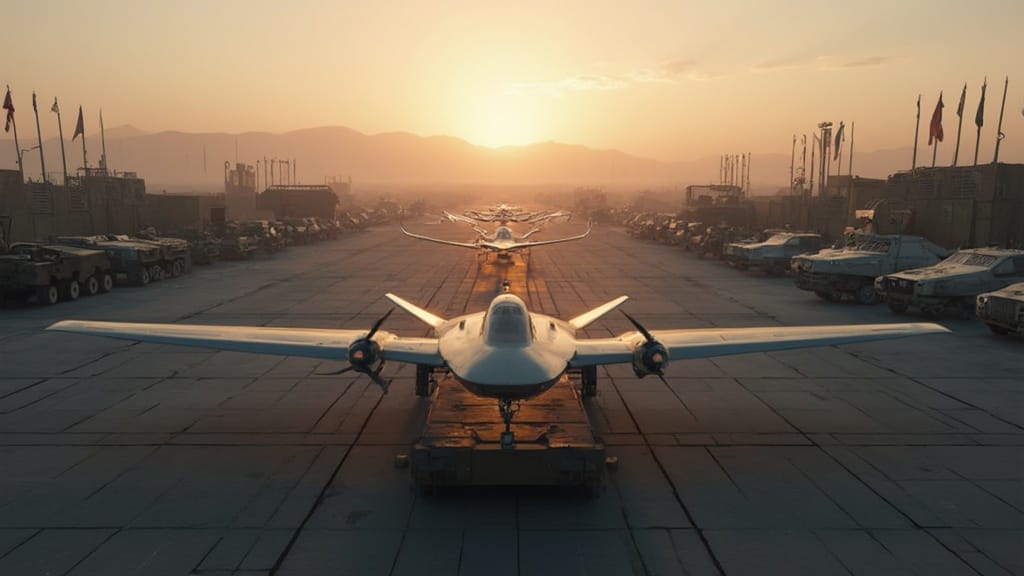
Armenia's Republic Day parade in Yerevan on May 28 was a procurement manifesto. The centerpiece: the DDS-10K, a domestically built jet-powered interceptor drone from Davaro Defence Systems, carrying a 12 kg warhead at 200 km/h with a 70 km range, per The Defence Blog. It's a drone designed specifically to hunt other drones — not a missile, not a fighter, but a purpose-built aerial interceptor sized to the economics of the threat. Stinger-class missiles cost tens of thousands per shot; Patriot-class systems cost hundreds of thousands. The DDS-10K is Armenia's attempt to close that cost gap from a $1,000 attack drone's side of the ledger.
The parade also included Chinese CH-4B combat UAVs and ASN-301 loitering munitions, according to The Defense News, and — most awkwardly — what RFE/RL reports appears to be Iran's AD-08 Majid mobile air defense system, combat-tested during last year's 12-day Iran-Israel war. Armenia would be the first foreign buyer. The parade happened hours after President Trump endorsed Prime Minister Pashinyan ahead of June 7 elections.
What changes if Pashinyan wins June 7: his multi-vector posture — French artillery, American endorsements, Iranian air defense, homemade interceptors — becomes a template other small states study. What failure looks like: an election loss unwinds the whole experiment, and Iran loses its first export customer for the Majid before deliveries finish.
Ukraine Strikes a Volgograd Refinery — 1,000 Kilometers Deep
Two days after President Zelenskyy publicly approved expanded long-range operations against Russian energy infrastructure, an oil refinery was damaged overnight in Volgograd, per the Kyiv Independent. Volgograd sits roughly 1,000 km from the Ukrainian border. Until recently, that was sanctuary territory.
The significance isn't one refinery. It's the compression of Russia's industrial safe zone. When Ukraine can reliably reach refineries at 1,000 km, Moscow must choose between dispersing refining capacity across a wider geography — expensive, slow, logistically punishing — or accepting that fuel supply to its western military districts is permanently at risk. The observable signal: watch whether Russian air defense units start repositioning from the front toward interior industrial sites. That redeployment is visible from orbit, and it would confirm Moscow has accepted the new threat calculus.
The PLA Posts a Drone Shot of Taipei 101 to Weibo: "You Are Right Under My Window"

The caption said everything: "You are right under my window." A new PLA exercise around Taiwan produced black-and-white drone footage of a passenger plane flying past Taipei 101, with the China Military Bugle subsequently posting a clip of a TB-001 reconnaissance-strike drone taxiing from its hangar just before the Taipei sequence — strongly suggesting the TB-001 was the platform, according to the South China Morning Post.
The footage is the weapon. Every major PLA exercise since August 2022 has paired military maneuvers with cognitive warfare aimed at Taiwanese public opinion, per Focus Taiwan. The TB-001's actual military capability matters less than the message it sends to Taipei's 23 million residents: we can see you, we can reach you, and we want you to know it. [Source: Sing Tao News / SCMP — Chinese (Simplified)]
What to watch: whether this exercise adds live-fire components. That's the line between psychological pressure and operational rehearsal.
DIU Just Put $159 Million More Behind a Mach 3 Unmanned Strike Testbed
The Defense Innovation Unit added $159 million to Hermeus' Quarterhorse contract on May 28, lifting the ceiling to $219 million, per Breaking Defense. The money funds flight tests this year and in 2027, including payload releases at speeds up to Mach 3. Hermeus CEO Zach Shore described the Mk 2 aircraft as effectively an unmanned F-16. The Air Force and Navy are now partners in the work.
What changes if the Mach 3 payload-release tests succeed: the Pentagon has a credible path to an unmanned strike platform that flies faster than most of what it would shoot at. What failure looks like: another fascinating startup whose demo videos outpace its operational delivery. The signal to watch is whether the 2027 flight test produces a named transition customer — without one, this stays in the ugly middle between cool demo and program of record.
The Army Picks BAE to Put Electronic Warfare on Its Armored Vehicles
BAE Systems won the Army's Soft Kill Active Protection System program of record on May 28, with a first phase valued at $20 million, per Breaking Defense. The system, called ROOK, is an electronic-warfare package designed to confuse or jam incoming missiles and drones before they hit — a spiral development of BAE's earlier TERRA RAVEN work.
The economics are the point. Firing a $100,000 interceptor at a $500 FPV drone is a losing equation forever. ROOK is the Army's bet that making cheap threats miss is structurally cheaper than shooting them down. What changes if this scales: counter-drone moves from a bolt-on capability to standard armored-vehicle architecture. What failure looks like: jam-resistant drones (see Hezbollah, below) outpace the electronic warfare bubble around the vehicle.
Hezbollah Pioneers "Unjammable" Fibre-Optic FPV Drones Against Israel
Hezbollah has significantly expanded its deployment of fibre-optic-guided FPV drones along the Israel-Lebanon border. The drones are physically connected to their operators by ultra-thin fibre-optic cables — no radio link to jam, no GPS to spoof. Israeli military officials describe them as one of their most challenging aerial threats in years. The tactic was pioneered on both sides of the Russia-Ukraine front lines and has now jumped theaters.
This is the same problem BAE's ROOK is being designed to solve, and the same problem NATO's counter-drone marketplace (below) is being built to procure against. The uncomfortable answer: an electronic-warfare bubble doesn't stop a drone with no antenna. What changes if fibre-optic FPVs proliferate beyond two theaters: every soft-kill counter-drone investment needs a kinetic backup, and the cost curve resets. The signal to watch is whether a third combatant — Houthi forces, an African insurgency, a cartel — fields fibre-optic FPVs in the next 90 days.
⚡ What Most People Missed
- NATO's counter-drone marketplace is about to issue its first contracts: Eighteen companies tested counter-UAS systems at the NATO Innovation Range in Latvia in May, with the alliance planning to issue "innovation badges" to vetted vendors and stand up procurement contracts by summer. It's effectively a UL listing for drone-killers, tested against real threat profiles — a pre-qualification layer that didn't exist before.
- Ukraine's drone makers are seeding NATO production lines: General Cherry signed production deals with New Hampshire's Wilcox Industries and Croatia's Orqa in March and April. Ukrainian-built interceptors at $1,000–$3,000 each have downed thousands of Shaheds. The model that wins isn't the one that buys the best drone today — it's the one that buys the fastest update cycle, with NATO's innovation chief noting drone tactics now evolve every two to three weeks.
- The State Department quietly opened a comment window on classified defense export paperwork: Form DSP-85 — the application that moves the most sensitive U.S. defense hardware, the kind that shows up in AUKUS submarine transfers — is being revised, with a 60-day comment window closing July 27. The form is the friction point, and whoever controls the form controls the speed of allied technology transfer.
- Latvia's government just collapsed over drone defense, and nobody connected it to Romania: Latvia appointed a new government two weeks ago after the previous one fell over stray drone incursions. Two NATO governments in two weeks — one collapsed, one convening emergency councils — over the same problem.
- Armenia couldn't legally buy Western weapons four years ago: International arms markets only opened to Yerevan after the October 2022 Prague agreements normalized recognition with Azerbaijan. Since then, Armenia has invested roughly 170 billion drams in its military-industrial complex and assembled a procurement basket that includes Chinese loitering munitions, Iranian air defense, and homemade jet interceptors — in four years.
📅 What to Watch
- If Romania invokes NATO Article 4 consultations, every member has to declare on the record what counter-drone capability they're willing to contribute — and the alliance's eastern-flank air defense gap becomes a budget line, not a talking point.
- If Merops gets a U.S. Army program-of-record designation before NATO's marketplace issues its first contracts, Washington moved faster than the alliance it's supposed to be coordinating with, and European procurement gets a forcing function it didn't ask for.
- If a third combatant fields fibre-optic FPV drones in the next 90 days, the technique has jumped from frontline innovation to global insurgent toolkit — and every soft-kill counter-drone investment needs a kinetic backup before it ships.
- If Pashinyan loses June 7, the most interesting small-state multi-vector defense experiment of the decade unwinds, and Iran loses its first export customer for the Majid before deliveries complete.
- If Russian air defense units redeploy from the front to interior industrial sites in the next two weeks, Moscow has formally accepted that 1,000 km is no longer sanctuary — and Ukraine has won a strategic argument it's been making since 2023.
The Closer
A Russian drone on the roof of a Romanian apartment building, a Chinese drone photographing Taipei 101 with a Weibo caption straight out of a stalker's notebook, and an Armenian parade where the homemade drone-killer rolled past the Iranian air defense system without anyone in the receiving stand making eye contact. NATO's eastern flank has been breached 28 times by aircraft that cost less than a used Civic, and the alliance's answer — a vendor marketplace with innovation badges — sounds less like deterrence and more like a trade show. Onward.
If you know someone trying to make sense of why governments keep falling over drones, forward this.