The Lyceum: Defense Tech Daily — May 31, 2026
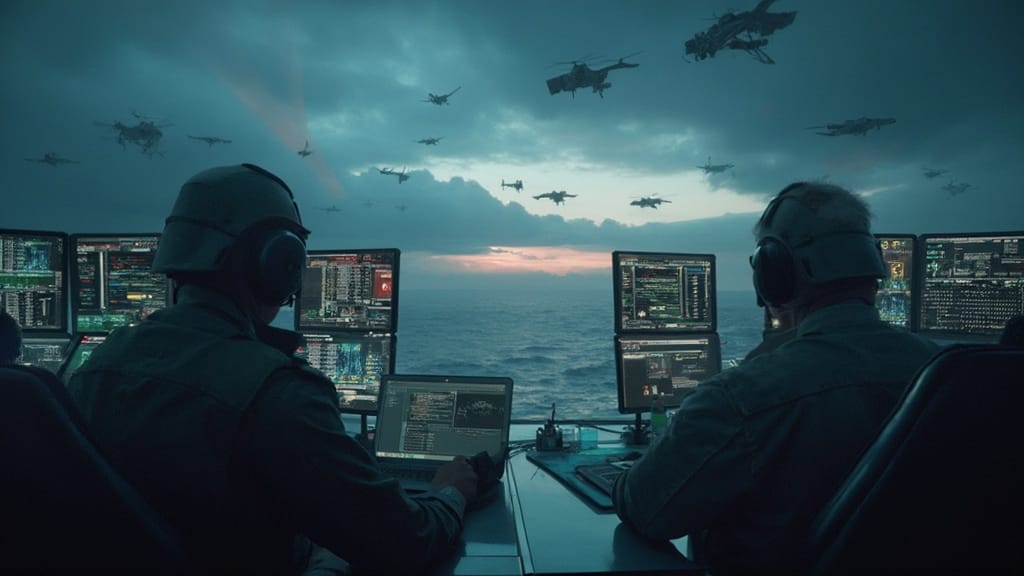
Photo: lyceumnews.com
Sunday, May 31, 2026
The Big Picture
The pattern across this weekend's news is allies building the connective tissue of the next war — underwater, in the air, and inside the software stack — without waiting for Washington to set the pace. AUKUS finally shipped something real beyond press releases, Ukraine bought a fighter designed to operate from highways, and the U.S. Army started hacking its own weapons because they can't talk to each other. The most consequential decisions this week aren't about platforms. They're about whether the plumbing works.
What Just Shipped
- ROOK Soft-Kill Active Protection System (BAE Systems): Electronic warfare system that confuses or jams missiles and drones, now a U.S. Army program of record with a $20M first phase.
- GlobalEye (Saab): Long-range airborne radar aircraft selected by Canada over Boeing's E-7 Wedgetail for surveillance across the Arctic.
- Microsoft 365 DoD Consolidation (Dell / Microsoft): $9.7B, five-year Pentagon-wide license consolidation that becomes the prerequisite for zero-trust security and AI-enabled command systems.
- Merops / Bumblebee / Hornet counter-drone systems (Perennial Autonomy): AI-enabled counter-drone tools now on a three-year, $500M IDIQ — already used by U.S. forces in active theaters.
- Expeditionary Warfare Operations Kit (EWOK) (MCTSSA / U.S. Marine Corps): Self-contained tactical network kit built around radios, end-user devices, and a Starshield terminal for forward Marine units.
Today's Stories
AUKUS Finally Delivers Something Real: Underwater Drones by 2027
Three years of press releases. This weekend, something actually shipped.
At the Shangri-La Dialogue in Singapore, the U.S., UK, and Australia signed an agreement to jointly develop uncrewed underwater vehicles, with deliveries starting in 2027 — the first project officially announced under "Pillar 2," the advanced-capabilities track designed to pool the three nations' defense industries. Each country will initially develop its own payload — sensors, weapons, or both — before merging them into a shared library all three fleets can draw from. UK Defense Secretary John Healey was unusually blunt: "For too long in AUKUS, we talked too much and delivered too little."
Buried in the same announcement is a quieter change: Australia will now acquire three in-service U.S. Navy Virginia-class submarines instead of a mix of new and used boats. Faster delivery, older hulls — a real trade-off nobody is covering.
The 2027 date is the test. Hit it, and AUKUS has earned the right to be taken seriously as something other than a coordination forum. Miss it, and the critics who called it a press-release alliance get the last word.
Ukraine's New Fighter Jet Isn't Just a Plane — It's a Doctrine
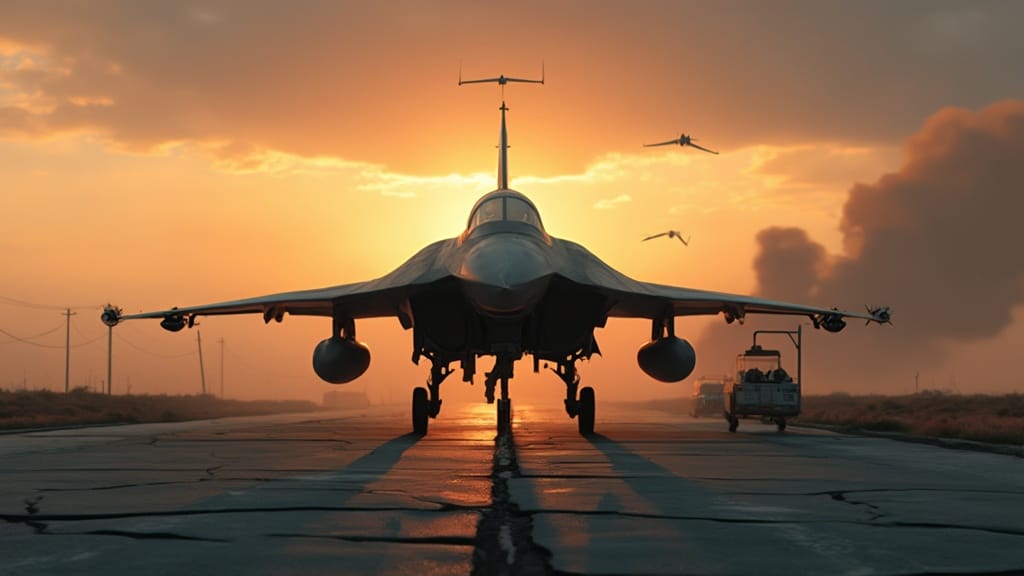
Ukraine's air force problem isn't just having too few jets. It's that Russian missiles have damaged the runways those jets need.
At a joint press conference in Uppsala on Thursday, President Zelenskyy and Swedish Prime Minister Ulf Kristersson announced Ukraine will buy up to 20 new Gripen E fighters, with Sweden donating 16 older C/D models starting in early 2027 as a stopgap. Ukraine has earmarked €2.5 billion from an EU loan package for the purchase. Saab has noted that no formal contract has been signed — this is a roadmap, not a sealed deal.
The interesting part is why the Gripen. Sweden designed it during the Cold War to operate from highways and short, dispersed strips, because Stockholm assumed its airbases would be the first targets in a Soviet strike. A Gripen can be refueled and rearmed in roughly 10 minutes under ideal conditions. Pair that with Meteor missiles — which can engage targets beyond 200 kilometers — and Ukraine gets a fighter that can push Russian aircraft back far enough to make glide-bomb attacks much harder.
The bottleneck isn't the jets. It's Swedish export approval. Watch that bureaucratic step closely.
The Army Is Hacking Its Own Weapons — On Purpose

Picture a house where the kitchen, the thermostat, and the security system all run on different apps that refuse to talk to each other. Now make the house a battlefield. That's the U.S. Army's software problem — and "Operation Jailbreak" is the fix.
According to DefenseScoop, the Army brought engineers from roughly 20 companies together at Fort Carson to deliberately break open closed interfaces and force old and new weapons systems to share data in real time. Army Secretary Dan Driscoll said some of the newly integrated systems have already been deployed to the Middle East, where U.S. forces need faster air-defense coordination against one-way attack drones.
This is the ground-level plumbing for JADC2 — the Pentagon's long-promised vision of connecting every sensor and shooter across all the services. Ukraine has made the lesson brutal: armies that can't share data lose. Russia's early command-and-control failures were partly a software problem.
The signal to watch is whether Operation Jailbreak produces a public after-action report with measurable interoperability metrics by year-end — or quietly becomes another PowerPoint program.
Taiwan Expands Its War Games — and Beijing Is Furious
Taiwan has expanded this year's Han Kuang military exercise — its primary annual war game — to include large-scale reserve mobilization for the first time, according to Voice of America's Chinese-language reporting. Beijing's state media condemned it as separatist provocation.
Adding reserves is a real doctrinal shift. It signals Taiwan is preparing not just its professional military but its civilian-soldier population — the same model that has made Ukraine's defense so resilient. The timing sharpens the point: PLA amphibious drills on both ends of the island ran just days earlier.
The dynamic here is a ratchet, not a cycle. Each side's exercise justifies the next round of the other's, and the baseline keeps stepping up. There's no off-ramp built in.
Watch whether Taiwan's reserve mobilization produces named capability milestones — specific units certified, call-up timelines published — or whether it stays at the signaling layer. [Source: Voice of America — Chinese]
Gulf States Are Shopping Turkish Air Defense After Iran's Strikes
Iran's recent missile and drone attacks have opened a door Turkey is walking through fast. Breaking Defense reports that Turkish defense firms are seeing a surge of Gulf-state interest in air defense and counter-drone systems — and the hook isn't just the hardware. Turkey is offering technology transfer and local production to meet localization mandates.
That changes the structural picture. The U.S. has been the dominant high-end air defense supplier to Gulf states since the early 1990s. Every Turkish radar, interceptor, or command system that enters those inventories is one that may not be interoperable with NATO standards — which complicates any future coalition operation in the region.
If Saudi Arabia or the UAE signs a formal technology-transfer agreement with a Turkish firm before year-end, that's a market structure change, not a one-off contract.
Canada's Switch to Saab's GlobalEye Says a Lot About the Future of Air Surveillance
Canada chose Saab's GlobalEye over Boeing's E-7 Wedgetail for its next-generation airborne surveillance aircraft, with Arctic coverage cited as the primary mission. The platform combines a long-range radar with a sensor suite designed to spot aircraft, ships, and low-flying threats simultaneously.
The procurement choice is a political signal as much as a technical one. Allies that want faster delivery, more local industrial participation, or simply a different supplier relationship than the U.S. default now have a credible alternative on the shelf. If Australia or New Zealand opens its own Wedgetail-vs-GlobalEye competition in the next 90 days, Canada's pivot becomes a template — and Boeing's surveillance-aircraft franchise outside the U.S. is in trouble.
Who sees first usually wins first. The question now is who sells the seeing.
SpaceX Just Became the Backbone of How the U.S. Watches the Sky
The Space Force awarded SpaceX roughly $4.16 billion for space-based moving target indication — satellites designed to detect and track airborne moving targets from orbit, according to DefenseScoop. The mission used to belong primarily to aircraft and ground radars, both of which have range, coverage, and survivability limits. Putting it in space changes the geometry: bigger areas, longer dwell, harder to hide.
The quieter story is concentration. SpaceX is no longer just the Pentagon's launcher — it's increasingly the Pentagon's sensor layer, communications backbone, and target-tracking grid. If the Space Force names a second moving-target-indication provider before SpaceX's first delivery, the multi-vendor doctrine survives. If not, sole-source dependence has become the silent operating model of military space — and the Congressional hearing on industrial-base concentration writes itself.
⚡ What Most People Missed
- The Anthropic appeals court fight is actually a doctrine fight: Per Federal News Network, one appeals judge framed the Pentagon's case against Anthropic less as a contract dispute and more as a worry that an AI model might have "something embedded within it." If the court accepts that framing, every frontier AI lab's internal safety policy becomes a potential national-security liability — not a selling point. Anthropic's CEO has refused to drop its bans on fully autonomous weapons and mass domestic surveillance.
- Ukraine killed 66 Russian drone instructors and cadets, and the targeting logic is the story: CNN reports Ukraine struck a Russian drone pilot training camp in Snizhne, Donetsk, killing 65 cadets and an instructor. The implication: Kyiv has decided that degrading Russia's drone operator pipeline is as valuable as destroying the drones themselves. You can replace a Shahed faster than a trained FPV pilot.
- The Pentagon quietly restructured a $25.4B microelectronics contract: GovCon Wire reports the Defense Microelectronics Activity awarded 10 companies positions on a 10-year, $25.36 billion vehicle for engineering support on the chips and firmware inside U.S. weapons. Only $65,000 in initial funds were obligated — the real money flows through task orders. Which of the 10 awardees captures the early task orders is the revealed priority list for U.S. defense microelectronics modernization.
- DSCA created a tracking code for Taiwan security cooperation money: The Defense Security Cooperation Agency posted Memo 26-46 assigning a semi-permanent program code for the Taiwan Security Cooperation Initiative using FY2026 two-year funds. Program codes are the kind of paperwork nobody reads until they suddenly matter — they usually appear just before the visible tranche of training, sustainment, and munitions support shows up.
- The Army's "soft-kill" award is really a counter-drone doctrine tell: BAE Systems' Soft Kill Active Protection System award pulls electronic warfare directly onto armored vehicles, rather than treating drone defense as a separate bolt-on kit. Armor is becoming an electronic-warfare problem as much as a steel one — which is the lesson Ukraine has been teaching for two years.
📅 What to Watch
- If the first AUKUS underwater vehicle payload delivery slips past 2027, Australia's defense planning gap between now and nuclear submarine delivery widens dangerously — and Pillar 2 loses the only milestone that gave it credibility.
- If Sweden's export approvals for the donated Gripen C/Ds hit the early-2027 target, it becomes the template for how European NATO members transfer combat aircraft to partners without U.S. export-control bottlenecks — and the queue of countries watching gets very long.
- If Saudi Arabia or the UAE signs a formal technology-transfer agreement with a Turkish air defense firm before year-end, the U.S. has lost a market it has held since the 1990s — and future coalition operations in the Gulf get materially harder to plan.
- If the appeals court rules for the Pentagon in the Anthropic case, every AI lab now knows that publishing safety policies invites being declared a supply-chain risk — and the industry's posture toward defense contracts changes overnight.
- If Operation Jailbreak produces a public report with measurable interoperability metrics by year-end, the Army has finally turned JADC2 from a slogan into a deliverable. If not, the stovepipes survive another budget cycle.
- If a second provider is named for the Space Force's moving-target-indication mission before SpaceX's first satellite delivers, the multi-vendor doctrine is alive. If not, sole-source has quietly become the operating model of military space.
The Closer
This weekend gave us a British defense secretary publicly admitting his alliance "talked too much and delivered too little," a Marine Corps electronic warfare program named EWOKs, and an Army that has decided the only way to make its weapons talk to each other is to hack them itself. Somewhere in a Russian classroom, 65 drone cadets learned the hard way that the pipeline is the target — which is the kind of lesson that gets quietly added to every Western training syllabus this summer without anyone admitting why.
Stay sharp.
Forward this to the friend who keeps asking what "JADC2" actually means — they're closer to caring than they think.