The Lyceum: Macro & Markets Daily — Apr 10, 2026

Photo: lyceumnews.com
Friday, April 10, 2026
The Big Picture
War-driven gasoline prices shoved U.S. headline inflation to 3.3% year-over-year in March — the fastest pace in nearly two years — but the number everyone actually cared about came in cool: core CPI rose just 0.2% for the month and 2.6% annually, both below expectations, allowing markets to interpret it as giving the Fed room to pause. Markets split the difference. The S&P 500 closed near 6,819, down 0.08% on the session; the Nasdaq edged up to roughly 22,888, up 0.29% on the session as money rotated into semiconductors; and the Dow sagged to around 47,861, down 0.67% on the session. The 10-year Treasury yield settled near 4.32% on the session, Brent crude hovered around $97–98 per barrel on the session, and the VIX drifted into the high 19s on the session — options traders pricing a tense weekend, not a catastrophe.
Today's Stories
Gas Prices Broke the Headline — Core Inflation Broke the Narrative
What happened. The Bureau of Labor Statistics reported that the Consumer Price Index rose 0.9% in March — triple February's pace and the largest monthly jump since June 2022. Gasoline surged 21.2% in March, the biggest monthly spike since 1967, accounting for nearly three-quarters of the total increase. Year-over-year headline CPI hit 3.3%. But core CPI, which strips out food and energy, rose just 0.2% for the month and 2.6% annually — both below the 0.3% and 2.7% the Street expected. Food was flat. Shelter rose 0.3% for the month. Medical care, used cars, and personal care all declined. The inflation spike was almost entirely an energy tax, not a broad-based re-acceleration.
What changes. If core stays tame, the Fed can "look through" the energy shock — Goldman Sachs Asset Management's Alexandra Wilson-Elizondo said as much today, per CNBC: "We believe the Fed will look through the energy-driven noise so long as these factors hold." That view implies no rate cuts and no hikes in the near term — the April 29 FOMC meeting is largely a formality. The real question is whether the energy shock bleeds into broader categories in April and May. Watch Tuesday's Producer Price Index: if wholesale prices show pass-through, the "look-through" thesis gets harder to defend.
What failure looks like. If April's CPI shows core accelerating above 0.3% monthly — which would indicate energy costs are contaminating services, transportation, and goods — the Fed's patience would likely end and rate-cut odds for 2026 would fall sharply. CME FedWatch, as of April 10, 2026, shows about a 15.4% probability of a September cut, according to Morningstar. The signal to watch: next month's shelter and airfare components.
The Ceasefire Is Three Days Old and Already Fraying
What happened. The two-week U.S.-Iran ceasefire that triggered this week's equity rally is entering its first real stress test. Only a handful of tankers have transited the Strait of Hormuz since the deal was announced. Iran still controls access and has demanded coordination protocols many operators find onerous. WTI crude traded near $96 on Friday's session — down from Thursday's $99 but still roughly $30 above pre-war levels. U.S. and Iranian delegations are scheduled to meet in Islamabad this weekend, and markets are treating that summit as the single most important variable for Monday's open. Separately, Israeli Prime Minister Benjamin Netanyahu agreed to hold talks with Lebanon at the State Department, though Israel said military operations in Lebanon will continue in the meantime.
What changes. Goldman Sachs' base case, per Yahoo Finance's live coverage, is that tanker flows resume this weekend and Persian Gulf exports recover to pre-war levels over the next month. If that happens, Brent could drift below $90 and the ceasefire rally would extend — mortgage rates could ease toward the low 6% range, giving the spring housing market a second chance. If the Islamabad talks produce a credible reopening timeline, oil gaps could narrow Sunday night.
What failure looks like. If tanker traffic doesn't visibly resume by Monday, expect oil to re-test $100 and the ceasefire rally to unwind. Goldman warned that Brent could average above $100 through 2026 if the Strait remains closed another month. Any strike on a Gulf energy facility — the scenario that sent Brent above $120 in March — would reprice markets instantly. The observable signal: vessel-tracking data over the weekend, available from maritime intelligence services by Sunday evening.
Real Wages Just Went Negative — and the Consumer Knows It
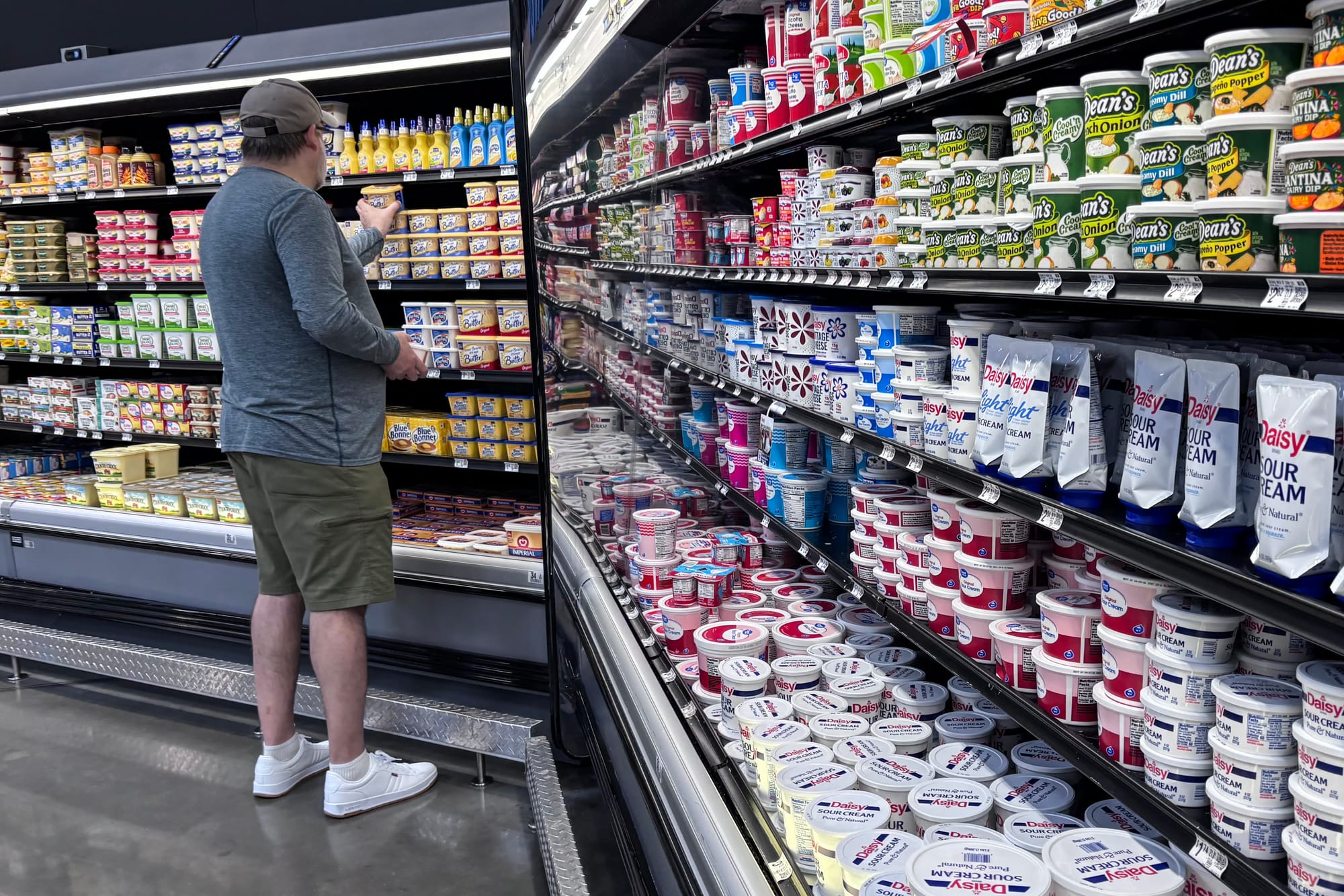
What happened. Buried in today's CPI report: real average hourly earnings fell 0.6% in March, as the 0.9% price surge swallowed the 0.2% gain in nominal wages. For the trailing twelve months, real earnings grew just 0.3% — the thinnest cushion in years. Americans' wages had been outpacing inflation for nearly three years; that streak effectively ended in March, per CNN. The University of Michigan's preliminary April consumer sentiment index, also released today, plunged to 47.6 — the lowest since February 1978 — signalling weaker household sentiment even while the labor market holds. Initial jobless claims rose to 219,000 (above the 210,000 expected), but continuing claims fell to 1.79 million, suggesting the job market is softening at the edges without cracking.
What changes. This is the stagflation signal in its most direct form: prices up, purchasing power down. Airlines are already responding — American, Delta, JetBlue, Southwest, and United have all raised checked baggage fees to offset fuel costs, per CNN's live coverage. United CEO Scott Kirby warned that certain routes will be eliminated in the next two quarters. Fewer routes means less competition on surviving routes, which means higher fares. The second-order inflation effects — airfares, shipping, food — haven't fully printed yet.
What failure looks like. If real wages stay negative through April and May, consumer spending could crack — and the 4.3% year-over-year card spending growth Bank of America reported for March could reverse. The leading indicator: the April retail sales report (due mid-May). If lower-income discretionary spending — already softening in BofA's card data — accelerates downward, the "resilient consumer" narrative breaks.
⚡ What Most People Missed
- Tariff pass-through is hiding inside the CPI. Toys jumped 2.3% in March — the largest monthly gain in nearly five years. Tools and hardware rose 1.4% in March, the most since October 2022. Vehicle servicing costs spiked 1.4% in March. These aren't energy categories. They're import-sensitive goods, and they suggest tariff costs are layering on top of the energy shock in ways the "just an oil story" read completely misses, per CNN.
- The yield curve is screaming what equities won't. The 2-year Treasury is trading in the mid-4.6% range while the 10-year sits near 4.32% as of this session — a classical inversion that says the bond market sees policy as too tight for growth. That spread is a growing constraint on the soft-landing narrative, and it's widening as rate-cut expectations evaporate.
- Consumer inflation expectations are spiking independently. The New York Fed's March 2026 Survey of Consumer Expectations showed one-year inflation expectations rising to 3.4%, with gasoline expectations at their highest since March 2022. When consumers expect higher prices, they change behavior — demanding higher wages, pulling forward purchases, reducing savings — which is a separate channel through which the energy shock can become self-reinforcing.
- Baker Hughes rig count rose by 5 to 548. The latest Baker Hughes rig count increased by 5 to 548 as of April 10, 2026. U.S. producers are still responding to price incentives rather than freezing activity. If sustained, that supply response could moderate future oil upside — a small but meaningful counterweight to the Hormuz risk premium.
- Delta's record $14.2 billion quarter is a template, not an exception. Delta reported $14.2 billion in revenue for the March quarter (Q1 2026), up nearly 10% year-over-year in the quarter, but fuel costs rose about 8% year-over-year and management flagged further increases ahead, per Delta's earnings release. Every fuel-intensive company reporting in the next three weeks will read from the same script: demand holding, margins compressing.
📅 What to Watch
- Islamabad summit readout (this weekend): If U.S.-Iran delegations signal a credible Strait reopening timeline, oil gaps could narrow and Monday could be a risk-on session; if talks stall, crude could re-test $100 and the ceasefire trade could unwind — with mortgage-rate and housing-market implications.
- PPI (Tuesday, 8:30 AM ET): If wholesale prices show energy costs bleeding into manufacturing margins, the Fed's "look-through" posture weakens and the market's last excuse for calm core inflation disappears.
- JPMorgan Chase Q1 earnings call (Tuesday, 8:30 AM ET): Jamie Dimon's commentary on consumer credit quality and loan demand will be a cleaner macro read than most economist forecasts — if charge-offs are rising in lower-income cohorts, the spending bifurcation is accelerating and bank balance-sheet stress could spread.
- FOMC blackout begins April 18: Any Fed speaker remarks between now and next Thursday carry outsized positioning impact — a single hawkish comment could materially reduce the roughly 15% probability of a September cut as of April 10, 2026.
- March PCE (April 30): If the Fed's preferred inflation gauge confirms the same "hot headline, tame core" split as today's CPI, the look-through posture survives; if core PCE surprises upward, the no-cut camp gains the upper hand.
The Closer
Gasoline prices posting their largest monthly spike since LBJ was president, a consumer sentiment reading last seen when disco was dying, and a ceasefire whose most visible achievement is a handful of nervous tankers inching through a strait Iran still controls.
Somewhere in the BLS building, a statistician typed "food: unchanged" and accidentally wrote the most reassuring sentence in American economics this month.
Have a weekend. Watch the Strait.
If someone you know is trying to figure out what today's CPI actually means for their portfolio, their mortgage, or their sanity — forward this.