The Lyceum: Macro & Markets Daily — Mar 22, 2026

Photo: lyceumnews.com
Sunday, March 22, 2026
The Big Picture
U.S. markets were closed today, but the war didn't take the weekend off. Trump gave Iran 48 hours to reopen the Strait of Hormuz or face strikes on its power grid — a deadline that expires Monday evening — and Iran responded by threatening to close the strait permanently and to target water desalination plants across the Gulf. Friday's confirmed closes already told the story of a market under siege: the S&P 500 closed down 1.5% on the session, the Russell 2000 closed down 2.3% on the session, the VIX closed up 11% on the session to nearly 27, and WTI crude closed at $98.32 on Friday and was climbing intraday. By Sunday afternoon, oil futures had breached $100 intraday. Monday's open will price a weekend's worth of escalation in a single gap.
Confirmed Closes — Friday, March 20, 2026:
S&P 500: 6,506.48 (−1.51% on the session) · Nasdaq: 21,647.61 (−2.01% on the session) · Dow: 45,577.47 (−0.96% on the session) · Russell 2000: 2,438.45 (−2.26% on the session) · VIX: 26.78 (+11.31% on the session) · 10-Year Treasury: 4.391% (+11 bps on the session) · WTI: $98.32 (+2.27% on the session) · Brent: $112.19 (Friday close) · Gold: $4,574.90 (−0.67% on the session) · DXY: 99.46 (+0.40% on the session)
Today's Stories
The 48-Hour Clock Is Running — and Iran Just Said No
What happened: President Trump issued a 48-hour ultimatum Saturday night — reopen the Strait of Hormuz or the U.S. would begin striking Iranian power plants. National Security Advisor Waltz confirmed Sunday that strikes would begin with "one of Iran's largest power plants" if the strait isn't reopened by Monday night. Iran's response was immediate and unambiguous: the strait would be "completely closed" if Trump follows through, and Tehran would target U.S. and Israeli energy, IT, and desalination infrastructure across the region. Reuters reported Iran warned of "irreversible" damage to Middle East infrastructure — a shift from threatening discrete facilities to threatening the region's plumbing.
What changes if this escalates: Roughly one-fifth of the world's oil transits the Strait of Hormuz. WTI crossed $100 intraday on Sunday; a sustained closure pushes crude well beyond that and forces energy rationing in Asia within weeks. U.S. retail gas hit $3.94 per gallon Sunday morning, per AAA — up more than a dollar in a month. Every ten-cent increase costs American consumers roughly $15 billion in annual spending power. The desalination threat is the underappreciated dimension: Saudi Arabia, the UAE, and Kuwait get the majority of their drinking water from these plants. Damaging them would trigger humanitarian crises in countries whose political cooperation Washington needs.
What to watch for: The deadline expires Monday evening. If it passes without resolution and strikes begin, watch whether Brent gaps above $120 and stays there — analysts put that as the level where the global economy shifts from "shock" to "rationing." If Trump quietly extends the deadline or signals flexibility, risk assets may find a floor. The 24-hour policy whipsaw — Trump floated ending the war without reopening the strait just one day before issuing the ultimatum — is its own risk factor, because it makes hedging harder when the range of outcomes widens this fast.
The C-Suite Has Its Own Deadline — and It's About Two Weeks
What happened: While Washington and Tehran trade threats, corporate executives are watching a different clock. On a CNBC CFO Council call, energy analyst John Kilduff of Again Capital told executives that traders see roughly a two-week window for resolution before oil prices spike dramatically higher and Asia begins rationing industrial activity. The math on rerouting is brutal: about 20 million barrels a day normally flow through Hormuz, and the Saudi East–West Pipeline can handle 1 to 1.5 million barrels at best. There is no pipe big enough to solve this.
What changes if the two-week clock runs out: Guidance withdrawals, capex freezes, and supply-chain restructuring — particularly from industrials, logistics, and companies with Asian exposure. The Trump administration has tried pressure-release valves: lifting some sanctions on Iranian oil at sea, suspending the Jones Act, temporarily easing Russian oil sanctions. None has moved the needle on Hormuz. Even if a deal materializes tomorrow, analysts expect an enhanced risk premium to remain embedded in oil prices because facilities across the Middle East are damaged and production restoration will take time.
The signal to watch: If earnings calls this week — even from mid-cap names like Carnival or Chewy — start citing energy costs and shipping uncertainty as reasons to pull or lower guidance, that's the corporate sector confirming what the bond market already suspects: the shock is durable, not transient.
The S&P's 200-Day Break Is Officially a Pattern, Not a Blip
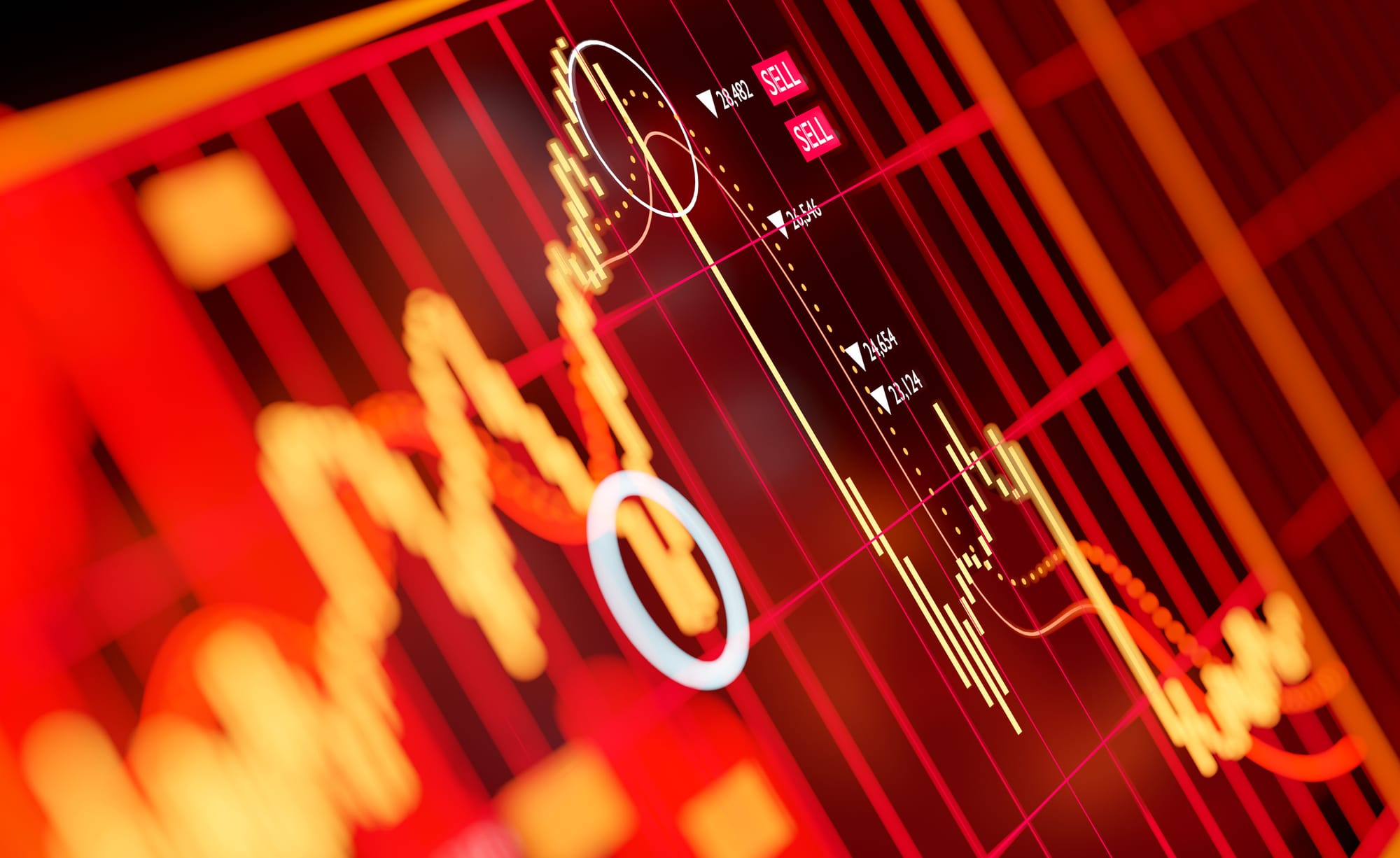
What happened: The S&P 500 has now declined four consecutive weeks and broke below its 200-day moving average — a technical level that institutional risk-management rules often use as an automatic trigger for de-risking. The index closed Friday at 6,506.48, roughly 6% below its January peak of 6,797. The Russell 2000's 2.3% drop on the session outpaced the S&P's 1.5% decline on the session, a quiet warning that credit-sensitive, domestically focused firms are feeling the squeeze from both higher oil and a Fed that held rates steady at 3.5%–3.75% with several officials penciling in zero cuts this year.
What changes if the pattern holds: Historical data shows the average S&P decline following a 200-day breakdown is about 17% from peak — which would imply a move to roughly 5,642, another 13% below Friday's close. That's not a prediction, but it's the number institutional models are running. The 200-day break matters mechanically because it triggers systematic selling from trend-following funds, which can create self-reinforcing downward pressure. Meanwhile, the bond market is pricing stagflation: the 10-year yield hit 4.39% on Friday, its highest since July 2025, amid energy-driven inflation repricing rather than growth optimism.
The signal: Watch the 6,492–6,512 zone on the S&P at Monday's open — that's where the 23.6% Fibonacci retracement, the November swing low, and the October low-day close all converge. A gap-down below it on escalation news would be technically significant. If the VIX breaks above 30 — it closed Friday at 26.78 — that's the threshold where forced selling and disorderly flows historically accelerate.
⚡ What Most People Missed
- War-risk insurance and tanker charters aren't pricing a prolonged Hormuz closure yet. A sustained spike in war-risk premiums could force tankers to reroute around Africa, adding weeks to delivery times and sharply raising freight costs for refined products into Asia — an added channel that would amplify supply shortages beyond crude barrels alone.
- The "TACO trade" — Trump Always Chickens Out — is losing believers. Wall Street's old reflex of buying every geopolitical dip on the assumption that political self-preservation will force a reversal is being stress-tested by a war that policy reversals can't simply unwind. If investors stop assuming shocks are time-limited, risk premia rise structurally — and that's a regime change, not a dip.
- Retail macro forums are circulating Fed funds futures showing a material probability of a July rate hike (as of March 22, 2026). That's crowd-sourced sentiment, not confirmed policy — but it's already shifting short-horizon positioning out of long-duration tech and speculative growth. When the marginal liquidity dries up in those names, single-stock moves become market moves.
📅 What to Watch
- If oil futures gap above $105 WTI at Sunday's 6 PM ET open and Brent, gold, and the dollar all break higher together in Monday's first hour, equity dip-buying will be brief and selective — that triad moving in unison signals a risk-off regime, not a tradable pullback.
- If Trump's deadline passes Monday evening without strikes or a visible extension, the market will treat the silence as escalation — Iran has already declared it would close the strait permanently, so the absence of resolution is itself a negative catalyst.
- If the S&P gaps below 6,492 at Monday's open, systematic trend-following funds hit their de-risking triggers, and the next meaningful support is considerably lower — watch whether the VIX simultaneously breaks 30, which historically marks the transition from anxiety to forced selling.
- Flash PMIs land Monday at 9:45 AM ET — a services miss with gas at $3.94 and rising would confirm what the bond market is whispering about stagflation, and could pull rate-cut expectations off the table entirely for 2026.
- Thursday's initial jobless claims (8:30 AM ET) are the week's sleeper — a surprise jump would be the first hard evidence that the oil shock is hitting the labor market, and would force the "no cuts vs. maybe hike" debate into a completely different frame.
The Closer
A president threatening to bomb power plants by Monday night, a bond market pricing inflation that hasn't hit the data yet, and reports of strikes on Russian refining facilities deep behind the front lines.
Somewhere in the Gulf, a desalination plant operator just became the most strategically important person nobody in markets has heard of.
Eyes open Monday. Hands steady.
If someone you know trades, invests, or just wants to understand what's actually happening — forward this.