The Lyceum: Macro & Markets Daily — Mar 27, 2026

Photo: lyceumnews.com
Friday, March 27, 2026
The Big Picture
The White House extended its Iran deadline by ten days, and markets sold off amid the extension. Brent crude closed at its highest level since Russia's invasion of Ukraine, the Dow joined the Nasdaq in correction territory, and — for the first time this cycle — futures markets are pricing a Fed rate hike as more likely than a cut as of Friday morning. This is no longer a week where things might get complicated. They are complicated.
Today's Stories
The Deadline Extension That Made Everything Worse
What happened. President Trump extended his ultimatum to Iran — reopen the Strait of Hormuz or face strikes on power infrastructure — by ten days to April 6, posting on Truth Social, according to CNBC, saying: "I am pausing the period of Energy Plant destruction by 10 Days to Monday, April 6, 2026." In a normal crisis, that buys relief. Instead, Brent crude surged 4.2% on the session to $112.57 at session highs, and WTI jumped 5.5% on the session to $99.64 at session highs — both their highest since July 2022. Iran turned back two China-owned container vessels from the Strait in an unusual escalation, since Tehran's blockade had previously targeted only countries it considers supporters of Israel and the U.S., according to the Wall Street Journal via TheStreet's live coverage. Energy research firm Rystad warned the global system has shifted from "buffered to fragile," with nearly 17.8 million barrels per day of flows disrupted and close to 500 million barrels of total liquids lost since the crisis began.
What changes if this gets worse. The China detail is the buried lead. Beijing has been the implicit backstop for Iranian oil exports throughout this crisis — if Iran is now willing to block Chinese shipping, that assumption breaks, and the case for a contained oil shock collapses. Iran's formal reply to the U.S. 15-point plan included demands for war reparations and recognition of Tehran's "sovereignty" over the Strait, according to Euronews — conditions so far beyond the American proposal that the gap between the two sides may actually be widening. Meanwhile, Lloyd's List reports a trickle of ships paying what amounts to a "Tehran toll" to transit near Larak Island — the Strait is simultaneously "open" and "closed," which is worse for insurance and shipping markets than a clean blockade.
What to watch. April 6 is now the most important date on every macro calendar. If it passes without a deal, Brent could test $115–120 in the days after April 6. The observable signal before then is whether any additional Chinese vessels attempt transit; if they don't, the market will price in a longer, broader disruption.
The Rate Hike Nobody Wanted to Think About Just Became the Base Case
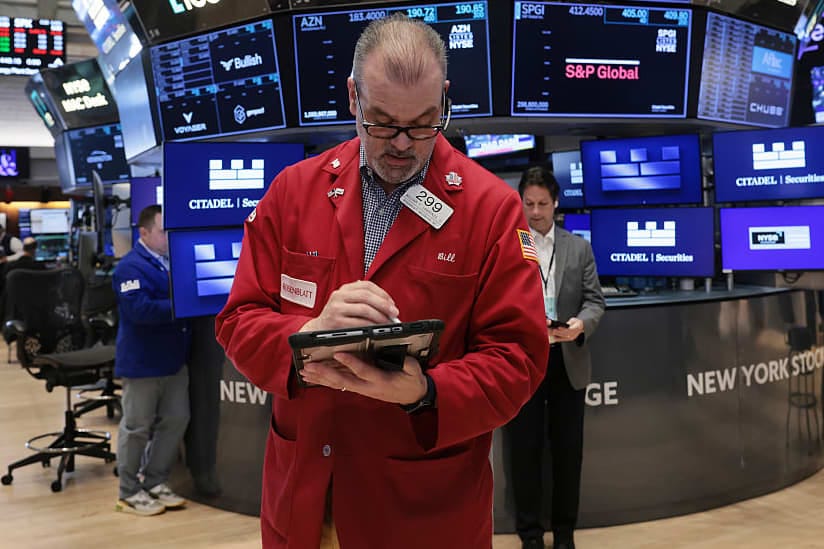
What happened. For the first time this cycle, futures traders pushed the probability of a Fed rate increase by year-end to 52% on Friday morning, crossing the 50% threshold as crude topped $110. The Fed held rates at 3.5%–3.75% at its March 18 meeting — the second consecutive hold — with the dot plot still projecting one rate cut in 2026. Fed Governor Michael Barr warned explicitly about the risk of inflation persistence from oil-driven shocks — the clearest signal yet from a sitting policymaker that stickier inflation is on the institutional radar.
What changes if this sticks. This is the stagflation scenario nobody wants to say out loud: oil above $100 into Q2, inflation re-accelerating, and the Fed squeezed between a softening economy and rising prices. The University of Michigan's final March consumer sentiment index printed at 53.3, missing the 54.0 consensus (March 2026 survey), with the inflation expectations component moving in the wrong direction for weeks — confirming that the war-to-oil-to-consumer-psychology feedback loop is now in the data, not just in commodity prices. TD Securities argues the Fed will "look through the energy shock" so long as longer-term expectations stay anchored, but that anchor is visibly slipping.
What to watch. The New York Fed Desk quietly confirmed stepped-up Treasury bill purchases at roughly $40 billion monthly — a liquidity backstop that suggests the plumbing is being reinforced even as the policy stance tightens. The next inflection point is PCE inflation data and Fed speakers next week. If PCE surprises above 2.7%, rate-hike pricing hardens fast.
Google Taught an AI to Need Less Memory — and Split the Chip Trade in Half
What happened. Google's TurboQuant algorithm compresses the key-value cache that large language models use to track context down to three bits without retraining, claiming a sixfold reduction in memory size and up to eight times faster performance on some hardware. Micron plunged roughly 7% on the session on the initial headlines; SanDisk and Western Digital saw steep declines. By Friday, a split emerged: Samsung and SK Hynix — makers of high-bandwidth memory (HBM) used in Nvidia's AI accelerators — recovered most of their losses, while flash memory names kept falling. According to Bloomberg, the selloff exposed a divide between memory types that the market hadn't previously priced.
What changes if this scales. Here's the nuance the initial panic missed: Google's claimed 6x improvement is a theoretical maximum based on 32-bit calculations. Since 70–80% of actual AI inference already uses 8-bit precision, the real-world memory reduction is approximately 2.6x, according to analyst coverage in the Seoul Economic Daily. That's meaningful but not existential for the memory buildout thesis. The open-source release is expected in Q2, likely timed around the paper's formal presentation at ICLR 2026 in late April. Until production benchmarks exist, the selloff is pricing a demo, not a deployment. [Source: Seoul Economic Daily — Korean]
What to watch. Micron has near-term commentary windows early next week. If management reaffirms AI memory demand guidance, HBM names stabilize and flash stays under pressure — confirming the market's new two-tier thesis. If Micron hedges, the repricing broadens. The ICLR presentation in late April is when this debate gets real benchmarks.
⚡ What Most People Missed
- Iran-linked hackers breached FBI Director Kash Patel's personal email and published photos, a resume, and documents, according to Reuters. The DOJ confirmed the breach and said the material appears authentic. This personalizes the shadow war and raises the political cost of any rapid de-escalation — markets read it as confirmation the diplomatic track is weak.
- The average Nasdaq stock has drawn down 31% from its highs while the index is down about 10% from its highs. Schwab's market update flagged this divergence: the S&P 500's maximum drawdown from highs is 7%, but its average member has seen 17% from its highs. The headline numbers are flattering a much uglier reality underneath, and systematic strategies that trigger on index-level correction thresholds are now amplifying selling in crowded names.
- Sony raised the PS5 price to $649.99 — up roughly $100 — effective April 2, citing "continued pressures in the global economic landscape," per GameSpot. Sony's move is a real-time data point on cost pass-through that the Fed is trying to decide whether to "look through."
- Banking regulators are quietly reshaping resilience rules during a crisis. New Basel III and GSIB surcharge proposals dropped this week alongside a rare Section 23A exemption for Morgan Stanley's Frankfurt affiliate — signals that large banks are testing cross-border mechanics while Governor Barr publicly warns that loosening buffers now increases systemic vulnerability.
- Bitcoin is holding around $66,000 while equities crater, and the Kansas City Fed granted Kraken a limited-purpose master account this week, giving Kraken closer-to-direct access to Fed services. If the decorrelation persists and the plumbing improves, institutions may start treating Bitcoin less like a leveraged Nasdaq proxy and more like a high-beta inflation hedge.
📅 What to Watch
- If PCE inflation (Tuesday, March 31) prints above 2.7%, the rate-hike probability jumps from coin-flip to consensus and forces Fed speakers into explicitly hawkish language — removing what remains of the 2026 easing narrative.
- If Nike earnings (Tuesday after close) show demand destruction in discretionary spending, it confirms the oil-price squeeze is reaching consumers faster than GDP models assume — and puts every consumer-facing Q1 guide at risk.
- If no Chinese vessels attempt Strait of Hormuz transit before April 6, the market loses its last containment thesis for the oil shock and Brent could test $120 in the days after April 6.
- If ISM Manufacturing (Monday) new orders drop below 47, recession chatter intensifies and small caps face another leg down — watch the Russell 2000's 2,400 level as a trapdoor.
- If Micron's management reaffirms AI memory demand guidance early next week, the Google TurboQuant selloff stays contained to flash memory; if they hedge, the repricing broadens across the entire semiconductor complex.
The Closer
A diplomat's deadline that raised oil prices, a consumer sentiment survey that confirmed what gas station receipts already told you, and a Google algorithm that taught Wall Street the difference between the memory chips that matter and the ones that don't. Sony raised the PS5 price to $649.99, effective April 2, citing "the global economic landscape" — corporate shorthand for passing on cost pressures to consumers. Stay sharp out there.
If someone you know is navigating this mess without a daily read, forward this their way.