The Lyceum: Macro & Markets Daily — Mar 30, 2026

Photo: lyceumnews.com
Monday, March 30, 2026
The Big Picture
Jerome Powell walked into a Harvard economics classroom today and, in about forty minutes, dismantled a rate-hike trade that had consumed bond markets for the better part of two weeks — hike odds collapsed from above 50% to roughly 2% by the close. The S&P 500 still finished lower at 6,343.72 (−0.39% on the session), dragged by a Micron-led tech rout, while the Nasdaq dropped 0.73% on the session to 20,794.64; the Dow closed up 0.11% on the session to 45,216.14, carried by energy and utilities. The 10-year Treasury yield fell roughly 10 basis points on the session to around 4.33% on Powell's dovish signal, but the thing that refuses to cooperate with any relief narrative is oil: WTI settled up 3.25% on the session at $102.88 — its highest close since July 2022 — while Brent settled at $112.78, on pace for the largest monthly surge in the contract's 38-year history. Powell says look through it. Oil says make me.
Today's Stories
Powell Walks Into a Classroom and Reprices the Entire Rate Market
For two weeks, bond traders had been doing something remarkable: betting the Fed would raise rates in response to the Iran war's oil shock — a full reversal from the three cuts delivered last year. Today, Powell ended that debate. Speaking at Harvard, he said inflation expectations remain anchored, the central bank doesn't need to hike, and monetary policy operates with lags long enough that "by the time the effects of a tightening takes effect, the oil price shock is probably long gone," per CNN's account. The Wall Street Journal characterized the posture as explicit "wait and see."
What changes if Powell holds this line: Treasury yields stay capped on the session, which relieves the pressure valve on equity multiples and corporate borrowing costs — banks and utilities rallied immediately on the remarks.
What breaks it: longer-run inflation expectations. Powell was precise about the tripwire: "a critical, essential aspect is you have to carefully monitor inflation expectations." Consumer sentiment has already dropped 6% this month, per the March 2026 University of Michigan survey. Near-term expectations are elevated; the five-year forwards the Fed watches most are still in range — for now. The March PCE print, due later this week, is the first reading that captures gasoline's climb toward $4 per gallon nationally as of late March 2026. If that number is ugly and the University of Michigan's longer-run expectations tick up in the next survey, Powell's "look through" framework gets tested immediately. Watch the April 6 Trump deadline on Iranian energy infrastructure for the geopolitical accelerant.
Oil's Record March — and the 6 Million Barrels Nobody Can Find
Brent has surged roughly 55% in March — a record for the contract dating back to 1988, surpassing even the Gulf War. WTI is up 48% for the month. The Angle 360 commodity desk estimates the conflict has removed nearly 9 million barrels per day from global supply. Treasury Secretary Scott Bessent acknowledged the gap on Fox News, saying the market is "in deficit about 10 to 12 million barrels a day" with the IEA's coordinated strategic reserve release covering roughly 4 million of that. Four hundred million barrels have been released from emergency reserves. Oil is still at $112.
What changes if the deficit persists: the remaining 6–8 million barrel daily gap flows directly into gasoline prices (already around $4 per gallon nationally as of late March 2026), freight costs, and eventually core inflation — the channel that would force Powell off his "look through" stance. For energy-importing economies like Japan and South Korea, it's already a balance-of-payments event; for net exporters, it's a windfall that reshapes fiscal math overnight.
What to watch for resolution — or escalation: the Baker Hughes rig count stalled at 409 on the week, the first flat reading since mid-February, suggesting U.S. drillers are pausing rather than chasing upside — a supply response that isn't coming. The April 6 expiration of former President Trump's pause on striking Iranian energy infrastructure is the binary event. Trump told the Financial Times his "preference would be to take the oil," referencing Kharg Island, which handles roughly 90% of Iran's crude exports. A strike there would be a categorically different military action — one that permanently removes Iranian barrels, not just throttles them. The comment was a preference, not a policy. Markets haven't priced the tail.
Micron's 30% Wipeout in Eight Sessions — and the Google Paper Behind It
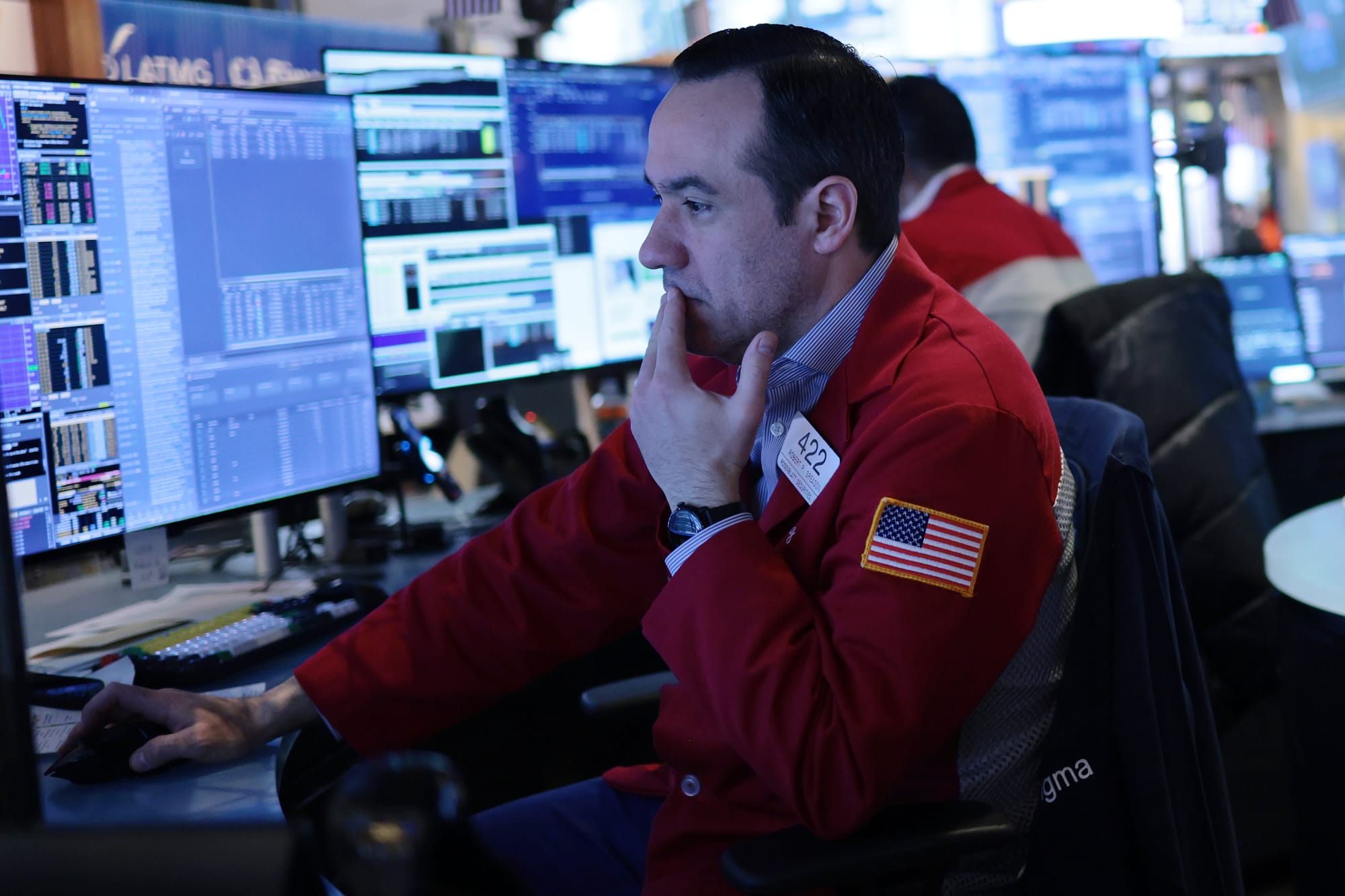
A month ago Micron was up more than 60% year-to-date, riding AI-driven memory demand the company called extraordinary. Today it fell another 10% on the session, barely positive for the year, down over 30% in eight sessions. SanDisk and Western Digital each dropped more than 9% on the session. The catalyst: Google published research suggesting AI models could be made far more compute-efficient, potentially compressing the memory-per-workload ratio that underpinned Micron's entire bull thesis.
What changes if Google's architecture insight scales: the memory shortage narrative of early 2026 gets reframed as a build-ahead cycle, not a structural deficit. Capex plans across the semiconductor stack get revisited. Memory pricing power — the thing that made Micron's blowout earnings possible — erodes faster than anyone modeled.
What failure looks like: Google's paper turns out to describe a narrow optimization that doesn't generalize across production workloads, and the selloff becomes the best entry point of the year. The observable signal is Micron management's response — any updated guidance, customer commentary, or technical rebuttal in the next few trading days will tell you whether this is a thesis-ending shift or a crowded-trade unwind dressed up as fundamental news. Meanwhile, the Schwab market update notes the average Nasdaq member has drawn down 31% from recent highs as of the Schwab update — the index is a Potemkin village held up by energy and defensives while broad tech carnage accelerates underneath.
⚡ What Most People Missed
- Spain closed its airspace to U.S. military aircraft involved in the Iran campaign — the first NATO-member airspace ban on a U.S. operation mid-conflict, going further than France or Germany did during Iraq in 2003. Defence Minister Margarita Robles confirmed the closure on Monday, March 30, 2026. Forbes reports the rerouting adds real logistics costs and response-time delays. This hasn't hit asset prices yet, but if other European allies follow, it lengthens the war timeline — and the oil shock with it.
- Japan's 10-year JGB yield reached 2.39% on the session, its highest in 34 years, after the Bank of Japan flagged further rate hikes and unveiled a new core inflation gauge above 2%. The last big buyer of foreign risk assets is getting a risk-free alternative at home — a feedback loop that adds upward pressure to global long-term yields and compresses growth multiples everywhere.
- The SOFR-OIS spread widened 12 basis points on the session to 28 basis points — the widest since January's mini-stress, per Fed funding data. Spreads above 25bps have historically preceded more acute liquidity pressure. Not a crisis, but the funding market is whispering while equities shout.
- Powell also flagged private credit as a growing concern, saying he's watching the sector "super carefully." The next transparency event is June 30, when business development companies file semiannual reports and must mark holdings to fair value — the first real window into losses across portfolios with heavy mid-market industrial and logistics exposure, per Techi's account. That filing date will be the first concrete set of marks to test whether private-credit valuations hold.
- The Dallas Fed manufacturing survey (March 2026) showed Texas factories stalling at −0.2, with the outlook uncertainty component spiking to its highest since spring 2025. Higher oil is acting more like a tax than a stimulus for parts of the industrial economy — exactly the stagflation-lite rhythm that complicates every policy decision ahead.
📅 What to Watch
- If Tuesday's Consumer Confidence (10:00am ET) drops sharply, it validates the sentiment channel Powell is most worried about — and would increase the odds that markets reprice the Fed's reaction function ahead of the March PCE print later this week, making that release a tactical inflection for front-end rates and short-duration corporate credit.
- If Wednesday's ISM Manufacturing PMI (10:00am ET) prints below 50, it's the first hard evidence the oil shock is contracting real activity, not just lifting prices — expect downward revisions to manufacturing GDP contributions and hit to industrial earnings forecasts over the next two quarters.
- If Friday's nonfarm payrolls (8:30am ET) disappoint into a closed market (Good Friday), the gap risk for Monday, April 6 is substantial — that is also the day the pause on striking Iranian energy infrastructure expires, creating a rare double catalyst into a long weekend.
- If SOFR-OIS spreads push above 35 basis points this week, short-term funding costs for banks and leveraged lenders will likely reprice, forcing money market and prime funds to widen spreads and tightening roll-over financing for leveraged credit structures.
- If any second NATO ally follows Spain's airspace ban, markets will have to materially reprice the expected duration of Iranian export outages and the diplomatic isolation premium — lifting term premia in oil, increasing hedging costs for airlines, and repricing risk across defense contractors.
The Closer
A Fed chair killing a rate-hike trade from a lecture hall, 400 million barrels of emergency oil released into a market that shrugged and kept climbing, and a NATO ally slamming its airspace shut on the world's largest military mid-sortie. Powell says the oil shock is transitory; Brent crude, up 55% this month, would like a word with his teaching assistant. Stay sharp.
If someone you know is navigating this market without a daily read, forward this their way.