The Lyceum: Macro & Markets Weekly — Apr 02, 2026

Photo: lyceumnews.com
Week of April 2, 2026
The Big Picture
The week's best day in equities — a 2.9% S&P 500 surge on Tuesday's session — was built on a rumor about a phone call that may not have happened, and by Thursday the gains were leaking away. That tells you everything about where we are: the Strait of Hormuz is still functionally closed, Iran is trying to turn it into a permanent toll booth, Powell told a Harvard lecture hall the Fed would wait and see until the picture clears, and the April 6 deadline for U.S. strikes on Iranian power infrastructure expires on Monday evening, April 6, 2026. The macro environment isn't deteriorating in a straight line — it's oscillating between hope trades and hard data, and the hard data is winning.
What Just Shipped
- ISM Manufacturing PMI — March 2026 (Institute for Supply Management): Headline reading snapped back to 52.7, the strongest expansion signal in months — though input-cost subindices surged alongside it.
- China NBS Manufacturing PMI — March 2026 (National Bureau of Statistics of China): Official PMI crossed back above 50, signaling modest expansion, with input prices at a two-year high.
- South Korea Trade Data — March 2026 (Korea Customs Service): Record $86 billion in monthly exports, semiconductor shipments up ~151% year-over-year.
- China–Pakistan Five-Point Peace Initiative (FMPRC): Joint diplomatic framework calling for immediate ceasefire and Strait of Hormuz reopening mechanisms — the first non-Western peace proposal with institutional backing.
- Chicago PMI — March 2026 (MNI/ISM-Chicago): Plunged to 45.4, signaling sharp Midwest industrial contraction even as the national ISM expanded.
This Week's Stories
Iran's Hormuz Playbook: From Blockade to Toll Booth
What happened. Iran stopped negotiating about whether to reopen the Strait of Hormuz and started negotiating about how much to charge. The head of Iran's Supreme National Security Council said the strait will eventually reopen "but not for Trump," while Iranian officials floated a fee system they estimate could generate $70–80 billion annually — at least a 10% levy on each transiting vessel. CNN reported that ship-tracking data already shows some tankers using a route closer to Iran's coast, with reports that certain operators may have paid for safe passage. Iranian state media reported that Parliament is moving to formalize these fees into law.
What changes if this sticks. A codified toll regime doesn't vanish with a ceasefire — it becomes a permanent structural cost on global energy trade. At a reported $2 million per tanker, that's roughly $600 million a month from oil alone, rising past $800 million if LNG is included. Senator Marco Rubio called it "illegal, unacceptable, and dangerous to the world," but the legal framework is being built while diplomats draft joint statements. For every energy-intensive business — airlines, chemicals, agriculture, logistics — this is a scenario that belongs in planning models now, not after a deal is signed.
What failure looks like. If the toll system gets rejected by enough major shipping nations and naval coalitions form to guarantee free passage, the premium collapses. The tell: watch tanker insurance rates and whether the London summit of 35 nations produces anything beyond a communiqué. Joint statements don't move tankers. Military escort commitments do.
Meanwhile, the physical damage continues. A Defense Intelligence Agency assessment estimated Iran could keep the passage shut for one to six months. Analysts warn that stopgap measures keeping prices from going vertical lose effectiveness in early-to-mid April. The April 6 deadline — when the authorization for U.S. strikes on Iranian power infrastructure expires on Monday evening, April 6, 2026 — is the forcing function. If it passes without a deal or another extension, the market's ceasefire-optimism trade could unwind in a single news cycle.
Powell at Harvard: The Fed Won't Move, and the Debt Path Is the Bigger Problem

What happened. Jerome Powell spent Monday, March 30, 2026, in a Harvard lecture hall and delivered the clearest articulation yet of where the Fed stands: nowhere. The Fed will take a "wait-and-see" approach to the Iran war's economic impact, and Powell said the Fed historically hasn't reacted to energy supply shocks because they are often short-lived; he said the committee will monitor inflation expectations "very, very carefully" before adjusting policy. He expressed confidence in the financial system's "resilience" while singling out private credit — the roughly $2 trillion market of direct lending that bypasses public bonds — as something the Fed is watching "super carefully."
Markets read this as taking rate hikes off the table. Futures pricing that had recently built a meaningful chance of a 2026 hike reset sharply lower after the speech, with the near-term window centering on a long hold. The FedWatch snapshot showed April hike probability collapsing toward zero.
What changes if this posture holds. The Fed's "wait and see" is now the base case through at least mid-year. Anyone hoping the oil shock forces a pivot to cuts is misreading the room — Powell is more worried about inflation expectations becoming unanchored than about growth slowing. For companies with floating-rate debt, 2026 refinancing needs, or capex plans that assumed a declining rate environment: the window you were waiting for is not opening on the timeline you modeled.
The fiscal warning matters more than the rate signal. Powell said the $39 trillion debt isn't the real problem — it's that Congress's current spending path is "not sustainable," warning: "It will not end well if we don't do something fairly soon." That's a signal that the long end of the Treasury curve has a structural problem no ceasefire solves. He also defended Fed independence without commenting on Trump's nominee for Fed Chair, Kevin Warsh — whose confirmation before Powell's term ends in May would introduce a new communication regime at the worst possible moment for rate-path clarity.
The Rally That Wasn't: $1.7 Trillion on a Rumor
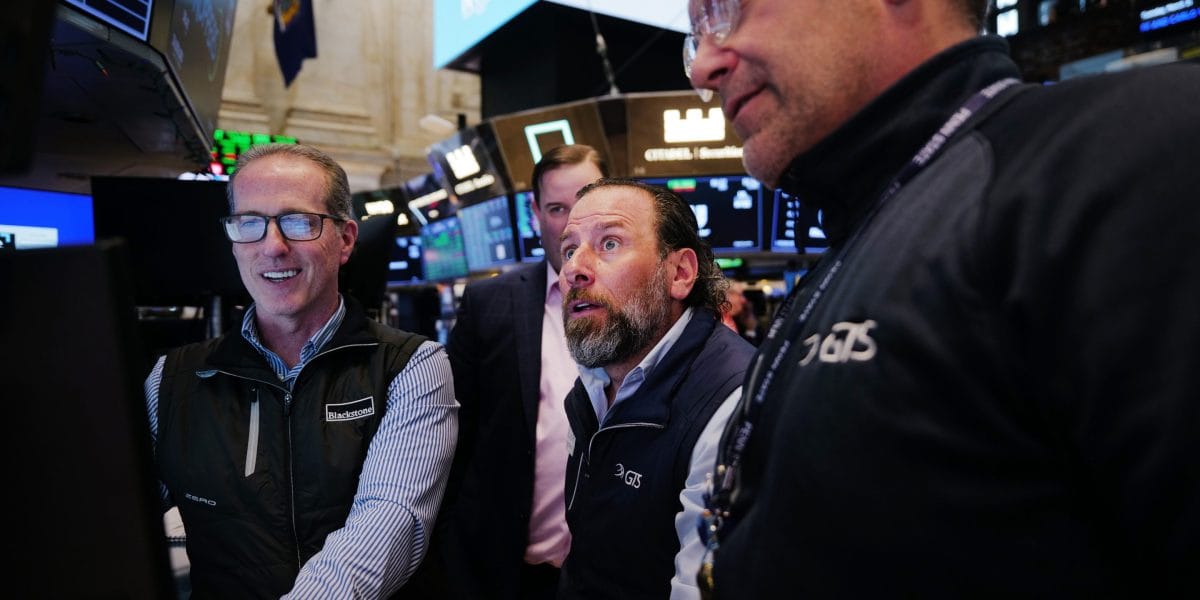
What happened. Tuesday's 2.9% S&P 500 surge on the session — the best day since last spring — was triggered by Iran's official news agency reporting an unconfirmed phone call where Iran's president expressed "necessary will" to end the war. The S&P recovered roughly $1.7 trillion in market cap on the session. The Nasdaq snapped back 795 points on the session. Wednesday brought a similar mechanics: the Dow surged over 1,100 points on the session on the China–Pakistan five-point proposal. By Thursday, the gains were fading.
Why it matters. This is now the defining feature of equity market structure: violent, positioning-driven moves on headlines, with no follow-through. The pattern is classic short-covering — panicked bears closing bets fast, creating upside that doesn't reflect durable conviction. March closed as the worst month since 2022 for major indices, with roughly three-quarters of stocks trading below their 200-day moving average. The VIX term structure remains in backwardation (near-term fear priced higher than longer-term), which historically signals the market hasn't found a floor. The IPO window is effectively closed.
Capital Economics captured the structural problem: "De-escalation hopes have given markets a lift, but we think the effects of the war would, in many cases, persist even if the war did end soon."
What to watch. Whether the S&P holds above its 200-day moving average. A break below signals the positioning-driven bounce has exhausted itself. And watch ETF flows: recent data from ETF Channel shows heavy outflows from broad U.S. equity trackers even as selective Asia and cash-like ETFs attracted funds — allocators are de-risking, not buying a recovery.
The Bond Market Is Pricing Stagflation, Not Recession
What happened. In a normal shock, bonds rally when stocks sell off — investors flee to safety, yields fall. That's not what's happening. The 10-year Treasury yield was 3.97% in late February and rose as high as 4.44% intraday before settling around 4.32% midweek — a half-point rise driven by inflation fears, not growth optimism. Bonds and stocks sold off simultaneously.
What this means in plain English. The yield curve (the gap between short-term and long-term government borrowing rates) is steepening — but not because the economy looks good. It's steepening because the long end is selling off on inflation fears while the short end stays anchored by a Fed that won't move. That's a stagflationary steepening — the worst configuration for corporate borrowers, because both short-term funding costs and long-term capital costs rise at the same time.
Credit markets are starting to differentiate. High-yield spreads — the extra yield investors demand to hold riskier corporate debt instead of safe Treasuries — have drifted from roughly 2.83% at the start of the year toward about 3.17% by late March. That's not a crisis, but it's a meaningful tilt away from cycle lows and a sign investors are pricing incremental default risk. Investment-grade credit remains relatively calm, which is the classic early pattern: quality holds while the riskier tiers start to leak.
The signal for corporate treasurers. If you have floating-rate debt, refinancing needs in 2026, or capex plans built on a declining-rate assumption, the bond market is telling you that window isn't opening. Term out while you can. The Morgan Stanley 1% Move Report underscores the equity-credit disconnect — when stocks and bonds tell different stories, credit has historically been the smarter room.
Manufacturing Snaps Back — Into an Energy Buzzsaw
What happened. The ISM Manufacturing PMI jumped to 52.7 in March — the strongest expansion reading in months — with new orders, production, and backlogs all improving. If you only read war headlines, you'd assume U.S. factories were rolling over. They're not. But the national strength masks a brutal regional divergence: the Chicago PMI plunged to 45.4, signaling sharp contraction in Midwest auto and machinery clusters — exactly the regions where energy and logistics costs bite hardest.
What changes. Stronger manufacturing activity colliding with an energy shock squeezes margins: more output, but meaningfully higher input and freight costs. Diesel — the fuel of freight and delivery — is now at $5.45 per gallon nationally as of late March 2026, up from about $3.76 before the war, according to the Washington Times' five-chart roundup. That's not just an energy story — it's a logistics cost story, a manufacturing input story, and a consumer price story simultaneously.
The international picture reinforces the squeeze. South Korea printed record exports of $86 billion in March, with semiconductor shipments up ~151% year-over-year — a sign AI-driven demand is real and pulling shipping and input costs higher. China's manufacturing PMI crossed back above 50 on pricier inputs. A synchronized upturn in Asian manufacturing and U.S. factory output, arriving alongside an energy shock, is the exact combination that feeds producer-price pressure within a quarter.
The planning takeaway. For industrial CFOs: expect volume upside in some sectors, but build scenario tables where margin erosion from energy and freight materially offsets revenue gains. The national ISM number is not your planning number if your operations sit in the Midwest.
⚡ What Most People Missed
- The paper oil price and the physical oil price have diverged by 50+ percentage points. Brent futures are up 36% since the war began, but the Dubai physical price — which tracks actual delivery — is up 76%. The gap exists because ceasefire rhetoric keeps suppressing futures while tankers remain unable to move. Supply chain and procurement teams pricing off Brent futures are using the wrong number. When the gap closes — and it will — it closes violently.
- Powell's private-credit call raises a different transmission risk. Powell singled out the roughly $2 trillion private credit market in his Harvard remarks; that focus increases the prospect that stress in sponsor financing, warehouse lines, or related bank exposures could transmit to banks and CLOs if rates stay high, tightening funding available to leveraged buyouts and mid-market firms.
- Rate-hike odds quietly round-tripped in a single week. Futures briefly priced over 50% odds of a 2026 hike in late March 2026; Powell's Harvard remarks collapsed those odds back toward a long hold. The speed of the reversal tells you positioning is fragile and headline-driven, not anchored in conviction about the rate path.
- Recession odds are drifting up, not spiking — and that's the dangerous kind. Several macro shops now peg U.S. recession probability around 37% (as of late March 2026), up from the mid-20s pre-war. A slow drift encourages capex deferrals and hiring freezes rather than immediate cuts — the kind of corporate caution that becomes self-fulfilling.
📅 What to Watch
- If the April 6 deadline passes without a deal or extension, expect oil to reprice sharply higher and the ceasefire-optimism trade to unwind — the second-order effect is that credit spreads will widen, pressuring bank funding and corporate borrowing costs.
- If March nonfarm payrolls (Friday) come in below 100K, the "frozen jobs market" narrative gets data confirmation — watch average hourly earnings as much as the headline, because rising wages alongside falling hires is the stagflation signature.
- If mid-April CPI prints above 3.0% year-over-year, it's the first reading to fully capture the oil shock's pass-through and would materially reprice the rate path before the April 29 FOMC meeting — testing Powell's "transitory supply shock" framing in real time.
- If the London Hormuz summit produces military escort commitments rather than just a joint statement, tanker insurance rates will be the first signal that physical reopening is credible — without escorts, the summit is theater.
- If high-yield primary deals get pulled or repriced wider this month, it's the early warning that funding stress is migrating from equities into credit — the sequence that forces corporate treasurers to act.
The Closer
Iran building a toll booth on the world's most important waterway, Powell telling Harvard undergrads the national debt won't end well, and $1.7 trillion in market cap materializing from a phone call that may not have happened — that's your week in three frames.
The bond market is pricing stagflation, the equity market is pricing hope, and somewhere in between, a diesel truck driver is paying $5.45 a gallon to deliver the goods that make both of those bets possible.
See you next week. ✌️
If someone you know is modeling H2 costs, refinancing debt, or just trying to figure out what's real — forward this their way.
From the Lyceum
A Los Angeles jury found Meta and YouTube liable in a bellwether social media addiction trial, turning "design defect" into a litigation playbook with balance-sheet implications for every platform. Read → The "Design Defect" Theory for Social Media Just Became a Litigation Playbook