The Lyceum: Macro & Markets Weekly — Mar 22, 2026

Photo: lyceumnews.com
Week of March 22, 2026
The Big Picture
Three central banks held rates this week, oil is above $110 intraday, and a gas most people associate with birthday parties is quietly threatening to gate the entire AI chip buildout. The Iran war has moved from geopolitical risk to base-case macro assumption — and every institution that sets the price of money admits it has no idea how long this lasts.
This Week's Stories
The Fed Held — But the Dot Plot Just Told You When Rates Are Coming Down
The Federal Reserve voted 11-1 to hold its benchmark rate at 3.5%–3.75%, and nobody flinched. The story is what the committee wrote underneath.
The dot plot — each official's individual rate forecast — still points to one cut this year and another in 2027. But the projections beneath it shifted: both PCE and core PCE inflation expectations rose to 2.7% for 2026, up from December's 2.4%–2.5%. The Fed simultaneously raised its GDP forecast — an unusual pairing that amounts to a bet the oil shock is transitory. The median path now implies an effective funds rate around 3.4% by year-end 2026 and 3.1% by end-2027, materially fewer cuts than markets had priced in January.
Powell said the quiet part: "It is a one-time increase in the price of a good. People say the same thing traditionally about an energy-price spike." But he hedged immediately: "The forecast is conditional on the performance of the economy, so if we don't see that progress, then you won't see the rate cut." Markets are pricing one 25bp cut in December 2026 as of March 19, 2026 — agreement with the Fed, for now.
What changes if the "transitory" call is right: the first cut arrives in Q4, mortgage rates drift lower, and the housing and credit markets exhale. What changes if it's wrong: core inflation stays sticky above 2.5%, the cut gets pushed to 2027, and every rate-sensitive business plan written this year needs revision. The signal to watch: April's PCE print. If core PCE stays above 2.5%, the hold hardens. Below 2.4%, cut expectations return fast.
One more layer: April 28–29 is Powell's last scheduled meeting as chair. If nominee Kevin Warsh isn't confirmed, Powell would remain as acting chair — amid potential political pressure to cut rates at a consequential monetary policy moment.
Producer Prices Run Hot Just as the Fed Was Hoping for a Breather
Hours before the Fed met, February's Producer Price Index landed at roughly +0.7% month-over-month — more than double the ~0.3% consensus. Core PPI also surprised higher. This is wholesale inflation, the pipeline that feeds into consumer prices with a lag.
The timing was brutal. The Fed was preparing to frame the oil shock as temporary, and the PPI print suggested pipeline pressures were already re-intensifying before the full energy spike hit. For businesses, this is the leading edge: supplier prices, freight contracts, and energy-linked inputs are all drifting higher into spring. If you've been modeling easy cost disinflation in your 2026 budget, reopen the spreadsheet.
If PPI moderates in March, the "transitory" thesis holds. If it doesn't, the gap between wholesale and retail inflation widens — and someone absorbs the difference, either through margin compression or consumer pass-through. Watch the March PPI release in mid-April alongside CPI for the first clean read on whether the oil shock is feeding through.
Oil traded at $114 intraday, Goldman Says Through 2027 — This Is No Longer a Temporary Shock
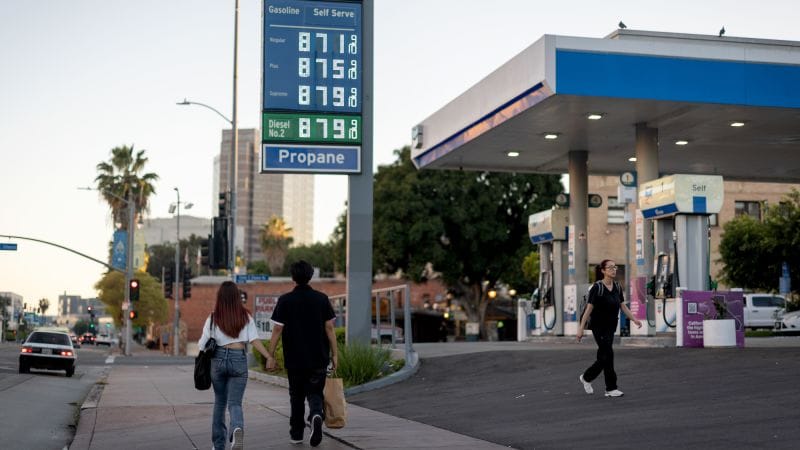
Goldman Sachs suggested Friday that elevated oil prices could persist through 2027. That is not the exhale scenario.
Three weeks into the Iran war, the administration privately estimates higher prices could linger for months as passage through the Strait of Hormuz remains nearly impossible. Tanker traffic has plunged roughly 90% from pre-conflict levels since the conflict began — this is a physical flow problem, not just a price problem. More than 30 countries have released 400 million barrels of strategic reserves, the largest coordinated action in history, and it isn't working.
In a move that captures the policy contradiction perfectly, the administration is temporarily lifting sanctions on Iranian oil at sea so allies can buy it — a policy that increases allied access while allowing Tehran to collect revenue. Treasury Secretary Bessent framed it as "using the Iranian barrels against Tehran," but the implication is starker: every conventional supply-side lever has been deployed and proved insufficient.
If a ceasefire or maritime security deal reopens the Strait, prices could correct sharply — CFTC data shows speculators at multi-year long extremes, meaning a crowded trade that can reverse violently. If the Strait stays closed, $120+ Brent is the next stop. Any CFO who hasn't stress-tested against $100+ oil for 12–18 months is behind.
The Semiconductor Industry Has a Helium Problem — and It's About to Get Real
This story got buried under oil headlines, but it may be more structurally consequential for the AI buildout. Qatar supplies a third of the world's helium, and production halted when the war began. Reports said follow-up strikes on March 18–19 damaged Ras Laffan — the world's largest LNG hub and a major helium source — with AP reporting annual helium exports could fall roughly 14% for years.
Helium is essential for semiconductor fabrication — it cools silicon wafers during etching, and analysts at Frost & Sullivan call it "non-substitutable in advanced semiconductor manufacturing." Spot prices have about doubled since mid-March. South Korea imported 64.7% of its helium from Qatar in 2025; Fitch Ratings flagged Samsung and SK Hynix as particularly vulnerable.
The physics make it worse: helium is stored in specialized containers that lose their contents in 35–48 days as the liquid warms to gas and escapes. About 200 of those containers — at roughly $1 million each — are stranded in the Middle East. Industry expert Kornbluth told the Boston Globe: "Nobody's run out of helium yet. But it's a few weeks out when the shortage really hits."
If fabs in South Korea and Taiwan get helium-constrained, AI chip delivery timelines slip — and every hyperscaler modeling GPU availability into 2027 has a new variable. If alternative sources (Russia's Amur facility, U.S. caverns, German storage) ramp fast enough, the industry muddles through with higher costs but intact schedules. The signal: any production adjustment announcement from Samsung, SK Hynix, or TSMC in the next 2–4 weeks.
The ECB and Bank of England Are Frozen Too — and Europe Has It Worse
The ECB kept rates unchanged at 2.00%/2.15%/2.40%, citing the war as creating "upside risks for inflation and downside risks for economic growth." It revised growth down to 0.9% for 2026 and raised inflation forecasts across the next three years. That is a stagflation forecast in everything but name.
Europe's exposure is structurally worse than America's — the US is a net energy exporter; Europe is not. The ECB explicitly framed the Iran war as a two-sided risk, which in central-bank dialect means easing gets pushed further out.
The Bank of England held at 3.75% with a unanimous vote, but the minutes flagged upside inflation risks from oil, gas, fertilizers, and even helium. Staff projections see UK CPI above 3% for much of 2026, and wage settlement data has pushed higher, creating real risk of second-round effects. For any business with European revenue, floating-rate euro debt, or UK operations: the rate-relief trade has been pushed out by months.
Credit Markets Blink: Spreads Widen, Curves Twist, and the Cushion Is Thin
Credit is where growth fears finally outweigh the carry trade — and we're starting to see the pivot. High-yield spreads have widened from roughly 2.91% to about 3.27% over three months, with CLO issuance slowing about 20% week-over-week as managers pull back from leveraged loan risk. Investment-grade spreads have crept higher but remain contained.
The Treasury curve is doing something messy: the 2-year has moved more than the 10-year, steepening not on growth optimism but because the short end is repricing fewer Fed cuts while the long end stays elevated on sticky inflation expectations. That's not the classic recession signal — it's a tug-of-war between inflation and growth that leaves everyone uncomfortable.
The cheap, abundant credit that defined late 2025 is fading just as energy costs tax cash flows. If you run a company with high-yield exposure or covenant-light loans, assume refinancing will be more expensive and more heavily scrutinized. The window is still open but narrowing — the next 4–6 weeks are materially easier than what follows.
Dollar Strength Comes Back, and FX Is Quietly Tightening Global Financial Conditions
The dollar index jumped roughly 3% week-over-week to about 108 on the week, reversing its early-year drift lower as safe-haven demand and the Fed's less-dovish tone pulled capital back into the greenback. The euro and sterling slipped after softer European data and the ECB/BoE holds.
A stronger dollar tightens global financial conditions by making dollar-denominated debt more expensive for emerging markets and compressing translated earnings for US multinationals. For executives with global P&Ls, the combination of higher domestic rates and a resurgent dollar is a double squeeze: it pressures margins abroad while raising your home-market discount rate. For energy-importing emerging markets, it's a triple hit — pricier oil, a dearer dollar, and tighter local monetary policy to defend the currency.
If geopolitical risk fades, the dollar gives back gains quickly — CFTC positioning shows leveraged funds trimming short-dollar exposure, meaning the trade isn't yet consensus. If risk persists, DXY at 110+ becomes the base case for Q2.
Ukraine Just Industrialized Its Drone Campaign — and Russia's Rear Is No Longer Safe
This one is flying under the macro radar but matters for anyone pricing Russian energy supply. Drones reportedly damaged the Ufa refining complex — according to Bashkiria's regional head — and the Saratov refinery, which has design capacity of about 140,000 barrels per day. Rosneft's Bashneft unit in Ufa runs three facilities with combined capacity of about 470,000 barrels daily.
The scale shift is the real story. Ukraine's drone pace has roughly doubled in recent weeks to about four targets per night, with 100–200 drones crossing into Russian airspace on average — and for the first time in the war, Ukraine's long-range drone launches now match or exceed Russia's.
This is a quiet but material shift in Russia's energy production math. Sustained attrition of refining capacity compresses Moscow's fiscal headroom and complicates the "Russian oil returns to market if sanctions ease" narrative embedded in some analysts' price forecasts. Treat OSINT-sourced damage assessments with appropriate skepticism until satellite or production data confirm, but the trend line is clear.
S&P 500 Earnings Still Lean on Margins, Not Volume, as Energy and Rates Complicate 2026
The earnings machine is grinding through Q4's back half, and the pattern matters for how companies absorb this new shock. Per FactSet's latest Earnings Insight, about three-quarters of S&P 500 companies have reported, with blended EPS growth in the mid-single digits and revenue growth running lower — meaning most upside is coming from margins, not top-line acceleration.
Beat rates are strong in tech, communication services, and select industrials where pricing power remains intact. Domestically focused consumer and small-cap names are more mixed. The risk: 2026 consensus numbers still assume both benign input costs and easing financial conditions — a combination that's becoming less likely by the week. Expect the next wave of guidance calls to include more hedging language on energy, FX, and demand elasticity, especially for housing-adjacent cyclicals and discretionary retail.
⚡ What Most People Missed
- The dot plot's "longer run" neutral rate quietly moved up to 3.0% — that reprices long-duration assets, increases pension liability valuations, and raises the discount rate used across many equity valuation models.
- Margin debt hit $1.28 trillion in January, up 36% year-over-year, pushing past Dot-Com-era leverage relative to income. The market has quietly rebuilt enormous leverage while recession odds are rising and geopolitical risk is live — any shock now has a wider channel for forced deleveraging.
- Bond funds are soaking up cash while equity flows crack. ICI data shows fixed-income funds pulling in roughly $19 billion while U.S. equity funds logged nearly $20 billion in net redemptions over recent weeks — classic late-cycle rotation toward "safe yield" that benefits issuers trying to term out debt but starves equity-funded growth stories.
- Global freight costs are quietly re-inflating. Freightos data shows Asia–U.S. East Coast container rates jumping 9% week-over-week to about $3,000/FEU, with VLCC spot earnings north of $150,000/day — complicating the disinflation narrative central banks have been leaning on.
- The October 2025 government shutdown left a hole in the data. Unemployment and CPI figures for that month are still missing from the time series, meaning the Fed is making policy with a gap in the middle of its measurement window. When backfilled data arrives, it could shift the picture in either direction — a revision risk nobody is pricing.
📅 What to Watch
- If March CPI (mid-April) shows energy feeding into core inflation, the "transitory" consensus collapses and the December rate cut gets priced out — watch for core CPI above 0.4% month-over-month as the trip wire.
- If Samsung, SK Hynix, or TSMC announce helium-related production adjustments in the next 2–4 weeks, AI chip delivery timelines shift and hyperscaler capex plans need revision — the second-order effect is on cloud pricing and AI model training schedules.
- If high-yield spreads push above 3.5% OAS while CLO issuance stays depressed, the refinancing window for leveraged issuers effectively closes for Q2 — triggering a wave of covenant renegotiations and potential downgrades that feeds back into bank lending standards.
- If the Strait of Hormuz sees even partial tanker resumption (watch daily vessel-tracking data), speculative oil longs unwind fast and energy-sensitive equities whipsaw — the positioning is so crowded that a 10% oil decline could happen in days.
- If backfilled October 2025 labor data comes in weaker than trend, it strengthens the dovish camp and makes the June FOMC meeting a live cut decision — the data gap is an underpriced revision risk.
The Closer
A gas that escapes from birthday balloons in 35–48 days is now gating a trillion-dollar chip buildout; the world's largest strategic oil release in history couldn't move the price; and the Fed's most confident forecast this week was that it doesn't know what happens next.
Somewhere in Bashkortostan, a refinery executive is watching a drone swarm the size of a flock of starlings and wondering if his insurance covers "industrialized hobby aircraft."
Until next week — stay solvent.
If someone you know is making decisions without this context, forward it. They'll thank you when the helium runs out.
From the Lyceum
The White House released a formal AI regulatory blueprint telling states to stand down — the biggest federal preemption signal for technology governance this year. Read → The White House Hands Congress an AI Rulebook
The SEC and CFTC finally agreed on who regulates crypto, officially classifying 16 tokens as commodities. Read → The SEC and CFTC Finally Draw a Map for Crypto