The Lyceum: Power & Infrastructure Weekly — Jul 18, 2026
Photo: lyceumnews.com
Week of July 18, 2026
The Big Picture
The AI power fight stopped being about whether the grid can handle data centers and became about who signs the check. This week the argument reached the White House — which is asking utilities and hyperscalers to make a voluntary pledge not to stick households with the bill — while Texas quietly did the opposite, imposing binding technical rules that force data centers to behave like grown-ups on the grid. Meanwhile Ireland handed every grid planner on earth a number to be terrified of: data centers now eat 23% of the country's electricity, more than all its homes combined.
This Week's Stories
The White House Wants a Handshake. The Grid Needs a Contract.
The most consequential question in American energy right now isn't about generation — it's about who pays for the wires. The White House's answer, for now, is: please volunteer. (The White House Wants a Handshake. The Grid Needs a Contract.)
Reuters reported Monday that the White House plans to bring utilities and data center developers together for a voluntary pledge designed to ensure that AI-driven demand growth doesn't push up power bills for households and businesses. Earlier this year, Amazon, Google, Meta, Microsoft, OpenAI, Oracle, and xAI signed a "Ratepayer Protection Pledge" at a White House ceremony, committing to finance the electricity infrastructure their AI projects need rather than socializing it. Now the administration wants more signatures. (White House prepares pledge on AI power costs with utilities and data centers)
The problem is the gap between the pledge and the plumbing. Regulators and consumer advocates in Virginia, California, and North Carolina have warned that households could end up subsidizing grid upgrades built for the world's largest tech companies — and a voluntary pledge is only as strong as the enforcement mechanism behind it, of which there currently is none. (The White House Wants a Handshake. The Grid Needs a Contract.)
Here's what to watch: does the event produce measurable commitments — specific dollar figures, named projects, independent verification — or a photo op? If it's the latter, expect state legislatures to accelerate binding law and FERC to face renewed pressure to write a federal cost-allocation rule that would make the pledge largely moot. (The White House Wants a Handshake. The Grid Needs a Contract.)
Texas Just Made Data Centers Behave Like Real Grid Citizens
If you run a data center in Texas and it trips offline every time the grid hiccups, you just became someone else's problem. The Texas Public Utility Commission decided this week that's no longer acceptable.
The PUC approved "ride-through" rules for data centers, per Utility Dive — meaning large computational loads must now stay connected and keep operating through voltage and frequency disturbances rather than disconnecting and making the disturbance worse. Think of it as requiring a heavy truck to hold its lane in a storm instead of swerving into oncoming traffic. When a 200 MW cluster suddenly drops its breakers during a frequency event, it makes the grid less stable, not more. The rule forces data centers to install the power electronics and controls to tolerate disturbances — standard practice for generators, historically not required of large loads. PUC filings warned that voltage and frequency excursions "create reliability concerns, which increase with the interconnection of each new large computational load."
This is the first U.S. state to impose binding grid-stability obligations on data centers as a load class — and it's a template. ERCOT has watched its interconnection queue fill with computational load fast enough to make this urgent rather than merely sensible. Watch whether PJM and MISO follow, and whether FERC federalizes it. The failure signal would be industry compliance-cost complaints stalling enforcement; the success signal is a copycat filing in another RTO within the quarter.
Ireland's Data Centers Now Eat More Power Than Every Home in the Country

Ireland is the canary in the coal mine for what happens when a small grid hosts a disproportionate share of global digital infrastructure — and the canary is wheezing. (Ireland's Data Centers Now Eat More Power Than Every Home in the Country)
Ireland's data center electricity consumption has risen 360% in a decade and now accounts for 23% of national power, according to The Register — as much as every Irish home combined. That's despite a years-long moratorium on new data center grid connections around Dublin. The catch: facilities already connected keep growing their draw as they swap in denser, more power-hungry AI hardware. The physical footprint doesn't change, so no new interconnection review is triggered — but the electrical load climbs anyway. (Ireland's Data Centers Now Eat More Power Than Every Home in the Country)
That's the dynamic every operator with a major cluster needs to internalize: hardware upgrades inside existing walls are a load-growth mechanism that bypasses the queue entirely. The water angle compounds it — Ireland's data centers are largely air-cooled or evaporative, and the shift to liquid cooling for AI racks rewrites the water-consumption profile even as it improves power efficiency. Watch EirGrid's next capacity statement for whether the island grid's reserve margin still has headroom, or whether the moratorium needs teeth. (Ireland's Data Centers Now Eat More Power Than Every Home in the Country)
North Carolina Moves to Make Hyperscalers Pay for Their Own Wires
Virginia is living the problem. California is trying to prevent it. Now North Carolina — one of the Southeast's fastest-growing data center markets — is trying to legislate its way in front of it.
The bill would require data centers to pay for the transmission upgrades their facilities necessitate rather than spreading those costs across all ratepayers, and would mandate a cost-benefit analysis before large loads connect. But the North Carolina version goes further than its peers: the amended text also bans evaporative cooling for large data centers and directs the Department of Environmental Quality to write rules by September 1 on closed-loop or reclaimed-water cooling — pairing a pro-nuclear push with a hard water constraint.
That's the tell. Interconnection cost allocation — who pays for the wires — is the single biggest lever determining whether data center growth is a gift or a burden. When a 500 MW campus needs a $200 million substation upgrade, whether that lands on Meta's balance sheet or across four million residential bills is entirely a regulatory design choice. North Carolina is now making both power and water a permitting condition. If it passes, it joins Virginia and California as a three-state cluster that could force FERC's hand federally. Watch the committee timeline and the September 1 DEQ deadline.
Switzerland Lifts Its Nuclear Ban — and the Timing Is Not a Coincidence
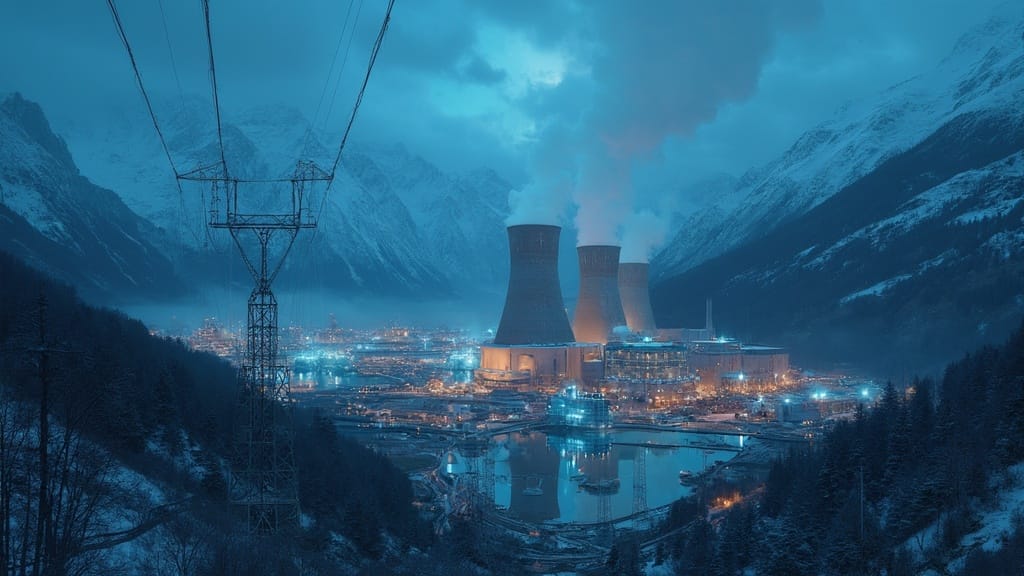
Switzerland has run on nuclear for decades — five reactors supply about a third of its electricity — but a 2017 law banned building any new ones. The Swiss parliament has now voted to lift that ban, making Switzerland the latest European country to reverse course. (Switzerland Lifts Its Nuclear Ban — and the Timing Is Not a Coincidence)
Be clear about what this is and isn't: the vote removes the legal prohibition, but authorizes no specific project and provides no funding. Any new plant faces full licensing, environmental review, and cantonal approval — putting the earliest realistic in-service date in the late 2030s at best. This is a policy signal, not a construction announcement. (Switzerland Lifts Its Nuclear Ban — and the Timing Is Not a Coincidence)
The timing is the story. Switzerland has a summer/winter problem — abundant power when dams are full and the sun shines, a real shortfall in winter — and nuclear's value is dispatchability regardless of season, weather, or hydrology. The vote follows reversals in Belgium and Sweden and lands as Canada plans up to 10 new reactors by 2040. The European nuclear renaissance is no longer fringe; it's the mainstream answer to AI load, intermittent renewables, and winter security stacked on top of each other. The faster near-term signal to watch: whether this vote accelerates life-extension licensing at existing plants, which delivers firm capacity years sooner than any new build. (Switzerland Lifts Its Nuclear Ban — and the Timing Is Not a Coincidence)
⚡ What Most People Missed
- Nordic and Polish data center waste heat becomes district-heating backbone: atNorth signed a deal with Danish utility Vestforbrænding to pipe waste heat from its DEN01 campus into Copenhagen's district heating network — enough to warm more than 8,000 homes once fully operational around 2028. In Milan, Equinix and A2A are recovering up to 225 GWh a year via 72 MW of heat pumps and 6,000 m³ of thermal storage. Server exhaust is becoming firm urban energy infrastructure, and it lands right as Germany's Energy Efficiency Act forces new data centers to hit a 1.2 Power Usage Effectiveness and reuse at least 10% of waste heat, rising to 20% by 2028.
- The Bloom Energy–Brookfield deal is a $25 billion vote of no confidence in the grid. On June 30, the two expanded their partnership fivefold, from $5 billion to $25 billion, as AI operators increasingly route around interconnection queues with on-site solid oxide fuel cells that install in months, not years. The caveat: it's a financing framework, not upfront revenue — Brookfield helps Bloom's customers finance the servers. The real signal is that a $100 billion infrastructure fund sees bypassing the grid as the fastest path to reliable AI power.
- Infineon and LS Electric announced a partnership on DC power infrastructure for AI data centers. Most facilities run on alternating current — the kind from your wall — but AI GPU clusters are increasingly designed around direct current, which eliminates conversion steps and improves efficiency. DC-powered campuses would need fundamentally different interconnection equipment, and that supply chain isn't built yet.
- Entergy's revised Meta deal claims higher customer savings. Entergy told Reuters its restructured long-term contract for Meta's Louisiana data center delivers more savings for ordinary ratepayers while still serving multi-hundred-megawatt demand — the backdrop to a plan for seven new gas plants totaling 5,200+ MW, transmission, storage, and nuclear upgrades. These deals are drifting out of "large commercial" rate classes and into bespoke quasi-regulated asset structures.
📅 What to Watch
- If the White House event produces only a general statement without enforcement, state legislatures will accelerate binding law — and the voluntary approach will have been tested and found wanting.
- If FERC formally acknowledges Spanberger's intervention, the federal cost-allocation framework starts moving faster than the state-by-state patchwork, which reshapes every utility's large-load queue math.
- If North Carolina's evaporative-cooling ban survives to the September 1 DEQ rulemaking, water stops being sustainability language and becomes a redesign requirement — pushing OEMs toward closed-loop and reclaimed-water systems nationwide.
- If Canada's gas-inside-"clean-grid" framing holds, it gives political cover south of the border for keeping gas peakers in nominally clean plans — meaning combined-cycle plants built today aren't stranded assets, provided they're paired with storage or nuclear.
- If ERCOT's ride-through rule triggers a copycat filing in PJM or MISO within the quarter, large load officially becomes its own grid product rather than a customer class.
The Closer
A canary in Dublin gasping under the weight of 23% of a nation's electricity, a Texas data center forced to white-knuckle its way through a frequency storm instead of bolting for the exit, and a Swiss parliament dusting off the nuclear playbook it swore off in 2017 — because winter, it turns out, does not care about your referendum. The White House, meanwhile, is trying to solve a wiring problem with a handshake, which is roughly like fixing a transformer shortage with a firm nod. Read this, and go check your interconnection queue. (Switzerland Lifts Its Nuclear Ban — and the Timing Is Not a Coincidence)
Forward this to the one person you know who's still arguing about whether AI will strain the grid — they've missed the part where the fight moved on to who pays. (Switzerland Lifts Its Nuclear Ban — and the Timing Is Not a Coincidence)