The Lyceum: Power & Infrastructure Weekly — Mar 28, 2026
Photo: lyceumnews.com
Week of March 28, 2026
The Big Picture
Texas hit 33 gigawatts of instantaneous solar generation at session highs — 54% higher than California's all-time solar peak on the session — while simultaneously leading the nation in battery storage additions, and the question is no longer whether renewables can scale but whether the grid can absorb them fast enough. Britain cited the Iran war energy shock as it finalized a building code that bans gas boilers and mandates heat pumps and rooftop solar in every new home from 2028, tripling projected heat pump demand on the government's build-out timeline. And on Capitol Hill, a federal proposal would require data centers to publicly disclose their water and electricity consumption for the first time — the same week Idaho moved to ban evaporative cooling in new facilities and Colorado introduced a first-of-its-kind framework testing grid capacity, water strain, and ratepayer protection in a single statute. Power, cooling, and water are converging in regulatory chambers and rate cases at a speed that outpaces most capital planning cycles.
This Week's Stories
Texas Just Became the Undisputed Solar Capital of the World
On March 21, ERCOT hit 33 gigawatts of instantaneous solar generation at session highs — a record 54% higher than California's all-time solar peak on the session. Texas added roughly 11 gigawatts of solar capacity last year, bringing installed capacity to approximately 52 gigawatts. None of this was mandated by a renewable portfolio standard. The market built it because the market pencils out.
The number behind the headline matters more. The EIA's March Short-Term Energy Outlook shows ERCOT entered 2026 with approximately 13.9 gigawatts of commercially operational battery storage — surpassing California for the first time — with another 12.9 gigawatts planned through year-end. Battery costs have fallen to roughly $117 per kilowatt-hour installed, less than a third of 2023 levels since 2023, per EIA data. ERCOT load growth is projected at 21% between 2024 and 2026, amid rising demand from data centers and heavy industry.
If this works — if storage absorbs enough midday solar to prevent chronic curtailment — Texas becomes the proof case that market-driven solar-plus-storage can serve hyperscale loads without mandates. If it doesn't, the signal will be rising curtailment hours in Q2 and collapsing midday power prices that undermine merchant battery economics. Watch ERCOT's real-time curtailment data and ancillary service prices over the next sixty days. That data will tell you whether the grid is absorbing 33 GW or buckling under it.
Britain's Iran War Response: Every New Home Gets Solar and a Heat Pump
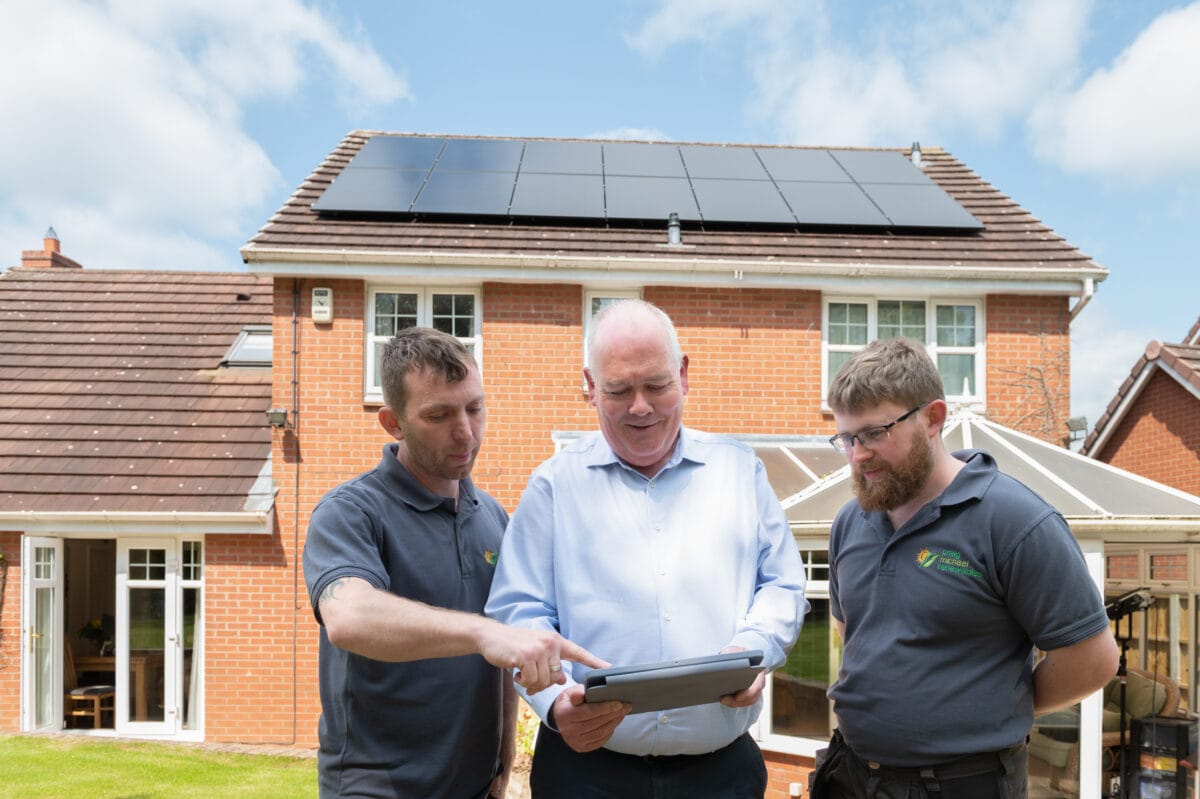
This is a finalized regulation — SI 2026/335, the Building Regulations (Amendment) (England) Regulations 2026 — not a proposal. From 2028, every new home in England must include a heat pump (or district heating connection) and rooftop solar panels covering an area equivalent to 40% of the ground floor. No new gas connections. Energy Minister Ed Miliband framed the mandate explicitly as a national security response to the Iran war.
The supply chain math is immediate: the UK targets 1.5 million new homes by 2029, and the heat pump market needs to roughly triple from around 100,000 units per year to 300,000, per industry estimates. Developers estimate the changes add approximately £10,000 per home. The Home Builders Federation's CEO called the solar mandate unexpected, claiming "60% of homes can't actually reach that standard."
If manufacturers — Vaillant, Daikin, Mitsubishi Electric, Viessmann — scale production fast enough, this creates the largest captive heat pump market in Europe overnight and hard-wires millions of controllable electric heating loads into the housing stock, a massive resource for demand response and virtual power plant aggregation. If they can't, expect housebuilders to push for implementation delays and judicial review challenges. Watch UK order books from those four OEMs in Q2 for the first real demand signal.
FERC Just Approved a Radical Plan to Unclog America's Grid Connection Queue
FERC approved the Southwest Power Pool's Consolidated Planning Process, which merges transmission planning and generator interconnection into a single workflow. Instead of developers picking a spot and waiting years for reactive studies, SPP will proactively identify where to build transmission using 10- and 20-year forecasts and provide upfront, standardized connection costs.
FERC commissioners openly called this a "potential national template." The first application window opens next month. If MISO, PJM, or CAISO adopt similar frameworks, it materially shortens the timeline for connecting utility-scale renewables, long-duration storage, and data-center-adjacent firming resources — reducing the incentive for costly on-site gas backup. If they don't, the interconnection queue remains the single biggest bottleneck in the energy transition, and SPP becomes an island of speed in a sea of restudies. Watch for copycat filings from other ISOs by Q3.
Form Energy Inks 12 GWh Deal to Power AI Data Centers for 100 Hours Straight
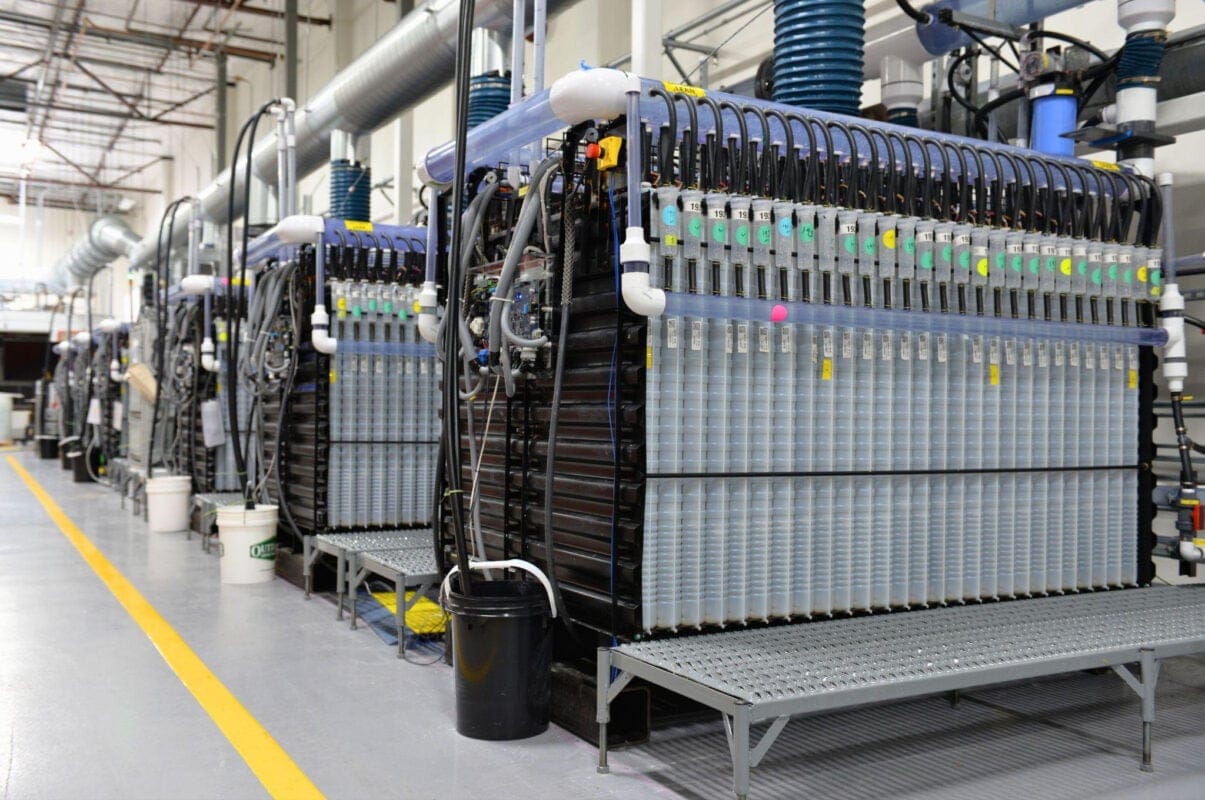
Form Energy signed a 12 GWh agreement with Crusoe Energy Systems to supply iron-air batteries — a technology that discharges for 100 hours by reversibly oxidizing iron pellets in a water-based electrolyte. Deliveries are slated from 2027. This follows Form's 30 GWh deal with Google and Xcel Energy earlier this year.
This is the commercial validation threshold for multi-day storage. If iron-air performs at scale — maintaining round-trip efficiency and degradation curves that match lab results — it converts intermittent renewables into dispatchable baseload for AI data centers without grid interconnection or gas backup. Crusoe can co-locate these batteries with wind and solar to create private, firm power islands. If the technology stumbles on manufacturing yield or field reliability, the fallback is exactly the on-site gas capacity (roughly 56 GW in various planning stages nationally, per industry tracking) that the sector is trying to avoid. The observable signal: watch whether Form breaks ground on its manufacturing facility on schedule and whether Crusoe's first battery-firmed campus announces a power purchase agreement with a hyperscaler.
Data Centers Are Ditching AC Power — and It Changes Everything About How They're Built
The AC-to-DC transition inside hyperscale data centers crossed from "future possibility" to "commercially available" this month. At Nvidia's GTC conference, Vertiv announced an 800V DC ecosystem for Nvidia's Vera Rubin Ultra Kyber platforms shipping in H2 2026; Eaton showed a medium-voltage solid-state transformer at the heart of its DC distribution system; and Delta released 800V DC in-row power racks rated at 660 kW with 480 kW of embedded battery backup.
The physics case: at near-megawatt rack densities, eliminating AC-to-DC conversion stages cuts copper requirements by 45%, improves efficiency by 5%, and reduces total cost of ownership by 30% for gigawatt-scale facilities, per IEEE Spectrum's reporting. Crucially, this is a cooling story as much as a power story — fewer conversion stages mean less waste heat in the white space, which directly shrinks cooling infrastructure. One unresolved gap flagged at APEC 2026: DC solid-state circuit breakers don't yet exist at the ratings needed for system protection.
If 800V DC becomes the default architecture, it reshapes facility design, UPS topology, and the cooling load calculation for every new build. If the circuit breaker gap isn't closed, adoption stalls at the campus perimeter. Watch which cooling OEMs — Vertiv, Schneider Electric — release DC-optimized thermal product lines in Q2.
A Federal Transparency Push and State-Level Moves Tighten Data Center Siting Rules
A federal proposal filed on March 25 would require data center operators to publicly report electricity and water consumption, including source and projected five-year demand for new facilities. States would collect the data and share it with federal agencies, which would publish regional impact reports. Penalties were proposed for each day of non-compliance.
This is proposed legislation, not law, but it arrives alongside a separate proposal from Sen. Bernie Sanders and Rep. Alexandria Ocasio-Cortez calling for a national moratorium on new AI data center construction — a largely symbolic move that nonetheless provides political cover for state regulators tightening siting rules. Meanwhile, Idaho passed legislation this week effectively banning evaporative cooling in new data centers, and Colorado introduced SB26-102, the first state bill to legislate grid capacity, water strain, and ratepayer protection in a single data center framework.
If the federal transparency proposal picks up Republican co-sponsors from rural data-center-hosting districts — Indiana, Ohio, Georgia — it becomes viable legislation. If it doesn't, the state-level patchwork accelerates, and operators building nationally face a compliance matrix instead of a single standard. The signal to watch: co-sponsorship announcements in the next thirty days.
It's Official: Air Cooling Is Obsolete for High-Density AI Racks
As AI accelerators like Nvidia's GB200 push single-rack power past 120 kilowatts, air cooling has hit a hard physical wall — water conducts heat roughly 25 times more effectively. The liquid cooling market nearly doubled in 2025 and is forecast to reach $7 billion by 2029. This week, construction firm Gray and fluid specialist Valvoline announced a joint offering to deploy liquid-cooled data centers as a packaged construction-plus-fluids service — a sign that liquid cooling has graduated from niche retrofit to mainstream construction discipline.
Separately, a UCLA study of "adaptive phase cooling" (partner: Ferveret) reported a PUE of 1.03 with zero water consumption via a subcooled-boiling refrigerant loop — a potential step-change over current direct-to-chip methods, though still at lab scale. And Ecolab agreed to acquire CoolIT Systems for roughly $4.5–4.75 billion, explicitly building a combined thermal-and-water platform with a Cooling-as-a-Service model.
If liquid cooling consolidates around integrated service providers like Ecolab-CoolIT and Eaton-Boyd (completed March 12 for $9.5 billion), operators get turnkey thermal management but lose negotiating leverage. If the UCLA phase-cooling approach validates at scale, it could eliminate the water-use tradeoff entirely. Watch for Ecolab's first CaaS contract announcement and Ferveret's first rack-scale deployment.
New Products & Launches
- Vertiv 800V DC Ecosystem for Nvidia Vera Rubin Ultra Kyber: Commercially available H2 2026, this is the first purpose-built DC power distribution system designed for next-generation AI GPU platforms at near-megawatt rack densities.
- Delta 800V DC In-Row Power Racks (660 kW): Shipping now with 480 kW of embedded battery backup, these racks eliminate multiple AC-DC conversion stages and integrate UPS directly into the power distribution path.
- Microsoft MicroLED Datacenter Networking: Microsoft demonstrated intra-datacenter optical links using micro-LEDs and hollow-core fiber that cut switching power and reduce network heat within racks — a thermal management benefit disguised as a networking innovation.
- LG R290 Therma V Indoor Heat Pump Units: LG expanded its propane-refrigerant (R290) air-to-water heat pump line with new indoor configurations designed for tighter installation spaces — timed precisely for the UK Future Homes Standard demand surge.
⚡ What Most People Missed
- Pennsylvania quietly piloted the "10-year take-or-pay" data center tariff. PPL's March rate case settlement includes a new LP-6 large load tariff that reportedly forces data centers into decade-long contracts with pre-funded grid upgrades — a template that shifts interconnection risk from ratepayers to developers. Florida took a different approach with SB 484: it bars visible utility bill impacts from data centers while creating new confidentiality rules that hide project details from the public.
- Thermal storage popped up across three continents this week. MGA Thermal raised $11.9M in Australia for electro-thermal blocks claiming higher energy density than typical heat systems. Salt River Project greenlighted a 50 MWh iron flow battery pilot with ESS Inc. in Arizona. Polar Night Energy completed a 3 MWh pit thermal storage pilot in Tampere, Finland, demonstrating seasonal heat shifting at costs the World Economic Forum flagged as directly relevant to AI data center cooling.
- The 800V DC transition has a hidden grid-interface problem. AI GPU workloads can swing from idle to maximum power draw across 72 GPUs in milliseconds during all-reduce operations. Aggregated across a gigawatt campus, those step-load transients will show up on the transmission system — and no utility or ISO has publicly studied what that load profile looks like from the grid side, creating a potential standards and protection gap for transmission planners.
- Materials scientists are targeting short-chain PFAS with metal-organic frameworks. A new computational screening study identified MOF candidates that selectively adsorb short-chain PFAS compounds (like PFBA) that slip through today's granular activated carbon and ion-exchange plants — pointing toward a second wave of treatment media upgrades at water utilities already spending billions on PFAS compliance.
- Geothermal used data centers to argue for permitting reform. Congressional testimony argued geothermal could provide 100 GW by 2050 if permitting were streamlined, explicitly citing AI data center demand as the firm load that justifies the investment. If that permitting relief materializes, the competitive siting map for AI infrastructure changes materially.
📅 What to Watch
- If ERCOT curtailment hours spike in Q2, it means Texas solar has outrun storage deployment pace — and merchant battery revenue models need repricing before the next round of project finance closes.
- If MISO or PJM file copycat proposals mirroring SPP's Consolidated Planning Process by Q3, the interconnection queue bottleneck starts breaking nationally, not just regionally — accelerating where long-duration storage and firm renewables can scale.
- If the federal transparency proposal picks up a Republican co-sponsor from a rural data-center-hosting district, it becomes viable legislation rather than messaging — and operators may need to restructure siting timelines, disclosure systems, and community engagement plans preemptively.
- If Ecolab announces its first Cooling-as-a-Service contract, it confirms that water chemistry, corrosion control, and rack-level thermal management are being sold as one integrated outcome — forcing competitors like Xylem, Veolia, and Carrier to respond.
- FERC's large-load interconnection rulemaking has an April 30 deadline — if the commission acts, it sets a national framework for how data centers connect to the grid, directly reshaping siting decisions across PJM, MISO, and SERC footprints.
From the Lyceum
Two juries in two days found Meta and YouTube liable for social media addiction — the "design defect" theory is now a litigation playbook for any sector building addictive digital infrastructure. Read → Two Verdicts in Two Days
The Closer
A state with no renewable mandate hitting 33 gigawatts of solar while its battery fleet races to catch up; a British building code that just turned every new semi-detached into a small power plant with a heat pump; and an iron-air battery deal premised on the idea that rusting and un-rusting pellets can keep an AI data center alive for four straight days.
In Idaho, legislators just banned evaporative cooling to cool servers, which is the kind of sentence that would have gotten you committed in 2015.
See you next week.
If someone you know is making siting, cooling, or grid decisions right now, they probably need this in their inbox — forward it.