The Lyceum: Power & Infrastructure Weekly — May 30, 2026
Photo: lyceumnews.com
Week of May 30, 2026
The Big Picture
The grid ran out of margin this week, and the regulators noticed. The DOE issued two emergency orders in five days — one letting PJM curtail data centers during a heat wave, another keeping a retired Maryland gas plant on life support through August 19 — while NERC's Level 3 alert moved data center load behavior from "emerging risk" to "compliance obligation." Meanwhile, EPA tried to split the PFAS drinking water rule in half, Oregon told giant loads to pay their own bills, and the Lombardy region in Italy slapped a 200% surcharge on data centers built on farmland. Power, cooling, and water aren't separate stories anymore — they're the same regulatory squeeze hitting the same buildings from three sides.
What Just Shipped
- Victor Jara Hybrid Solar-Storage Project (ContourGlobal): 231 MW solar paired with a 1.3 GWh battery system in Chile's Tarapacá region, including a 200 MW unit capable of 6.5 hours of discharge — what ContourGlobal describes as Latin America's longest-duration BESS.
- Microsoft Høje-Taastrup Heat Recovery (Microsoft / VEKS / Høje Taastrup Fjernvarme): waste heat from a Danish Microsoft data center routed into the local district heating network, sized to cover annual heating for roughly 6,000 households.
- Byron Nuclear Uprate (Constellation): construction began in March on power uprates at the Byron plant in Illinois, part of an $800 million program adding a combined 158 MW across Byron and Braidwood, with Byron completing in 2028.
- Lake Mariner Infrastructure Package (TeraWulf / Schneider Electric): $290 million deal covering Motivair direct-to-chip cooling and rear-door heat exchangers for the Lake Mariner AI campus — liquid cooling sold as a packaged infrastructure layer, not a pilot.
- Wagner Unit 4 Emergency Operation (Talen Energy / PJM): a retired Anne Arundel County, Maryland generating unit returned to dispatch under DOE Order 202-26-24 through August 19, 2026.
This Week's Stories
When a Data Center Trips Offline, the Whole Grid Feels It
Grid planners spent years worrying about data centers adding load. The new problem is what happens when they suddenly drop it.
On May 4, the North American Electric Reliability Corporation issued a Level 3 "Essential Actions" Alert — its highest urgency tier — after documenting multiple events since 2022 in which 1,000+ MW of computational load disappeared from the bulk power system in seconds. These were customer-initiated: protection circuits at data centers detected disturbances on grid-supplied power and disconnected automatically to protect sensitive equipment. The speed is what makes it dangerous. Frequency stability tools assume load comes off in minutes, not seconds.
Registered entities had to acknowledge the alert by May 11, and must report on implementation status by August 3, 2026. The seven required actions cover modeling, protection settings, commissioning, and real-time communications — NERC is telling utilities they don't know how these loads behave and need to find out before connecting more of them. Morgan Lewis's read is that the alert "moves data centers from emerging risks to planning obligations," which in regulatory English means new computational load now needs to clear evidentiary bars that didn't exist six months ago.
What to watch: the August 3 response window. If utilities report widespread modeling gaps, expect NERC to accelerate formal reliability standard development — which would make interconnection materially slower for any AI campus larger than a few hundred megawatts.
DOE Issues Back-to-Back Emergency Orders for PJM — Data Center Curtailment, Then a Zombie Power Plant
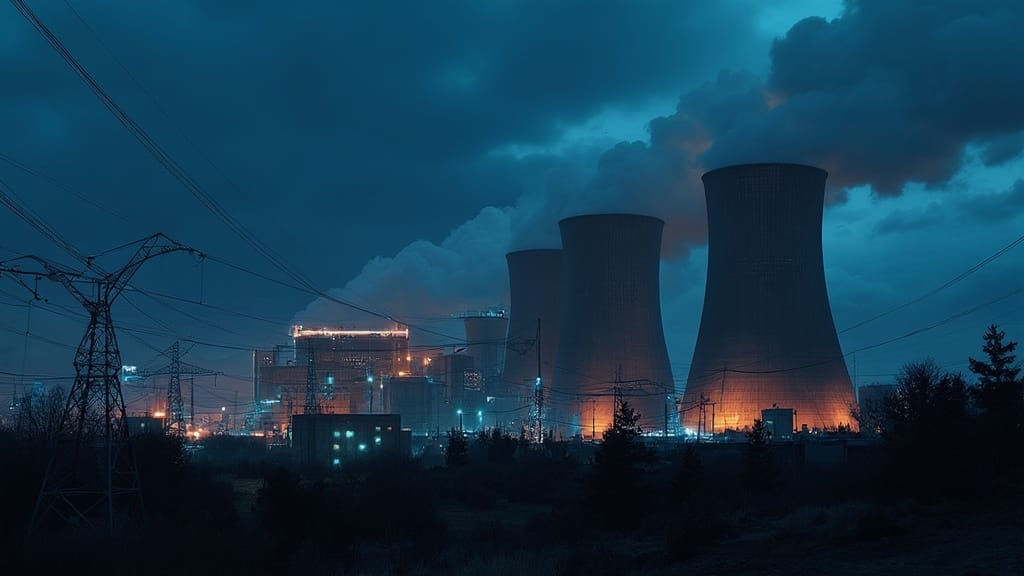
Two Section 202(c) emergency orders in five days is not a normal operating tempo for the DOE.
The first, issued May 18, granted PJM authority to curtail data centers and other large loads with on-site backup generation during a heat event when reserves were expected to fall below 5,800 MW, with Maryland and Virginia flagged as especially stressed. Per Utility Dive's reporting on the order, the directive explicitly framed hyperscaler diesel generators as a grid reliability tool — a meaningful conceptual shift. The second order, signed by Energy Secretary Chris Wright on May 22 after a PJM application filed May 21, lets Talen Energy run Unit 4 at the retired Wagner Generating Station in Anne Arundel County, Maryland through August 19, 2026.
PJM's own filing noted the "growing resource adequacy concern" it cited back in July 2025 still exists today. That's the tell. One emergency order is weather. Two in five days — covering both demand curtailment and supply extension — is structural. The grid has no margin and is improvising in both directions simultaneously.
What to watch: whether the Wagner authorization gets quietly extended past August 19. If it does, "emergency" becomes the operating model.
Oregon Just Gave Utilities a New Playbook for Charging Giant Data Centers
If you've been wondering who pays when a 200 MW data center shows up and asks the grid for a small city's worth of electricity, Oregon just offered one answer: probably the data center.
On May 28, the Oregon Public Utility Commission approved Portland General Electric's large-load tariff framework — the first major implementation of Oregon's 2025 POWER Act. It takes effect June 10 and ties very large new loads to longer contract terms, added surcharges, and emissions-linked interconnection requirements. The largest projects — 220 MW and above — can face contract terms as long as 30 years. If you want the utility to build around you, you don't get to act like a short-term tenant.
What changes if it sticks: the cost-causer model becomes the default frame in state PUC dockets from Virginia to Texas. What failure looks like: economic development teams pressure commissioners to soften the surcharges, and the framework becomes a paper standard. The observable signal will be whether the next two or three commissions taking up similar tariffs — Virginia's SCC is the one to watch — copy Oregon's structure or weaken it.
Texas Data Centers Are Building Their Own Power Plants — and That's Everyone Else's Problem

If you can't get a grid connection fast enough, you build your own grid. That's not a metaphor.
Reuters Events reports that over 20 GW of behind-the-meter data center projects were announced in Texas in 2024–2025, with a further 10 GW announced in just January–April 2026. Fermi America's Project Matador alone pledged to add 5 GW of gas-fired capacity to its private grid, for a total campus capacity of 17 GW. The turbine supply chain is the hidden bottleneck — Wood Mackenzie has noted that a new gas turbine ordered today may not arrive until 2031 — so developers are repurposing aeroderivative turbines from aircraft and cruise ships, and El Paso Electric is planning a 366 MW plant for a Meta data center that ties together 813 small generators of the kind usually used as hospital backup.
The equity problem is structural. Per Metrotechs's analysis, behind-the-meter generation at utility scale runs $50M to $500M and up — out of reach for almost any mid-market manufacturer. Hyperscalers are engineering around the grid. Everyone else is stuck in it.
What to watch: whether ERCOT or the Texas Legislature moves to regulate BTM generation as a grid asset. The moment that happens, the economics of these private power plants change overnight.
Constellation Is Squeezing More Megawatts Out of Existing Nuclear Plants — and Selling Them Straight to Data Centers
Building a new nuclear plant takes 15 years and $20 billion. Upgrading an existing one takes two years and a fraction of that.
Constellation has committed $800 million to uprates at its two largest Illinois plants — Braidwood (Will County) and Byron (southwest of Rockford) — adding a combined 158 MW. Byron work began in March and finishes in 2028; Braidwood starts next spring and completes in 2029. The broader Constellation program targets roughly 1 GW of uprates across the fleet. Per Data Center Dynamics, the strategy already sits behind a 20-year PPA with Microsoft taking 100% of the 837 MW revived Three Mile Island plant, plus a 380 MW long-term agreement with CyrusOne. Constellation also disclosed that a net-metering application for data center co-location at its Freestone site was approved — co-location is moving from policy debate to operating reality faster than regulators can keep up.
What changes if this works: nuclear uprates become the fastest path to new firm carbon-free baseload in PJM, MISO, and ERCOT — no new site, no new NRC site license, no new interconnection queue position. What failure looks like: NRC review timelines stretch from two years to four, and the megawatts don't show up until the PJM capacity shortage has already been papered over with diesel and zombie gas plants. Watch whether Dominion, Duke, or Entergy file uprate applications behind Constellation.
The "Forever Chemical" Problem Just Landed Inside Your Server Room
PFAS — the synthetic chemicals at the center of cancer litigation and billions in water utility liability — aren't just a drinking water story anymore. They're a data center cooling story.
Per Schneider Electric's technical guidance, PFAS appear in two-phase immersion cooling and two-phase direct-to-chip systems — two of the fastest-growing thermal architectures for dense AI racks. Two-phase immersion works by boiling a dielectric fluid around hot components; PFAS-based fluids have been the workhorse because they boil at the right temperature and don't conduct electricity. The problem is they don't break down. Ever.
Under the Toxic Substances Control Act, PFAS manufacturers, processors, and distributors were supposed to begin reporting in 2024. After three EPA extensions, the reporting deadline now lands January 31, 2027. Data center operators are among the parties required to report. TSCA doesn't ban PFAS outright, but reporting is the typical precursor to phase-out.
What to watch: which hyperscaler publicly commits to PFAS-free cooling architectures in its next sustainability disclosure. That signal will move the market faster than the rule. Schneider, via its Motivair acquisition, is already marketing single-phase direct-to-chip as the PFAS-free alternative.
EPA Splits the PFAS Drinking Water Rule in Two
On May 18, EPA Administrator Lee Zeldin signed two proposed rules restructuring the Biden-era PFAS drinking water framework. The first extends the compliance deadline for PFOA and PFOS — both kept at 4.0 parts-per-trillion — from 2029 to 2031. The second proposes to rescind drinking water regulations for PFHxS, PFNA, HFPO-DA (GenX), and the mixture hazard index covering those three plus PFBS. Per Pillsbury's analysis, opponents may challenge the rescission under the Safe Drinking Water Act's anti-backsliding provision, and the extension may face attack as a de facto nationwide compliance delay rather than the case-by-case exemption Congress authorized.
The split structure is the interesting move. EPA is threading a political needle that may not hold. And it doesn't fully matter for utilities in states — including New York, Massachusetts, Illinois, and California — that have already enacted their own PFAS limits. Those operators face a two-track compliance reality regardless of what EPA finalizes.
Comment period closes July 20. What to watch: state primacy agencies' reactions. If California or Massachusetts publicly disclaims the federal extension, utilities in those states keep planning capital programs against the 2029 deadline, and the EPA action becomes regionally irrelevant.
⚡ What Most People Missed
- Lombardy's 200% land-use surcharge: Italy's Lombardy region — home to Milan, one of Europe's fastest-growing data center markets — introduced charges of up to 200% for data centers built in green and agricultural zones, per Il Sole 24 Ore. Instead of outright bans, regulators are pricing externalities into the permit. Expect German Länder and Dutch municipalities to study the template.
- Erin Brockovich is now mapping data centers: Per Nieman Lab, Brockovich launched a public map tracking U.S. data center locations, framed explicitly around water consumption. The map is a community organizing tool, but it's also a regulatory gap made visible: most states don't require water disclosure as a condition of permitting. A planned Delaware City facility, per WHYY, could draw up to 20 million gallons annually.
- PJM's load-must-bring-supply trajectory: FERC accepted PJM tariff revisions in April covering large-load additions, with Commissioner Rosner's concurrence pointing to PJM's "Critical Issue Fast Path – Large Load Additions" process. FERC has said it will act on the national large-load interconnection docket, RM26-4, by June 2026. The direction of travel: data center growth that doesn't arrive with associated generation may face curtailment ahead of pre-emergency demand response.
- California's cost-causer push is still building: Per CalMatters, the CPUC is under sustained pressure from consumer advocates to formalize rules requiring data centers to carry a greater share of grid upgrade costs. If California finalizes before Virginia's SCC weighs in, the state hosting the fewest hyperscalers ends up writing the rules for the state hosting the most.
- NextEra signed 1.3 GW of battery storage in a single quarter: And expects to build 43 GW of storage by year-end 2032 — roughly the entire U.S. installed BESS base as of early 2025, replicated by one developer in seven years. NERC's Level 3 alert adds a new reliability-value tailwind for storage co-located near large computational loads.
📅 What to Watch
- If the August 3 NERC alert responses reveal widespread modeling gaps, ISO interconnection studies will start citing the new large-load guideline in compliance filings — and the data center queue gets measurably longer before it gets shorter.
- If DOE extends the Wagner Unit 4 order past August 19, "emergency" stops being weather and becomes the PJM operating posture through the 2027/2028 capacity auction.
- If a hyperscaler publicly commits to PFAS-free cooling before the January 2027 TSCA reporting deadline, two-phase immersion gets stranded as a transitional architecture before it ever scales.
- If a second state PUC adopts Oregon's large-load tariff structure with the 30-year contract term intact, the cost-causer model becomes the regulatory default and hyperscaler site selection economics shift toward states with shorter terms.
- If New York or California publicly disclaims EPA's PFOA/PFOS compliance extension, the federal rulemaking becomes regionally irrelevant and water utility capex schedules stay on the 2029 clock.
- If ERCOT or the Texas Legislature moves to regulate behind-the-meter generation as a grid asset, the 30+ GW of announced Texas BTM pipeline gets repriced overnight.
The Closer
A retired Maryland gas plant blinking back to life like a horror-movie villain through August, 813 hospital backup generators being daisy-chained into a Meta data center in El Paso, and Erin Brockovich — the Erin Brockovich — drawing maps of server farms. The grid has officially run out of ideas that don't sound like a screenplay pitch, and somewhere in Lombardy a notary is charging triple to stamp a permit for a building that boils PFAS to keep a chatbot warm. Stay liquid, stay grounded, stay skeptical of anything labeled "emergency" that lasts past Labor Day.
Forward this to the one person you know who can explain a 202(c) order without looking it up — they need the company.