The Lyceum: Quantum Intelligence — Jun 25, 2026
Photo: lyceumnews.com
Week of June 25, 2026
The Big Picture
This was the week post-quantum cryptography stopped being a planning exercise and became a clock. President Trump signed two quantum executive orders in a single day — one of them moving the federal migration deadline forward by five years — while STMicroelectronics shipped the first mobile chip with quantum-safe cryptography baked into silicon and QuEra put an actual calendar date on fault-tolerant cloud computing. Policy, hardware, and the sensing stack all moved in the same seven days, which almost never happens.
What Just Shipped
- ST54M secure mobile chip (STMicroelectronics): a single-die mobile processor with a hardware accelerator for post-quantum cryptography, supporting ML-KEM and ML-DSA — sampling now, production targeted for July 2026.
- PIV post-quantum working drafts (NIST): draft updates that wire ML-KEM and ML-DSA into federal identity credential standards using a dual-stack model that preserves existing classical credentials.
- draft-ietf-jose-hpke-pq-pqt-00 (IETF): a Standards Track draft registering post-quantum and hybrid algorithm identifiers for JOSE/HPKE — the naming layer for tokenized identity and API systems.
- RFC 9958, "Post-Quantum Cryptography for Engineers" (IETF): an informational RFC translating PQC theory into concrete guidance on algorithm choice, hybrid deployment, and migration pitfalls.
- Quantum Sensing Initiative competitions (SPRIND): two open challenge tracks, "QuantumSense Exploration" and "Funken," funding sensing teams against milestones rather than papers.
This Week's Stories
Trump Signs Two Quantum Executive Orders — and Sets a 2030 Deadline That Changes Everything
If your organization was waiting for a clear government signal before starting its post-quantum migration, the signal arrived on June 22 — with deadlines attached.
President Trump signed an executive order directing the Office of Management and Budget and the National Cyber Director to lead an accelerated, nationwide migration to post-quantum cryptography. PQC means encryption designed to survive attacks from both today's computers and tomorrow's quantum ones. The urgency is the "harvest now, decrypt later" problem: adversaries are collecting encrypted data now, betting they can crack it once a powerful enough quantum machine exists. The clock is already running, which is precisely why the order attaches dates to it.
Agencies must move "high value assets" to post-quantum keys by December 31, 2030, and to PQC digital signatures by the end of 2031 — a sharp acceleration from the Biden-era 2035 horizon, as Federal News Network reported. The order also directs the agencies that write contracting rules to require contractors to comply with NIST's standards by the end of 2030, turning PQC from an IT project into a supply-chain compliance problem. A second order updates the National Quantum Strategy and directs the Secretary of Defense to identify at least three next-generation quantum sensor projects for fielding by September 30, 2028.
Here's what changes if this works: every federal contractor, cloud provider, and SaaS vendor touching government systems will have to prove what cryptography they use and where — and most don't know. Here's what failure looks like: agencies that lack the budget and staff to execute, a real risk Federal News Network flagged directly. The observable signal is OMB's 90-day guidance memo, due around September. If it names specific algorithm requirements beyond ML-KEM and ML-DSA, the transition becomes a fixed schedule. If it punts, 2030 starts looking like 2035 in a different suit.
QuEra and AWS Put a Date on Fault-Tolerant Quantum — and It's 2028

"Fault-tolerant quantum computing" has been a slogan for years. QuEra just turned it into a shipping date.
The company announced Libra, its first fault-tolerant machine, arriving on Amazon Braket in 2028 alongside a deepened multi-year collaboration with AWS. QuEra builds neutral-atom systems — individual atoms held in laser beams called optical tweezers, operating at room temperature in the trapping region rather than colder than deep space. Libra is designed for 256+ error-corrected logical qubits at a 10⁻⁶ logical error rate, per the Futurum Group analysis — roughly one error per million operations, the threshold where useful computation becomes possible. A logical qubit is one wrapped in enough redundancy to behave far more reliably than the raw physical qubit underneath.
If QuEra delivers, neutral atoms leapfrog into the fault-tolerance conversation that superconducting players have dominated, and AWS gets a credible answer to its own quantum-cloud ambitions. If it slips, "2028" joins the long graveyard of quantum dates that quietly became "soon." The observable signal lands fast: QuEra presents technical specs at the AWS DC Summit on Tuesday, June 30. Publish the logical-qubit overhead and error budget, and this is an engineering program. Withhold them, and it's a partnership headline.
STMicroelectronics Ships the First Mobile Chip With Quantum-Safe Cryptography Built In
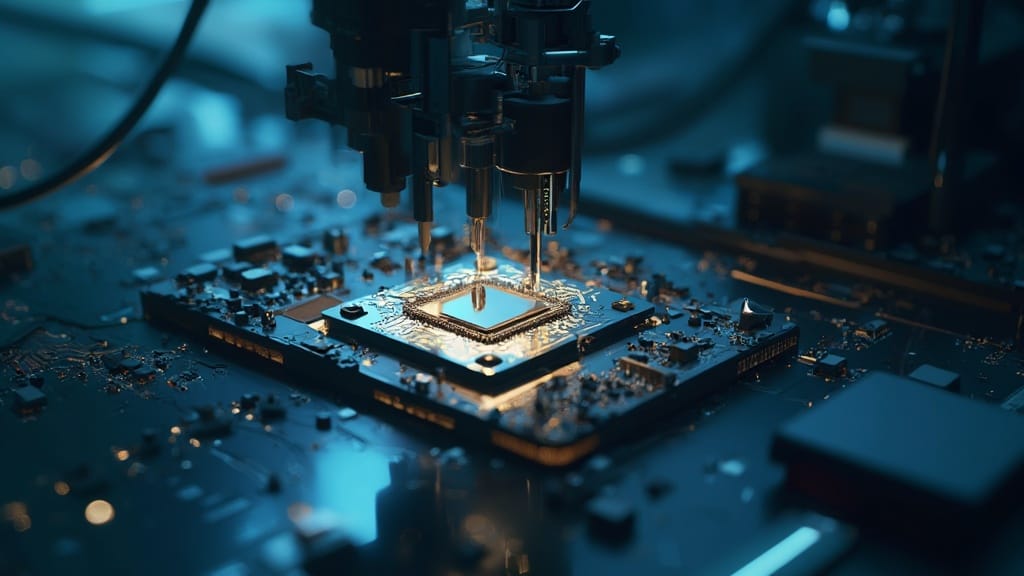
The PQC migration just jumped from cloud infrastructure into the device in your pocket.
STMicroelectronics, a Franco-Italian chipmaker and one of Europe's largest, introduced the ST54M: a single-die secure mobile processor with a dedicated hardware accelerator for post-quantum cryptography, combined with NFC, secure element, and eSIM functions. It supports ML-KEM and ML-DSA — the formerly named Kyber and Dilithium algorithms NIST standardized — with sampling now and production targeted for July 2026. Accelerating these in silicon rather than software means the performance penalty of quantum-safe crypto essentially vanishes on mobile.
The target use cases — contactless payments, transit tickets, digital identity, driving licenses, digital car keys — are exactly the things that lean on cryptography a future quantum computer could break, and ST pitches the chip at compliance with anticipated 2030 deployment requirements. If a major handset OEM picks it up, PQC becomes a consumer story rather than an enterprise one. The signal to watch is simply: which smartphone ships first with the ST54M inside.
Germany Launches a National Quantum Sensing Competition — With Real Money
Quantum sensing is the part of the stack closest to real-world deployment, and Germany just decided it wants to lead it.
SPRIND — Germany's Federal Agency for Breakthrough Innovations, essentially a German DARPA — launched its Quantum Sensing Initiative with two open competitions for teams across Germany and Europe. Quantum sensors exploit the extreme sensitivity of individual atoms to magnetic fields, gravity, or time to measure things classical instruments can't: GPS-free navigation, brain imaging without surgery, underground mapping. The structural detail that matters is that this is a milestone-funded competition, not a grant program — money follows deliverables, which is how you get from lab demos to deployable hardware.
If it works, Europe builds an industrial sensing sector rather than another pile of patents — and "patents yes, products no" is a critique German press already levels at itself. If it stalls, it's another well-funded program that produces papers. Following Korea's ₩645 billion commitment and France's 2030 encryption deadline, the larger tell is that Europe has stopped treating quantum sensing as a research curiosity. Watch which university-industry consortia enter, and whether the EU Quantum Flagship co-funds the winners.
Fujitsu Named Asia-Pacific Quantum-Inspired Computing Leader
While everyone argues about qubit counts, Fujitsu built a business on a different idea entirely — and just got recognized for it.
According to Korean quantum industry reporting, Fujitsu was named the Asia-Pacific leader in quantum-inspired computing, cited for both strategy and execution. The category deserves a clean definition: these are classical systems — no liquid helium, no laser traps — that borrow mathematical ideas from quantum mechanics to crack optimization problems faster than conventional algorithms. Fujitsu's Digital Annealer uses custom CMOS chips to mimic an Ising machine, which is unusually good at scheduling, logistics, and portfolio problems.
What changes if this category matures: quantum-inspired systems solve real problems now — drug discovery, traffic, finance — while gate-based machines are still chasing fault tolerance. The risk is that "quantum-inspired" stays a marketing prefix on classical optimization that a sufficiently clever GPU cluster could match. Watch whether the recognition converts into enterprise contracts in Southeast Asia, where digital infrastructure spending is climbing fast. [Source: Quantum Newspaper — Korean]
China Builds a Domestic Dilution Refrigerator That Can Cool a Thousand-Qubit Machine
The quantum hardware race isn't only about qubits — it's about the refrigerators that keep them cold. China just built its own.
According to Xinhua News Agency via the Chinese Academy of Sciences, China rolled a domestically produced single-core dilution refrigerator with large cooling power off the production line — rated to support a thousand-qubit machine. A dilution refrigerator chills superconducting processors to around 15 millikelvin, roughly a hundred times colder than deep space. Until now this market was dominated by Bluefors of Finland and Oxford Instruments of the UK.
This is a supply-chain milestone as much as a technical one. Western export controls have increasingly targeted quantum-enabling tech, and a domestic cryogenics capability removes one of the biggest hardware chokepoints in China's program. If the specs hold up under independent benchmarking, export controls on this layer lose their leverage — a geopolitical shift dressed as a fridge. Watch whether USTC or Origin Quantum publishes performance data; the Xinhua report is authoritative as an announcement, but the thermal-load numbers need third-party confirmation. [Source: Chinese Academy of Sciences / Xinhua — Chinese]
China's Xuanxiang Technology Claims a Million-Atom Optical Tweezer Array
The neutral-atom race has a new entrant, and the claimed scale is eyebrow-raising.
Xuanxiang Technology announced what it calls the world's first metasurface chip with a million-level atom optical tweezer array — a flat, nanoscale-engineered optical element meant to replace bulky lens systems and pack atoms far more densely than conventional setups allow. Optical tweezers are the same focused-laser trapping technique QuEra uses; the scaling bottleneck has always been that traditional optics can only juggle so many atoms before the hardware becomes unmanageable.
A million-atom array would dwarf anything demonstrated to date — which is exactly why this needs scrutiny. The claim comes from Chinese technology press citing the company directly, not a peer-reviewed venue, and the gap between trapping a million atoms and performing coherent quantum operations on them is enormous. You can fill a room with atoms you can't use as qubits. Treat this as a preprint-grade signal: watch whether Xuanxiang publishes specs in a reviewed journal and whether an established neutral-atom group reproduces it. [Source: Electronics Weekly — Chinese]
Microsoft's Majorana 2 Chip Is Still Under Academic Fire
Microsoft's topological-qubit bet — one of the boldest in the field — is taking renewed fire this week.
Korean outlets Digital Today and Nate report that academic debate is intensifying over the Majorana 2 chip, with a Nature article again questioning Microsoft's claimed breakthrough. Topological qubits encode information in the topology of exotic states called Majorana fermions, theoretically far more error-resistant than ordinary qubits — a bet Microsoft has pursued for over a decade. The dispute is whether the company has actually observed the Majorana signatures it claims, or whether the signals have mundane explanations.
This isn't new — a 2021 Nature paper was retracted over similar concerns — but its resurfacing around Majorana 2 says the scientific community remains unconvinced. If Microsoft delivers a rebuttal with fresh experimental data, topological qubits stay in the race. If the silence holds, the roadmap questions metastasize. Microsoft had not publicly responded at publication time. Watch for a formal response from Station Q or an independent replication attempt. [Source: Digital Today / Nate — Korean]
⚡ What Most People Missed
- Federal IT leaders are now operating under marching orders, not advice: CyberScoop's argument that agencies must stick to NIST's algorithms now reads less like an op-ed and more like a compliance memo, given the new order's 30-day requirement to name a PQC migration lead.
- The second executive order quietly tasks the Pentagon with fielding quantum sensors by 2028: Within 60 days, the Secretary of Defense must pick at least three next-gen sensor projects to field by September 30, 2028 — an aggressive, largely unreported deadline for the most deployment-ready corner of the quantum stack.
- CISA's coming "cryptographic bill of materials" will expose how far behind everyone is: Within 270 days, CISA and NIST must define a CBOM — think SBOM, but for encryption — and once it drops, every federal contractor will have to audit their crypto dependencies, which is when the gaps become visible.
- Saudi Aramco and France's PASQAL launched the Middle East's first commercial Quantum-Computing-as-a-Service, per Japanese and Chinese press — the first quantum cloud in the Gulf, and a sign adoption is no longer just a US-Europe-China story. [Source: Okinawa Times — Chinese]
- Fuxi Quantum closed two funding rounds in under sixty days, according to Mobile Sina — a Chinese startup barely two months old, raising twice over, a tell of how hard Chinese VC is chasing quantum hardware after Origin's ~$415M round. [Source: Mobile Sina — Chinese]
📅 What to Watch
- If OMB's 90-day memo names algorithm requirements beyond ML-KEM and ML-DSA, every federal contractor must update crypto libraries on a fixed schedule — not eventually, but by date.
- If QuEra publishes Libra's logical-qubit overhead at the June 30 AWS Summit, the 2028 fault-tolerance claim becomes an engineering program rather than a roadmap slide.
- If USTC or Origin benchmarks the new domestic dilution refrigerator, Western export controls on quantum cryogenics quietly lose their leverage.
- If a handset OEM commits to the ST54M, PQC crosses from compliance checkbox into a feature consumers never knew they wanted.
- If Microsoft stays silent on the Majorana 2 critique through the next news cycle, expect the topological roadmap to start drawing the kind of scrutiny that reorders investor confidence.
The Closer
This week: a president handing the entire federal government a five-years-early homework deadline, a Franco-Italian chipmaker quietly stuffing quantum-proof crypto into the thing you'll use to tap-pay for coffee, and a Chinese startup raising two rounds before it's old enough to have a functioning expense policy. Somewhere in all this, the Pentagon got told to field quantum sensors by 2028 and almost nobody noticed — which is roughly how every important deadline starts. The clocks are running; nobody's checked the budgets.
Stay cold, stay coherent.
If you know someone still treating post-quantum migration as a 2035 problem, forward this — their calendar just changed.