The Lyceum: Robotics & Automation Weekly — Apr 05, 2026

Photo: lyceumnews.com
Week of April 5, 2026
The Big Picture
This was the week the tariff-automation paradox became real math, not theoretical risk. Reciprocal tariffs landed on imported robots the same week China restricted rare-earth exports feeding every servo motor on the planet — raising the cost of automation at the exact moment labor economics demand more of it. Meanwhile, China's humanoid production infrastructure crossed a threshold that's hard to dismiss: government-backed training networks, 30-minute production cycles, and a vendor claiming 10,000 units shipped. The West is responding with permits, pilots, and partnerships, but the gap between "filing for factory space" and "shipping at industrial cadence" is widening, not closing.
What Just Shipped
- Mantis MR-1 Cobot (Mantis Robotics): TÜV-certified to ISO 10218 and ISO 13849, hitting 10 m/s in clear zones with 360-degree adaptive safety sensing — first customer shipments confirmed.
- SANY Connected Electric Forklift Line (SANY Robotics): Telematics-integrated electric forklifts debuted at LogiMAT 2026 with 600+ European preorders — connectivity-first platforms designed for fleet coordination upgrades.
- VDA 5050 v3.0 (VDA/VDMA): Major standard release adding path-sharing, zone-based traffic rules, and dynamic collision avoidance for multi-vendor AMR fleets — adopted by Vanderlande and Dematic.
- AGIBOT Humanoid — 10,000th Unit (AGIBOT): Shanghai-based maker reportedly crossed 10,000 cumulative humanoid shipments, doubling from 5,000 in three months across logistics, retail, and early industrial workflows.
- Leju/Dongfang Foshan Production Line (Leju Robotics / Dongfang Precision): Automated humanoid production facility in Foshan went live, producing one unit every 30 minutes across 24 digitalized assembly processes.
This Week's Stories
Foxconn Will Deploy Humanoid Robots to Build AI Servers in Texas
Nikkei Asia reported this week that Foxconn plans to deploy humanoid robots, trained and simulated on NVIDIA's Omniverse platform, to a Texas AI server plant within months. The report frames the project as a production commitment rather than a research partnership or concept demo.
If this works, it validates the sim-to-real pipeline for complex electronics assembly and gives every contract manufacturer a reference architecture to follow. Foxconn's scale means even modest per-unit productivity gains compound fast. If it doesn't — if autonomy rates stay below 50% on operational lines and teleoperation fills the gap — it becomes an expensive proof-of-concept that delays broader adoption by resetting expectations.
Two risks worth tracking: China's April 4 rare-earth export restrictions concern the neodymium and dysprosium in permanent-magnet servo motors — the joints a humanoid needs to function. And reciprocal tariffs raise duties on imported robot subassemblies. Both can inflate unit costs and stretch delivery timelines for Foxconn's suppliers even as the line ramps. The observable signal: if Foxconn reports >70% autonomous operation within six months, U.S. humanoid deployment timelines compress across the industry.
China Builds the Data Infrastructure to Train Humanoids at National Scale

Chinese humanoid firms told Nikkei Asia this week that real-world data — not hardware — is the binding constraint, and they're solving it by pushing robots into factory "internships" to collect labeled task data at volume. Unitree and UBTECH plan small-batch deployments across material handling, assembly, sorting, and quality inspection over the next two to three years, with every firm emphasizing the same bottleneck: data, data, data.
But the more significant development is structural. China's Ministry of Industry and Information Technology is backing a network of nine humanoid "training schools" running 395 robots across 13 models on standardized industrial scenarios — a centralized data collection infrastructure with no Western equivalent. Separately, over 100 humanoids are operating as supervised interns in a Guangxi smart factory, and AGIBOT has reportedly crossed 10,000 cumulative units shipped. A Foshan production facility is producing a humanoid every 30 minutes.
What changes if this succeeds: China gets both manufacturing scale and fleet-level operational learning simultaneously — the twin advantages that collapsed EV and solar costs. Failure looks like the data being too noisy or domain-specific to generalize, which would keep each deployment a custom integration project. Watch for Chinese vendors publishing standardized task-completion benchmarks from these training centers. That's when the data flywheel becomes a competitive moat, not just a government program. [Source: Seoul Economic Daily — Korean; Nikkei Asia — English; Interesting Engineering — English]
The Tariff Paradox Lands: Robots Cost More, But You Need Them More Than Ever
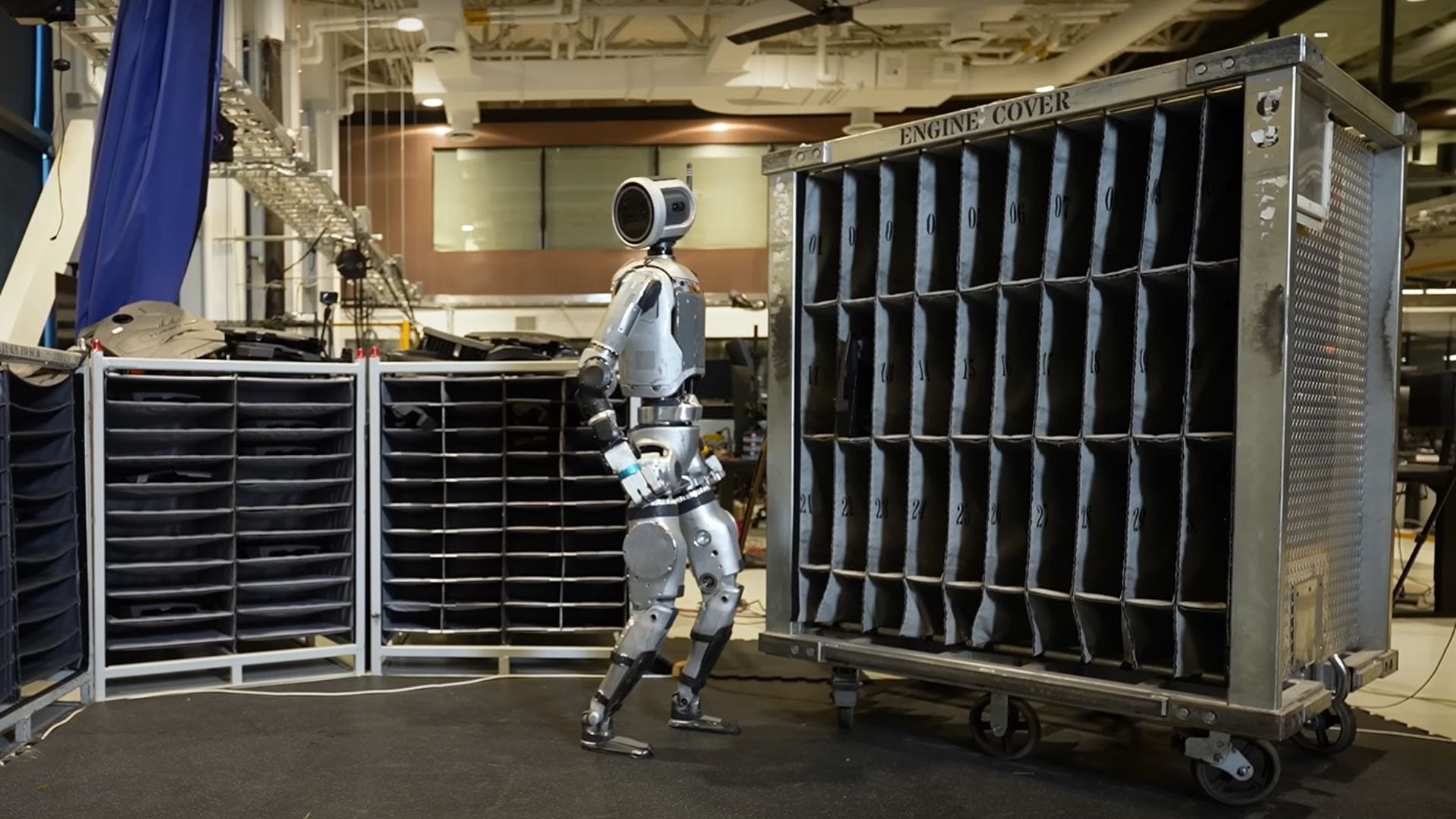
Reciprocal tariffs that took effect this week and China's April 4 export restrictions on seven rare-earth elements affected the industrial robot supply chain on two fronts simultaneously. Added duties raise landed costs on imported robots — and the U.S. imports most of its industrial robots from Japan and Europe, from Fanuc, Yaskawa, ABB, KUKA, and Stäubli. China's export controls constrain access to the neodymium and dysprosium magnets inside every modern servo motor. The U.S. imported roughly $603 million in industrial robots in 2024, per IFR data. A 10–25% tariff on hardware that typically runs $150,000–$500,000 per integrated cell is enough to push marginal automation projects back into the "not yet" column.
The cruel irony is structural: tariffs simultaneously raise the cost of automation equipment and increase the labor-cost pressure that makes automation necessary. Wake Industrial's tariff analysis details how component-level duties cascade through integrator pricing. Tesla has flagged Optimus rollout risks tied to magnet access. Integrators at the Robotics Summit reported tariff and rare-earth worries dominating hallway conversations.
If this persists, expect integrators to reprice projects, SMEs to defer rollouts, and OEMs to accelerate domestic production plans — but Fanuc's Michigan plant won't ship robots for 18–24 months. The gap between tariff impact and domestic capacity is where projects die. The signal to watch: formal Section 232 or IEEPA exemption filings from industry groups like A3. That's the first coordinated pushback, and its success or failure sets the cost baseline for 2027 automation budgets.
Fanuc Files $120M Permit for Robot Production Expansion in Michigan
When the world's largest industrial robot maker files permits for domestic production space, it's not a press release — it's a demand forecast poured into concrete. Fanuc submitted permits on April 2 for a $120 million expansion of its Rochester Hills, Michigan facility, adding 150,000 square feet of production capacity for cobots and heavy-payload models targeting automotive and EV battery lines. County filings confirm a Q2 2026 construction start and a projected 250 manufacturing jobs.
This follows additional reporting of a parallel $90 million land acquisition and 840,000-square-foot plant plan — signaling either multiple phases or complementary investments in the same strategic push. Combined with Fanuc's Q1 signal of 25% North American order growth year-over-year in Q1, the picture is clear: demand is real enough to justify building where the customers are.
If Fanuc executes on schedule, it shortens the supply chain for U.S. integrators and partially insulates customers from the tariff wall on Japanese imports. If construction delays or demand softens, the permits become expensive options. Watch for equipment orders for 500+ units from local integrators — that's the confirmation that capacity is being pre-sold, not speculatively built. Fanuc's MODEX 2026 preview — showing mobile and warehouse-focused manipulators alongside industrial arms — signals the company is placing strategic bets across both factory and logistics segments.
OSHA Issues Repeat Citation to Rivian Over AMR Pinning Incident
OSHA cited Rivian on April 3 for a repeat violation after a contractor was pinned between an autonomous mobile robot trailer and a loading dock at the company's Normal, Illinois warehouse. The fine was $18,500 — modest in dollar terms, but "repeat violation" is the classification that matters. It means OSHA found substantially similar hazards to a prior citation, which escalates future enforcement and signals a pattern the agency will track.
This is the third EV logistics enforcement action this year, per OSHA logs. The agency's broader 2024 injury summary now names robotics as a discrete hazard category, and a new Safety Champions Program is collecting robot incident narratives that historically precede inspection checklists. Rivian disputed the severity but confirmed the investigation.
Labor contract clauses are a parallel theater to regulatory enforcement: they can embed operational limits that outlast a single citation and reshape rollout economics. Separately, the Teamsters reached a tentative agreement with DHL that includes explicit anti-automation clauses — the clearest example yet of labor contracts writing operational limits on autonomous equipment into binding language. If you deploy in unionized environments, this changes rollout economics and timelines.
If OSHA continues this trajectory, expect formal guidance on lockout/tagout procedures for AMR systems and possibly new incident reporting codes specific to robot interactions. If enforcement stays ad hoc, the industry self-regulates unevenly. The downstream signal: when insurers start pricing AMR density into warehouse liability premiums — that's when safety becomes a line-item cost, not just a compliance exercise.
GE Vernova Breaks Ground on $1.2B Turbine Plant with Robotic Welding Cells
GE Vernova started construction April 1 on a $1.2 billion turbine facility in Greenville, South Carolina — 800 jobs, 200,000 square feet of automated bays, and Fanuc robotic welding cells for blade assembly. Permits detail IRA-qualified incentives worth $300 million and utility hookups sized for Industry 4.0 digital twin infrastructure. This is greenfield energy manufacturing at scale, with automation baked into the design rather than retrofitted.
What changes: this plant becomes a reference site for how robotic welding integrates into energy transition manufacturing — turbine blades require precision weld quality that's difficult to sustain manually across three shifts. If the welding cells hit target cycle times and defect rates, expect GE Vernova's Q2 earnings to signal expansion to additional sites. If integration takes longer than planned — welding automation in heavy industry is notoriously finicky — it becomes a cautionary tale about greenfield ambition outrunning commissioning reality. Watch capex guidance in Q2 earnings for language about scaling automated welding beyond Greenville.
EU Draft Regulation Mandates Safety Logs and Remote Diagnostics for Industrial Robots
An EU draft revision to the Machinery Safety Directive, in public consultation since March 22, proposes mandatory safety logs, remote diagnostics hooks, and tighter EN ISO 13849 functional safety requirements for industrial robot core components — precision reducers, servo drives, and safety PLCs. Industry coverage notes Chinese component makers are already racing to upgrade designs and documentation to maintain EU market access.
This is policy risk and competitive pressure fused into one regulation. If adopted, it transforms procurement: buyers will need to require digital safety-case artifacts and diagnostic APIs in RFQs, not just paper certificates. Chinese suppliers that certify early gain market share; those that don't get locked out of Europe's high-end automation market. The failure mode is regulatory delay — if the consultation drags into 2028, the market fragments between compliant and non-compliant component tiers. Watch for the consultation close date and whether major OEMs (Fanuc, ABB, KUKA) publicly endorse the telemetry requirements — that would signal they see compliance as a competitive moat.
New Products & Launches
Mantis MR-1 Cobot — Mantis Robotics' MR-1 passed full TÜV certification to ISO 10218 and ISO 13849, enabling 10 m/s operation in clear zones with 360-degree adaptive safety sensing that decelerates on human approach. Targeted at electronics and metal fabrication SMEs with 12 kg payload and zero-programming tablet setup. First customer shipments are confirmed.
VDA 5050 v3.0 — The warehouse robot interoperability standard hit v3.0 on March 28, adding path-sharing, zone-based traffic rules (speed limits, one-way lanes), and dynamic collision avoidance for mixed-vendor AMR fleets. Vanderlande and Dematic are early adopters, with a reported 40% integration time reduction in pilot deployments.
SANY Connected Electric Forklift Line — Debuted at LogiMAT 2026 with integrated telematics and partial automation features, collecting 600+ European preorders. These are connectivity-first platforms designed to upgrade into fleet-coordinated, semi-automated lift trucks — turning forklift procurement into a strategic automation decision.
⚡ What Most People Missed
- Warehouse fleet orchestration still breaks at scale. A WareRover simulator paper on arXiv showed that state-of-the-art multi-robot path planners suffer major throughput drops and deadlock spikes once you add realistic congestion and rush orders. Integrators have said this off the record for years; now there's a benchmark proving it. If you're evaluating 100+ AMR fleets, demand stress tests with ugly order mixes, not demo-day choreography.
- The actuator bottleneck just got named. IDTechEx's new humanoid market report identifies high-precision actuators, harmonic drives, and precision bearings — produced by a small set of Japanese and German suppliers including Harmonic Drive, Nabtesco, and THK — as the binding constraint on humanoid scale. Lead times and allocation from these suppliers, not compute or funding, will determine how fast volumes ramp.
- Prologis is becoming the automation kingmaker in logistics. The warehouse landlord published research showing it's embedding robotics-ready power, network, and floor standards into new builds, enabling tenants to deploy AMRs up to 12x faster. If your next DC lease doesn't specify floor flatness, mezzanine wiring, and pre-installed power drops, you're paying for that infrastructure twice.
- LogiMAT 2026 showed humanoids entering factories through side doors. Show-floor reporting from Direct Industry describes credible humanoid use cases as narrow and niche — one integrator's upcoming deployment has a humanoid fetching finished cameras to feed an existing line, essentially a flexible tugger with arms. The honest framing: ergonomic gap-fillers where fixed automation doesn't pencil out, not wholesale labor replacement.
- China published its first full-lifecycle humanoid standard system. MIIT released a framework covering design, testing, safety, and application categories for humanoid robots and embodied AI — official policy, not a vendor proposal. There's nothing comparable in the West yet, and Beijing is clearly trying to industrialize humanoids the way it did EVs: top-down standards spine first, volume second. [Source: Robozaps Blog — English summary of Chinese government release]
📅 What to Watch
- If Fanuc's Q1 earnings confirm >20% North American order growth year-over-year in Q1, the Michigan permits are a leading indicator of a broader reshoring wave, not an isolated bet — watch for integrator hiring and supplier tooling announcements in the Upper Midwest.
- If OSHA issues formal AMR-specific lockout/tagout guidance following the Rivian pattern, it will force every warehouse operator running 50+ AMRs to re-do risk assessments — creating a compliance cost that accelerates the shift to safety-certified platforms and changes procurement specifications.
- If the Teamsters-DHL anti-automation clause survives ratification, expect similar language in UAW spring bargaining — which would reshape OEM capex planning by making automation deployment a negotiated item rather than a management prerogative.
- MODEX 2026 opens April 13, 2026 in Atlanta — if Fanuc or OMRON announce ship dates for mobile manipulators (cobot arms on AMR bases), it confirms industrial OEMs are pivoting hard into logistics, not just showcasing prototypes.
- If China's rare-earth export license process produces supplier disclosures of 60+ day delays, servo motor lead times will cascade into robot cell delivery schedules across every major OEM — the first integrator to publicly reprice a project sets the market expectation.
The Closer
A Foshan factory stamping out humanoids every half hour like dim sum, an OSHA inspector writing up Rivian for the same robot hazard twice, and a Wisconsin utility docket quietly revealing a 40-megawatt factory that nobody's announced yet.
Somewhere, a procurement director is staring at a spreadsheet where the tariff on the robot and the tariff on the rare earth inside the robot are both going up — while the line item for "do nothing" just got more expensive too.
Until next week, keep your risk assessments current and your utility filings interesting.
If someone you know is buying robots, hiring integrators, or just trying to figure out why their BOM changed overnight — forward this their way.
From the Lyceum
Tariff shocks are reshaping factory siting and procurement, with chips and drugs carved out only temporarily. Read → Tariff Earthquake Lands — Chips and Drugs Get a Temporary Pass, Not a Permanent One