The Lyceum: Robotics & Automation Weekly — Mar 21, 2026
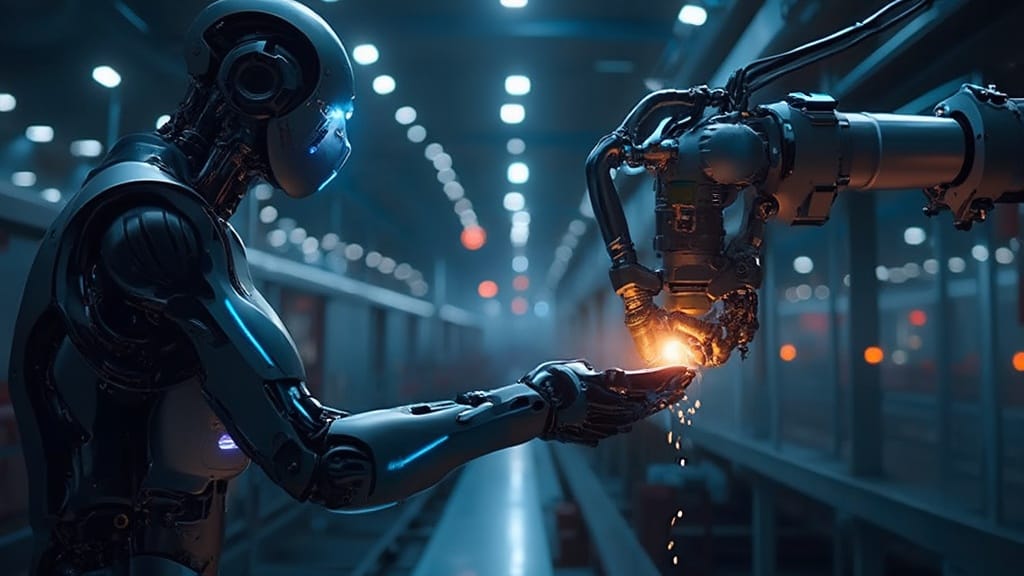
Photo: lyceumnews.com
Week of March 21, 2026
The Big Picture
This was the week the physical AI stack got its first real seams stitched together — and the week the numbers started arriving to test whether those seams hold. NVIDIA used GTC to pull every major robot OEM onto a shared simulation and training layer. Chinese humanoid producers showed up in Seoul with commercial hardware and paying customers, not pitch decks. And the first concrete factory-floor metrics — Xiaomi's 90.2% task success rate in the three-hour trial, Agility's 80% autonomy fraction in a warehouse pilot, Walmart's 500-unit AMR deployment — landed in the same seven-day window. The gap between platform rhetoric and production evidence is narrowing. It hasn't closed.
What Just Shipped
- Isaac GR00T N1.7 (NVIDIA): Open reasoning VLA model for humanoid robots, enabling zero-shot planning and whole-body control on Jetson Thor.
- V-JEPA 2 (NVIDIA / OpenClaw): Zero-shot robot planning model trained on 62 hours of domain-specific data, released in the OpenClaw ecosystem.
- Cosmos 3 (NVIDIA): World foundation model for generating synthetic training environments for physical AI.
- Nemotron 3 Super (NVIDIA): Open MoE model for agentic AI, available now for reinforcement learning prototyping via NeMo Gym.
- Atlas RL locomotion policies (Boston Dynamics × Robotics and AI Institute): Reinforcement-learning-trained zero-shot behaviors including running, crawling, and breakdancing on the electric Atlas platform.
- AmbiVision (Ambi Robotics): Perception-as-a-subscription layer under AmbiOS, offering packaging measurement, OCR, inspection, and quality-control skills for high-speed distribution centers.
This Week's Stories
NVIDIA Pulls Every Major Robot OEM Into a Single Platform — and the Factory Floor Is the Battleground
At GTC in San Jose, NVIDIA didn't just announce models. It announced an ecosystem lock-in attempt for the physical world. ABB, FANUC, KUKA, Yaskawa, Figure, Agility, Universal Robots, AGIBOT, Skild AI, and World Labs are all now building on NVIDIA's Isaac GR00T platform, Cosmos synthetic-world generator, and Jetson Thor compute module. The NVIDIA newsroom framed this around a "world foundation model" approach — a common simulation and training layer for everything from 5-ton welders to humanoids.
The most operationally specific claim: Skild AI is partnering with Foxconn to run high-precision assembly on NVIDIA Blackwell production lines, enabling dual-arm manipulators to handle what NVIDIA calls "the industry's most complex manufacturing tasks." That's the one to watch for validation — if Foxconn publishes cycle-time or yield data from a foundation-model-trained robot on a semiconductor line, it's a first.
What changes if this works: integration friction drops across vendors, and NVIDIA captures the middleware layer the way it captured GPU training. What failure looks like: OEMs adopt the simulation tools but keep proprietary control stacks, fragmenting the ecosystem the way ROS fragmented a decade ago. The observable signal is whether any OEM ships a commercially deployed robot trained end-to-end on Isaac/Cosmos within twelve months.
Seoul's Automation Expo Becomes the World's Most Important Humanoid Trade Show
Smart Factory & Automation World 2026 filled all of Seoul's Coex venue — 2,300 booths, the largest in 36 years. The significance isn't the booth count. It's that AGIBOT, Unitree, and Leju showed up with commercial humanoid hardware in a non-Chinese market, standing alongside Korean industrial buyers and Japanese OEMs with actual purchase authority. AGIBOT confirmed to The Robot Report that its X2 and G2 models are already in commercial use in China — not "ready for pilot," but deployed and generating revenue.
Korea's government used the event to announce a target of increasing factory automation by 10% by 2030, with legal and financial support for SMEs. Hyundai announced the MobED Alliance and reportedly plans to invest $6 billion in a robotics, data, and energy hub near Seoul — though that figure is stated intention, not a confirmed capital commitment with permits.
The structural story: Korea is now a commercial battleground between Chinese producers (volume, speed, price), Japanese OEMs (precision, reliability), and American platforms (software, AI). If Chinese humanoids start winning Korean procurement contracts at scale, Western OEMs lose a key reference market. Watch for named Korean buyer contracts with AGIBOT or Unitree — that's when the competitive dynamics become irreversible.
Walmart Deploys 500 AMRs in Texas — and the Throughput Numbers Are Real
Walmart rolled out 500 Locus Robotics autonomous mobile robots at a Texas distribution center, reporting roughly a 30% throughput boost in that deployment, per The Robot Report. This is production, not a pilot — a single-site deployment at a scale that makes AMRs standard operating equipment rather than a special project.
If this succeeds and replicates: AMRs become a line item in every DC buildout, and the market shifts from "should we automate?" to "which fleet management platform do we standardize on?" If it doesn't replicate — if throughput gains don't hold at other sites with different layouts or SKU mixes — the 500-unit number becomes an expensive outlier. The signal to watch: whether Walmart announces similar 300–500 unit rollouts at additional DCs by Q3. If it does, the procurement model has flipped.
Xiaomi Publishes the First Real Humanoid Factory Benchmark — and It's Not Quite Enough
Xiaomi published results from a three-hour autonomous trial at a Beijing EV plant: humanoid robots performing bilateral installation of self-tapping nuts on die-cast parts with a 90.2% task success rate in the three-hour trial and a 76-second cycle time. This is a station with die-cast variation and real line pacing — not a lab jig — making it one of the first public benchmarks of humanoids meeting takt requirements on a production line.
The caveat matters: 90.2% sounds impressive until you remember that automotive-quality defect rates are measured in parts per million, not percentages. A 9.8% failure rate in the trial on a fastening operation would shut down a quality audit. The evidence is company-sourced and amplified on Reddit forums, not third-party audited. Treat this as a firm "scaling pilots" signal — the kind of number that justifies continued investment, not the kind that justifies fleet orders. The observable next step: third-party verification and multi-station uptime data across a full shift.
BYD-UBTECH Is Running 100–200 Humanoids — the World's Largest Commercial Fleet
A market intelligence report published this week mapped actual commercial humanoid deployments with unit counts for the first time. The number that should stop you: BYD-UBTECH has 100 to 200 humanoids in automotive manufacturing — described as the world's largest commercial fleet. GXO-Agility Robotics has 100 units contracted through 2026 in logistics. BMW-Figure AI has 15 to 30 at Spartanburg. Mercedes-Apptronik has 10 to 20 for tote delivery.
Separately, analyst summaries discussed in forums estimate roughly 13,000–14,500 humanoids shipped in 2025, with Chinese vendors accounting for approximately 90% of that volume in 2025. Those figures are directional and based partly on vendor disclosures, but the implication is consistent across sources: the real-world learning curve for humanoids — the failure data, the maintenance logs, the edge-case library — is accumulating overwhelmingly in China. Western OEMs can't buy that data back. They can only generate their own, and they're starting from a much smaller installed base.
Agility's Digit Hits 80% Autonomy in a Warehouse Pilot
Agility Robotics announced that its Digit humanoid achieved 80% autonomous operation in a warehouse pilot, handling tote movement and palletizing with teleoperation filling the remaining 20% in the pilot, per The Robot Report. That autonomy fraction is the metric to track — it tells you how much human supervision the system still requires and, by extension, what the labor-cost equation actually looks like.
If the autonomy fraction climbs above 90% and a named customer signs a multi-year contract, Digit moves from "promising pilot" to "commercial product." If it stalls at 80% for another year, the teleoperation overhead erodes the ROI case. Watch for multi-shift uptime figures and a named customer — without both, this stays in the "interesting but unproven" category.
A $2.4 Billion Submarine Factory Opens in Alabama — and It's Already Running
Hadrian cut the ribbon on a 2.2-million-square-foot facility in Cherokee, Alabama, dedicated to mass-producing components for the Navy's Columbia- and Virginia-class submarine programs. The $2.4 billion project combines over $1.5 billion in private capital with $900 million in government funding. Secretary of the Navy John Phelan attended. This is not a speculative announcement — the plant is operating with automation and precision manufacturing lines.
This matters for the robotics supply chain: defense reshoring at this scale would create durable, multi-decade demand for heavy-duty material-handling robots, precision machining automation, and inspection systems. If defense manufacturing pulls even a fraction of the automation investment that automotive does, it would represent a new demand vertical that no major OEM currently models in its forecast. The signal: watch for Hadrian's equipment procurement disclosures — they'll tell you which robot OEMs are winning defense contracts.
OSHA Opens Investigation at Rivian Warehouse — and the Enforcement Pattern Is Shifting
OSHA confirmed an investigation into a contractor death at a Rivian warehouse near Normal, Illinois, where a worker was reportedly pinned between a trailer and a dock. The incident didn't directly involve a robot, but it's emblematic of how automation layers — AMRs, dock automation, conveyors, powered industrial trucks — interact with traditional logistics hazards in the same operational envelope.
Separately, OSHA enforcement logs surfaced a Michigan fulfillment center citation tied to an AMR collision that pinned a worker's foot — the first widely noted mixed-fleet citation of 2026. OSHA still has no dedicated robot rulebook; employers rely on general industry standards while ISO handles collaborative operations. But the OSHA robotics portal is where enforcement guidance will appear when regulators catch up — and the accumulating citation pattern suggests that's happening faster than the standards committees.
If OSHA's early actions emphasize dock-interface controls or powered-truck management, expect a wave of stricter enforcement at mixed manual/automated warehouses. Your automation project needs old-school traffic management and lockout/tagout rigor as much as it needs AI models.
Mind Robotics Raises $500 Million — and the Capital Wave Into Physical AI Hardware Is Real
Mind Robotics, a Rivian spin-out in Palo Alto, closed a $500 million Series A co-led by Accel and Andreessen Horowitz at a $2 billion valuation, targeting AI-driven robotic systems for manufacturing. In the same week, Rhoda AI emerged from stealth with a $450 million Series A (led by Premji Invest) for video-trained factory manipulation, and Nexthop AI secured $500 million for low-latency networking infrastructure designed for multi-robot fleet coordination.
That's $1.45 billion in a single week across three companies — bodies, brains, and wires. The signal isn't any one round; it's that top-tier VCs are simultaneously funding the hardware, the learning stack, and the infrastructure layer. For years, the big money chased software and LLMs. This week it bought physical AI as a category. If these companies deliver, the commercialization timeline for factory robotics compresses. If they don't, it's the most expensive demo reel in venture history.
New Products & Launches
KUKA KR TITAN ultra — KUKA expanded its heavy-duty portfolio with a robot handling up to 1,500 kg payload and 4,200 mm reach, targeting EV battery packs and vehicle body modules. A foundry version handles heat, dust, and moisture. This is the robot you need when your parts got heavier because you switched to EVs and your old cells can't lift the battery tray.
igus Iggy Rob — German polymer-components maker igus unveiled a humanoid built on its ReBeL cobot arms and mounted on a mobile base, claiming eight-hour battery life and targeting affordable industrial service applications. The interesting bet: attacking humanoid joint costs with plastic and polymer engineering instead of precision metal actuators.
Fanuc next-gen cobot — Fanuc released a new collaborative robot with enhanced real-time safety sensing designed around ISO/TS 15066, targeting SMEs in electronics and automotive assembly. Orders open immediately.
Mantis Robotics MR-1 — Mantis published specs for a cobot claiming 10 m/s speed in clear workspace with 360-degree adaptive safety zones, certified to ISO 10218 and ISO 13849. Notable caveat: the launch materials don't claim ISO/TS 15066 certification for power-and-force-limiting mode — a distinction that matters enormously for risk assessments.
⚡ What Most People Missed
- The 14-month actuator wait is project-killing. Lead times for precision actuators from top Japanese suppliers are now roughly 14 months, driven by booming demand and tariff frictions on Chinese-made linear actuators. Software and controls can be ready in weeks; if your actuator is on a boat that hasn't been loaded yet, your deployment timeline is fiction.
- ISO 25785-1 doesn't exist yet — and that's the liability window. The humanoid-specific fall-risk safety standard is still in ISO working groups, which means every company running humanoid pilots today is accumulating operational hours under the General Duty Clause with no consensus standard to point to. The first serious incident will define "recognized hazard" retroactively.
- Rockwell is building a 1-million-square-foot factory in Wisconsin — backed by a $2 billion U.S. investment program. This will become a reference site for how PLCs, robot cells, and warehouse AMRs integrate end-to-end. If you're a systems integrator, expect New Berlin to set procurement expectations for your customers within 18 months.
- The Commerce Department is quietly talking "physical AI" with robotics CEOs. A March 10 roundtable segmented the conversation into industrial robotics and humanoids — the classic D.C. precursor to targeted grant programs or export-control tweaks. No money yet, but the taxonomy is forming.
- Warehouse injury rates are building the automation case from the liability side. Warehouse sector injury rates run roughly 5.5 cases per 100 workers — materially above the private-industry average — and musculoskeletal disorders concentrate at exactly the tasks AMRs and cobots replace. The ROI spreadsheet is increasingly written by the workers' comp department, not the operations team.
📅 What to Watch
- If Foxconn publishes cycle-time or yield data from Skild AI-powered Blackwell assembly, it's the first independently verifiable metric from a foundation-model-trained robot in semiconductor manufacturing — and the proof point for NVIDIA's entire platform play.
- If OSHA issues robotics-specific enforcement guidance (not just General Duty Clause citations), it will reorder compliance expectations faster than ISO committees can move and immediately change insurance pricing for pilot sites.
- If Walmart announces 300–500 AMR rollouts at additional DCs by Q3, AMRs shift from special project to standard procurement line item — and fleet-management software becomes the real margin battleground.
- If Chinese humanoid producers sign named Korean buyer contracts at commercial terms, Western OEMs lose a key reference market and the price-competition dynamic becomes structural.
- If the 14-month actuator lead time persists through Q2, expect a wave of "software-ready, hardware-delayed" deployment announcements — and watch for alternative actuator suppliers (Chinese, Korean) gaining share by default.
The Closer
A plastic humanoid on wheels from a polymer company, a robot that can bench-press a pickup truck, and half a billion dollars for a startup whose parent company still can't deliver its own trucks on time.
Somewhere in a Seoul convention hall, an AGIBOT sales rep is explaining to a Hyundai procurement manager that the humanoid is already in production — while in San Jose, NVIDIA is explaining to everyone else that the operating system for those humanoids runs on their chips. The actuator, meanwhile, is on a 14-month backorder from Osaka.
Until next week. —
If someone you know is buying robots, building factories, or trying to figure out which of these headlines actually matters — forward this.
From the Lyceum
The FTC just made AI hiring bias an active federal enforcement target — any employer using automated screening in manufacturing or logistics hiring now carries real legal exposure. Read → The FTC Just Made AI Hiring Bias a Federal Enforcement Target