The Lyceum: Robotics & Automation Weekly — Mar 22, 2026
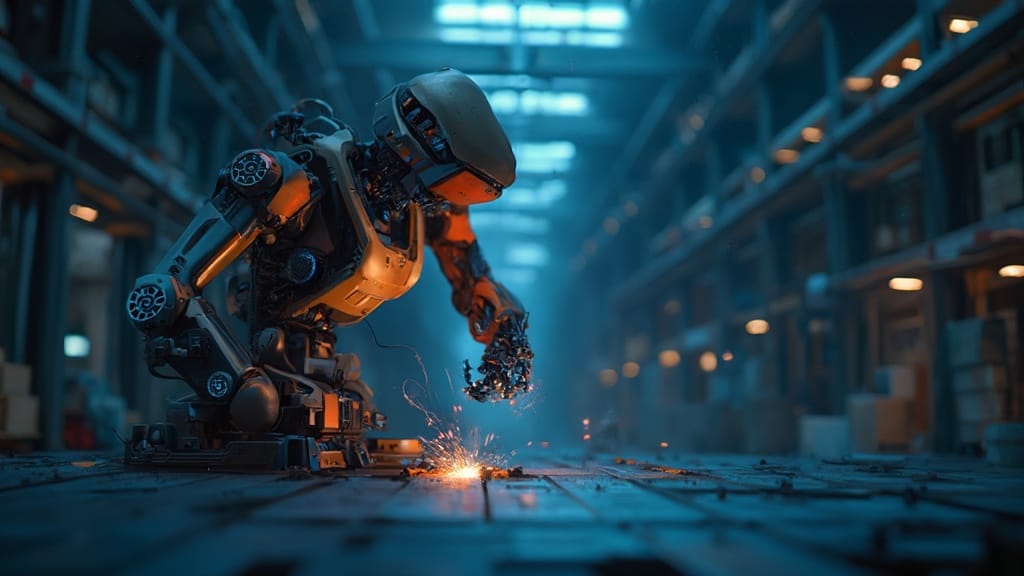
Photo: lyceumnews.com
Week of March 22, 2026
The Big Picture
This was the week NVIDIA completed its quiet encirclement of the global robotics industry — every major OEM now builds on its stack — while the components those robots actually need got harder to source. Actuator lead times hit 14 months, China's rare earth magnet restrictions became a direct constraint on Tesla's Optimus production line, and tariffs designed to encourage reshoring simultaneously made the automation equipment that enables reshoring more expensive. The capital is enormous and real: Intel's $19.5 billion CHIPS Act package, a $1.5 billion Michigan EV plant, Walmart's 500-robot warehouse fleet. But the supply chains, trade rules, and safety infrastructure haven't caught up to the ambition. This is the week the industry stopped debating whether physical AI is coming and started fighting over who controls the bottlenecks.
What Just Shipped
- NVIDIA OpenClaw (NVIDIA): Open-source robotics experimentation toolkit released at GTC 2026 for community-driven manipulation research.
- V-JEPA 2 (Meta): World model achieves zero-shot robot planning after training on just 62 hours of domain-specific data — a meaningful step toward robots that generalize without task-specific fine-tuning.
- PTC–NVIDIA Onshape-to-Isaac Sim Workflow (PTC/NVIDIA): Automates design-to-simulation pipeline, eliminating manual data transfer for manufacturers like FANUC; PTC claims up to a 60% reduction in prototyping costs over the prototyping cycle, per PTC claim.
- Orca Dexterity Open-Source Robotic Hands (Orca Dexterity): Three new open-source dexterous hands for advanced manipulation, full availability slated for May 2026.
- NVIDIA Cosmos World Models & Isaac GR00T N (NVIDIA): New world foundation models and humanoid skill-transfer frameworks unveiled at GTC, designed to give robots generalizable skills across hardware platforms.
- Shotoku Aura TR-XPTZ & Swoop Robotic Crane (Shotoku): Broadcast robotic control system and crane family replacing manual jibs, with QR-coded navigation for studio pedestals.
This Week's Stories
NVIDIA Pulls Every Major Robot OEM Into a Single Platform — and the Factory Floor Is the Battleground
The most important robotics announcement of the quarter wasn't a new robot. It was a platform lock-in.
At GTC 2026, NVIDIA revealed that ABB Robotics, AGIBOT, Agility, FANUC, Figure, KUKA, Universal Robots, and YASKAWA are all building on NVIDIA's simulation and AI stack to develop and deploy physical AI. Per NVIDIA's announcement, these companies represent a combined installed base exceeding two million robots. The new Cosmos world models, Isaac simulation frameworks, and GR00T N skill-transfer models are designed to let robots learn generalizable tasks in simulation and deploy them across different hardware — the piece that traditional fixed-task programming has never delivered.
If this works, NVIDIA becomes the operating system layer of industrial robotics the way Android became the OS of smartphones: the OEMs build the hardware, but the platform owner captures the ecosystem economics. Factory operators get faster deployment cycles and transferable skills across robot brands. If it doesn't — if sim-to-real transfer continues to break on real-world variation — NVIDIA has a very expensive set of partnerships that produce impressive demos and mediocre production throughput. The signal to watch: whether OEMs start shipping robots with NVIDIA inference hardware baked in as standard, not optional. That's when "partnership" becomes dependency.
Actuator Lead Times Hit 14 Months — and Integrators Are Redesigning Cells Around the Shortage
The robots are ready. The gearboxes inside them are not.
Lead times on RV reducers and harmonic drives from Nabtesco and Harmonic Drive have stretched to 14 months, per Manufacturing Magazine, forcing integrators into real-time kinematic workarounds. Teams are swapping six-axis cobots for Cartesian pick-and-place systems or linear-actuator designs to hit delivery windows — changes that add $15,000–$40,000 in re-engineering cost but shave months off schedules. Nabtesco, which controls roughly 60% of the RV reducer market as of 2025, has broken ground on a $140 million expansion at its Tsuruga plant, but industry sources don't expect meaningful relief before 2027.
If the expansion delivers on schedule, the bottleneck compresses and deferred projects flood back into the pipeline — watch for Fanuc and KUKA order surges as the leading indicator. If it slips, the redesign-around-the-shortage pattern becomes permanent for a generation of robot cells, and alternative actuator architectures (direct-drive motors, cycloidal drives from smaller suppliers) gain structural market share they wouldn't have earned on technical merit alone. The practical signal: integrators who buffered stock are now in a position of unusual leverage. Those who didn't are learning an expensive lesson about treating precision components like commodity parts.
Tesla Bets the Fremont Factory on Optimus — and China Controls a Key Ingredient
Tesla is ending Model S and Model X production to convert Fremont into a humanoid robot factory, per Automotive News. The capital commitment is unambiguous: Tesla plans over $20 billion in 2026 capex, up from $8.5 billion in 2025, with a significant share going to Optimus production, per Robozaps.
Friction matters more than the factory conversion. Reports say China's Ministry of Commerce has imposed export restrictions on rare earth magnets in response to U.S. tariffs, and Tesla is reportedly seeking licenses for the permanent magnets its Optimus arm actuators require. Tesla has said that while the company broadly doesn't need permanent magnets, the volume-constrained arm actuators require motors made as small as possible, requiring rare earth magnets.
If the license comes through, Optimus production proceeds on schedule and Tesla becomes the largest single buyer of rare earth magnets outside the EV motor market. If it doesn't, Tesla faces either a multi-quarter hardware redesign to alternative motor topologies or a diplomatic resolution that gives Beijing leverage over the production timeline of America's most high-profile humanoid program. Watch BIS filings and Chinese commerce ministry statements — not Musk's posts — for the real signal.
Walmart Deploys 500 AMRs in Texas — and the Throughput Numbers Are Real
Walmart rolled out 500 Locus Robotics autonomous mobile robots at a Texas distribution center, reporting roughly a 30% throughput boost on the deployment, per The Robot Report. These aren't pilot units in a cordoned-off section of a warehouse — this is a production-scale fleet handling live fulfillment volume.
If this deployment holds its throughput gains through peak season, it becomes the procurement benchmark that every logistics VP uses to justify their own AMR fleet. Walmart's scale means its vendor choices ripple through the entire 3PL ecosystem: when Walmart validates a platform at 500 units, mid-market logistics operators follow within 12–18 months. If throughput degrades under peak load or maintenance costs spike, it's a cautionary tale about the gap between controlled rollout and sustained operations. The signal: watch whether Walmart expands to additional DCs by Q3, or whether this stays a single-site deployment through year-end.
Seoul's Automation Expo Becomes the World's Humanoid Trade Show — and China Showed Up With Product
Smart Factory & Automation World 2026 filled all of Seoul's Coex venue — 2,300 booths, the largest in 36 years — and the subtext was unmistakable: this is now the world's most important humanoid trade show, and almost no Western outlet covered it that way.
AGIBOT displayed its X2 and G2 humanoids and claimed world-leading shipment volume, with a representative confirming commercial use in Chinese factories. Unitree signaled openness to technology cooperation with South Korean manufacturers — notable given Korea's production expertise at Samsung, Hyundai, and LG. The Korean government has publicly committed to increasing factory automation by 10% by 2030, and Hyundai reportedly plans a $6 billion robotics, data, and energy hub near Seoul with plans to buy "tens of thousands" of robots from its Boston Dynamics unit.
If Korean manufacturers start signing supply agreements with Chinese humanoid OEMs, it validates China's production lead and creates a commercial ecosystem that Western competitors will struggle to match on volume and price. If Korea builds domestic alternatives or buys Western, the humanoid market fragments along geopolitical lines. The observable signal: procurement announcements from Korean auto and electronics firms in Q2–Q3 naming specific humanoid suppliers.
CHIPS Act Money Turns Into Automation Procurement — $500 Million for Fab Upgrades
The Commerce Department awarded roughly $500 million this week specifically for upgrading automation inside U.S. semiconductor fabs — digital twins, AI-driven quality control, and related systems. This sits alongside Intel's finalized $19.5 billion CHIPS Act package (up to $8.5 billion in direct funding plus ~$11 billion in loans), per the Commerce Department announcement.
Every new fab is a multi-billion-dollar automation procurement event — robotics, metrology, custom end-effectors, and massive systems-integration contracts follow the cement truck. The $500 million automation-specific pool is an immediate signal for software, vision, and metrology vendors. If these funds flow quickly into RFPs, expect integrator capacity in semiconductor automation to tighten by Q3. If disbursement stalls in bureaucratic review, the gap between policy ambition and production reality widens. Watch Commerce Department disbursement timelines and the next CHIPS payouts — TSMC and Samsung are candidates, and each creates its own procurement pipeline.
China's Rare Earth Restrictions Are Now a Robot Supply Chain Problem
The rare earth story has been covered as a chip story and an EV story. It's now a robotics story.
Permanent magnets made from neodymium and dysprosium sit inside virtually every high-torque servo actuator used in industrial robots and humanoids. Per Interesting Engineering, the U.S. relies heavily on imported robots and components from Japan, Germany, and South Korea, and new tariffs risk increasing costs and slowing adoption — with over 500,000 factory jobs unfilled as of March 2026. Layer on the temporary 10% global surcharge in effect as of March 2026 and the open Section 301 probe covering 16 economies, per a Reddit policy tracker, and the same tariffs meant to encourage reshoring are simultaneously making the automation equipment that enables reshoring more expensive.
If BIS classifies actuator components or servo magnets as controlled items, the cost structure for U.S. robot imports from allied nations reshuffles overnight. If diplomatic channels resolve the licensing bottleneck, the current friction becomes a temporary surcharge rather than a structural redesign trigger. The signal: watch BIS export control filings and USTR Section 301 scope announcements for specific HS codes covering servos, actuators, and robot end-effectors.
OSHA Opens Fatal Incident Investigation at Rivian — and the Enforcement Pattern Is Shifting
OSHA confirmed an investigation into a contractor death at a Rivian warehouse near Normal, Illinois, where early reports indicate a worker was pinned between a trailer and a dock in a facility with automated equipment. This is an active enforcement case, not a policy discussion.
Multiple sources indicate OSHA is shifting from one-off fines toward systemic audits and programmatic enforcement in facilities running mixed fleets — AMRs alongside conveyors alongside manual workers. A DOL Inspector General report that's been recirculating notes that OSHA has historically under-classified robot-related incidents in its Injury Tracking Application, weakening inspection targeting. Meanwhile, OSHA's robotics guidance pages display a notice that the site hasn't been updated since October 2025 due to suspended government operations — the worst possible timing given the pace of deployment.
If this investigation results in significant citations tied to automated equipment, it sets precedent for how OSHA treats mixed human-robot environments and could trigger updated guidance that raises compliance costs across the logistics sector. If it's classified as a conventional dock incident, the regulatory gap persists. The practical signal for operators: clean OSHA 300 logs and formal risk assessments for every robot cell and AMR fleet are no longer optional — they're the minimum defensible position.
John Deere Expands Autonomous Tractors Across 50,000 Midwest Acres
Autonomy isn't limited to factories and warehouses. John Deere rolled out autonomous tractors handling planting and tilling across roughly 50,000 acres of Midwest farmland this week, per Agriculture.com. This is field robotics at genuine production scale — not a demo plot, not a controlled test section.
If yields and operational costs hold through the growing season, Deere has the proof point to push autonomous operations into its broader dealer network and make the case to mid-size farms that can't find seasonal labor. If equipment failures or edge cases (weather, soil variation, obstacle detection) cause meaningful downtime during planting windows, the reputational cost is high — farmers don't get a second chance at planting season. Watch Deere's Q2 earnings for acreage expansion targets and dealer adoption rates.
New Products & Launches
Fanuc next-gen collaborative robot — Fanuc released a new cobot with enhanced real-time safety sensing designed around ISO/TS 15066, explicitly targeting SMEs in electronics and automotive assembly. Available for order now. Per The Robot Report, the ease-of-use features aim to lower the integration barrier for shops without dedicated robotics engineers.
UR AI Trainer — Universal Robots and Scale AI launched a leader-follower imitation learning system that captures motion, force, and vision data while a human demonstrates tasks. Per the press release, the system creates a data flywheel — demo, dataset, model, deployment — designed to shorten cobot deployment cycles for small manufacturers.
Figure 03 — Figure AI's third-generation humanoid claims twice the camera frame rate, one-quarter the latency, and 60% wider field of view in Figure AI's lab-spec comparisons versus its predecessor, with palm-embedded cameras for close manipulation. Per Figure AI, early pilot activity targets automotive body shop operations. Still marketing claims — watch for third-party metrics from partners like BMW.
⚡ What Most People Missed
- Lightwheel is co-developing NVIDIA's Newton physics engine to enable Samsung's assembly robots to master cable handling in simulation — buried in NVIDIA's ecosystem announcement and covered by nobody. Cable routing is one of the hardest manipulation tasks in electronics assembly amid cables that deform unpredictably and resist rigid-body simulation. If Newton handles this in sim-to-real transfer, it closes a gap that has blocked electronics assembly automation for a decade. Source: NVIDIA press release (company marketing).
- China's insurance industry is writing the rules humanoid OEMs can't avoid. China Pacific Property Insurance released China's first dedicated insurance for commercial humanoid robots, covering production, sales, leasing, and usage, per China Daily. Insurance products encode risk assumptions that become de facto safety standards — Chinese insurers pricing this risk first are accumulating the actuarial data that will inform global frameworks. U.S. integrators are building similar datasets without the same structured insurance product. [Source: China Daily — English]
- Bloomberg analysis puts current humanoid payback periods at roughly nine years — but projects that figure could shrink to just over a year by 2035 if hardware costs fall and runtimes extend to full shifts. The earliest cost savings are likely in material transport, where humanoids could cut final-assembly labor costs by about 4% on an annual basis, per Bloomberg Professional Services. That 4% is small enough to be credible — and it tells you where ROI will actually accumulate first.
- The RoCo planetary gearbox assembly benchmark sets a production-relevant standard for testing collaborative robots on tasks that resemble real industrial assembly — not lab puzzles. The physical round attracted 60+ teams and emphasized recovery-from-failure strategies. Per arXiv, if any major OEM adopts this as a bake-off test, sim-to-real research finally gets held to factory-grade standards.
- A recent 10-Q filing revealed over half of a $73 million capex program went into subsea robotics and autonomous mobile systems — a clear signal that field-grade robots are moving from R&D to capacity build-out. Per the SEC filing, when subsea businesses buy fleets, utility and heavy-industry robots usually aren't far behind.
📅 What to Watch
- If Tesla announces a rare earth licensing deal with China — or a motor redesign to eliminate permanent magnets — it signals whether Optimus production proceeds on schedule or faces a multi-quarter hardware delay. The redesign path would also validate alternative motor topologies for the entire humanoid industry.
- If USTR signals that specific HS codes for servos, actuators, or CNC controllers are in scope for Section 301 remedies, every 2027 automation capex plan in the U.S. needs a sourcing re-think — and RaaS providers who own their hardware gain a structural pricing advantage over import-dependent integrators.
- If Nabtesco's Tsuruga expansion yields ramp earlier than expected, deferred robot cell projects flood back into the pipeline simultaneously — creating a surge that could overwhelm integrator capacity and flip the bottleneck from components to labor.
- If Korean auto or electronics firms announce humanoid supply agreements naming Chinese OEMs in Q2, it validates China's production lead and creates a commercial ecosystem the West can't match on volume — effectively splitting the humanoid market along geopolitical lines.
- If the Rivian OSHA investigation results in citations tied to automated equipment rather than conventional dock operations, it sets enforcement precedent for every mixed human-robot facility in the country — and could trigger the updated guidance that OSHA's frozen website currently can't deliver.
The Closer
A chip company became the operating system of every robot on earth, a car factory became a humanoid factory that needs a Chinese export license to function, and a gearbox shortage forced engineers to redesign entire production cells around a component the size of a coffee can. Somewhere in a Seoul convention center, a Chinese robotics company is selling finished humanoids while American regulators display a website notice that says "not updated since October 2025." Forward this to someone who still thinks automation is a 2030 problem.
—The Lyceum
From the Lyceum
The White House released a six-principle AI legislative blueprint and told states to stand down — directly relevant to automation liability and OSHA rulemaking timelines. Read → The White House Hands Congress an AI Rulebook