The Lyceum: Space Economy Weekly — Apr 16, 2026
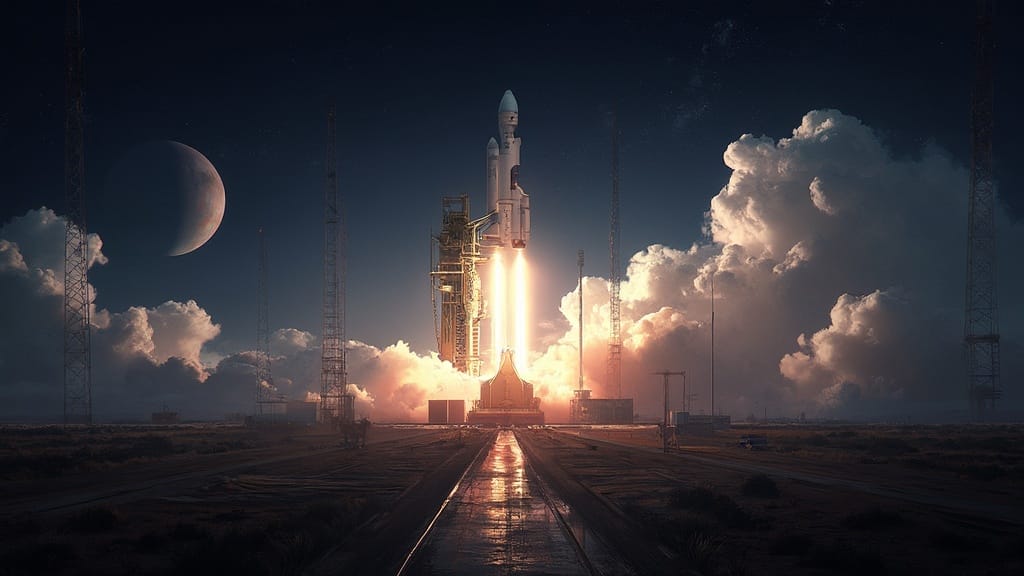
Photo: lyceumnews.com
Week of April 16, 2026
The Big Picture
Amazon agreed to acquire Globalstar for approximately $11.57 billion — the satellite operator used by Apple's Emergency SOS feature — and in doing so acquired spectrum licenses that could help Project Kuiper compete with Starlink. Meanwhile, the Space Force quietly signaled it will dissolve the agency that built the Pentagon's fastest-ever satellite constellation, SpaceX cleared the last ground test before Starship V3's first flight, and the FCC prepared to vote on rules that could multiply LEO broadband capacity without launching a single new rocket. This was a week where the pipes — spectrum rights, launch pads, regulatory templates, org charts — mattered more than any payload.
What Just Shipped
- Northrop Grumman CRS-24 Cygnus XL (Northrop Grumman / NASA): Launched April 11 on Falcon 9, delivering supplies and research payloads to the ISS under Commercial Resupply Services — routine logistics that quietly validates the orbital delivery market.
- Artemis II Orion Capsule — Mission Complete (NASA): Four astronauts returned April 10 after a 10-day lunar flyby, flight-proving Orion's heat shield, life support, and deep-space navigation under real cislunar conditions.
- Starship V3 Super Heavy Booster 19 — Full 33-Engine Static Fire (SpaceX): All 33 Raptor 3 engines fired at Pad 2, Starbase, clearing the final major ground test before Flight 12 targets a May launch window.
- SWFO-L1 Space Weather Data Products (NOAA): New solar-wind monitoring data now flowing to utilities, airlines, and satellite operators — better warning inputs for geomagnetic storm disruption risk.
This Week's Stories
Amazon Buys Globalstar for $11.6 Billion — and the Satellite Broadband Market Just Restructured
Amazon announced Tuesday it will acquire Globalstar for approximately $11.57 billion — $90 per share — folding the satellite operator into its rebranded "Amazon Leo" broadband business (formerly Project Kuiper). The deal, expected to close in 2027 pending FCC review, is the largest space-sector acquisition in history.
What Amazon is really buying isn't Globalstar's two dozen operational satellites. It's the spectrum. Globalstar holds internationally coordinated S-band and L-band licenses — the frequencies critical for direct-to-device connectivity, where your phone talks to a satellite without special hardware. According to TechCrunch, those licenses would have taken years to obtain independently through international coordination bodies. By buying Globalstar, Amazon bypasses the queue and inherits harmonized rights across dozens of countries overnight.
The competitive shockwave was immediate. AST SpaceMobile's stock dropped 25% on the session, according to FinancialContent reporting — the market's verdict on what an Amazon-backed direct-to-cell service means for independent players. Apple faces a different problem: its iPhone Emergency SOS feature currently runs on Globalstar's network, and the acquisition hands Apple's satellite partner to a direct competitor.
There's a delicious subplot: Globalstar has an existing contract with SpaceX to launch replacement satellites this year, per TechCrunch. That means SpaceX is contractually obligated to launch hardware for a company that just became Amazon's property — and Amazon's primary rival in broadband. Expect that agreement to be renegotiated or quietly unwound before closing.
FCC Chairman Brendan Carr told CNBC the agency is "very open-minded" about the deal and sees potential for Amazon to become a genuine competitor to SpaceX in direct-to-cell. Watch whether Amazon uses the acquisition to argue for an extension on its July 2026 FCC milestone requiring roughly 1,600 Kuiper satellites in orbit — it currently has approximately 241 spacecraft in orbit as of April 2026.
Starship V3 Clears Its Last Ground Test — Flight 12 Targets May
SpaceX ignited all 33 Raptor 3 engines on the Starship V3 Super Heavy booster at Starbase's Pad 2 on April 14, clearing the final major ground-test milestone before Flight 12. The upper stage, Ship 39, completed a separate six-engine static fire — skipping the usual single-engine checkout, which suggests high confidence in the Raptor 3 hardware.
The version jump is not incremental. V3 stands 408 feet tall and can carry over 100 tons to low Earth orbit in a fully reusable configuration, per Teslarati — roughly triple the V2's capacity. That's a different class of vehicle, and it's the one that makes next-generation Starlink economics work: each V3 flight can carry dramatically more bandwidth capacity than a Falcon 9 mission ever could.
But the story most people aren't writing is the pad. This test was conducted at Pad 2, which will double Starbase's launch capacity when fully operational. A single pad with a single integration stack is a bottleneck regardless of how fast you build rockets. Pad 2 is the infrastructure that makes SpaceX's stated ambition of high-cadence Starship operations physically possible. The FAA also published a final tiered environmental assessment on April 15 covering additional launch trajectories and return-to-launch-site profiles from Boca Chica — the airspace template that makes higher-tempo operations legally plausible.
If V3 meets performance targets without major redesigns, every competing constellation — Kuiper, Telesat Lightspeed, IRIS² — is building business cases against a Starlink that no longer exists. If the FAA license slips, Flight 12 could move to June, cascading into Starlink Gen3 deployment and the Starship Human Landing System test schedule that Artemis 3 depends on.
⚡ The SDA Is Probably Going Away — and Its "Go Fast" Culture May Go With It
The Space Development Agency — the Pentagon shop that built the Proliferated Warfighter Space Architecture faster and cheaper than anything the traditional defense acquisition system had managed — is being reorganized out of existence. SDA's acting director said this week that "there probably won't be an SDA or Space RCO or SSC — there will be something else," according to Breaking Defense. The Space Force intends to finalize its new portfolio-based acquisition structure by June.
The org chart change matters less than what it does to the budget. The SDA's Transport Layer Tranche 3 — roughly 140 planned satellites for military data relay — is not funded in the FY27 budget request. Earlier appropriations included $500 million for Tranche 3, but the FY27 request suggests the administration isn't interested in continuing that fight. Instead, the budget includes $1.6 billion for "Proliferated LEO SATCOM" — a line item that Breaking Defense reports represents funding for a classified SpaceX-operated constellation serving as the military's LEO communications backbone.
The practical implication: the Pentagon's space data network is increasingly likely to be a hybrid of government-owned Tranche 1/2 satellites and a classified commercial constellation, not the fully government-owned architecture SDA originally designed. For York Space Systems, Northrop Grumman, Lockheed Martin, and Rocket Lab — all of whom hold Tranche 2 contracts and expected Tranche 3 follow-ons — this is a direct revenue risk. The observable signal: if Tranche 3 gets formally cancelled rather than deferred in the June finalization, the "go fast" model didn't just get absorbed — it got replaced.
New Glenn Gets Closer to Vandenberg — and the Military Gets a Second Heavy-Lift Option
Blue Origin is one step closer to launching New Glenn from Vandenberg Space Force Base in California, according to Spaceflight Now. The Space Force selected Blue Origin to develop Space Launch Complex 14 at Vandenberg — a greenfield site that will require building pad infrastructure from scratch.
Why this matters: if you want to put a spy satellite or an Earth observation payload into a polar orbit (the kind that sweeps over the entire globe from north to south), you launch from California, not Florida. Right now, SpaceX's Falcon 9 dominates polar-orbit access through its Transporter rideshare missions from Vandenberg. A New Glenn capability there would give Blue Origin — which has completed two successful New Glenn flights from Cape Canaveral — direct access to the polar-orbit market that serves national security, weather, and Earth observation customers.
The real test isn't the rocket. It's the concrete. SLC-14 is currently empty land. Environmental reviews, lease approvals, and construction pace now matter as much as propulsion engineering. If Blue Origin can stand up a functional pad in two years, the military gets genuine vendor redundancy for heavy-lift polar access. If construction drags past three years, the window for competing with SpaceX on national security launch contracts narrows considerably. Watch for an FAA Part 450 license application and SLC-14 environmental approval as the next concrete milestones.
The FCC Prepares to Kill the 1990s Speed Limit on LEO Broadband
On April 30, the FCC will vote on replacing its Equivalent Power Flux Density rules — regulations from the late 1990s that cap how much power low Earth orbit satellites can transmit, originally designed to protect geostationary satellite operators from interference. The proposed shift to a performance-based interference standard would let LEO operators increase on-orbit transmit power significantly.
The math is striking: by some industry estimates, the rule change could increase usable capacity of existing LEO constellations by up to seven times — without launching a single new satellite. That's a massive, regulator-issued capacity upgrade that would directly reduce per-megabit costs for Starlink, Kuiper, and every other LEO broadband operator.
Legacy geostationary operators are pushing back hard, arguing the change risks interference with their services. If the rules pass, expect a rapid decline in LEO broadband pricing and a corresponding squeeze on GEO operators who compete on bandwidth. If the vote fails or gets delayed, LEO operators face the same capacity constraints that currently make rural broadband economics marginal. The April 30 vote is the single most consequential near-term regulatory event in the satellite broadband market.
⚡ What Most People Missed
- Starlink launched its 1,000th satellite of 2026 in just 104 days. Two Falcon 9 missions fired 19 hours apart from opposite coasts to cross the milestone, per KeepTrack. The annualized rate approaches 3,500 satellites per year. Nobody else in the industry is within an order of magnitude of this manufacturing and launch throughput.
- Artemis II quietly doubled as a solar observatory. A preprint on arXiv reveals the crew captured observations of the sun's outer dust ring during a natural eclipse geometry along the cislunar trajectory — turning an engineering test flight into opportunistic heliophysics. That kind of operational flexibility is the real signal about Orion's system margins.
- Europe is funding a satellite constellation built specifically for pipelines and railways. LiveEO secured a seven-figure ESA contract for Twinspector — two satellites flying in formation to capture 35-centimeter 3D stereo imagery optimized for narrow infrastructure corridors. It's a strategic shift toward dedicated commercial formations rather than general-purpose imaging.
- Lynk Global filed to test multi-orbit direct-to-device relay — bouncing traffic from LEO through SES spacecraft in MEO and GEO instead of relying on ground stations, per SatNews. If it works, it's a contrarian workaround to the backhaul bottleneck that every satellite-to-phone company is fighting.
📅 What to Watch
- If the April 30 FCC EPFD vote passes, legacy GEO broadband operators face an overnight competitive squeeze — LEO networks gain capacity equivalent to thousands of new satellites without a single launch.
- If Amazon files for an extension on its July 2026 Kuiper deployment milestone, the FCC's response will reveal how much regulatory goodwill $11.57 billion in spectrum acquisition actually buys.
- If Tranche 3 of the SDA Transport Layer gets formally cancelled in the June portfolio finalization, York Space Systems, Northrop Grumman, Lockheed Martin, and Rocket Lab all lose expected follow-on revenue — and the Pentagon's LEO data network becomes permanently dependent on a classified commercial constellation.
- If Blue Origin's SLC-14 environmental review clears by year-end, the military's two-year timeline for a second heavy-lift polar-orbit provider stays credible; if it slips, SpaceX's Vandenberg monopoly extends indefinitely.
- If JAXA's formal H3 anomaly report attributes the December failure solely to a manufacturing defect, expect a bounded return-to-flight; if it reveals propulsion issues tied to the Michibiki satellite's incorrect orbital insertion, the manifest reshuffles and Japan's commercial launch ambitions lose another year.
The Closer
Amazon spent approximately $11.57 billion to acquire Globalstar — acquiring spectrum licenses it could not have waited years to obtain. The Space Force is dissolving the only acquisition shop that ever scared Lockheed into shipping on time. And somewhere in Boca Chica, a concrete pad nobody's writing about is the actual bottleneck between "rocket works" and "rocket business."
The FCC is about to vote on whether to let LEO satellites turn up the volume — and the geostationary operators lobbying against it are essentially asking regulators to protect the 1990s from the 2020s, which historically goes about as well as you'd expect.
Clear satisfactions and murky horizons — the usual ratio.
If someone you know tracks orbits, spectrum, or defense budgets, they probably need this in their inbox.
From the Lyceum
Tariffs hit space hardware supply chains too — the reciprocal tariff pause is temporary, and satellite component manufacturers are already repricing contracts. Read → Tariff Earthquake Lands