The Lyceum: Space Economy Weekly — Jul 07, 2026
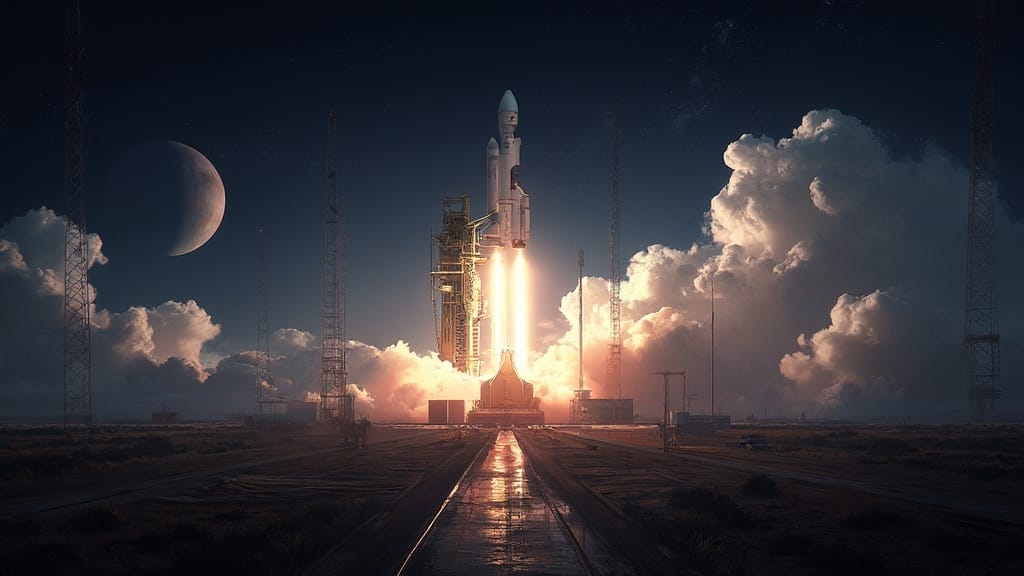
Photo: lyceumnews.com
Week of July 7, 2026
The Big Picture
The most important thing that happened in space this week wasn't a launch — it was consolidation. Rocket Lab is buying Iridium for $8 billion, and SpaceX is quietly closing its rideshare booking window past 2028. Both stories point the same direction: the space economy is racing to own the whole stack — rockets, satellites, spectrum, data links, servicing — amid the pull toward recurring revenue in the pipes, not the launch livestream. This was a plumbing week, and plumbing is where market power hides.
What Just Shipped
- BOHR (Betavoltaic Orbital High-Reliability) (City Labs): reached orbit on Transporter-17, July 7 — the first commercially built nuclear-powered satellite. Its tritium betavoltaic battery powers a tech demo independently of the CubeSat's solar arrays.
- Apolink relay satellite (Apolink): made first contact after the July 7 rideshare launch, clearing the way for a data-relay demonstration under an experimental FCC license.
- Pulsar-0 (Xona Space Systems): published the first from-orbit measurements mapping the scale of GPS jamming across Europe and the Middle East — worse than researchers expected.
This Week's Stories
Rocket Lab Is Buying Iridium for $8 Billion
On June 29, Rocket Lab and Iridium Communications entered a definitive agreement under which Rocket Lab will acquire Iridium for $54 per share in cash and stock — an enterprise value of roughly $8.0 billion, according to the companies' joint release. It's the biggest commercial-space M&A deal in years, and the map it redraws won't be fully visible until closing, which Rocket Lab expects in mid-2027 pending shareholder and regulatory approval. (Rocket Lab Is Buying Iridium for $8 Billion — and the Space Industry Should Pay )
What Rocket Lab is actually buying is an operating global network with paying customers — 2.55 million active subscribers — something most space companies spend a decade trying to build. But the underrated asset is spectrum. Iridium's globally harmonized L-band — the band that penetrates weather, works at the poles, and underpins GPS alternatives — is a strategic moat you cannot replicate quickly at any price. Add it to Rocket Lab's Electron and Neutron rockets and its Space Systems manufacturing arm, and the company would design, build, launch, and operate its own constellation — a full-stack capability only SpaceX has at scale today. (Rocket Lab Is Buying Iridium for $8 Billion — and the Space Industry Should Pay )
If the deal closes, Rocket Lab stops being a supplier and becomes a space utility, earning recurring service revenue instead of one-off hardware and launch sales. The failure point is regulatory: watch whether the Department of Defense flags the transaction for national-security review, given Iridium's large government and defense subscriber base. Antitrust timelines and any DoD scrutiny are the signals that tell you which way this goes. (Rocket Lab Is Buying Iridium for $8 Billion — and the Space Industry Should Pay )
The Rideshare Market's Quiet Crisis: Transporter-17 Flies, But the Booking Window Is Closing
A SpaceX Falcon 9 launched the Transporter-17 rideshare mission from Vandenberg on July 7 — 81 payloads, all deployed, anchored by CAS500-4, a 514-kilogram South Korean imaging satellite for agriculture and forestry. A clean flight. The problem is the manifest beyond it. (SpaceX launches 81 satellites to orbit from California, lands rocket on ship at )
At least nine SpaceX partners and customers told SpaceNews that SpaceX has stopped accepting Transporter reservations for late 2028, early 2029, and beyond — a squeeze one rival executive described as reaching "panic." SpaceX hasn't confirmed or explained it. The leading theory: Falcon 9 capacity is being redirected toward Starlink expansion, national-security missions, NASA crewed flights, and SpaceX's own orbital-manufacturing ambitions. For the small-satellite industry, Transporter has been the bus that made cheap orbital access routine. Losing it — or losing certainty about it — reshuffles everyone's business plan. (Falcon 9 Block 5 | Transporter 17 (Dedicated SSO Rideshare) Mission)
The alternatives exist but aren't ready. SEOPS, which flew 10 spacecraft on this mission, bought its own dedicated Falcon 9 for a 2028 rideshare — and filled the manifest in three weeks, waitlisting roughly 30 customers. Arianespace's Ariane 6 secondary-payload system won't be ready until 2029–2030. That gap between when SpaceX closes its books and when competitors open theirs is the supply crunch nobody priced in. The observable signal: any public SpaceX statement on Transporter's future. Silence will be read as confirmation. (Falcon 9 Block 5 | Transporter 17 (Dedicated SSO Rideshare) Mission)
The First Commercial Nuclear Satellite Is Now in Orbit
Tucked into Transporter-17's manifest was City Labs' BOHR satellite — the first commercially built spacecraft to carry a nuclear power source into orbit. To be precise: BOHR is not a reactor or a plutonium generator. It's a small betavoltaic battery using tritium to power a tech demonstration independently of the CubeSat's solar arrays, which still handle main operations. The battery is a proof of concept. (The First Commercial Nuclear Satellite Is Now in Orbit)
The engineering matters less than the paperwork. BOHR is the first commercial mission to run the FAA's pathway for nuclear-launch approval, earning authorization in September 2025. "The innovation here is not just in the technology," City Labs CEO Peter Cabauy told Payload Space. "Nuclear has been done for decades... but to really take it to the next step and to scale up, it's got to be commercial." (The First Commercial Nuclear Satellite Is Now in Orbit)
If betavoltaic power proves out, it opens more capable small spacecraft that don't depend on sunlight — relevant to deep-space missions, high-performance Earth observation, and responsive defense assets. The regulatory road, at least, now exists so the next company doesn't have to pave it. Watch for whether City Labs publishes on-orbit performance data — that's what tells you whether this is production-ready or a science-fair win.
Japan's H3 Rocket Flies Its Sixth Mission — With a New Engine Configuration
Japan's H3 has had a rough road. Its 2023 debut ended in a commanded self-destruct after the second stage failed to ignite; its second flight, in 2024, was the first success. This week, JAXA's replacement for the workhorse H-IIA completed its sixth flight, launching successfully with three main engines in a new configuration and achieving satellite separation, per Japanese reporting from 47NEWS and JAXA. That configuration change is the detail worth tracking.
The H3 is designed to fly in multiple configurations depending on payload mass — that flexibility is how it competes commercially against Ariane 6 and Falcon 9 rideshare. Flight 6 is JAXA and Mitsubishi Heavy Industries proving they can vary the hardware and still deliver.
If Japan can fly H3 reliably across configurations, it has a real shot at recapturing commercial launch share it lost during the H-IIA years. JAXA also reportedly completed a new rocket test site in Akita prefecture this week. The signal to watch: a named paying commercial customer for an upcoming H3 flight — that's the line between test program and operational competitor.
Orbit Fab Gets New Leadership and Funding to Move From Demo to Business
Most satellites die not because they break, but because they run out of fuel. Orbit Fab is betting that's fixable. This week it hired a new CEO and closed a funding round explicitly to move from technology development into operations, according to SpaceNews. The target: commercial refueling for satellites in geostationary orbit, the belt roughly 35,786 kilometers up where most communications and weather satellites live. (Orbit Fab Gets New Leadership and Fresh Funding to Move From Demo to Business)
Refueling a healthy GEO satellite can add years of life — worth hundreds of millions to an operator who'd otherwise buy a replacement. The catch is a chicken-and-egg problem: operators won't add refueling ports without a service, and the service isn't viable without compatible spacecraft. A new CEO signals Orbit Fab believes it has enough early customer commitments to justify the shift. (The funding amount wasn't disclosed.) (Orbit Fab Gets New Leadership and Fresh Funding to Move From Demo to Business)
The milestone that validates the business — not the tech — is a first commercial refueling contract. And the new CEO's background will tell you whether Orbit Fab is chasing defense customers, where the money is now, or holding the line on commercial GEO, where the long-term market lives. (Orbit Fab Gets New Leadership and Fresh Funding to Move From Demo to Business)
⚡ What Most People Missed
Xona's Pulsar-0 mapped GPS jamming from orbit — and it's worse than expected: Xona Space Systems' first satellite measured the scale of GPS tampering across Europe and the Middle East from 500 kilometers up. Separately, research led by the late Todd Humphreys of UT Austin found Russia's Kosmos 2546 may have jammed GPS on a continental scale on a Tuesday-through-Thursday, business-hours schedule — a rehearsed capability, not a rogue actor. Because constellations like Starlink use GPS for collision avoidance, this degrades orbital operations, not just ground navigation — and it just handed Xona's stronger-signal Pulsar network a live demo it couldn't have bought.
ESO put a number on the night-sky problem: 100,000: A European Southern Observatory study, led by astronomer Olivier Hainaut and accepted in Astronomy & Astrophysics, found current proposals for over 1.7 million satellites would have "devastating consequences" for astronomy, and concluded no more than 100,000 faint satellites should orbit Earth. Reflect Orbital's mirrors alone would scatter light as bright as Venus. ESO's Betty Kioko: "the ball is now in the FCC's court."
The FCC votes July 22 on a satellite licensing overhaul: The Commission has put a licensing-framework rewrite on its open-meeting agenda — moving from discussion to action. Context includes Amazon's request for a 24-month waiver on its July 2026 deadline to deploy roughly 1,600 Kuiper satellites. Any change to "use-it-or-lose-it" deployment timelines could reshuffle which constellations claim key orbital shells.
NASA's draft Commercial LEO Destination contract starts the post-ISS race: NASA's Johnson Space Center posted a Draft RFP for buying services from privately owned stations after the ISS, with a pre-proposal conference July 9 and written comments due July 24. The framing — buying crew time and lab space as a service, not funding hardware — forces station developers to lock in launch partners early. LEO real estate is becoming a contracted line item.
📅 What to Watch
- If the DoD flags Rocket Lab–Iridium for national-security review, the timeline extends by quarters and the deal's strategic logic gets litigated in public.
- If SpaceX stays silent on Transporter bookings past 2028, the small-sat industry will price the gap as real — and rivals' waitlists get longer, faster.
- If the FCC cites the ESO 100,000-satellite figure in its July 22 licensing order, it has to adopt, reject, or explain a peer-reviewed number — a very different posture than "astronomers are unhappy."
- If JAXA announces a paying commercial customer for an H3 flight, Japan re-enters the launch market as a competitor, not a national program.
- If the State Department or Space Force references Xona's spoofing data publicly, PNT resilience moves from research to policy — and spectrum rules could follow.
The Closer
A tritium battery riding to orbit on a rideshare bus that's about to stop taking reservations; a rocket company buying a phone network because the real treasure was the radio spectrum; and a Russian satellite that jams GPS on a strict Tuesday-through-Thursday, nine-to-five schedule like it clocks out for the weekend. The last one is the tell — when your adversary's electronic warfare keeps banker's hours, you're not dealing with a rogue actor, you're dealing with a job description. (Orbit Fab Gets New Leadership and Fresh Funding to Move From Demo to Business)
That's the week.
Forward this to the satellite operator you know who's still assuming there'll be a rideshare seat in 2029.