The Lyceum: Space Economy Weekly — Jul 16, 2026
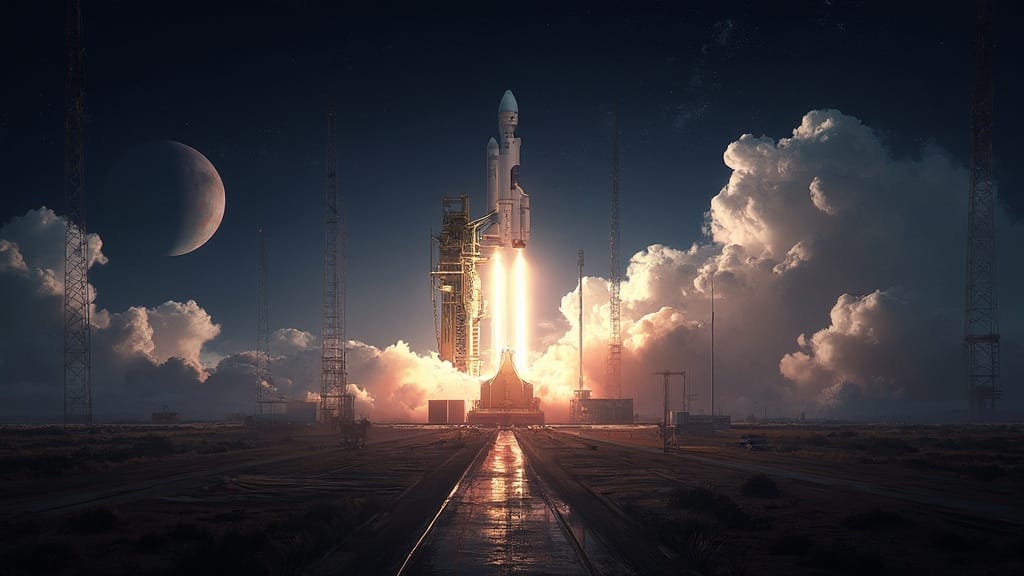
Photo: lyceumnews.com
Week of July 16, 2026
The Big Picture
This week, the space economy's two engines — commercial consolidation and government money — are both running hot, and they're starting to feed each other. Rocket Lab's $8 billion bid for Iridium is the biggest vertical-integration play the sector has seen, and it looks better every time a new headline reminds us how scarce good spectrum is. The Pentagon wrote another $1.75 billion check for Golden Dome's missile-tracking satellites. And tonight, Starship attempts the one thing it hasn't yet proven it can do — relight an engine in space — with the first next-generation Starlink satellites riding along. The theme underneath all of it: everyone is racing to claim orbital real estate, spectrum, and infrastructure before the rules get written, while the hardware scrambles to catch up to the ambition.
What Just Shipped
- Long March 10B (CNSA): Maiden test flight on July 10 with a successful first-stage booster recovery — China's first, and the foundation for a reusable, crew-capable launcher.
- Falcon 9 booster 600th flight (SpaceX): A flight-proven booster completed its 600th cumulative mission on July 13, part of a pair of Starlink launches less than eight hours apart.
- SDA Tranche 1 Transport Layer (Space Development Agency / York Space Systems): 21 data-transport satellites launched from Vandenberg this week on a Falcon 9, ending a nine-month pause and bringing half the planned constellation on orbit.
This Week's Stories
Rocket Lab Is Buying Iridium for $8 Billion — and Rewriting What "Vertically Integrated" Means
The commercial space consolidation wave has arrived, and it has a price tag.
Rocket Lab announced on June 29 a definitive agreement to acquire Iridium Communications for $54 per share in a cash-and-stock deal valuing the company at roughly $8 billion. The deal has generated industry discussion all week — and the more you look at it, the more structural it seems. (Rocket Lab Is Buying Iridium for $8 Billion — and the Space Industry Will Never )
Here's why this is more than a big number. The merger combines Rocket Lab's launch and satellite-manufacturing capabilities with Iridium's global satellite network, its 2.55-million subscriber base, its ecosystem of 500-plus partners, and — most importantly — its L-band spectrum. That last asset is the one that can't be replicated on any timeline that matters. L-band penetrates weather, works with small antennas, and underpins aviation and maritime safety services. Iridium's licenses took decades and a bankruptcy to secure. Rocket Lab just bought a spectrum position, a defense customer list, and a direct-to-device business that Electron and Neutron launches alone could never have reached. (Rocket Lab Is Buying Iridium for $8 Billion — and the Space Industry Will Never )
Rocket Lab expects the deal to close in mid-2027, subject to Iridium stockholder approval and regulatory clearances. Watch the FCC review closely: spectrum transfers at this scale draw national-security scrutiny, and any conditions attached to approval will define what the combined company can actually offer. Clear it clean, and the vertically integrated model — launch, manufacturing, spectrum, subscribers under one roof — becomes the template every rival has to match or block. If regulators impose conditions on the spectrum, the strategic logic thins considerably. The Form S-4 filing, when it lands, will contain the integration assumptions that tell you whether this is built for growth or for cash extraction. (Rocket Lab Is Buying Iridium for $8 Billion — and the Space Industry Will Never )
Starship Flight 13 Is on the Pad Tonight — and the Whole Program Hinges on One Engine Relight

Starship is scheduled to fly tonight — no earlier than 6:45 p.m. EDT from Starbase — and the mission profile sounds routine until you read the fine print. (Starship Flight 13 | Starship-Super Heavy v3)
Flight 13 is the second launch of the vehicle's Version 3 configuration. Flight 12 was mostly successful, but the booster had a bad day: SpaceX said slight differences in engine startup threw the directional flip off by roughly 90 degrees, and then five of the 33 booster engines failed to relight, cutting the boostback burn short. The FAA required an investigation, closed it this week, and cleared Flight 13 to proceed. (Starship Flight 13 | Starship-Super Heavy v3)
The payload is what makes this flight matter. Starship will carry the first V3 Starlink satellites — 20 of them, six fitted with cameras to scan the vehicle's heat shield. They'll extend arrays and antennas and attempt laser links to ground stations in South Africa and the broader Starlink constellation, all on the same suborbital trajectory as the ship. Since they won't reach orbit, they'll burn up on reentry. This is a systems test, not a deployment. (Starship Flight 13 | Starship-Super Heavy v3)
The real milestone is whether SpaceX can relight a Raptor engine in space. Without an in-space reignition, Starship cannot reach orbit, cannot deploy Starlink from the vehicle, and cannot meet NASA's requirements for the Artemis III and IV lunar landers. Succeed tonight, and the entire orbital roadmap — plus the credibility of the 100,000-satellite Gen3 plan — moves closer to reality. Fail again, and NASA's Human Landing System schedule absorbs another slip. That single engine relight is the observable signal for the whole program. (Starship Flight 13 | Starship-Super Heavy v3)
The Pentagon Wrote a $1.75 Billion Check for Golden Dome's Eyes in Space

Golden Dome just got its most concrete space hardware commitment yet.
The Space Development Agency awarded L3Harris Technologies and Sierra Space a combined $1.75 billion to build 36 missile-warning and tracking satellites. L3Harris takes 18 hypersonic and ballistic tracking sensor variants across two orbital planes (roughly $955 million); Sierra Space takes 18 missile-warning and tracking variants (roughly $798 million), according to Military Times.
The timeline is the pressure point. These "Accelerated Missile Defense Tranche 3" vehicles must be ready to launch in 2028 — the year President Trump has mandated Golden Dome be operational. The earlier Tranche 3 Tracking Layer contracts, awarded last December to L3Harris, Lockheed Martin, Northrop Grumman, and Rocket Lab, aren't slated to fly until 2029. So the government is buying a faster lane, and the third tranche now swells to 104 spacecraft.
The sensor technology matters as much as the check. L3Harris's satellites carry infrared sensors derived from the Hypersonic and Ballistic Tracking Space Sensor — precise enough to generate fire-control-quality data, meaning they can guide an interceptor rather than just flag a launch. That's a real capability step. But sensors are only useful if they can pass what they see to a shooter — which is exactly the problem lurking in the next two stories.
China Recovered a Booster — Then Immediately Named the Commercial Version
On July 10, China's Long March 10B completed its maiden test flight and recovered its first stage — the country's first successful booster recovery, and a credible step toward Falcon 9-style reusability.
The recovery is the milestone; what China did next is the business story. Per SpaceNews, Beijing immediately confirmed a methane-fueled variant, the Long March 10C, as its commercial workhorse and injected fresh capital into commercial rocket ventures. Methane and liquid oxygen — the same combination powering SpaceX's Raptor and Rocket Lab's Archimedes — burns cleaner and suits reusable architectures far better than China's older kerosene rockets.
This is China's clearest signal yet that it means to compete on launch economics, not just cadence. A reusable methane rocket with a commercial variant is precisely the architecture that makes cheap, high-frequency orbital access possible — the Falcon 9 playbook, run again. The 10C won't fly commercially tomorrow, and the observable signal to watch is the first announced commercial customer. For satellite operators locked into Falcon 9 or Ariane 6 pricing, a credible Chinese alternative — even years out — changes the negotiating table. If no international booking materializes, this stays a domestic capability. If one does, launch pricing has a new floor.
Europe Is Spending 12% More on Space While Everyone Else Cuts
The SDA contract isn't the week's only defense-space story with a budget number attached.
European government space spending rose 12% to roughly $15.4 billion in 2025, according to a July 13 European Space Agency report — a sharp reversal against a 3% decline in global government space spending over the same period. Rising national defense budgets are driving the increase, and the money is shifting toward military and dual-use programs rather than pure science.
The timing isn't coincidental. The war in Ukraine and the volatile Middle East have made European governments acutely aware of how dependent modern operations are on space-based communications, navigation, and intelligence. A 12% rise in a year when everyone else pulled back is a dramatic divergence — European defense ministries now treat space infrastructure as urgent, not aspirational. For commercial operators and launch providers with European customers, this is a demand signal worth tracking. The follow-through to watch is program-level: whether France, Germany, and the UK route the new money into communications, ISR, or positioning services will tell you where the contracts actually land. (Golden Dome's Space Layer Is Getting Bigger — and Europe Is Spending More to Kee)
⚡ What Most People Missed
- SpaceX filed for 100,000 Gen3 Starlink satellites — and buried the real story in the spectrum annex: The July 6 FCC filing (SAT-LOA-20260630-00264) requests up to 100,000 third-gen satellites, but the sharper move is the bid for pioneering W- and D-band frequencies between 92 and 275 GHz — greenfield spectrum. Whoever claims those bands first sets the interference-coordination baseline for every high-throughput LEO operator in the 2030s. At ~2,000 kg each, these satellites only fly at scale on Starship, which is why tonight's flight matters to the whole plan.
- The SDA's laser cross-links still haven't been demonstrated in space: With this week's launch of 21 York transport satellites, half the Tranche 1 Transport Layer is on orbit — but Director GP Sandhoo acknowledged the agency still can't build its envisioned mesh network because of trouble producing the optical inter-satellite links (the lasers that let satellites cross-talk). Satellites that can't cross-link are nodes, not a network. If the links still fail after the next planes fly, Golden Dome's bottleneck is confirmed to be networking, not rockets — a problem no launch cadence can fix.
- NASA quietly nudged its commercial space-station competition forward: NASA updated its Commercial LEO Destination draft RFP on July 10, with one-on-one meetings for prime offerors and transportation providers running July 13–15. The content change was minor, but the move forces primes to line up now — the primary-source signal that "commercial space station" is becoming a real buying mechanism, not a slide deck.
- Vandenberg is planning a "massive, multi-phase investment portfolio": A Space Launch Delta 30 notice invites industry to a July 29 summit on the base's "Spaceport of the Future," with unusually blunt language about removing bottlenecks toward launch-on-demand. Vandenberg is the key U.S. gateway to Sun-synchronous polar orbit — the workhorse for Earth observation and defense sensing — so this reads less like branding and more like West Coast range capacity becoming a strategic chokepoint.
- Artemis III rocket stacking has begun at Kennedy Space Center: Per Space.com, NASA has started assembling the Space Launch System for the crewed lunar landing, with solid rocket booster segments arriving at the Vehicle Assembly Building. The 2027 target is still on the manifest — but stacking is the first physical commitment that's hard to walk back. Watch the core-stage arrival date for whether any schedule margin remains.
📅 What to Watch
- If SpaceX relights a Raptor in space tonight, the 100,000-satellite Gen3 filing stops looking aspirational and starts looking like a build schedule — and the Artemis lunar-lander timeline gets its first real credibility in a year.
- If the FCC treats Iridium's L-band as a national-security asset requiring transfer conditions, the entire vertical-integration thesis behind Rocket Lab's $8 billion bet gets repriced before the deal even closes.
- If the SDA's next transport plane flies clean but still can't demonstrate laser cross-links, the constraint on Golden Dome shifts from the launch pad to the factory floor — a much harder problem to buy your way out of.
- If China names a first international commercial customer for the Long March 10C, launch pricing gets a new global floor and Ariane 6's addressable market shrinks overnight.
- If the Vandenberg "Spaceport of the Future" summit produces actual construction commitments, West Coast pad capacity — not rockets — becomes the gating factor for polar-orbit Earth observation and defense sensing.
The Closer
This week: a rocket company bought a phone company to get its hands on radio waves; China caught a falling booster and used the applause to launch a sales brochure; and twenty satellites are about to ride to the edge of space, take selfies of a heat shield, and then cheerfully incinerate themselves on the way down. Somewhere in a Pentagon spreadsheet, 104 missile-tracking satellites are being ordered to watch the sky by 2028 — while the lasers that would let them actually talk to each other remain a PowerPoint promise, which is a bit like buying a hundred security cameras and forgetting to run the cables. (Golden Dome's Space Layer Is Getting Bigger — and Europe Is Spending More to Kee)
That's the week — spectrum, boosters, and the growing suspicion that the hard part of Golden Dome was never the rocket.
Forward this to the mission analyst who keeps muttering "it's a networking problem" — they were right, and they'll want the receipts. (Golden Dome's Space Layer Is Getting Bigger — and Europe Is Spending More to Kee)