The Lyceum: Space Economy Weekly — Jul 30, 2026

Photo: lyceumnews.com
Week of July 30, 2026
The Big Picture
This week’s consequential space news was about conversion, not discovery. Starship turned a test flight into a satellite-deployment demonstration, the U.S. Space Force turned strategy into launch orders, and the European Space Agency turned lunar ambition into funded hardware. Meanwhile, regulators and range operators began reshaping the rules and infrastructure needed for much denser traffic.
What Just Shipped
- Starship Flight 13 (SpaceX): On July 24, Starship deployed 20 Starlink V3 test satellites on a suborbital trajectory. SpaceX established communications with the spacecraft before their planned reentries.
- Starlink Group 17-51 (SpaceX): A Falcon 9 placed 24 Starlink satellites into low Earth orbit on July 25. The mission continued SpaceX’s high-cadence deployment from Vandenberg Space Force Base.
- MAGPIE Phase 2 (ispace-Europe and the European Space Agency): On July 24, the European Space Agency funded the rover’s remaining development, manufacturing, lunar delivery and operations. MAGPIE is planned to investigate regolith and volatile materials near the lunar south pole.
This Week's Stories
Starship Finally Did a Satellite Launcher’s Job
Starship Flight 13 mattered most during the roughly 20 minutes it behaved like a real satellite-delivery system—not when its upper stage splashed down intact. (Starship Finally Became a Satellite Launcher)
Payload reported that SpaceX launched Flight 13 from Texas on July 24 and released 20 Starlink V3 test satellites about 200 kilometers above Earth. SpaceX contacted the spacecraft through radio-frequency and laser links, deployed their antennas and solar arrays, and downloaded data before they reentered as planned along the suborbital flight path. (Starship Finally Became a Satellite Launcher)
The upper stage also completed an in-space Raptor engine relight and survived reentry. The booster had a harder day: too few engines ignited during its landing sequence, causing a hard splashdown. The cleanest verdict is a partial success: the highest-value upper-stage objectives worked. (Starship Finally Became a Satellite Launcher)
Repeat those results on an orbital flight, and Starship begins to relieve Falcon 9 of the heaviest Starlink deployment burden. It would also make the company’s proposed 100,000-satellite Gen3 system look more like an industrial plan than a regulatory placeholder. Failure would mean another long test campaign in which Starship delivers impressive demonstrations without repeatable orbital delivery. (Starship Finally Became a Satellite Launcher)
Flight 14 is the signal to watch. An orbital target, a payload manifest and another successful engine relight would matter more than another spectacular landing video. (Starship Finally Became a Satellite Launcher)
The Space Force Booked 18 Falcon 9 Launches
The U.S. Space Force just bought cadence at scale. Reuters reported that it awarded SpaceX approximately $1.6 billion for 18 Falcon 9 launches through 2027. The missions will support low Earth orbit systems intended to detect airborne threats and move targeting information.
The rough arithmetic—about $89 million per mission—does not represent a commercial Falcon 9 price. National-security orders generally include specialized payload processing, integration, schedule protection and mission assurance.
What the Space Force is buying is cadence. Eighteen missions over roughly 18 months would make the Department of Defense a much larger customer at Vandenberg Space Force Base, where commercial imaging companies, weather operators and constellation builders also need access to polar and sun-synchronous orbits.
If SpaceX absorbs the work without disrupting other customers, Falcon 9 will demonstrate that reusable launch can scale into standing military infrastructure. If commercial rideshares slip or prices rise, the constraint will have shifted from rocket production to pads, payload-processing buildings and range schedules.
Watch the first mission assignments. A tightly packed calendar would tell satellite operators more than the contract’s headline value.
The FCC Built an Assembly Line for Satellite Licenses
The trigger from the previous issue has fired: on July 22, the Federal Communications Commission adopted its Space Modernization Order, creating a new Part 100 framework for satellite licensing.
Aerospace America reported that the rules shorten typical public-notice periods from 30 days to 15 and add categories such as “Variable Trajectory” licenses for spacecraft that move between orbits. The framework aims to replace bespoke paperwork with more standardized processing for large constellations.
If it works, satellite companies can modify repeatable spacecraft designs and deployment plans without forcing the FCC to treat every change as a new species of mission. Common requirements for tracking and safety data could also give insurers and operators a more consistent basis for judging collision risk.
Even after passage, non-adoption will be easy to spot. Processing backlogs will persist, operators will keep seeking waivers, and similar constellations will receive inconsistent treatment. Faster paperwork without consistent enforcement would simply move uncertainty from the application queue into orbit.
The first substantial processing rounds under Part 100 will show whether the FCC created an assembly line—or merely installed a shorter timer above the same desk.
Rocket Lab Won a $266 Million Reason to Build in Alaska
Rocket Lab has a $266 million reason to turn Kodiak into launch infrastructure. The company announced a U.S. Space Force agreement covering 12 suborbital missions, with options for six more. Flights will begin no earlier than late 2026, primarily from the Pacific Spaceport Complex-Alaska on Kodiak Island.
These are not Electron missions carrying satellites into orbit. Rocket Lab expects to use HASTE, a suborbital vehicle derived from Electron, to create realistic flight conditions for missile-defense and hypersonic experiments.
That distinction carries commercial value. HASTE can generate production volume and launch revenue without competing directly for orbital payloads, while shared Electron heritage lets defense testing support Rocket Lab’s broader manufacturing base. Rocket Lab also plans to establish Kodiak as its fourth launch location.
If the program reaches regular cadence, the Space Force gains a repeatable testing service and Rocket Lab gains a defense-funded launch network that could support additional responsive missions. Failure would look like slow range approvals, delayed construction or unexercised options—the familiar gap between a large contract ceiling and actual launches.
The first named payload and visible work at Kodiak are the milestones that turn the award into infrastructure.
Europe Put €65 Million Behind a Commercial Lunar Rover
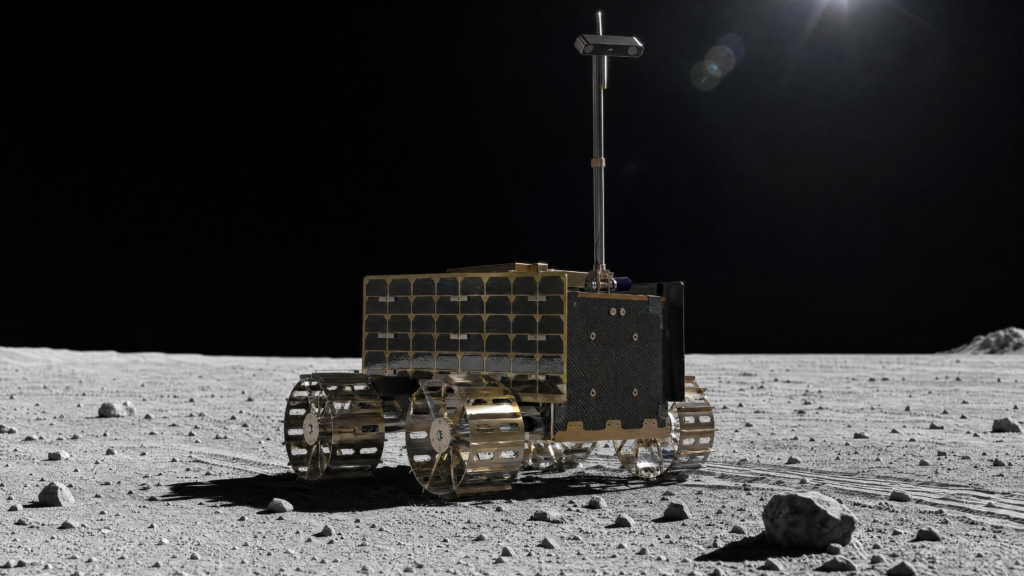
Europe has put €65 million behind a commercial lunar rover. The European Space Agency awarded ispace-Europe a Phase 2 contract for MAGPIE, the Mission for Advanced Geophysics and Polar Ice Exploration. (Europe Put €65 Million Behind a Commercial Lunar Rover)
According to ispace-Europe’s announcement, the award covers the remaining rover and payload development, manufacturing, testing, transportation to the Moon, surface operations and delivery of scientific data. The rover is planned to fly on ispace’s Mission 4 lander in 2029 and investigate regolith and volatile materials near the lunar south pole. (Europe Put €65 Million Behind a Commercial Lunar Rover)
The important shift is contractual. The European Space Agency is buying an end-to-end lunar service from Luxembourg-based ispace-Europe instead of separately managing each spacecraft, payload and operational layer through traditional institutional procurement. (Europe Put €65 Million Behind a Commercial Lunar Rover)
If MAGPIE succeeds, smaller commercial companies gain a stronger path to becoming mission primes—the organizations responsible for making the whole system work. Failure would reinforce the argument that lunar services still require the cost, schedule margin and integration machinery of traditional aerospace contractors. (Europe Put €65 Million Behind a Commercial Lunar Rover)
The next useful evidence is not another rendering. It is successful completion of the rover’s structural-thermal model review and the appearance of qualified hardware. (Europe Put €65 Million Behind a Commercial Lunar Rover)
⚡ What Most People Missed
- Amazon Leo’s deployment clock is still running: Amazon Leo’s Federal Communications Commission milestone falls on July 30, and the FCC order lists 396 deployed satellites against a requirement for 1,616 deployed and operational spacecraft. As of publication, the deadline remains active; if the shortfall remains when it expires, later satellites face weaker spectrum priority until Amazon reaches 50% deployment or March 30, 2028.
- The Space Force is shopping for commercial MEO communications: A Space Force request for information seeks access to a commercially owned, ultra-high-frequency satellite already operating in medium Earth orbit. It is not a purchase, but it tests whether the military can rent immediately available capacity instead of waiting for a purpose-built constellation.
- The FAA wants broader environmental waivers: The Federal Aviation Administration proposed allowing the U.S. Department of Transportation to waive requirements under 13 environmental laws for certain launch, reentry and spaceport approvals. The proposal still requires the federal rulemaking process; if adopted, it would accelerate licensing while shifting more scrutiny toward site-level politics and litigation.
- Vandenberg is getting a larger payload-processing pipeline: KEYT reported that the U.S. Space Force awarded All Points Logistics a contract worth up to $250 million to expand satellite-processing capacity by 2029. More rockets do not create more launch capacity if spacecraft are still waiting for clean rooms, integration bays and security-controlled processing.
- Environmental review is becoming a megaconstellation weapon: SpaceNews reported that an Earthjustice-represented coalition asked the FCC to pause orbital data-center licensing pending a programmatic environmental review. The coalition’s atmospheric and night-sky concerns are allegations, not FCC findings, but the petition could turn cumulative environmental effects into a schedule gate for million-satellite proposals.
📅 What to Watch
- If SpaceX targets orbit and names a payload for Flight 14, it means Starship is beginning to influence Falcon 9 factory and manifest decisions rather than merely advancing its own test program.
- If early Part 100 applications receive consistent treatment, it means the FCC may be creating standardized safety data that insurers can use before international regulators converge.
- If Vandenberg’s military schedule pushes commercial rideshares outward, it means range access—not launch-vehicle supply—will start setting the price of polar-orbit delivery.
- If Amazon Leo receives relief before its July 30 milestone expires, it means deployment deadlines are becoming negotiable tools rather than hard spectrum-allocation gates.
- If Rocket Lab names a first Kodiak payload and begins site work, it means suborbital missile testing is financing permanent launch infrastructure rather than a temporary campaign.
- If ispace-Europe clears MAGPIE’s hardware reviews on schedule, it means the European Space Agency’s commercial lunar-services model is surviving contact with manufacturing.
The Closer
A stainless-steel grain silo tossed 20 satellites into a 20-minute life. The Pentagon booked Falcon 9s like airport shuttles, and Europe ordered a moon rover with scientific data included. Meanwhile, Amazon Leo’s regulatory clock is ticking while the FAA asks whether thirteen environmental laws might kindly step away from the launchpad.
Mind the range schedule.
Forward this to the person who still thinks the rocket is the bottleneck. (Europe Put €65 Million Behind a Commercial Lunar Rover)