The Lyceum: Space Economy Weekly — Jun 11, 2026
Photo: lyceumnews.com
Week of June 11, 2026
The Big Picture
The space economy goes public this week — and the timing could not be more ironic. SpaceX prices the largest IPO in history on June 12 at a reported $1.75 trillion valuation, while Blue Origin's New Glenn sits in ruins at Cape Canaveral, its single launch pad still being cleared two weeks after a static-fire explosion. Meanwhile, Japan's H3 — twice-burned in eight flights — tries to claw its way back to credibility with everything from a Mars mission to ISS cargo riding on the next 48 hours. The launch market has never been more consequential, or more concentrated.
What Just Shipped
- Cygnus XL CRS (Northrop Grumman / SpaceX): The latest commercial resupply mission reached the ISS on a Falcon 9 from SLC-40; the booster returned to Landing Zone for its seventh recovery.
- Amazon Leo Mission 5 (Amazon / ULA): An Atlas V flying with five solid rocket boosters — its heaviest payload to date — deployed 29 operational satellites, bringing the constellation to 331 deployed.
- STP-Sat 7 (U.S. Space Force / Northrop Grumman): A Minotaur IV out of Vandenberg placed the Space Test Program payload and rideshare experiments into orbit, supporting hosted-payload experimentation for national security.
- Starlink G10-54 (SpaceX): The next Starlink batch is staged for a June 12 Falcon 9 launch, pushing the constellation past 10,000 spacecraft on orbit.
- Innovative Satellite Technology Demonstration 4 (JAXA): Axelspace's D-SAIL deployable deorbit system is on orbit via RAISE-4 and scheduled to begin its in-orbit demonstration in late 2026.
This Week's Stories
The Largest IPO in History Prices This Week — and It's a Rocket Company That Became a Data Center
SpaceX is about to become a publicly traded stock, and the number attached is genuinely staggering: a reported $1.75 trillion valuation, larger than the entire GDP of Australia.
The week before pricing, SpaceX dropped two deals that reshaped the story investors are being asked to buy. Google will pay SpaceX $920 million per month from October 2026 through June 2029 for access to roughly 110,000 Nvidia GPUs at xAI data centers — a deal echoing the one with Anthropic, which agreed to $1.25 billion per month through 2029 for compute from the Colossus 1 facility near Memphis. Together, per TechCrunch, those contracts add about $26 billion in annual revenue and pull SpaceX's valuation from nearly 100 times sales down to around 40.
Every launch customer should pay attention to what this means. SpaceX is now effectively three businesses — a launch operation with Falcon 9 commanding roughly 90% of global commercial launch share, Starlink, and xAI. The company your constellation depends on for launch access is increasingly a hyperscale compute provider that also happens to fly rockets.
The catch is in the fine print. Each compute deal carries a 90-day cancellation window, and the Google contract lets Google walk if SpaceX can't provision the committed GPUs by September 30, 2026. That makes the $26 billion figure a bridge, not a moat. Watch the GPU delivery deadline and the first post-IPO earnings call — if compute revenue wobbles, the profitability case underwriting the valuation becomes the question every analyst asks first.
New Glenn's Pad Is Still Rubble — and the Ripples Are Getting Wider

Two weeks after the explosion, the full scope of what Blue Origin lost on May 28 is coming into focus — and it's not just a rocket.
New Glenn was damaged during a static-fire test at Cape Canaveral's Launch Complex 36 while being prepared for the NG-4 launch carrying 48 Amazon Leo satellites. Photos from May 29 show extensive damage: one lightning tower collapsed, the transporter-erector damaged, the main launch tower standing but bent. New Glenn has just one pad, which means Blue Origin cannot fly again until LC-36 is repaired and the cause is identified — a process one source familiar with pad rebuilds called "15 months best case," per SpaceNews and Universe Today's reporting.
The reverberations reach further than Blue Origin. If the root cause traces back to the methane-fueled BE-4 engines, that could ripple into United Launch Alliance's Vulcan, which uses the same engine — and Vulcan is the Air Force's certified alternative to Falcon 9 for national security launches. The explosion also threatens Blue Origin's Human Landing System work for NASA's Artemis program.
Watch for a formal root-cause disclosure. If BE-4 is implicated, the next domino isn't Blue Origin — it's the national security manifest.
Blue Origin Vows to Fly New Glenn Again This Year — a Much Harder Promise After a Pad Explosion
A launch company can survive a failed mission. A damaged pad is nastier, because it holds your whole manifest hostage.
Blue Origin spent the week trying to reassure customers, with Dave Limp having framed the recovery as a confidence-rebuilding effort before his departure from the company. The company maintains it can fly again before the end of 2026. That's the optimistic version. The harder reality: Blue Origin must investigate the booster loss, rebuild pad systems at LC-36, and preserve confidence from customers already counting on New Glenn to clear backlog. It has begun preliminary work on a nearby pad, LC-36B, and plans a Vandenberg site — but both are just getting started.
The crucial distinction is status. This was not a launch failure; it was a test-stand explosion with manifest consequences. In launch economics that can be worse, because nothing flies until the ground systems are healthy again. Watch for remanifesting of Amazon or NASA payloads — that's the tell that "before year-end" has quietly slipped to next year.
Japan's H3 Is on the Pad — and Everything Is Riding on This One
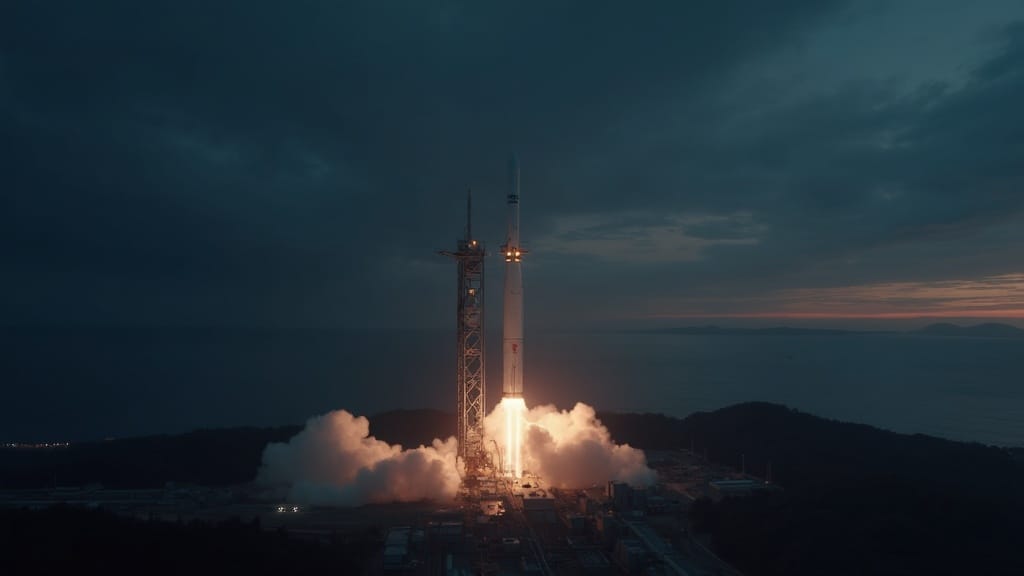
Japan's space program has had a rough six months. The next 48 hours will tell whether the comeback is real.
JAXA will launch H3 Flight 6 from Tanegashima on June 12, after weather delayed the original June 10 attempt. It's the first H3 flight since Flight 8 failed in December 2025 — a failure traced to delamination of the satellite adapter, a carbon-fiber-and-aluminum sandwich structure whose adhesive bond was weakened when manufacturing exposed it to higher temperatures than specified. When the fairing opened on ascent, the weakened adapter couldn't hold the satellite, which shifted and severed a second-stage fuel line.
Flight 6 is also the debut of the new "30 configuration" — a lower-cost variant flying without solid rocket boosters, on three liquid-fuel engines alone. JAXA Project Manager Makoto Arita has called it both a competitiveness milestone and a stepping stone toward reusable rockets.
The stakes extend well past the pad. Next up is HTV-X2 ISS cargo around July, then the Martian Moons eXploration mission, which must depart within a narrow planetary window or slip two years. A second consecutive failure would almost certainly push MMX to 2028, dragging a joint program with NASA, CNES, DLR, and ESA. Two failures in eight launches is a program-defining number — watch whether the new adapter fix holds through max-Q.
SpaceX's $26B Compute Revenue Changes the Profitability Math — and It Has a Hard September Deadline
This is being covered as a tech story. It has a direct read-through for the space economy.
Between the Anthropic and Google contracts, SpaceX is now collecting roughly $2.17 billion per month in compute revenue — about $26 billion annualized, a stream that didn't exist 18 months ago and now exceeds Starlink's entire 2024 run rate.
The signal is in the contract's termination language. Per CNBC and TechCrunch, if SpaceX fails to deliver the committed GPU capacity by September 30, 2026, Google may terminate after a one-month grace period or accept the available chips at reduced payments. After December 31, 2026, either side can exit with 90 days' notice. Those clauses suggest Google negotiated hard protection against a real risk — that the promised Nvidia hardware doesn't arrive on schedule.
That matters because the compute revenue is load-bearing. SpaceX posted a net loss of $4.94 billion in 2025 even as revenue rose 33% to $18.67 billion; the GPU money is what closes the gap toward the GAAP profitability the S&P 500 requires. The structural fragility is the story — this is a bridge contract, not a moat, and the entire valuation narrative rides on it holding. Watch the first post-IPO earnings call for any language change on compute commitments.
NASA's Swift Rescue Mission Is Making On-Orbit Servicing Look Less Theoretical
A lot of "in-space servicing" coverage reads like a conference panel wandered into a press release. This one is concrete.
NASA said this week it will showcase Katalyst Space's LINK robotic servicing spacecraft ahead of a late-June Pegasus XL launch that will attempt to rendezvous with the Neil Gehrels Swift Observatory and raise its orbit — extending the life of a science satellite never designed for a visitor.
The implication runs well past astronomy. If it works, it nudges the servicing market away from the old model — a handful of bespoke life-extension missions for very expensive communications satellites in geostationary orbit — toward something broader in low Earth orbit (LEO, roughly 200–2,000 km altitude). Operators with aging spacecraft would gain a third option between "accept degraded performance" and "buy a replacement" — especially valuable for civil and defense fleets that can't tolerate gaps.
It's still a demonstration, not a service line, and Pegasus remains a specialized launch choice rather than a workhorse. Watch the rendezvous and orbit-raise sequence — whether it works as advertised is the difference between concept art and a real market.
The Space Force Bought a Radar That Moves — and That's the Point
The most interesting defense-space story this week isn't about satellites. It's about what happens when you can't trust the ones you have.
LeoLabs deployed a containerized space-surveillance radar to the Pacific — a sensor that can track objects in LEO from wherever it's positioned. Space situational awareness — knowing where every object in orbit is, and whether it's about to hit yours — has historically required fixed ground infrastructure that takes years to build and can't move when the threat environment shifts.
A mobile radar changes that calculus. The military can stand up orbital tracking coverage in a new theater in days, not years. For commercial operators who depend on Space Force conjunction data — the warnings that flag a close encounter with debris — a more distributed network means better data, more warning time, and fewer emergency maneuvers. It also means the U.S. can hold space domain awareness in a conflict where fixed infrastructure is a target.
Watch whether future Space Domain Awareness contracts start explicitly requiring deployable sensors — that would mark a doctrinal shift, not a one-off buy.
⚡ What Most People Missed
JAXA suspended an IHI subsidiary's qualification for 10 years: Over falsified quality records spanning a decade in rocket manufacturing — IHI is a major supplier to the H3 program. A supply-chain integrity failure at exactly the moment Japan needs to rebuild trust in its quality assurance. [Source: Mainichi Shimbun / Yahoo! News — Japanese]
The H3's "30 configuration" is also Japan's first step toward reusability: Solid boosters are single-use by design; liquid engines can be throttled, shut down, and restarted. Mastering liquid-only ascent is the prerequisite for any recovery attempt — a future-rocket story buried under return-to-flight drama. [Source: Space Wave Japan — Japanese]
The BE-4 engine question is the hidden thread in the New Glenn story: If the explosion traces back to the BE-4, the same engine powers ULA's Vulcan — the Air Force's certified alternative to Falcon 9 for classified launches. One source (Spaceflight Now, citing industry analysis); Blue Origin hasn't confirmed an engine connection, so treat it as a watch item, not a confirmed risk.
SpaceX's S&P 500 exclusion is a structural market story: S&P Dow Jones declined to waive its profitability and seasoning rules, deferring an estimated $14 billion in forced passive buying to mid-2027 at the earliest — and only if SpaceX turns profitable first. That deferral actually stabilizes the IPO, but it leaves year one entirely to active investors who chose to be there.
Atlas V is becoming the accidental backbone of Amazon Leo: ULA's May 30 launch brought the constellation to 331 deployed, with 197 of those flown by ULA. A legacy rocket nearing retirement is now the vehicle turning Amazon's manufacturing inventory into on-orbit assets — while New Glenn sits sidelined.
📅 What to Watch
- If H3 Flight 6 fails on June 12, JAXA faces a third investigation and MMX almost certainly slips to 2028 — a binary outcome with multi-year, multi-agency consequences.
- If SpaceX can't provision 110,000 Nvidia GPUs by September 30, Google can walk, and the $26B compute revenue underwriting a $1.75T valuation becomes negotiable mid-flight.
- If Blue Origin's root cause names the BE-4, ULA's Vulcan manifest for national security launches inherits a problem it didn't create.
- If Amazon files an FCC waiver request on its service-commencement deadline, that confirms Kuiper is behind its license terms despite parallel launch providers — the reality the press releases are built to obscure.
- If SpaceX trades below its IPO price in the first 90 days, the Starlink V3 buildout timeline in the S-1 becomes the first thing analysts revisit.
The Closer
Picture it: a $1.75 trillion rocket company that mostly rents GPUs, a Blue Origin launch tower bent like a paperclip with a lightning tower lying beside it, and a Japanese rocket flying without its boosters to prove it can someday land. Somewhere in there, an IHI subsidiary spent ten years quietly falsifying the paperwork on the very hardware Japan now needs everyone to trust — which is the kind of detail that makes "return to flight" feel less like a comeback and more like a held breath. Watch the pads, not the press releases.
Forward this to the satellite operator who still thinks they have launch options.