The Lyceum: Space Economy Weekly — Mar 22, 2026

Photo: lyceumnews.com
Week of March 22, 2026
The Big Picture
The Pentagon just demonstrated — again — that "assured access to space" now means "call SpaceX when the other rocket breaks." Vulcan's solid rocket booster problems cost ULA the final GPS III mission, Artemis II is back on the pad with an April 1 window that will either validate SLS or hand ammunition to every commercial heavy-lift competitor, and Europe is simultaneously betting on rockets that haven't flown yet while one of its few orbital-capable vehicles sits on a Norwegian pad waiting for weather. The throughline: launch vehicle reliability remains the single variable that reorganizes everything downstream — government schedules, constellation economics, and sovereign access strategies all bend around who can actually get to orbit on time.
What Just Shipped
- Starlink Group 17-24 (SpaceX): Falcon 9 from Vandenberg expanded the Starlink constellation on March 17, continuing a launch-every-2.3-days cadence.
- Starlink × 29 (SpaceX): Another 29 Starlink satellites reached LEO on March 19, pushing 2026's deployment count past 600.
- Rocket Lab "Eight Days A Week" — StriX-6 (Rocket Lab / Synspective): Electron delivered Synspective's synthetic aperture radar satellite to LEO on March 20 for Earth observation.
- Soyuz-5 (Irtysh) maiden flight (Roscosmos): Russia's new medium-lift vehicle flew its first demonstration from Baikonur on March 21, carrying a mass simulator.
- GPS III SV-10 reassigned to Falcon 9 (USSF / SpaceX): The Space Force reassigned the final GPS III satellite from grounded Vulcan; the Falcon 9 launch is targeted no later than the end of April.
- FAA Part 450 transition complete (FAA): All commercial launch operators now operate under the streamlined single-license framework as of March 9.
This Week's Stories
Vulcan Is Grounded — and the Last GPS III Satellite Just Moved to SpaceX
The U.S. Space Force reassigned GPS III SV-10 — the tenth and final satellite in America's newest navigation constellation — from ULA's Vulcan to SpaceX's Falcon 9, with launch targeted no later than the end of April from Cape Canaveral. The move came amid persistent solid rocket booster anomalies on Vulcan while the investigation continues.
This is roughly the fourth time a GPS mission has migrated from ULA to SpaceX, according to Teslarati's reporting, and the pattern is no longer an anomaly — it's a structural feature. GPS III satellites are the backbone of precision navigation for military targeting, civilian aviation, financial timestamping, and the phone in your pocket. When the Space Force says it can't wait for Vulcan's fix timeline, it's signalling that the deployment schedule outranks the diversification strategy.
The contract mechanics matter: reporting indicates ULA and the Space Force swapped manifest slots, pushing Vulcan's next national security mission (USSF-70) to approximately 2028. That buys ULA time but costs it credibility in the near term. Meanwhile, SpaceX is absorbing missions specifically designed to flow away from it — the opposite of what "assured access" was supposed to produce.
If Vulcan's booster fix drags past mid-2026, expect more NSSL reassignments and a tighter squeeze on Falcon 9 manifest space at the Cape, where SLC-40 is approaching 375 lifetime launches. The signal to watch: whether ULA provides a public root-cause timeline before Q2 ends. If they don't, the next round of manifest reshuffling is already baked in.
Artemis II Is Back on the Pad — and April 1 Is No Longer Aspirational
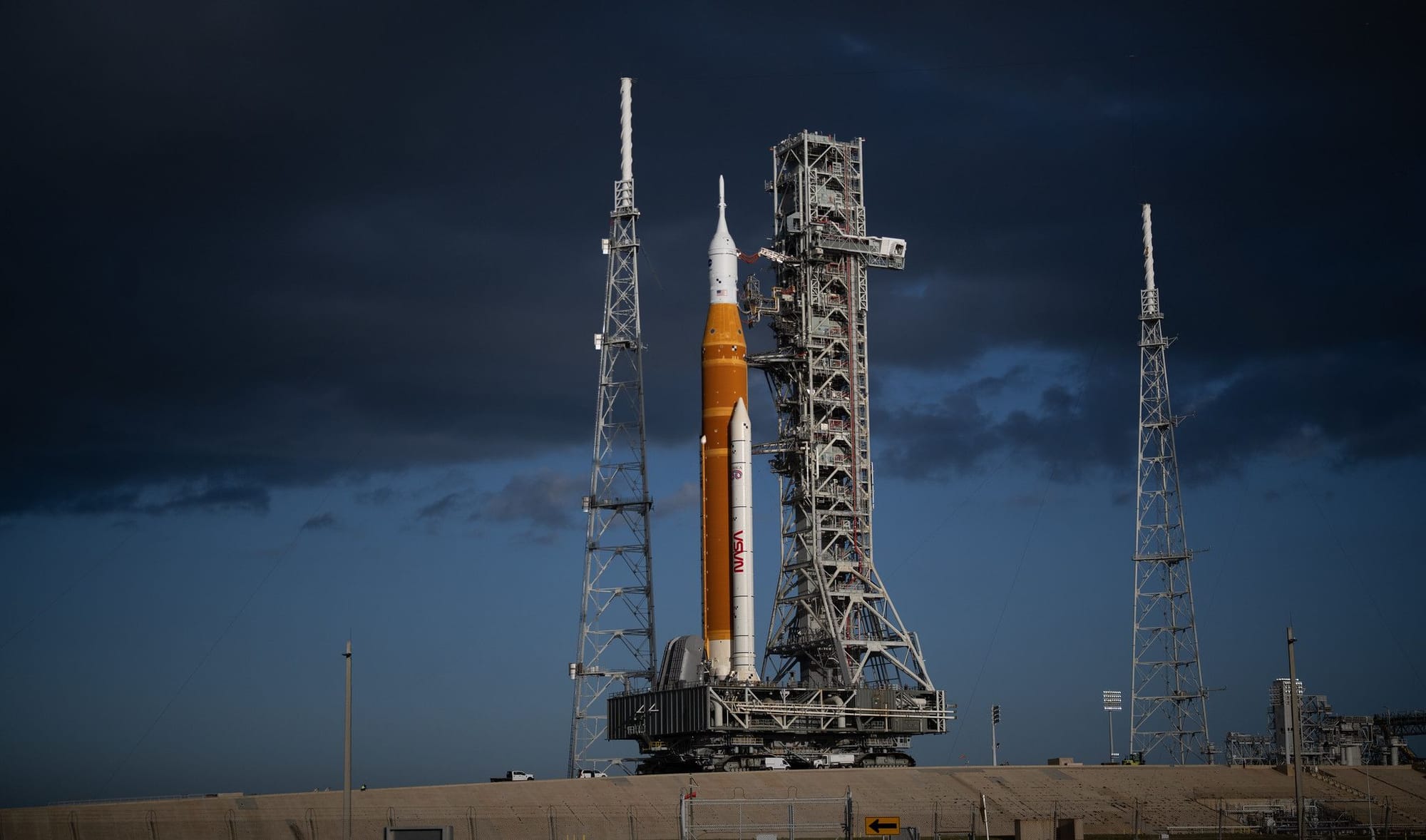
NASA rolled the SLS/Orion Artemis II stack back to Launch Complex 39B at Kennedy Space Center on March 20, after three weeks in the Vehicle Assembly Building fixing a helium flow issue discovered during February's wet dress rehearsal. The agency is now openly targeting an April 1 launch window — the first crewed lunar flyby since Apollo 17 in 1972.
Four astronauts are in quarantine. Ground systems are running final checkouts. This is no longer a conceptual timeline; it's a countdown with real crew operations behind it.
What changes if it flies: the current SLS/Orion configuration gets locked in, downstream hardware contracts stabilize, and the argument for commercial heavy-lift alternatives to SLS loses its most potent ammunition ("it hasn't even flown crew yet"). What changes if it slips again: every alternative architecture — Starship lunar lander variants, commercial crew-rated vehicles — gains political oxygen, and the Artemis III lunar landing (already restructured and targeted for 2028) slides further into uncertainty.
The tell over the next ten days is how NASA talks about contingency windows. If they start discussing backup dates publicly, the April 1 window is shakier than the press releases suggest.
The Space Force's "Commercial-Like" Launch Orders Keep Landing on SpaceX
The Pentagon's experiment in buying launch capacity more like a commercial airline customer — faster awards, less bespoke paperwork, more flexibility — produced another data point this week: SpaceX continues to dominate the Space Force's "commercial-like" National Security Space Launch task orders. A January task order worth approximately $739 million covers nine missions for the Space Development Agency and National Reconnaissance Office, all on Falcon 9.
The economics are stark. SpaceX launched its 33rd Falcon 9 of 2026 this month, averaging one every 2.3 days. Booster B1088 flew its 14th mission — carrying payloads for NASA, the NRO, and Starlink on the same airframe. A booster on its 14th flight is an almost fully amortized asset. No other Western launch provider is on the same cost curve, and the "commercial-like" contracting vehicle — designed to create competition — is instead quantifying the gap.
If this concentration continues, it creates a paradox: the Space Force gets cheaper, faster access to orbit but becomes operationally dependent on a single provider's manifest availability and pad infrastructure. The failure mode isn't a SpaceX rocket blowing up — it's a range scheduling conflict or a pad turnaround delay that cascades across both commercial and national security missions simultaneously. Watch whether the next NSSL solicitation introduces structural incentives for alternative providers, or whether the Space Force accepts the concentration risk as the price of cadence.
Amazon Leo Lines Up Atlas V Number Five — and the FCC Clock Is Still Running
Amazon's satellite internet constellation, now branded Amazon Leo, is targeting March 29 for its next launch — 27 Kuiper satellites aboard a ULA Atlas V from Cape Canaveral. The company completed its first heavy-lift mission of 2026 in February, when an Ariane 64 deployed 32 satellites, bringing the total constellation past 200 spacecraft.
The math remains unforgiving. Amazon has asked the FCC to extend its half-constellation deployment milestone — roughly 1,618 satellites — from July 2026 to July 2028, citing a shortage of available rockets. Amazon's factory in Kirkland can reportedly produce 30 satellites per week, meaning the bottleneck is entirely on the launch side. With 38 contracted Vulcan launches now uncertain (see: Vulcan grounding above), New Glenn in early ramp-up, and Atlas V nearing retirement, Amazon's launch portfolio diversity is more theoretical than operational.
If the FCC grants the extension without conditions, it signals lenient enforcement of deployment milestones for mega-constellations — a precedent that every future filer will cite. If the FCC attaches conditions (accelerated deployment rates, spectrum-sharing concessions), it becomes the first real test of how strictly the commission polices its own rules for constellations this large. Every Atlas V mission that slips pushes the commercial service start date with it.
The Space Force Just Bought Its First Satellite Disposal Service — and Created a Market
Starfish Space won a $52.5 million contract to deorbit satellites from the Space Development Agency's Proliferated Warfighter Space Architecture (PWSA) — the military's growing LEO broadband and tracking constellation. This is the first contract ever signed for end-of-life disposal services for an operational constellation, with Starfish's Otter spacecraft designed to rendezvous with, capture, and deorbit unmodified satellites starting in 2027.
The contract structure matters as much as the dollar figure: initial funding to build capability, then pay-per-deorbit for actual services rendered. That's not a tech demo — it's a service model. Once the Space Force demonstrates it will pay for disposal as a recurring line item, every LEO constellation operator has a new data point for end-of-life planning and insurance pricing.
The commercial parallel is already forming: Isar Aerospace booked a contract to launch Astroscale's ELSA-M mission, a commercial attempt to capture and deorbit a defunct OneWeb satellite. Two funded disposal missions — one government, one commercial — in the same quarter would be a genuine inflection point for in-space servicing. The failure signal: if Otter's 2027 launch slips or the per-deorbit pricing proves uneconomical at scale, disposal stays in the "nice to have" category. Watch whether the FCC's five-year deorbit rule enforcement gets more aggressive now that a funded option exists.
⚡ What Most People Missed
- Eutelsat signed a multi-launch deal with MaiaSpace for OneWeb replenishment — on a rocket that hasn't flown. MaiaSpace, an ArianeGroup subsidiary, is targeting a suborbital demo before year-end and commercial operations in 2027, but has since slipped its inaugural launch to 2027. Eutelsat is essentially betting Europe's constellation replenishment timeline on a vehicle that exists mostly in PowerPoint. The contract could account for the majority of Maia's early manifest — making this as much an industrial policy play as a procurement decision.
- Mantis Space emerged from stealth with $10 million to sell sunlight in Earth's shadow. The startup plans a laser-based orbital power-beaming network that would transmit energy from sunlit satellites to spacecraft in eclipse, potentially decoupling mission duty cycles from battery limits. This is seed-stage and speculative, but it's consistent with the broader move toward treating orbit as an environment with utility services — power, data, disposal — rather than a destination.
- Russia's Soyuz-5 maiden demonstration flight received little Western coverage but has outsized implications. The March 21 demonstration from Baikonur carried a mass simulator. Under current sanctions, the path from demonstration to sustained operational cadence is uncertain; if the vehicle reaches routine availability, it could materially change Russia's medium-lift options for domestic launches and export customers.
- Vast and Sierra Space closed over $1 billion in combined funding for post-ISS commercial stations. Vast landed roughly $500 million (equity plus debt) for its Haven-1 pathfinder; Sierra Space completed a $550 million Series C at about an $8 billion valuation to scale Dream Chaser and national security services, per Satellite Today. Two station builders cashing billion-dollar checks in the same quarter is a market signal that investors expect paying customers — not just NASA — to materialize by decade's end.
- Sweden bought sovereign military launch access. The Swedish Defence Materiel Administration signed a SEK 209 million contract with Swedish Space Corporation to develop Esrange for military satellite launches, targeting operations around 2028. A NATO Arctic nation with its own orbital launch pad changes the sovereign access map for Northern Europe.
📅 What to Watch
- If Artemis II's April 1 window slips again, the political case for SLS as the crewed lunar vehicle weakens materially — watch for NASA's language around "contingency windows" as the leading indicator.
- If Isar Aerospace's Spectrum reaches orbit from Andøya (targeting NET March 23), Norway becomes the first continental European country to host a successful commercial orbital launch — a sovereign capability milestone that reshapes ESA's launcher funding calculus.
- If the FCC grants Amazon Leo's 24-month deployment extension without conditions, every future mega-constellation filer will cite the precedent — effectively making deployment milestones advisory rather than binding.
- If Rocket Lab's LEO-PNT Pathfinder (targeting March 25) validates navigation signals from low Earth orbit at operational quality, it would provide the first real hardware data point for a commercial GPS-alternative market that defense and maritime operators have been waiting on.
- If ULA provides no public Vulcan root-cause timeline by end of Q2, assume more national security missions migrate to Falcon 9 and Amazon Leo's 38 contracted Vulcan launches face further delays — a cascade that touches both defense and commercial constellation schedules simultaneously.
The Closer
A Norwegian launchpad waiting for weather to clear so Europe can finally have a working small rocket; a $52.5 million contract that turns satellite garbage collection from aspiration into invoice; and four astronauts in quarantine hoping the helium plumbing holds this time.
Somewhere in Kirkland, Washington, a factory is cranking out 30 satellites a week with nowhere to put them — which is the most expensive storage problem since the U.S. government filled a mountain with cheese.
Clear satisficing skies —
If someone you know tracks orbits, budgets, or both, forward this their way.
From the Lyceum
The White House released a six-principle AI policy blueprint and told the states to stand down — directly relevant to autonomous satellite operations and AI-driven Earth observation analytics. Read → The White House Hands Congress an AI Rulebook