The Lyceum: Space Economy Weekly — Apr 02, 2026
Week of April 2, 2026
The Big Picture
Humans left low Earth orbit for the first time in fifty-three years — and the space economy barely paused to watch. While Artemis II climbed toward the Moon on Tuesday, the commercial layer kept building: SpaceX filed confidentially for what could be the largest IPO in history, a Starlink satellite broke apart and scattered debris across a crowded orbit band, and 119 smallsats rode a single Falcon 9 into sun-synchronous orbit like commuters on a rush-hour train. This was a week where exploration and industrialization ran on parallel tracks, and the industrial side moved faster.
What Just Shipped
- Artemis II / Orion (NASA): First crewed flight beyond LEO since Apollo 17; perigee-raise maneuver completed, crew nominal on translunar trajectory.
- Transporter-16 Rideshare (SpaceX): 119 payloads deployed to SSO LEO from Vandenberg, including ICEYE SAR sats, Myriota IoT craft, and Portugal's six national satellites.
- ICEYE SAR Constellation Expansion (ICEYE): Six 25-cm SAR satellites added aboard Transporter-16, serving commercial and sovereign intelligence customers including Poland and Portugal.
- Celeste LEO-PNT IOD-1 (ESA / GMV / Alén Space): Two 12U CubeSats launched on Rocket Lab Electron to test LEO-based navigation as a complement to Galileo and GPS.
- Tiqker Quantum Timing Integration (Infleqtion / Safran): First commercially available quantum optical clock integrated into Safran's synchronization systems for mission-critical PNT.
This Week's Stories
Artemis II Launches — Four Astronauts Are Headed to the Moon
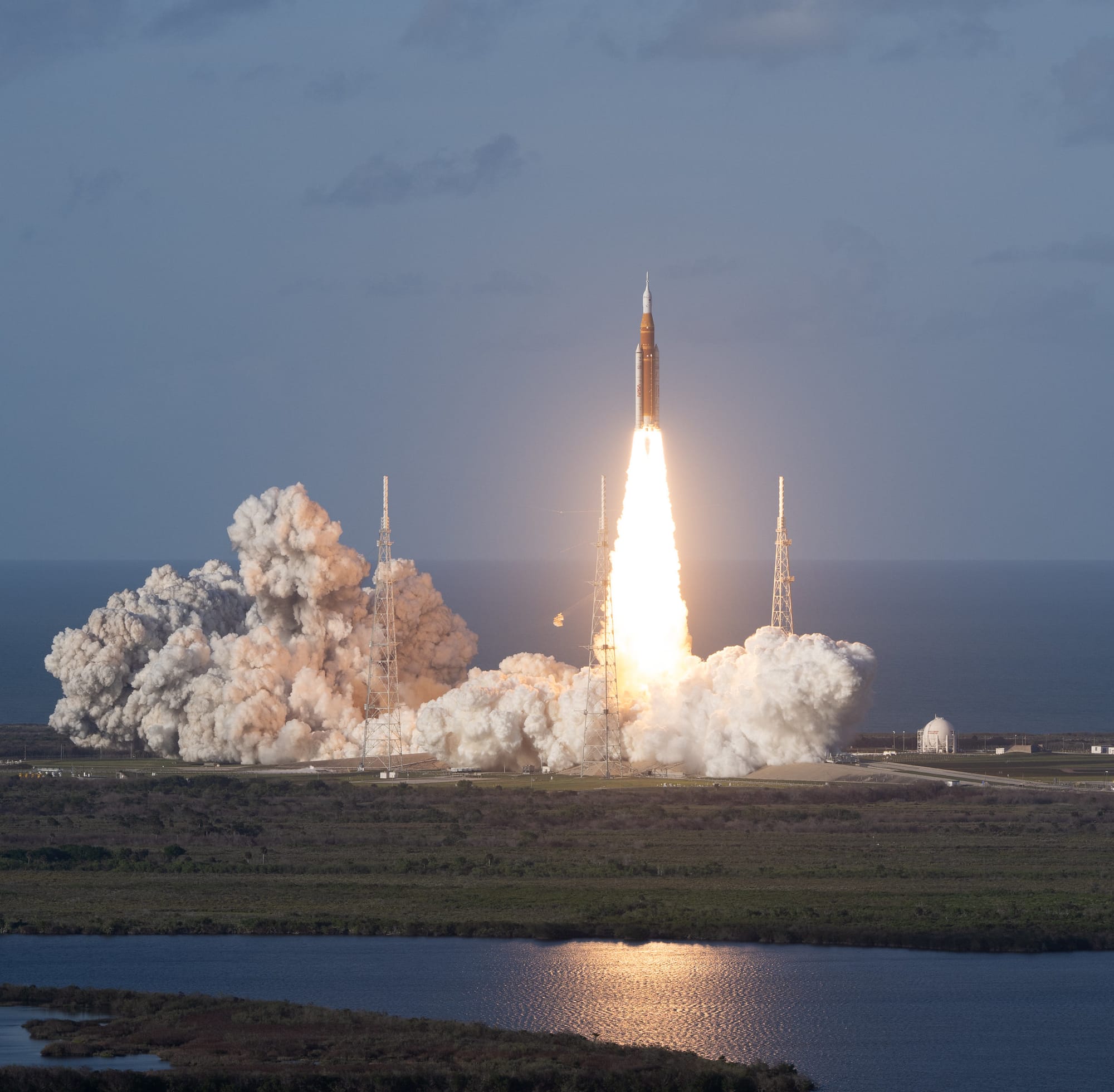
For the first time since December 1972, humans are on a trajectory beyond low Earth orbit. NASA's Space Launch System lifted off from Kennedy Space Center on April 1, sending astronauts Reid Wiseman, Victor Glover, Christina Koch, and Canadian Space Agency astronaut Jeremy Hansen on a roughly ten-day flight to loop around the Moon and return. This isn't a landing — it's a full-dress flight test of the SLS rocket and Orion capsule with a crew aboard, checking life support, navigation, communications, and the heat shield that has to survive a 40,000-km/h reentry.
Early operations went well. NASA confirmed a successful perigee-raise maneuver shortly after launch, though mission teams logged a brief communications dropout during that burn — resolved quickly, but now under review for implications on backup comm design for future Artemis flights. Solar arrays deployed, manual vehicle checkouts proceeded nominally. Via Satellite and other outlets note that industry players are treating a clean mission as the condition for locking down hardware contracts that had been on provisional timelines.
If splashdown around April 10 goes cleanly, Artemis III — the actual lunar landing, currently slated for 2028 — moves from aspirational to programmatic. If the heat shield or life support data shows surprises, the downstream schedule absorbs another delay, and the commercial lander and surface-systems vendors (SpaceX's Starship HLS, Axiom's suits) face a longer wait for their payday. The signal to watch: NASA's post-splashdown technical briefings and whether any anomaly language creeps into the flight report.
One under-noticed datapoint: more than 500 California companies and roughly 16,000 workers contributed to Artemis II — a concentration of suppliers that's a strength for now and a single-state bottleneck if lunar programs need to scale fast.
SpaceX Files Confidentially for the Largest IPO in History
Bloomberg and CNBC reported this week that SpaceX has submitted a confidential S-1 filing to the SEC — the step just before a public roadshow and pricing. Reports suggest the company could seek to raise tens of billions of dollars at a valuation that Euronews attributed in part to Starlink, pegging it past €1.61 trillion as recently as late March. Third-party estimates put 2025 Starlink revenue and EBITDA in the billions, but no one outside SpaceX's finance team has seen audited figures.
That changes the moment the prospectus drops. For the first time, public investors — and every competitor, supplier, and regulator — could see Starlink's subscriber count, average revenue per user, churn, and how SpaceX allocates capital between rockets, satellites, and newer ventures including orbital compute. That transparency could re-price Kuiper, Eutelsat/OneWeb, and Telesat amid new visibility into Starlink's metrics, and it could give satellite component suppliers their first real demand signal from the largest buyer in the market.
If the IPO proceeds at the reported scale, it would validate the thesis that LEO broadband is a generational infrastructure business, not a venture experiment. If it stalls or prices down, the signal is that even Starlink's economics don't yet justify the hype — and the downstream capital environment for every smaller constellation tightens immediately. Watch for timing: a prospectus could land within weeks.
Transporter-16 Delivers 119 Payloads — and Sets the Price for Everyone Else
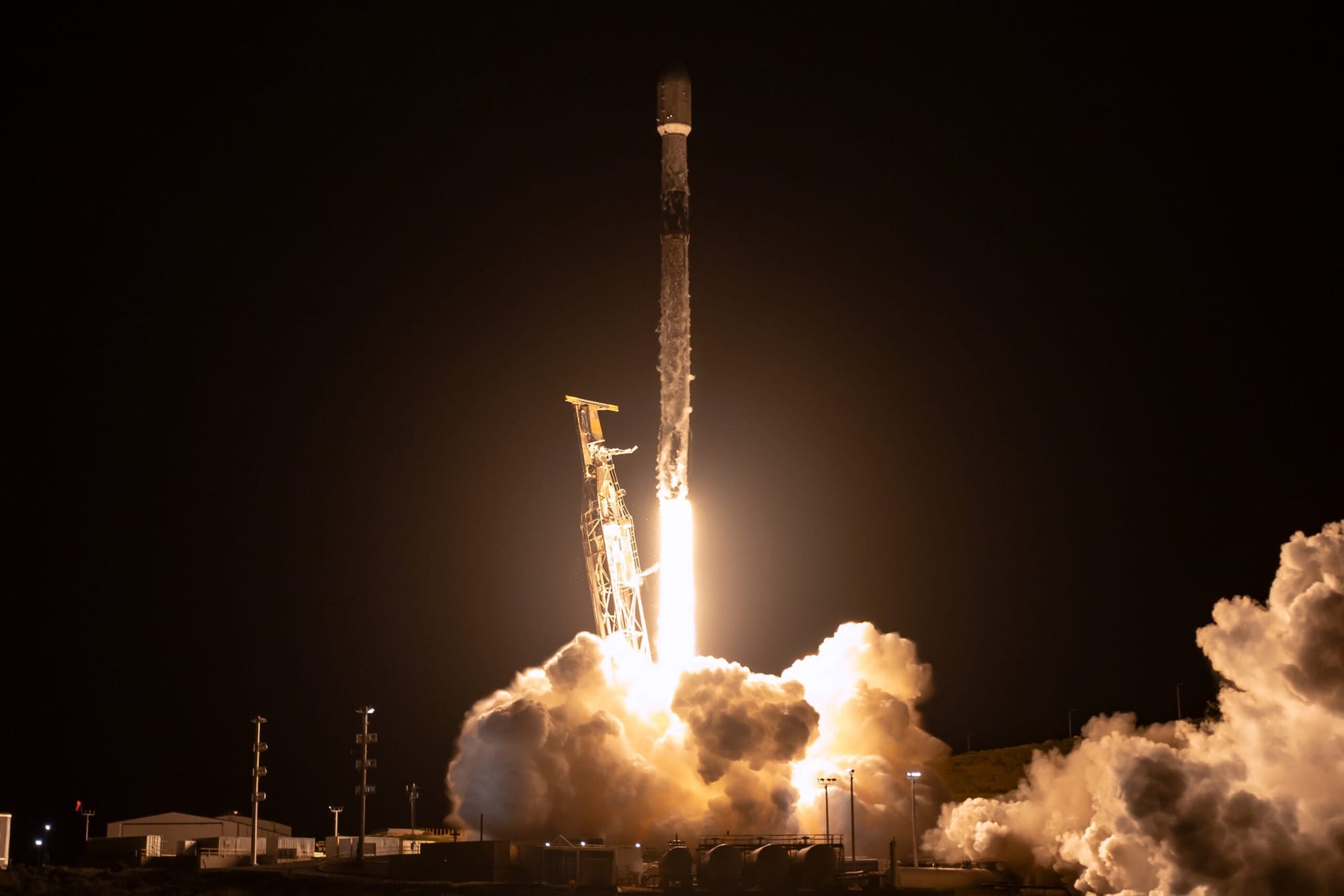
On March 30, a Falcon 9 lifted off from Vandenberg for SpaceX's Transporter-16 mission, deploying 119 payloads into sun-synchronous LEO. The booster — flying for its 12th time — landed on the droneship and will fly again. The upper stage spent roughly an hour dropping off cubesats, microsats, orbital transfer vehicles, and a reentry capsule from customers spanning defense, commercial EO, IoT, and national programs.
The manifest tells you who's actually building hardware. ICEYE added six SAR satellites supporting sovereign intelligence customers including Poland and Portugal. Myriota launched four IoT craft via Spire to expand its direct-to-sensor network. And Portugal flew six national satellites under its New Space Portugal program — part of a broader push that could put 11 Portuguese satellites in orbit by year-end.
Transporter-class rideshares are now the "container shipping" of orbit: cheap, reliable, high-volume, but on SpaceX's schedule and SpaceX's orbit. That's fine for operators who need SSO and can wait for a window. It's a problem for anyone who needs a custom orbit, a faster commissioning timeline, or deployment away from an increasingly congested band. If dedicated small-launch providers like Rocket Lab and PLD Space can offer those alternatives at a tolerable premium, they carve out a durable niche. If they can't, Transporter's pricing gravity pulls the whole market toward commodity rideshare — and SpaceX sets the floor.
Starlink 34343 Breaks Apart in Orbit — and the Debris Math Gets Harder
On March 29, Starlink satellite 34343 in a ~560 km orbit suffered what SpaceX called an "anomaly" and went silent. Within hours, commercial tracking firms detected tens of new objects in the satellite's vicinity — consistent with an internal breakup, not a collision. This is at least the second Starlink fragmentation in recent months.
SpaceX says current analysis shows no risk to the ISS or Artemis II traffic and expects most fragments to reenter within weeks. But every fragmentation adds to the tracking and maneuvering burden for every other operator sharing that altitude band. KeepTrack's deep dive notes that Starlink's VP of Engineering, Michael Nicolls, has discussed plans to lower roughly 4,400 satellites from 550 km to about 480 km over the course of 2026 — a massive shell-management maneuver that would shorten orbital lifetime for failed satellites and fragments, effectively using altitude as a safety valve.
If SpaceX follows through, "altitude as a safety knob" becomes a normalized tool for mega-constellation operations, and regulators may start pressing other operators to adopt similar practices rather than just filing deorbit paperwork. If fragmentations continue without clear root-cause fixes, insurers will start pricing operator-specific debris track records into premiums, and the FCC — which already set precedent with its DISH debris fine — will face pressure to tighten design and reporting standards for constellations above 5,000 satellites. The observable signal: whether the next FCC license amendment for Starlink Gen3 includes new passivation or altitude-management conditions.
Rocket Lab's CEO Cuts His Pay to $1 — and That's a Capital Allocation Signal
Effective March 30, Rocket Lab CEO Peter Beck reduced his base salary to $1, waived future bonuses, and cancelled 392,155 unvested restricted stock units — confirmed in an SEC 8-K filing. The company stated the freed-up capital will be redirected into strategic R&D, specifically development of the Neutron medium-lift reusable rocket.
This isn't just founder theater. Beck's previous compensation was valued in the millions, with the majority in stock awards. By forgoing salary and equity, he's tying his financial outcome entirely to Rocket Lab's share price — a high-conviction bet that Neutron and the company's expanding satellite component business (including the pending acquisition of laser-terminal maker Mynaric, now approved by German regulators) will drive long-term value. Owning a supplier of optical inter-satellite links reshapes Rocket Lab's negotiating position on SDA and commercial constellation work and reduces a supply-chain vulnerability that tariffs or export controls could otherwise exploit.
The same week, Rocket Lab completed its 85th Electron mission, delivering ESA's Celeste LEO-PNT demonstrators to orbit — a reminder that the company remains a working launch provider even as it pivots to medium-lift. If Neutron reaches orbit on schedule, Rocket Lab becomes the only Western company besides SpaceX with both a small and medium-class reusable vehicle. If Neutron slips, the $1 salary becomes an expensive gesture, and the Mynaric acquisition looks like vertical integration ahead of the product it's supposed to serve.
⚡ What Most People Missed
- The orbital data-center land grab is now a three-way race. Starcloud raised $170 million to build on its 88,000-satellite FCC filing, Blue Origin filed "Project Sunrise" for 51,600 compute satellites, and SpaceX has its own million-satellite ask pending. None of these have proven orbital economics, but investors and regulators are treating them as real — which means AI compute is now competing with broadband and EO for the same crowded LEO shells and spectrum.
- The Space Force keeps buying SpaceX launches even as its own satellites underperform. A $178.5 million contract for two SDA launches landed March 31, even though Space Development Agency leadership has acknowledged only about 17% of its on-orbit spacecraft met their strict "operational" definition as of March 2026. Launch cadence and price are outweighing on-orbit teething issues in procurement decisions — a "good enough, fast" posture with real implications for how defense acquires space assets.
- Starlink logged nine conjunction threats in four days. A KeepTrack/SOCRATES analysis showed nine close-approach events between March 20–24, including one rated HIGH risk, several involving dead satellites and upper stages that can't maneuver. Every avoidance burn eats propellant and ops time — conjunction risk is becoming a persistent line item, not an edge case.
- Amazon may be shopping for Globalstar. Via Satellite reported that Amazon is in talks for a possible Globalstar acquisition, which would give Kuiper access to narrowband capacity and S-band spectrum used for direct-to-device services. If true, big tech wants vertically integrated satcom stacks — not just wholesale bandwidth.
- Canada quietly invested $7 million in Kepler Communications through FedDev Ontario to commercialize its optical data-relay network and align it with national defense ISR needs — a small check with outsized strategic signal for sovereign optical-relay infrastructure.
📅 What to Watch
- If the Artemis II splashdown (~April 10) produces heat-shield anomaly language, it means the Artemis III timeline absorbs another multi-quarter delay — and every commercial lunar vendor's revenue forecast shifts right with it.
- If SpaceX's IPO prospectus reveals Starlink ARPU below $40/month, it signals the service is scaling on volume rather than premium pricing, which compresses the addressable market for every competitor targeting the same customer segments.
- If SpaceX actually begins lowering 4,400 Starlinks to ~480 km, altitude management becomes a de facto regulatory expectation for every mega-constellation — and operators who can't maneuver their fleets face new licensing friction.
- If the April 5 ITU workshop produces U.S. formal objections to Guowang's Ka-band filings, expect multi-month coordination delays that ripple into Chinese and allied LEO broadband deployment schedules.
- If Amazon closes a Globalstar deal, direct-to-device becomes a three-way fight (Apple/Globalstar, T-Mobile/Starlink, Amazon/Kuiper) — and the S-band spectrum map redraws overnight.
The Closer
Four astronauts riding a rocket older than some of their interns toward a Moon no one's visited since President Richard Nixon (who died 1994), a CEO paying himself less than a parking meter, and 119 satellites stuffed into one rocket like a clown car that actually works. Meanwhile, SpaceX is about to show the world its books — and half the industry is praying the margins are worse than they fear. Keep looking up; it's getting crowded.
From the Lyceum
New reciprocal tariffs landed this week — chips and drugs got a temporary pass, but space supply chains didn't. Read → Tariff Earthquake Lands
If someone you know tracks orbits, builds satellites, or just wants to understand why the Moon is back in the news, forward this their way.