The Lyceum: Space Economy Weekly — May 07, 2026
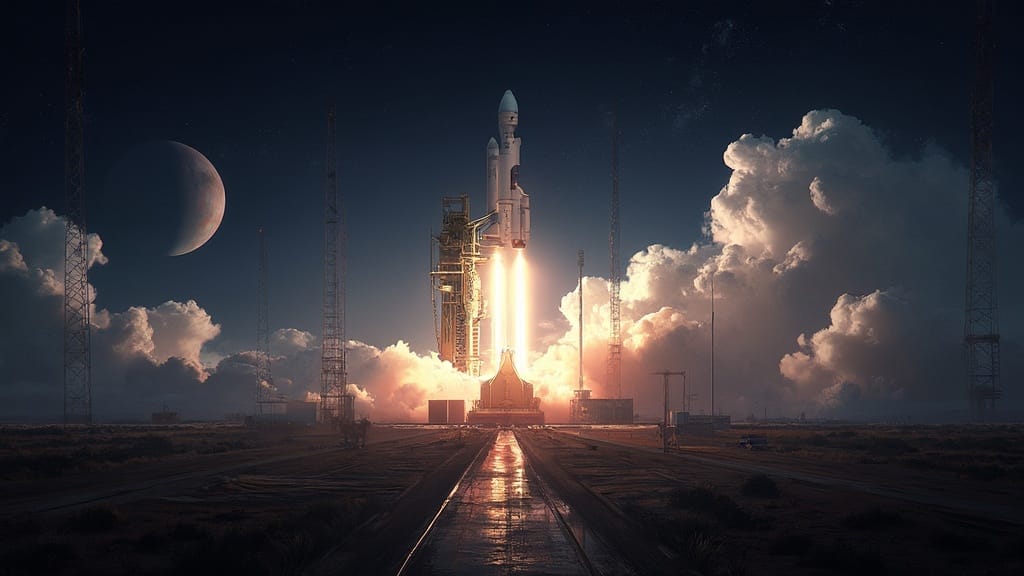
Photo: lyceumnews.com
Week of May 7, 2026
The Big Picture
This is the week the space economy stopped pretending it was just about rockets. SpaceX rented out its data center to an AI company that wants to put servers in orbit, the FCC quietly removed the biggest paperwork obstacle to direct-to-phone service, and Amazon Leo's July deadline math went from "tight" to "impossible" — with the regulator's response now the actual story. The infrastructure layer is getting crowded, and everyone wants to be the landlord.
What Just Shipped
- Starship V3 (Booster 19 / Ship 39) (SpaceX): First stretched V3 stack rolled to Pad 2 with launch windows opening May 12, designed to lift over 100 tons to LEO.
- Ariane 64 (Flight VA266) (Arianespace): Delivered 32 Amazon Leo satellites to LEO on April 30 — Ariane 6's seventh flight and second Kuiper mission, establishing repeatable cadence.
- Blue Moon Mark 1 cargo lander (Blue Origin): Completed thermal-vacuum testing in JSC's Chamber A, clearing the last major environmental gate before its lunar south pole demo flight.
- Colossus 1 capacity allocation (Anthropic / SpaceX): More than 300 MW and over 220,000 NVIDIA GPUs in Memphis were brought online for Anthropic's Claude within a single month.
- FCC Order DA-26-380A1 (FCC OET / Space Bureau): Waives certain Part 25 equipment-authorization requirements for Supplemental Coverage from Space for devices already certified for terrestrial use on or before June 29, 2024, clearing the device-side bottleneck for direct-to-phone satellite service.
- BlackSky Assured subscription tier (BlackSky): Announced a $25M multi-year contract converting a per-image buyer to reserved Gen-3 collection capacity at 35cm resolution.
This Week's Stories
Starship V3 Is Two Weeks From the Pad — and the Second Pad Is the Real Story
Every Starship flight has been called a milestone. Flight 12 might actually be one.
Federal launch notices reviewed by NASASpaceFlight show launch windows for Flight 12 running May 12 through May 18, with daily two-hour openings starting at approximately 5:30 p.m. Central. This is the first flight of the Version 3 vehicle and the first launch from Starbase's Pad 2 — two firsts in one mission, and both matter independently.
The V3 stack pairs Booster 19 with Ship 39, both running Raptor 3 engines, standing 408 feet tall, and designed to carry over 100 tons to low Earth orbit — nearly triple the V2's roughly 35-ton capacity, per independent trackers of SpaceX disclosures. If that payload number holds in practice, it reshapes the economics of Starlink deployment and, more critically, the orbital refueling math for NASA's Artemis lunar architecture. Greater propellant capacity per tanker flight means fewer tanker flights before any crewed lunar landing — a logistical bottleneck that has drawn pointed scrutiny from the NASA Inspector General.
The pad is the underappreciated piece. A second launch mount means SpaceX can prepare one vehicle while another is being stacked or serviced, removing the bottleneck that produced the 211-day gap between Flights 11 and 12. Ship 40 has already begun testing for Flight 13 before Flight 12 has flown — meaning SpaceX is now running an overlapping pipeline rather than a sequential test program.
Flight 12 itself takes a deliberate step back: suborbital arc, both stages targeting splashdown rather than tower catches. SpaceX is validating new architecture before chasing recovery milestones again.
What to watch: the FAA launch license. The FCC communications license is already in hand through October 2026; FAA flight safety approval is the remaining gate. If it clears before May 12, the window is live. Slip past May 18 and the cadence story restarts.
Anthropic Rents SpaceX's Data Center — and Floats the Idea of Servers in Orbit
The most interesting space story this week isn't a rocket launch.
Anthropic announced on Wednesday that it has secured all of the compute capacity at SpaceX's Colossus 1 data center in Memphis — more than 300 MW and over 220,000 NVIDIA GPUs available within the month, per Anthropic's own announcement and CNBC's reporting. The terrestrial part is straightforward: Anthropic needs GPUs, SpaceX has a building full of them, and the deal also packages higher Claude API limits for developers.
The orbital piece is what belongs in this newsletter. Anthropic also "expressed interest" in working with SpaceX to develop multiple gigawatts of compute capacity in space. SpaceX's own announcement framed the pitch directly: terrestrial power, land, and cooling can't keep pace with frontier AI training timelines, and SpaceX argues it is uniquely positioned — launch cadence, mass-to-orbit economics, constellation operations — to make orbital data centers a near-term engineering program.
That's a vendor pitch, not an independent assessment, and "expressed interest" is doing real work in that sentence. There is no funded program, no FCC experimental license filing, no announced spacecraft. The engineering problems — heat rejection in vacuum, gigawatt-scale power generation, ground-link latency — are unsolved at this scale.
But the framing matters. China's government committed $8.4 billion to space-based data centers last month. A frontier US AI lab now treats orbital compute as a near-term infrastructure question rather than a 2040s research curiosity. And there's a quieter subplot: the Pentagon declared Anthropic a supply chain risk in March and blacklisted it from classified networks, while xAI's Grok is being folded into SpaceX as "SpaceXAI." The result is a single private company that is now simultaneously a launch provider, satellite operator, data center operator, AI lab with Pentagon access, and would-be orbital compute infrastructure provider. That concentration has no precedent in the defense industrial base.
Watch for an FCC experimental license filing. That's the signal this moves from press release to engineering program.
Japan's H3 Is Back on the Manifest — With a Mars Mission Riding on Its Reputation
Japan's most important rocket has one job right now: don't fail again.
JAXA announced that the 6th H3 launch vehicle will fly between June 11 and June 30 from Tanegashima, carrying the Vehicle Evaluation Payload-5 dummy satellite plus six secondary payloads including PETREL, STARS-X, BRO-22, and VERTECS. This is the return-to-flight mission after the December 2025 second-stage anomaly that lost the Michibiki No. 5 navigation satellite — the second second-stage failure in H3's short history.
The cause was banal in a way that makes it worse. Per Orbital Today, JAXA traced the failure to adhesive holding layers of a structural component together. The adhesive degraded under prelaunch heat exposure, the component delaminated once the fairing opened, the satellite shifted, fuel piping broke, and ignition occurred late. A manufacturing defect, not a design flaw — which means the fix is process discipline, not redesign.
The return-to-flight vehicle is a stripped configuration: no solid rocket boosters, liquid engine only, dummy primary payload. Per The Japan Times, it will be Japan's first large rocket flying on a liquid engine alone. JAXA has explicitly said final pre-launch evaluation will include integrity confirmation of the Payload Separation System.
What changes if this works: Japan keeps its sovereign launch ambitions intact for the MMX mission to Phobos, the LUPEX lunar rover with India, and the next Michibiki navigation satellite — all designed around the H3. What changes if it fails: JAXA is forced to shop foreign launch services for missions Japan has spent a decade architecting around its own rocket. There is no third strike scenario where the H3 stays on the manifest.
Watch for any announcement of additional inspection findings during the June pre-launch checks. Slip the June 30 backup and the MMX schedule starts to wobble.
Ariane 6 Did the Most Important Thing a New Rocket Can Do: Repeat Itself
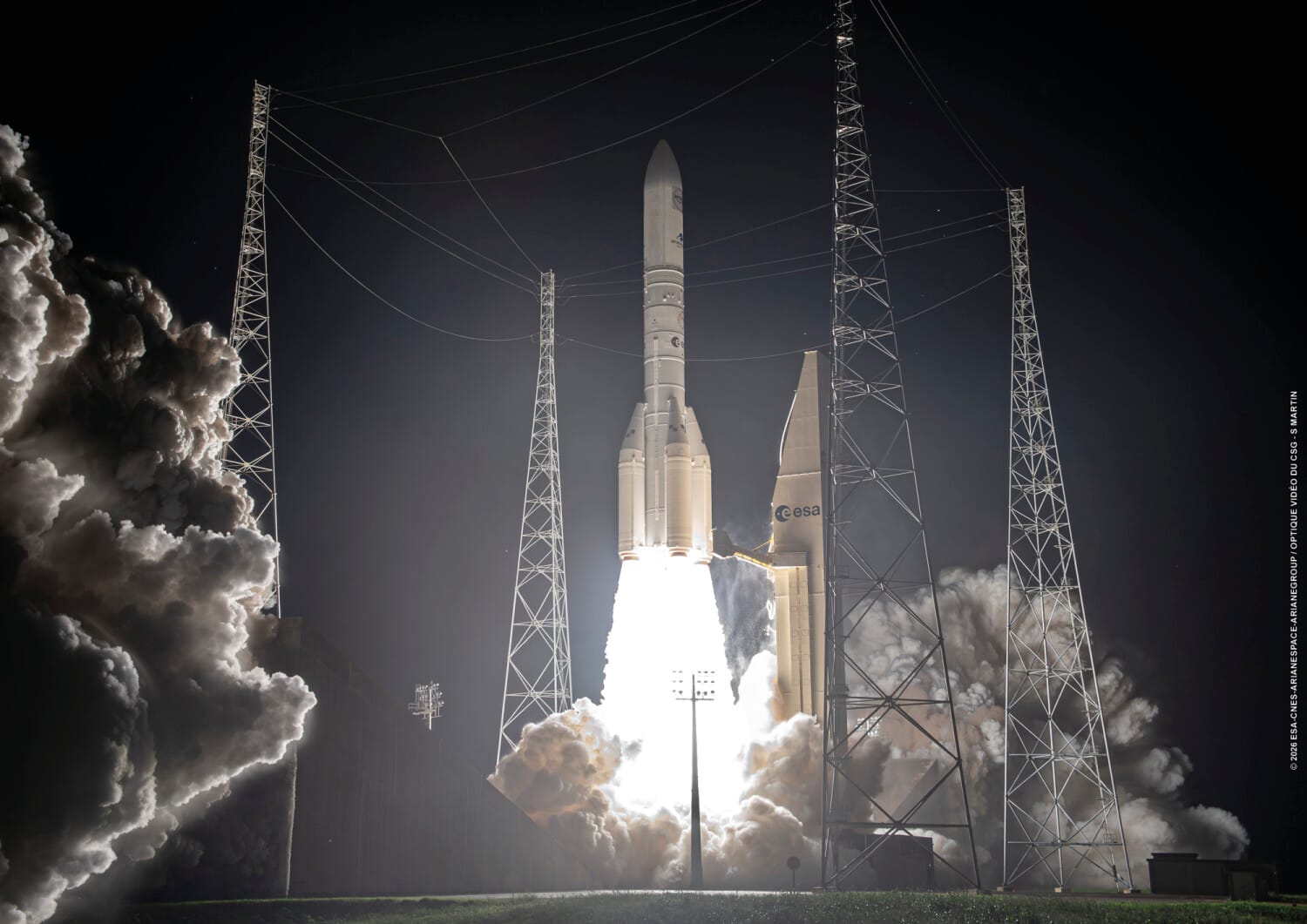
If you run a satellite program, the launch you care about most is rarely the flashy first one. It's the second, third, and fourth flight that tell you whether a rocket is becoming infrastructure or a headline.
Arianespace's April 30 mission flew Ariane 6 in its four-booster Ariane 64 configuration, lofting 32 Amazon Leo satellites from French Guiana. Per Arianespace, this was the second Ariane 6 mission for Amazon and the seventh Ariane 6 flight overall. That's the part that matters: Europe is rebuilding heavy-lift cadence after the long post-Ariane 5 gap, and Amazon has a non-SpaceX launcher actually delivering spacecraft on schedule during the worst regulatory squeeze of its constellation buildout.
What changes if Arianespace can hold this rhythm: European satellite operators get a credible alternative to Falcon 9, NSSL Phase 3 Lane 2 calculations shift, and Amazon's path back to FCC compliance gets slightly less catastrophic. What it looks like if cadence stalls: Amazon stays trapped in single-supplier geometry with SpaceX, and Europe's launch sovereignty narrative quietly empties out.
Watch the gap between Ariane 6 flights eight and nine. One successful repeat is relief; consecutive sub-quarter gaps are a market.
Commercial Earth Observation Pivots from Pixels to Reserved Capacity
The Earth observation market is splitting cleanly into two businesses: selling images, and selling outcomes. BlackSky just signed a clean example of the second.
BlackSky announced a $25 million multi-year "Assured" contract that converts a per-scene Gen-3 buyer into a subscription tier with guaranteed collection capacity, 35-centimeter imagery, and real-time AI-enabled analytics. The company now has four Gen-3 satellites on orbit — the capacity-guarantee pitch is only credible because the fleet exists.
SpaceNews framed the same trend from the demand side this week: island nations, maritime operators, and defense customers are increasingly buying fused operational intelligence — illegal fishing flags, maritime domain awareness overlays, climate anomaly alerts — rather than raw scenes. Per the SpaceNews piece, this product shift is the only path to software-like margins for EO providers, because per-scene pricing keeps drifting toward commoditization as supply expands.
What changes if "assured capacity" becomes the dominant procurement model: the winning EO companies look less like photo libraries and more like managed infrastructure providers, and the moat shifts from sensor specs to constellation availability and analytics integration. What it looks like if it doesn't take hold: average selling price per scene keeps falling, and the smaller-fleet EO companies get squeezed out by sheer pixel volume.
Watch whether other governments start signing capacity-style contracts over the next two quarters. If three or more do, the procurement model has shifted.
⚡ What Most People Missed
- The FCC just made direct-to-phone service vastly easier to turn on: On April 22, the FCC's Office of Engineering and Technology and Space Bureau waived certain Part 25 equipment-authorization requirements for Supplemental Coverage from Space. Phones already authorized for terrestrial use on or before June 29, 2024 can now connect to satellite-direct services without separate device-by-device satellite authorization. The bottleneck just moved out of the handset aisle.
- Amazon Leo's July deadline is now mathematically impossible: Amazon needs 1,618 satellites in orbit by July 30 and is at 231 with three months left. Amazon has formally requested a 24-month extension, telling the FCC it expects only 700 satellites by the original deadline. How the FCC rules sets the precedent for every future mega-constellation license — a permissive ruling effectively converts "use it or lose it" into a suggestion.
- SAM.gov's contract-award lag is itself a signal: SAM.gov posted an active alert on May 4 saying contract-award data is only correct through May 2, with downstream effects on databank reports and subcontract reporting. For anyone tracking Space Force, NRO, SDA, or NASA awards, that's a blind spot. Anyone claiming a quiet U.S. procurement week right now is overstating their confidence.
- The Artemis III SLS core stage arrived at Kennedy Space Center this week — a hardware milestone that tends to get buried under Starship news but starts the integration clock on the actual crewed lunar landing mission. Watch the next NASA Inspector General Artemis III schedule risk report; the OIG has consistently been more pessimistic than the agency's public timelines.
- JAXA quietly suspended its reusable rocket test program. Japanese-language outlets reported this week that JAXA paused tests on its smaller experimental reusable vehicle, with pre-flight operations unavailable. This is separate from the H3 return-to-flight effort but matters for Japan's long-term ambition of a domestic reusable launch capability.
📅 What to Watch
- If the FCC grants Amazon Leo's 24-month extension, every future LEO operator will treat constellation deployment milestones as negotiable rather than binding — a structural shift in what an FCC license actually guarantees.
- If SpaceX or Anthropic files an FCC experimental license for orbital communications relays related to compute, the Memphis announcement converts from press release into engineering program with a real timeline.
- If Ariane 6's eighth flight comes within 90 days of the seventh, Arianespace has functionally re-entered the heavy-lift market as a pricing constraint on SpaceX rather than a sovereign-only option.
- If H3 Flight 6 slips past June 30, JAXA's MMX Phobos sample-return launch window starts compressing, and the question becomes whether Japan books foreign launch services for missions it designed around its own rocket.
- If Blue Origin posts a firm Blue Moon Mk.1 launch date in the next month, commercial lunar cargo stops being a two-company conversation and CLPS payload pricing finally has comparables.
- If average EO scene pricing drops measurably this quarter while subscription contracts rise, the BlackSky model is the future and the per-image business is officially in terminal decline.
The Closer
A frontier AI lab daydreaming about gigawatt server farms in vacuum, a Japanese rocket grounded by failed glue, and Amazon politely asking the FCC for two more years to find 1,387 missing satellites. The Pentagon has blacklisted Anthropic from classified networks while folding xAI into the company that just sold Anthropic its GPUs — somewhere a procurement officer is staring at a flowchart and slowly closing their laptop. Until next week.
If you know someone whose week gets better when they understand who actually owns the pipes, forward this to them.