The Lyceum: Space Economy Weekly — May 14, 2026
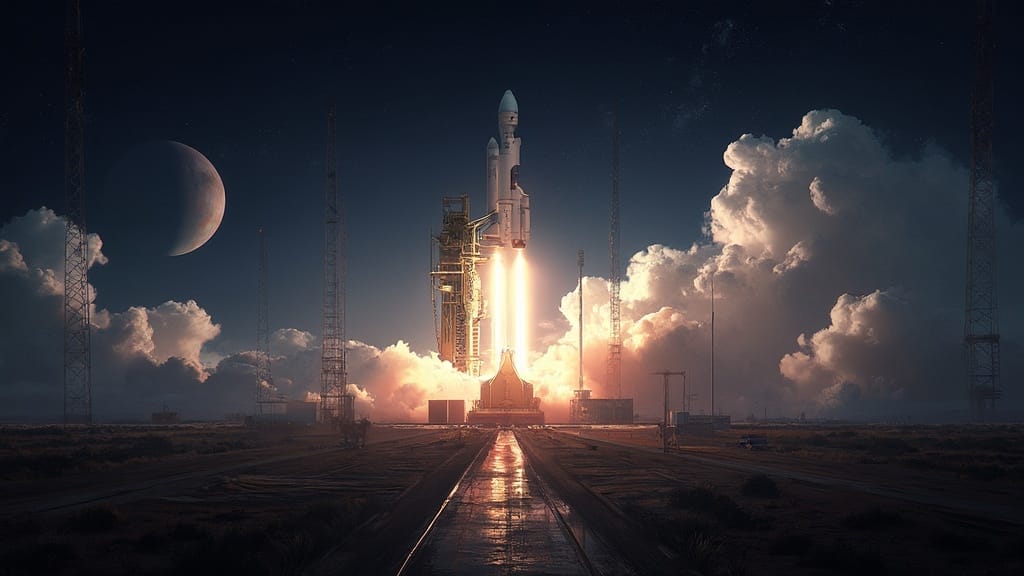
Photo: lyceumnews.com
Week of May 14, 2026
The Big Picture
This is the week the orbital data center stopped being a Musk talking point and started being a procurement conversation, with Google reportedly designing satellites with Planet Labs while talking to SpaceX about launching them. It's also the week Starship V3 finally got a date — May 19 — with the four docking ports and propellant transfer hardware that actually matter for Artemis. And underneath both stories, a quieter pattern: customers are reserving capacity before capability is proven, from Rocket Lab's pre-flight Neutron block sale to Amazon Leo's urgent FCC math.
What Just Shipped
- Starship V3 / Flight 12 stack (SpaceX): First fully fueled wet dress rehearsal completed at Pad 2 with more than 5,000 metric tonnes of propellant loaded; vehicle now stands ~408 feet, the tallest rocket ever stacked.
- Hellenic Space Dawn — HELIOS & SELENE (Greek Connectivity Programme / ESA / AAC Clyde Space): Two 8U CubeSats deployed to LEO carrying CubeCAT laser-communication terminals to validate direct-to-Earth optical links.
- Capella InSAR (Capella Space): Commercial debut of interferometric synthetic aperture radar — moving the product from imagery to millimeter-scale ground deformation measurement.
- FCC Order DA-26-398A1 (Federal Communications Commission): Denied SpaceX's bid to use portions of the 1.5 GHz and 1.6/2.4 GHz MSS bands for direct-to-device Starlink; the applications were dismissed with prejudice.
- Innoflight Tranche 1 avionics delivery (Innoflight): 1,193 cyber-secure avionics units delivered to the Space Development Agency for the Tranche 1 Proliferated Warfighter Space Architecture, with the company citing annual capacity above 1,500 units.
This Week's Stories
Starship V3 Has a Launch Date — and This One Actually Has Docking Ports
Every Starship flight has been called a milestone. Flight 12, targeting May 19 from Starbase's new Pad 2, is one for a specific reason that has nothing to do with how big the rocket is.
This is the first launch of Starship V3, and per Spaceflight Now it carries a clean-sheet propulsion redesign, increased tank volume, four docking drogues, and ship-to-ship propellant transfer connections. Translated: this is the first Starship with the plumbing required to refuel another Starship in orbit — a capability that figures in NASA's Artemis III architecture. SpaceX completed a full wet dress rehearsal this week, loading more than 5,000 metric tonnes of propellant on the stacked vehicle for the first time, per SpaceX's update. Flight 12 will also deploy 22 Starlink simulators, relight a Raptor in space, and deliberately stress the heat shield, per Drive Tesla Canada's summary of the mission profile.
What changes if it works: Artemis III moves from "aspirational" to "plausible," and SpaceX's IPO narrative about orbital infrastructure stops sounding like vaporware. What failure looks like: another upper-stage anomaly extends the V2-to-V3 transition into 2027 and forces NASA to reconsider its lunar lander timeline. The signal to watch is in the post-flight telemetry — specifically whether the propellant feed connections behave as modeled during the on-orbit relight.
Google and SpaceX Are Talking About Putting Data Centers in Orbit
The orbital data center conversation moved from speculation to procurement this week.
Per the Wall Street Journal, reported via TechCrunch and Bloomberg, Google and SpaceX are in active talks about launching Google's Project Suncatcher — a constellation of solar-powered satellites carrying Google's Tensor Processing Units, networked into an orbital AI cluster. Data Center Dynamics reports the long-term architecture envisions roughly 81 satellites spanning a 1 km radius, with an initial prototype launch targeted around 2027. Crucially, per Wall Street Journal reporting cited by Data Center Dynamics, Planet Labs — best known as the largest commercial Earth observation operator — has been chosen to design and build the spacecraft.
What changes if it works: Planet Labs becomes a satellite manufacturer for hyperscaler compute, not just an imagery vendor, and Google gets a hedge against terrestrial power and water constraints. What failure looks like: the unit economics may not close — per Tom's Hardware, the financial break-even for orbital compute sits near $200/kg to LEO, well below current launch pricing — and the prototype could become a research artifact rather than a product line. Watch for Google or Planet Labs FCC experimental license applications; until hardware paperwork shows up, this is still a Tier 2 report citing unnamed sources.
The FCC Just Told SpaceX "Not in Those Bands"
While everyone was watching Starship, the FCC released order DA-26-398A1, denying SpaceX's bid to use portions of the 1.5 GHz and 1.6/2.4 GHz mobile-satellite service bands for Starlink direct-to-device. The applications were dismissed with prejudice.
The practical effect is immediate: incumbents in those allocations keep their protections, and SpaceX cannot back-door into MSS spectrum for direct-to-phone via this filing path. What changes: spectrum control becomes the primary moat in direct-to-device, not raw constellation size — which favors operators with existing MSS rights and forces SpaceX into partnership or acquisition postures it has historically avoided. What failure for SpaceX looks like here is more interesting than success: if the company files revised applications or pursues a leasing arrangement, the direct-to-device market could consolidate around spectrum holders rather than satellite builders. The signal to watch is whether new SpaceX MSS filings appear in the FCC docket within 60 days.
H3 Flies Again — and Japan's Mars Mission Exhales
Japan's H3 rocket has had a brutal two years. The eighth H3 in December 2025 failed in its second stage, losing the QZS-5 navigation satellite per Spaceflight Now's coverage at the time. That failure put the Martian Moons eXploration mission and the joint Japan-India lunar polar mission in direct jeopardy.
This week NHK and Asahi Shimbun reported that preparations for the H3 No. 6 return-to-flight — carrying the VEP-5 mass simulator and six secondary payloads — are proceeding on schedule for a June 11–30 launch window from Tanegashima. Separately, Nikkei reported that JAXA and Japan's Ministry of Education, Culture, Sports, Science and Technology are drafting a development policy for an upgraded H3, and that the Epsilon S solid-fuel program may face plan revisions as resources concentrate on H3 recovery. [Source: Asahi Shimbun, NHK, Nikkei — Japanese]
What changes if it works: MMX keeps its 2026 planetary window, the HTV-X cargo program retains its Artemis-compatible upmass path, and Japan's medium-lift sovereignty story holds. What failure looks like: MMX slips to 2028, the Epsilon S program loses budget priority, and Japan's payload customers start quietly shopping Falcon 9 and Vulcan slots. The June window is the signal.
Rocket Lab Sold Five Neutron Launches Before Neutron Has Flown
Per Spaceflight Now, Rocket Lab announced on May 7 a block sale covering five Neutron launches and three Electron launches, while reaffirming late-2026 for Neutron's debut and pushing total backlog above $2.2 billion.
Neutron is a roughly 13,000 kg-to-LEO reusable medium-lift vehicle — about a quarter of Falcon 9's capacity — and it matters amid Space Force concern about Falcon 9 concentration risk. A pre-flight block sale is the market voting on that concern. What changes if Neutron flies on time: the U.S. gets its second credible medium-lift option, and government acquisition rooms get a fallback that isn't ULA. What failure looks like: a 2027 slip, a Pad 0-C licensing delay at Wallops, and customers quietly converting to Falcon 9 manifests. The signal to watch is the FAA Part 450 license docket — no public filing means late-2026 is aspirational.
Amazon Leo Has 77 Days and Needs 1,300 More Satellites
Per GeekWire and SatNews, Amazon Leo (formerly Project Kuiper) had launched approximately 302 production satellites as of April against an FCC license condition requiring 1,618 on orbit by July 30, 2026. Amazon has asked the FCC to push that deadline to July 30, 2028, citing a "near-term shortage of available rockets." The Commission has not ruled.
The launch math is the problem, not manufacturing — SatNews notes Amazon's Kirkland factory can build 30 satellites per week. New Glenn's post-anomaly grounding removed a primary contracted vehicle when Amazon needed launches. What changes if the FCC grants the extension: Amazon keeps its orbital shells at 590/610/630 km and the LEO broadband duopoly thesis stays intact. What denial or silence looks like: the FCC has grounds to revisit license terms, and those orbital slots become contestable — which is exactly what Starlink, AST SpaceMobile, and Eutelsat OneWeb would want. The waiver request is still active; watch the FCC docket between now and late July.
Capella's New InSAR Service Moves Earth Observation From Pixels to Measurement

Per Aviation Week, Capella Space commercially debuted an interferometric synthetic aperture radar service on May 4. The technique compares radar observations over time to measure millimeter-scale ground deformation — useful for subsidence monitoring, pipeline integrity, mine wall stability, and post-disaster damage assessment.
This is the same maturation cloud computing went through: vendors stop selling raw capacity and start selling answers. What changes: Capella's revenue mix tilts toward subscription monitoring contracts with infrastructure operators and insurers, who care less about pixel resolution than about whether the ground moved. What failure looks like: the InSAR service stays an enterprise-sales novelty while customers continue buying one-off tasking. The signal is whether Capella's next earnings call breaks out recurring monitoring revenue separately from imagery sales.
⚡ What Most People Missed
- SpaceX is scouting Louisiana for a third Starship site: Per SpaceNews, state officials disclosed that SpaceX is eyeing a 55,000-hectare Exxon-owned parcel near the Gulf Coast for a future Starship launch facility, and SpaceX confirmed it is seeking additional sites. The company's own framing — "thousands of flights per year" — makes the infrastructure logic for a fourth pad cluster hard to argue with.
- Aetherflux rebranded as Cowboy Space Corporation and pivoted to orbital data centers: Per Data Center Dynamics, the company previously focused on space-based solar power now plans "vertically integrated orbital data centers and rockets." Venture capital is rotating from space solar to space compute in real time — watch where the next round of Series A money lands.
- The U.S. military ran a classified tabletop on a nuclear detonation in LEO: Reddit and community-level discussion this week amplified reporting on a Pentagon exercise modeling orbital denial from a high-altitude nuclear event — the modern echo of Starfish Prime, which damaged early satellites in 1962. This is Tier 3 community signal at the moment; the verifiable indicator would be hardening or survivability language appearing in Space Force solicitations on SAM.gov.
- Greece quietly put two optical-comms demo CubeSats in LEO: Per ESA, HELIOS and SELENE launched May 3 on Falcon 9 carrying CubeCAT laser terminals from AAC Clyde Space to validate direct-to-Earth optical links. Sovereign space capability is built in 8U increments, not flagship rockets.
📅 What to Watch
- If Starship Flight 12's propellant transfer hardware behaves as modeled, NASA's Artemis III lander timeline gets its first non-aspirational data point — and SpaceX's IPO roadshow gains a tangible technical anchor beyond Starlink revenue.
- If the FCC grants Amazon Leo's extension request before July 30 with conditions attached, the conditions themselves will telegraph how regulators intend to handle the next round of mega-constellation milestone filings from AST SpaceMobile and others.
- If H3 No. 6 fails in the June window, expect Japan's payload customers to start quietly evaluating Falcon 9 and Vulcan manifests — and watch for the MMX mission to be formally rebaselined to 2028.
- If SpaceX files revised MSS spectrum applications within 60 days of the FCC's denial, direct-to-device competition could consolidate around spectrum partnerships rather than independent constellations — favoring incumbents like Globalstar over new entrants.
- If a Louisiana environmental impact statement or FAA pre-application docket appears for a Starship site, the "thousands of flights per year" target stops being rhetorical.
- If Planet Labs breaks out manufacturing revenue in its next quarterly report, the Suncatcher contract is material — and the company's investment thesis quietly shifts from imagery operator to dual-use space vendor.
The Closer
A 408-foot rocket gets its first full tank of gas, a search-engine company hires an Earth-imaging company to build satellites that think, and Amazon's factory cranks out 30 satellites a week into a launch queue that doesn't exist. Somewhere in a Pentagon SCIF, planners are war-gaming what happens to all of it if someone sets off a nuke in low Earth orbit — which, depending on how Flight 12 goes on May 19, may or may not be the second-most stressful thing happening in space this month.
Until next week.
Forward this to the satellite operator in your life who's been refreshing the FCC docket page since February.