The Lyceum: Sunday Edition — Jul 05, 2026

Photo: lyceumnews.com
Week of July 5, 2026
The Big Picture
The postwar order is being stress-tested on every front at once, and this week the tests came back messy. Russia launched its deadliest strike on Kyiv in years while Trump picked up the phone to Putin; Britain is halfway through a two-week scramble to install its seventh prime minister in a decade; and North Korea started putting nuclear-capable missiles on ships. None of these are the same story — but they rhyme, and the rhyme is that nobody has agreed on the rules anymore.
What Just Shipped
- Mythos (Anthropic): One of the company's most advanced AI models, released to select organizations after Commerce Secretary Howard Lutnick lifted an export block imposed earlier in June.
- GPT-5.6 (OpenAI): The most capable version yet released — and the first whose users the U.S. government will formally vet before granting access.
- Sub-1nm chip technology (IBM): The company says it has demonstrated the world's first sub-nanometer transistor process, pushing past a physics barrier the industry feared would stall Moore's Law — still a research result, not a production chip.
This Week's Stories
The Night Kyiv Burned: Russia's Deadliest Strike of the Year
If you live in a city with apartment buildings, this week's news from Ukraine should stop you cold.
Ukraine's emergency services confirmed Friday that the death toll from Russia's overnight assault on Kyiv had risen to 30, with more than 90 injured, after what the city's mayor called Moscow's "most massive attack" on the capital. Ukraine's air force said the barrage involved 570 air-attack assets — four Zircon hypersonic missiles, 24 Iskander ballistic missiles, and 496 Shahed-type drones. That's 570 weapons aimed at a single city in a single night. (Death toll rises to 21 with more than 80 injured in huge Rus)
Twenty-eight of the missiles were ballistic — a record for one attack on Kyiv, according to Air Force spokesperson Yurii Ihnat, per the Kyiv Independent. Ballistic missiles are the hardest to intercept: they travel faster than a bullet at peak and come nearly straight down. Ukraine downed 48 missiles and 476 drones, but 25 ballistic missiles and 12 drones still struck 33 locations. The metro sheltered a record 52,500 people, including nearly 4,500 children.
None of this is happening in a vacuum. Ukraine has spent a 40-day stretch systematically hitting Russian oil refineries, NPR reports, while Ukrainian drones struck an oil terminal in St. Petersburg, which Zelensky called "key infrastructure that generates revenue for Russia's war." The logic has become grimly symmetrical: Ukraine hits Russia's energy economy, Russia hits Ukraine's civilians.
What changes now hinges on a single variable: air defense. Zelensky renewed his plea for Patriot interceptors, thanking the American team but adding, "for today, it's too slow," Time reported. Complicating everything, the Kremlin says Trump spoke with Putin for nearly 90 minutes and offered to help end the war. Watch whether Washington answers with faster Patriot deliveries or a diplomatic gesture with no follow-through — the two point in opposite directions.
Britain's Revolving Door: Andy Burnham's Path to Downing Street
Britain is about to get its seventh prime minister in ten years. That's not a typo.
Less than two years after returning Labour to power in a landslide, Keir Starmer announced he would step down, Al Jazeera reported, after months of pressure from MPs alarmed by the rise of far-right Reform UK and dismal May council results. Starmer asked Labour's National Executive Committee to open nominations on Thursday, July 9, and close them by the July 16 recess — meaning a new leader in place before Parliament returns in September. He stays on as PM until then.
Andy Burnham, the Greater Manchester mayor, has confirmed he'll run — and analysts expect him to walk into Downing Street, Time reports. Former Health Secretary Wes Streeting, long seen as his likeliest rival, surprised many by backing him instead.
The mechanics matter here. Britain's system lets a party swap its leader — and therefore its prime minister — with no general election. A man who wasn't in Parliament two weeks ago could be steering British foreign policy by September, right as Europe juggles Ukraine, energy prices, and a fractious Washington. Watch for any serious challenger before the July 16 deadline: if Burnham runs unopposed, the whole transition accelerates, and the awkward answer to "who speaks for Britain" gets settled fast. (Andy Burnham distanced himself from UK Prime Minister ...)
North Korea Goes to Sea — With Nuclear Weapons
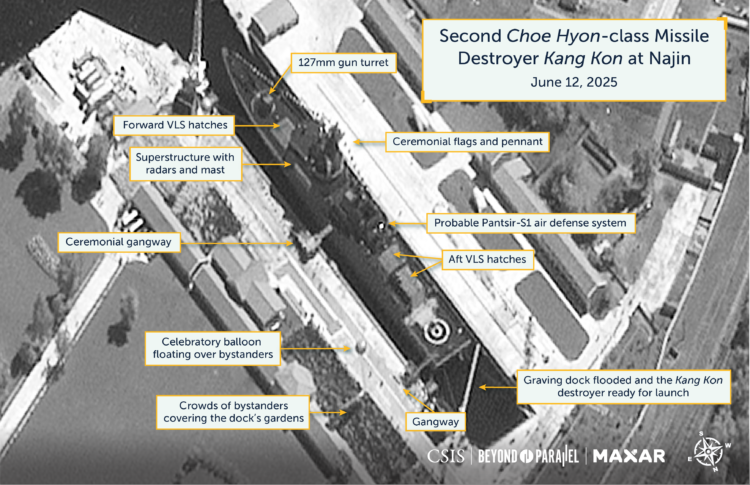
Kim Jong Un has spent years building longer-range missiles. This week, he started putting them on ships.
The North Korean leader observed the test-firing of a strategic cruise missile — Pyongyang's language for nuclear-capable — plus evaluations of anti-ship, anti-submarine, and air-defense systems aboard the new 5,000-ton destroyer Kang Kon, state media KCNA reported, via Reuters. The Kang Kon is North Korea's most advanced surface warship.
Why does this beat the usual missile test? Land-based launchers are relatively easy to watch — satellites see the sites, the trajectories are predictable. A ship-based nuclear-capable missile can move, hide in international waters, and change the geometry of deterrence for South Korea, Japan, and U.S. forces across the Pacific. It's the same logic that pushed Cold War powers toward submarine-launched missiles: a weapon you can't find is a weapon you can't preemptively destroy. (Chronology of U.S.-North Korean Nuclear and Missile ...)
The Kang Kon is one ship. But the observable signal is deployment: watch for satellite imagery of the destroyer at sea and any response from the U.S.–South Korea–Japan trilateral framework. If it starts patrolling, a new and far less predictable front in Pacific security has opened. (Launching of North Korea's Second Choe Hyon-Class Destroyer)
The AI Gatekeeper: Washington Takes Control of Frontier Models
The U.S. government just built something that would have read as science fiction two years ago: a federal vetting process for who gets to use the most powerful AI on earth. (Will Washington and Beijing Nationalize AI Labs?)
The Associated Press reported that Washington revised licensing rules to let Anthropic release its Mythos model to select organizations — after first ordering an export block earlier in June. Commerce Secretary Howard Lutnick announced the reversal. The sequence — block, review, selective release — is now the template. Separately, the Washington Post reported that OpenAI confirmed the government will vet users of its latest GPT-5.6 model, its most capable release yet. Think of it as an export license for a weapons system, except the "weapon" is software that reasons, writes code, and synthesizes information at a level that genuinely worries national security officials.
If this holds, the world splits into two tiers: organizations inside the fence and those outside it — and the fence is being built right now, model by model. The disruption lands on any foreign company, foreign government, or untrusted domestic outfit that assumed frontier AI was a product they could simply buy. The signal to watch: whether the Commerce Department extends the vetting framework to every frontier lab, or keeps it a case-by-case improvisation. One is industrial policy; the other is chaos. (Thought for the week: US government order forces ...)
Trump Ties the Iran Ceasefire to Your Gas Bill
Foreign policy and your commute merged this week. CBS News reported that Trump said the Iran conflict could wrap up in two to three weeks — even as it pushed gas prices past $4 a gallon. (US, Iran find deal for longer ceasefire, but Scott Bessent .)
The through-line runs to the G7 summit in Évian-les-Bains, where the leaders of Britain, France, Canada, Germany, Italy, Japan, the United States, and the EU pledged tougher sanctions on Russian oil and gas and more air defenses for Ukraine, while welcoming a deal to reopen the Strait of Hormuz — the chokepoint through which a fifth of the world's oil flows — for global shipping. (The Kyiv air-defense pleas above are the summit's promises meeting reality.) In late-June remarks, Trump publicly ordered gas companies to "drop your price." (G7 leaders back Trump's plan to end Iran war that faces ...)
Here's what's actually being renegotiated: not just a peace dividend, but who captures oil rents. Reopen Hormuz, pressure companies on price, back harsher Russia sanctions — do all three at once and you're re-routing the plumbing of global energy, not just nudging the monthly bill. Watch whether prices actually fall on Trump's timeline. If they don't, the "two-to-three weeks" framing becomes a promissory note the president has to make good on — with your fuel gauge as the receipt. (Trump says 'TIME IS OF THE ESSENCE' for Iran deal)
The Lens
Real outlet monitoring. Today's coverage gaps — what each side is watching.
What right-leaning outlets are watching
China has released imprisoned pastor Ezra Jin after sustained pressure from the United States, according to the Wall Street Journal. Jin had been detained by Chinese authorities and his case had become part of broader U.S.-China tensions over religious freedom and political prisoners. (Immediately and Unconditionally Release Pastor Ezra Jin ...)
Also in right-leaning news:
- Fox News led with a report that experts are deeply concerned about Iran's activity at an underground nuclear site.
- The Washington Examiner focused on how the Strait of Hormuz crisis has exposed China's energy strategy.
What progressive outlets are watching
The Guardian reported that Trump repositioned himself as a peacemaker during a long phone call with Vladimir Putin. The call came as Russia continued its war against Ukraine and as the latest strike on Kyiv drove up casualties and damage.
Also in progressive news:
- Mother Jones reported that the U.S. has accepted only white refugees for six consecutive months.
- Mother Jones also reported on public records showing the FBI secretly extracted data from ICE protesters' phones.
Same story, two lenses — which is which?
Trump's July 4th messaging and national identity framing. Two treatments. Same facts, genuinely different emphasis. Which perspective is which?
Version A
There is something worth taking seriously in Trump's July 4th address at Mount Rushmore, whatever one's view of the messenger. The speech reached for a language of national gratitude and continuity that American civic life genuinely needs — and that has been in short supply. To call America 'the most exceptional nation ever to exist' is not mere boosterism; it is an invitation to reflect on what, precisely, produced that exceptionalism: constitutional limits on power, a culture of individual enterprise, and institutions built to outlast any single leader or faction. Conservatives have long understood that national identity is not a vanity project but a binding agent — the shared inheritance that makes self-government possible across difference. The risk in such speeches is always that celebration slides into complacency, that pride displaces the honest reckoning a 250-year-old republic owes itself. The better tradition — Lincoln's, not the bunting-and-fireworks variety — holds gratitude and self-criticism together. If this address pointed toward that tradition, even imperfectly, it performed a function worth acknowledging: reminding citizens that what they share is worth defending.
Version B
Marking a nation's 250th anniversary is, by any measure, a significant civic occasion, and the language a president chooses for it reveals something real about how power understands itself. Trump's invocation of a 'golden age of America' is worth examining not as rhetoric to dismiss but as a framing with consequences. The phrase does genuine work: it locates national greatness in a recoverable past rather than an achievable future, and it implicitly defines who belongs to that golden inheritance. Progressives have always argued that American idealism is most credible when it is honest about the distance between founding promise and lived reality — for Black Americans, for Indigenous communities, for workers whose labor built the prosperity the speech celebrates. None of that requires cynicism about the republic itself; it requires the kind of accountability that makes self-government meaningful. A 250th anniversary is precisely the moment to ask whether institutions are serving the full breadth of the people they were built to represent. Pageantry that forecloses that question isn't patriotism — it's a substitute for it.
⚡ What Most People Missed
- China's quiet squeeze east of Taiwan: Beijing sent two Coast Guard ships to patrol the Pacific side of Taiwan — not the headline-grabbing strait, but the waters where U.S. and Japanese forces would operate and where Taiwan gets resupplied in a blockade. The New York Times reports it's a campaign to challenge Taiwan's control there; it's classic gray-zone pressure, and it got almost no coverage precisely because nothing exploded.
- Africa's satellite internet leap meets an orbital traffic jam: Starlink is racing across Africa — its 27th market, Côte d'Ivoire, is due online this month — while a new European Southern Observatory study warns that up to a million satellites and orbital mirrors could push the night sky past acceptable brightness. Much of the global south's connectivity plan is now effectively outsourced to one constellation operator. [Source: The Economist — English]
- Europe's cryptographic age-check battleground: A newly updated technical annex to the EU's age-verification framework describes proving you're over a minimum age using zero-knowledge proofs — cryptographic proofs that reveal only that a statement is true, not your full ID. The implementation is still in beta and unreviewed, but Brave's privacy researchers already warn that "anonymous" age-range proofs can leak more than intended and risk centralizing who gets to participate online.
- Webb keeps finding galaxies that shouldn't exist: The James Webb Space Telescope continues turning up early galaxies too big, too bright, and too old for the standard cosmological model — and the discrepancy is getting harder to wave away. Most physicists suspect our grasp of early galaxy formation is incomplete rather than the whole framework being wrong, but the data is real and accumulating.
📅 What to Watch
- If Burnham runs unopposed by July 16, Britain's foreign policy could shift on Europe and Ukraine before most capitals have finished briefing their old files on him.
- If Washington answers Zelensky's "too slow" with faster Patriots rather than a Putin phone call, it signals the U.S. is choosing pressure over a deal — and vice versa.
- If gas prices don't fall on Trump's two-to-three-week timeline, the Iran framing curdles from victory lap into political liability with a fuel-gauge receipt.
- If the Kang Kon starts patrolling international waters, the entire Pacific missile-defense math changes — because a nuclear weapon you can't locate is one you can't preempt.
- If Commerce extends AI user-vetting to every frontier lab, we get a formal two-tier world of AI access; if it stays case-by-case, we get unpredictable improvisation — both worth pricing in now.
The Closer
Picture 52,500 people, a fifth of them children, packed into the Kyiv metro while 570 machines fell on the city above them; picture a man who wasn't in Parliament two weeks ago tidying his desk for Downing Street; picture Kim Jong Un beaming on the deck of a destroyer that now carries the bomb out to sea. The reassuring part is that Washington has finally built a fence around who can use the world's most dangerous software — the unnerving part is that it decides who's inside the fence one model at a time, roughly the same speed at which it's promising your $4 gas will fix itself. Stay skeptical.
Forward this to the friend who keeps asking you to explain what's actually going on — this is the email.