The Lyceum: Sunday Edition — Jul 19, 2026

Photo: lyceumnews.com
Week of July 19, 2026
The Big Picture
The June ceasefire between the United States and Iran is dead, and this was the week that killed it beyond reviving. Seven consecutive nights of American airstrikes, oil up nearly 16% on the week, gas crossing $4 a gallon, and a strait that once carried a fifth of the world's traded oil reduced to a handful of ships a day — every other story this week bends around that one 21-mile-wide chokepoint. The war has stopped being a shipping story and started hitting the systems daily life runs on: airports, water plants, and the roughly 6,000 sailors now stranded at sea.
This Week's Stories
The Ceasefire That Wasn't: How the Iran War Came Roaring Back
If you felt like you'd already read this story once, you're right — and that's the point.
A week after Washington and Tehran signed a preliminary deal aimed at ending the war, an Iranian drone damaged a cargo ship transiting the Strait of Hormuz. No casualties, no major damage — but the attack set off a chain of hostilities that has now put the two countries back on a path toward all-out war less than a month after they agreed to stop. By Friday, the U.S. military had completed its seventh consecutive night of renewed strikes, targeting six bridges near Iran's southern coast, including near Bandar Abbas.
Iran answered by hitting U.S. bases in Kuwait and Bahrain and — in a move that alarmed the entire Gulf — damaging a desalination plant that provides drinking water to one of the driest countries on earth. The war has crossed from military assets into civilian utilities.
The strategic picture is grimly clarifying. Vice President JD Vance ruled out sending ground troops for regime change and admitted the core problem plainly: "You can bomb them, you can take away their radar, you can take away some of their drones and some of their missiles, but it's just too easy to fire at ships in the straits. So you've got to actually be willing to talk." Mediators announced yet another road map for de-escalation this week — but the bombs kept falling even as the diplomats talked.
President Trump told reporters the war could wrap up in "two to three weeks." That's a prediction, not a plan. The tripwire to watch is Iranian power infrastructure: Trump has openly threatened it, and reporting indicates Iran has instructed Houthi forces to prepare to disrupt the Red Sea's Bab el-Mandeb strait if it's hit. Two chokepoints closed at once would affect nearly 40% of globally traded oil and gas — a scenario almost nobody is pricing.
China's Economy Blinks — and the Iran War Is Part of Why
China's economy is supposed to be the world's growth engine. This week, it coughed.
Growth came in at 4.3% in the April-to-June quarter, its weakest since the lockdown-scarred fourth quarter of 2022, missing forecasts of 4.5% and slowing sharply from 5% in the first quarter, per China's official data as reported by CNBC. "This was the slowest growth in any quarter since the lockdown-impacted fourth quarter of 2022," ING's Greater China chief economist Lynn Song said.
The headline number understates the imbalance. State support and private capital are pouring into AI, chips, and robotics while lower-value manufacturing and services languish. Retail sales rose just 1% year-over-year in June; the property market keeps sinking. Exports are running hot — Chinese EVs and clean-energy tech are selling fast to importers scrambling off fossil fuels — but a country can't export its way to prosperity when its own consumers won't spend. (China's GDP Growth Slows to 4.3% in Second Quarter as Iran War Hits Oil Prices |)
The Iran war compounds it: as IBTimes noted, pricier fuel and commodities weigh on both consumer sentiment and manufacturing. Watch for a Beijing stimulus announcement in the coming weeks — the miss gives policymakers cover to act. The question is whether they reach for the old infrastructure playbook or finally target consumer demand. [Source: IBTimes JP — Japanese]
Related fallout: The New York Times reported Trump wants to delay his planned visit to China, citing the Middle East conflict — a small diplomatic casualty of a war that keeps widening its reach.
$4 Gas and a Fed in a "Family Fight"
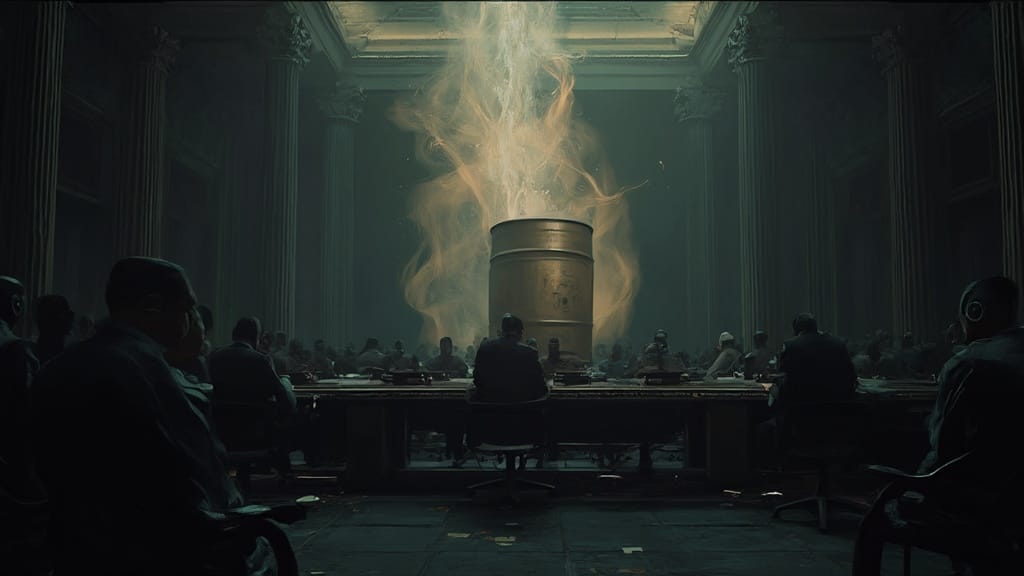
The Gulf war is no longer a foreign story. It's in your gas tank, your grocery bill, and your mortgage rate — and the people meant to manage the fallout are openly arguing about what to do.
Oil rose more than 14% on the session this week; WTI closed Friday at $82.47, capping a nearly 10% weekly gain. The national average for regular gas crossed $4 a gallon, a roughly 25-cent jump in a single week for most drivers. The inflation picture was already ugly before this: June import prices rose 1.9% month-over-month, an upside surprise almost certainly tied to energy. Housing starts fell 15.4% in June, a third straight monthly decline — higher rates finally biting.
Into this walks Federal Reserve Chair Kevin Warsh, who in his first congressional testimony before the Senate Banking, Housing, and Urban Affairs Committee described the central bank's internal tightening debate as a "family fight." The dilemma is real: raise rates to fight oil-driven inflation and you deepen a housing slump; hold steady and you risk letting an energy shock embed itself in expectations. The 10-year Treasury yield closed the week at 4.54%, easing off its 4.62% two-month high on safe-haven demand — a fragile equilibrium.
If oil stays above $85 into the July 28–29 FOMC meeting, the "family fight" becomes a public one. Watch the statement language: a single word change on the inflation outlook could move markets hard.
6,000 Sailors Stranded, 17 Dead: The Human Cost Nobody's Counting
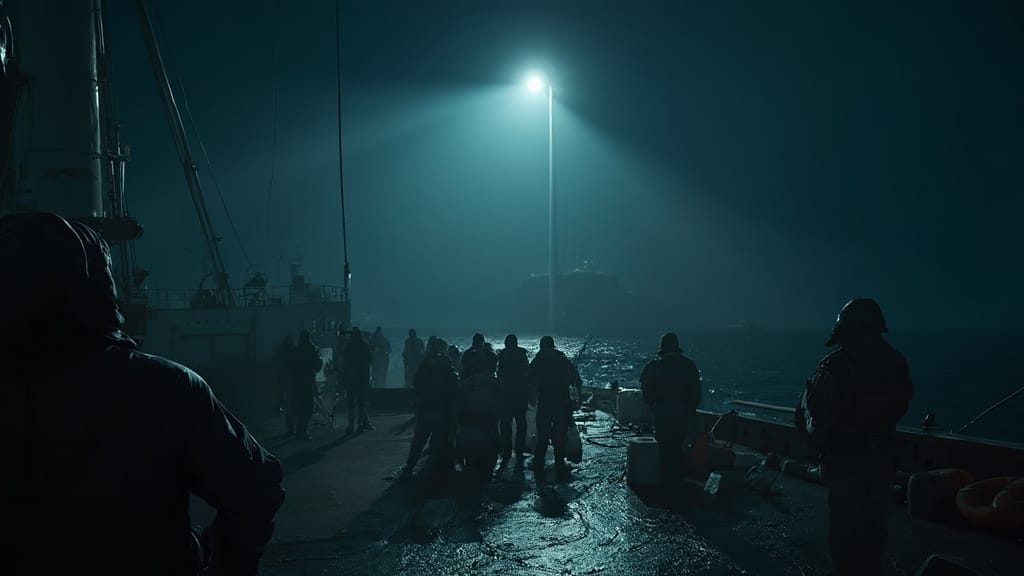
The headlines track missiles and oil prices. The quieter story is unfolding at sea, and it's worse.
The UN reported this week that hundreds of vessels carrying roughly 6,000 crew remain stranded in the Persian Gulf, unable to make port or rotate off. Maritime tracker Kpler has verified 56 attacks on commercial vessels and 17 seafarer deaths since the re-escalation. Unions warn of deteriorating conditions, mental-health strain, and scarce medical access for crews trapped for weeks.
One of the dead was Herambh Karmarkar, 30, a third engineer aboard the MV GFS Galaxy when Iranian Revolutionary Guard forces damaged it in the Gulf of Oman. Ten crewmates were rescued; he was not. This week India ordered operators not to deploy Indian seafarers on Hormuz voyages — and India supplies more than 300,000 sailors to the world's fleets, roughly the third-largest pool anywhere. (India ask its seafarers not to take Hormuz voyages | MarketScreener India)
That ban doesn't just protect Indian workers; it pulls a chunk of the global crewing base out of one of the world's most critical lanes. And here's the part that outlasts any ceasefire: with lost mines, GPS spoofing, and damaged radar, the strait won't simply "reopen" when the guns quiet. Watch whether the International Maritime Organization convenes an emergency session — that would signal the crisis has crossed the threshold demanding a coordinated response.
France Arms Ukraine to Build Its Own Arsenal
Buried under the Gulf this week was a Ukraine development that deserved more attention: France didn't just send weapons — it gave Ukraine the right to make them. (France Arms Ukraine to Build Its Own Arsenal)
President Macron announced France will grant Ukraine production licenses for Aster-30 interceptors, AASM Hammer precision bombs, and SCALP cruise missiles — confirmed alongside 16 Rafale fighters. It's the first time France has licensed weapons manufacturing to Kyiv, a shift from "we'll supply you" to "we'll help you become self-sufficient." Paired with the ten-nation Integrated Anti-Ballistic Missile Coalition launched in Paris and the UK joining the EU's €90 billion Ukraine facility, the week's European defense news told one story: the coalition is moving from emergency aid to long-term industrial partnership.
Ukraine, meanwhile, kept demonstrating its own doctrine. Overnight July 18, its Unmanned Systems Forces damaged 13 vessels of Russia's shadow fleet — the tankers Moscow uses to sell sanctioned oil — in the Black and Azov Seas. Long-range strikes have now hit refineries representing 82% of Russia's national capacity, with June refining output reportedly down 25% and domestic gasoline shortages spreading inside Russia. (France Arms Ukraine to Build Its Own Arsenal)
Ukraine is turning economic warfare into a doctrine, not a tactic — and France's licensing decision hands that doctrine a durable industrial base. Watch whether Russia's fuel shortages force Moscow to divert military logistics: that's the point at which the energy strikes start shaping battlefields, not just household budgets. (France Arms Ukraine to Build Its Own Arsenal)
The Lens
Real outlet monitoring. Today's coverage gaps — what each side is watching.
What right-leaning outlets are watching
Israeli officials have run a $50 million effort aimed at shaping U.S. public opinion, according to the Wall Street Journal. The campaign has focused on building support for Israel through targeted messaging and outreach in American media and political circles.
Also in right-leaning news:
- Fox News highlighted a consumer-promotion story arguing that skipping two years of college debt can help families build long-term wealth.
- The New York Post reported that a rookie NYPD officer's 24-year-old brother was fatally shot in the eye in Manhattan.
What progressive outlets are watching
Israeli ministers announced plans for new illegal settlements in Gaza and the West Bank. The move raises the prospect of further territorial entrenchment as the conflict continues and international criticism intensifies.
Also in progressive news:
- Vox published an explainer on the main implications of a new federal housing law.
- The Atlantic published an essay arguing that generative AI remains an engineering disaster.
Same story, two lenses — which is which?
Trump and election fraud. Two treatments. Same facts, genuinely different emphasis. Which perspective is which?
Version A
The persistence of election-fraud claims in American political life raises a question conservatives ought to take seriously: what does it mean for institutional legitimacy when a significant portion of the electorate believes the machinery of self-government cannot be trusted? The answer is not to dismiss the concern as mere demagoguery. Healthy skepticism of government competence has always been a conservative instinct, and the genuine administrative failures of 2020 — inconsistent rule changes, last-minute procedural shifts, uneven application of election law across jurisdictions — gave that skepticism real, if limited, purchase. The courts, to their considerable credit, evaluated the specific legal claims and found them wanting. That is the system working. What conservatives should insist upon now is not relitigating settled verdicts but channeling legitimate unease into constructive reform: uniform voter-ID standards, rigorous chain-of-custody procedures, transparent auditing. Institutions earn trust through demonstrated competence and accountability. The right response to eroded confidence is not amplifying grievance but doing the patient, unglamorous work of making elections visibly worthy of belief.
Version B
There is something genuinely instructive in the fact that Donald Trump's repeated election-fraud claims — amplified across years and multiple platforms — ultimately failed to overturn a democratic result. More than sixty courts, including judges appointed by Trump himself, reviewed the evidence and declined to act. State election officials, many of them Republican, certified results under significant political pressure. The Electoral College met. Congress, after the violence of January 6th, completed the count. What this sequence reveals is not that American democracy is healthy in any comfortable sense — the pressure applied to that system was extraordinary and the institutional damage real — but that the formal architecture of democratic accountability proved more durable than its critics feared. The lesson for progressives is not complacency but clarity: the same institutional structures that held in 2020 remain vulnerable to better-organized future challenges. Protecting democratic participation requires not just celebrating resilience after the fact but investing, urgently, in the structural conditions — access, transparency, independent oversight — that make resilience possible in the first place.
⚡ What Most People Missed
Insurance, not oil, is becoming the war's biggest trade shock: War-risk premiums have surged to 3–10% of hull value, up from 0.25% before the war — meaning a $100 million tanker now faces up to $10 million in coverage per voyage. Underwriters have stopped writing annual policies and switched to voyage-by-voyage pricing, and even a peace deal would leave supply chains snarled for months. The U.S. International Development Finance Corporation is backstopping with a $40 billion revolving facility — a government subsidy for a market that has broken down.
The shingles vaccine's dementia signal just got harder to dismiss: A Brown University study of 500,000-plus older adults found the recombinant shingles vaccine (Shingrix) tied to a 24% lower dementia diagnosis risk over four years. A separate peer-reviewed study of 436,788 people found the same effect for both the shingles and RSV vaccines — pointing at the AS01 adjuvant itself. A randomized trial, DAN-ZOSTER, is now underway to test it directly.
The EU just made it illegal to burn unsold clothes — as of July 19: Large companies across the EU are now prohibited from destroying unsold clothing and footwear, a rule live as of this weekend under the Ecodesign for Sustainable Products Regulation. Roughly 4–9% of Europe's unsold textiles are destroyed before ever being worn; France alone torches €630 million a year. The real enforcement lever arrives in February 2027, when companies must publish annual disclosures of what they discarded.
India's seafarer ban points to a human bottleneck: Reuters reported India directed shipowners not to deploy Indian sailors on Hormuz voyages until further notice — a direct labor constraint on one of the world's biggest mariner pools. If other seafarer nations follow, shipowners may find that even insured hulls are hard to crew, hinting that people, not ships, become logistics' next chokepoint.
America set an Iraq exit date mid-crisis: All remaining U.S. troops will leave Iraq by September 30, ending a 23-year presence — announced in the same week Iran struck across the Gulf and allied infrastructure came under fire. "Leaving" and "no longer involved" are not the same thing, and nobody has clarified what replaces those troops.
📅 What to Watch
- If U.S. strikes escalate to Iranian power infrastructure, watch for a Houthi Bab el-Mandeb closure order to activate — a dual-chokepoint scenario few are pricing.
- If Monday's H.15 Treasury release shows yields rising alongside oil, the bond market is starting to price a geopolitical inflation premium — the Fed tightening without lifting a finger.
- If Alphabet and Intel revise AI capex commentary downward Tuesday and Thursday, the chip selloff stops being a sentiment story and becomes an earnings one.
- If commercial Hormuz traffic resumes even partially, it's the single largest downward input on oil — and the fastest relief markets could get all month.
- If TSMC's 77% earnings beat and a falling stock keep diverging across chip reporters, the market is telling you expectations, not demand, are the new risk.
The Closer
A drone flies into a desalination plant so Kuwait's taps become a war target. Six thousand sailors watch the horizon from decks they can't leave. And a fashion executive in Brussels quietly reroutes a truckload of unsold coats away from the incinerator because burning them is now, as of this weekend, a crime.
The Fed calls its internal brawl over your mortgage rate a "family fight" — a very cozy phrase for the argument that decides whether your groceries and your gas keep climbing while a war two chokepoints away runs the tab, now up to $113.3 billion and counting.
That's the week.
Forward this to the friend who keeps asking why gas costs what it does — this is the answer, and it's longer than they think.