The Lyceum: Sunday Edition — Jun 06, 2026

Photo: lyceumnews.com
Week of June 6, 2026
The Big Picture
This was a week defined by things that almost happened. A war almost ended, then almost reignited. The most valuable private AI company on Earth almost became a public one. An Ebola outbreak almost got contained — and didn't. The thread running through all of it: the distance between "a deal is close" and "a deal exists" has rarely been wider, and the cost of that gap — in oil prices, in bond yields, in lives — is being paid in real time by everyone. Watch what gets signed, not what gets said.
What Just Shipped
- Anthropic confidential S-1 (Anthropic): The Claude developer filed a draft registration statement with the SEC on June 1 — the first formal step toward a public listing for a frontier AI lab, at a ~$965 billion valuation.
- Voltus "Bring Your Own Capacity" deal (Google + Voltus): A three-year agreement signed June 2 to unlock up to 100 megawatts of PJM grid capacity through flexible distributed energy resources — no new power plant required.
- OMB grant-review rule (NPRM) (Office of Management and Budget): A 412-page proposed rule, published May 29, that would require political appointees to sign off on every discretionary federal research grant. Comments open through July 13.
- Florida v. OpenAI (Florida Attorney General): A lawsuit filed this week targeting OpenAI and Sam Altman over alleged misleading disclosures and existential AI risk — the first state suit aimed at a frontier lab's governance, not its copyrights.
This Week's Stories
The War That Won't End — and the Deal That Won't Quite Close
If you've been watching your gas bill, your grocery receipt, or your 401(k), you've been watching the Iran conflict by proxy — you just didn't know it. (My President Went to China, and All I Got Was Even More ...)
On May 28, the U.S. and Iran reportedly reached a preliminary memorandum of understanding to extend the ceasefire by 60 days and begin talks toward permanently ending the war, according to official U.S. sources — but the framework still needed Trump's final approval. Neither Washington nor Tehran has confirmed the MOU, and skirmishes have continued since, per Al Jazeera. (Has the US really been at war 222 out of 239 years since ...)
The week got messier. After the U.S. launched what it called "defensive strikes" in southern Iran, Foreign Minister Abbas Araghchi warned that U.S. bases used to launch any aggression are now "legitimate targets." Trump insisted a deal could come "this weekend"; Araghchi countered that there had been no "significant progress," per CNN. The Wall Street Journal reported, citing unnamed U.S. officials, that Trump told aides he'd consider ending the ceasefire only if U.S. troops were killed — but otherwise wanted to avoid all-out war. (Who won the Heresy? The final analysis in the text itself. .)
The deal's core problem is that both sides need it and neither wants to be seen needing it. On the table, per the House of Commons Library: Hormuz navigation, Iran's nuclear and ballistic program, sanctions, reconstruction — essentially everything. If Trump signs the MOU before the weekend is out, oil eases and the 10-year Treasury yield retraces. If the weekend passes with nothing signed, the ceasefire's credibility erodes again — and the markets that have been pricing in a deal start pricing in a stalemate. (Trump Can't Even Surrender Right - Paul Krugman - Substack)
Anthropic Files for IPO — and the AI Money Moment Arrives

For years, the question about AI companies was whether the technology was real. This week it became whether the money is real — and the answer is about to be settled in public. (Anthropic Files to Go Public, Setting Stage for Huge I.P.O.)
On June 1, Anthropic confidentially submitted a draft S-1 to the SEC, per the company's own announcement — the option to go public once the review concludes. The filing came less than a week after Anthropic raised $65 billion in a Series H round that pushed its valuation to $965 billion, per TechCrunch. Anthropic's revenue run-rate reportedly hit roughly $47 billion in May, up from about $10 billion a year earlier, according to CNBC.
A confidential S-1 is not an IPO date — it's the starting gun. The signal is unmistakable, and it lands in a white-hot season: SpaceX is targeting a $2 trillion listing, and OpenAI is preparing its own debut. What makes this genuinely significant isn't the headline number — it's what a public filing eventually forces into the open. Right now AI runs on self-reported run-rates and venture optimism. A prospectus shows the cost of that revenue, and that number has never been disclosed. (Anthropic confidentially submits draft S-1 to the SEC)
If the public S-1 reveals compute costs that justify the valuation, the AI-is-printing-money narrative survives Wall Street's scrutiny. If it reveals a chasm between run-rate and burn, the whole IPO wave gets repriced — and the observable signal will be how the first lab to file publicly is received. Whoever goes first sets the benchmark for everyone.
The AI IPO Wave Is About to Hit the Market — and Nobody Knows If It Can Swim
Here's a question that sounds abstract but will touch your retirement account: can the U.S. stock market absorb three near-trillion-dollar companies going public at roughly the same time? (The AI IPO Wave Is Coming. It Will Answer the Wrong ...)
The Economist asked exactly that this week, and the answer is probably, but not without consequences. When a company joins a major index like the S&P 500, every index fund on Earth must buy its shares automatically, regardless of price. Three giants entering simultaneously would force a reallocation of capital at a scale unseen since the dot-com era — and the money to buy those shares has to come from somewhere, which means other stocks get sold. (The IPO wave will enshrine the AI gods' control over ...)
The deeper question is whether these companies are profitable enough to justify their prices, or whether public markets are being asked to fund AI's next phase at valuations that only make sense if the technology becomes as transformative as its boosters insist. The clue is buried in SpaceX's own prospectus: Anthropic agreed to pay SpaceX $1.25 billion per month through May 2029 for compute at its Memphis Colossus 1 data center, per CNBC.
If public investors price AI infrastructure costs the way venture investors have learned to ignore them, the valuations hold. If they don't, the index inflows that lift everyone's portfolio become the mechanism that drags them down. Watch the first public prospectus for the line item nobody wants to read aloud.
Ebola Without a Vaccine — and It's Spreading
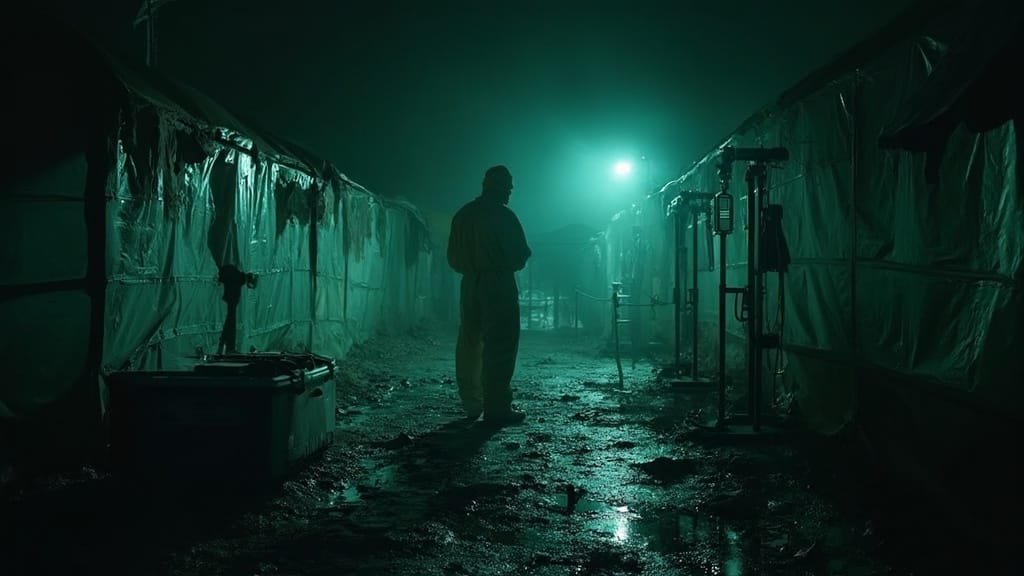
Most people think of Ebola as a solved problem — something that flares, gets contained, and fades because we have a vaccine. This outbreak is a reminder that we have a vaccine for one strain. This isn't it. (Factors that contributed to undetected spread)
As of June 5, the Bundibugyo-strain outbreak across the DRC and Uganda has reached 381 confirmed cases, including 64 confirmed deaths, with 18 new cases in the latest update, per the European Centre for Disease Prevention and Control. It is now the largest Bundibugyo outbreak on record, per the CDC. Ervebo — the vaccine that helped contain the 2018–19 DRC outbreak — was built for a different strain and doesn't work here. Past Bundibugyo outbreaks have carried fatality rates of roughly 25–50% of cases, per the CDC. (Ebola disease caused by Bundibugyo virus, Democratic ...)
The WHO director-general visited the Ituri epicenter this week and delivered a sobering number: contact tracing is reaching only about 45% of known contacts, and it needs to exceed 90% to get ahead of the virus. Some community leaders told him they don't believe Ebola is real. Ituri accounts for 359 confirmed cases across 17 health zones, with spread into North Kivu, South Kivu, and Uganda.
If contact tracing climbs past 90%, the outbreak can still be cornered. If it stays at 45% — or if a confirmed case reaches Goma's international airport — the WHO's "not yet pandemic" designation gets reopened within days. The next epidemiological update publishes Monday.
The White House Wants to Approve Your Science
This one got buried under Iran and the Anthropic IPO. It may be the most consequential domestic policy move of the month.
On May 29, the Office of Management and Budget published a 412-page proposed rule mandating "pre-issuance review" of all discretionary federal grants by political appointees, to ensure alignment with "the President's policy priorities," per Science. The proposal explicitly states that peer review "remains advisory and does not replace agency discretion" — a quiet but radical break from the merit-based model that has governed American science since World War II. It would touch the NIH's $48.7 billion and NSF's $8.75 billion FY2026 budgets, and, per Science, ban many foreign collaborations and cut federal support for publishing costs.
The legal strategy is the tell. Courts kept blocking the administration's ad hoc grant terminations last year; per Inside Higher Ed, OMB is now trying to write that authority into the regulatory record before the next round. Federal grants fund the foundational research that eventually produces everything from mRNA vaccines to GPS — and inserting a political veto doesn't just slow things down, it changes what gets funded.
If this rule gets cited in actual NIH decisions before it's finalized, "draft regulation" has become operating posture and the legal challenge is fighting a fait accompli. Comments close July 13 — before Congress returns from recess with any momentum to act. Watch for the first major scientific society to file formal opposition.
The Netherlands Just Said No — and Europe Is Watching
A small country made a large statement this week, and the implications stretch well beyond tulips.
The Dutch government blocked Kyndryl from acquiring Solvinity, a Dutch cloud provider that hosts DigiD — the identity platform 18 million Dutch residents use to file taxes, access healthcare, and claim pensions, per TechCrunch. Officials imposed a "complete prohibition," citing a "risk to the public interest." The legal hook: warnings that U.S. ownership could expose the data to the CLOUD Act, which compels U.S.-owned firms to hand over data regardless of where it's stored. Washington said it was "disappointed."
This is the same sovereignty logic the Netherlands once used to keep ASML's most advanced chipmaking machines out of China — now pointed at an American ally instead. For years, European "digital sovereignty" was more rhetoric than policy. The Dutch screening agency ran what its minister called a "country-neutral, risk-based" assessment — language engineered to survive U.S. trade pressure.
If a second European government blocks a U.S. tech acquisition on sovereignty grounds within 60 days — and we're now inside that window — the Dutch veto stops being a precedent and becomes a playbook. American cloud and AI acquirers should start pricing in a "friendly-fire" discount on European deals. Watch German, French, and Nordic reviews for that same "country-neutral" phrasing.
Florida Sues OpenAI as Washington Both Weakens and Centralizes AI Rules
The most revealing AI story this week wasn't a model — it was a courtroom filing and a watered-down signature, landing the same day.
Florida's attorney general sued OpenAI and Sam Altman, arguing the company's systems pose unacceptable risks and its disclosures have been misleading, per Politico. A day later, per Politico, Trump signed a slimmed-down AI executive order that dropped several restrictive ideas floated earlier in the year — even as congressional leaders advanced the Great American AI Act, designed to preempt tougher state laws for three years. Layer that onto the OMB grant rule, and the picture is of AI governance fracturing into a red-blue trench war with courts as the main battlefield.
The near-term risk isn't one sweeping rule. It's whiplash: aggressive state lawsuits, a lighter federal touch, and a looming preemption fight that leaves companies guessing which rulebook actually sticks.
If Florida's theory of harm survives early motions, it becomes a template other states copy. If the preemption clause survives committee markup, the regulatory floor drops to whatever Washington deems "minimally burdensome" and California's safety laws go dormant — a bigger decision than anything in the executive order. Watch the docket and the markup, in that order.
The Lens
Real outlet monitoring. Today's coverage gaps — what each side is watching.
What right-leaning outlets are watching
The Wall Street Journal reports that Iran is seeking cash as part of any peace arrangement with the United States, making the talks politically difficult for President Trump. The story centers on the gap between a tentative ceasefire framework and a durable agreement, including the unresolved terms that would have to be accepted before any deal could hold.
Also in right-leaning news:
- The Washington Examiner says the New York Assembly has sent a bill to Gov. Kathy Hochul that would replace gendered terms in state law with gender-neutral language.
- The New York Post reports that Jeremy Lin is returning to Madison Square Garden for the first time since leaving the Knicks, this time as a fan.
What progressive outlets are watching
Mother Jones reports that Jared Kushner's proposed resort project in Albania is facing a corruption probe and public protests. The coverage focuses on allegations surrounding the development and the political backlash it has generated inside Albania.
Also in progressive news:
- Mother Jones says the Trump administration is using World Cup visa policy in ways that are drawing criticism from affected applicants and observers.
- The Guardian reports that Armenia is heading to elections under Russian pressure and amid warnings about a possible 'Ukrainian scenario.'
Same story, two lenses — which is which?
U.S.-Iran war and peace negotiations. Two treatments. Same facts, genuinely different emphasis. Which perspective is which?
Version A
The persistence of this conflict — through administrations of both parties, through sanctions regimes that have demonstrably immiserated ordinary Iranians without dislodging the government they were designed to pressure — demands an honest reckoning with what American policy has actually produced. A deal that won't quite close is not a neutral stalemate; it is a condition with ongoing human costs, borne disproportionately by Iranian civilians and by communities across the region living under the shadow of potential escalation. The financial demands Iran has placed on negotiations are not simply a diplomatic inconvenience; they reflect, at least in part, the material damage that decades of sanctions have inflicted on a civilian economy. That context does not make Tehran's government less authoritarian, but it does complicate the moral arithmetic. A progressive foreign policy asks not only whether a deal serves American strategic interests, but whether the process is transparent, whether Congress has meaningful oversight, and whether the populations most affected by conflict and sanctions have any voice in the outcome. Those questions remain largely unanswered.
Version B
Any serious negotiation with Tehran must begin with a clear-eyed accounting of what Iran's government actually is: a revolutionary theocracy that has spent four decades exporting instability, funding proxy militias from Beirut to Sanaa, and treating diplomatic engagement as a pressure-release valve rather than a genuine path to normalization. The reported demand for financial concessions as a precondition for peace talks is not a negotiating position — it is a test of American resolve. Rewarding it with cash transfers, whether through sanctions relief or unfrozen assets, repeats the structural error of the 2015 JCPOA, which flooded Tehran with liquidity while leaving its ballistic missile program and regional adventurism untouched. Conservatives should support diplomacy, but diplomacy grounded in leverage, not in the hope that material concessions will moderate a regime whose legitimacy depends on hostility to the West. The harder question for the Trump administration is whether any deal achievable under these conditions would be verifiable, durable, and worth the domestic political cost of signing it. History suggests skepticism is warranted.
⚡ What Most People Missed
- Google is buying room on the grid itself: Google and Voltus signed a three-year deal on June 2 to unlock up to 100 MW of PJM capacity through flexible distributed resources rather than a new plant. The quiet shift: electricity is becoming a procurement problem for AI companies, not just a utility bill, because generation and transmission are moving too slowly for data-center demand. No other hyperscaler has publicly announced a comparable arrangement yet.
- Anthropic's compute bill is the number that reframes everything: Per SpaceX's prospectus, Anthropic will pay SpaceX $1.25 billion per month through May 2029 for compute at its Memphis data center. When that lands in Anthropic's own S-1 as a liability, it becomes the first audited look at what frontier AI actually costs — and the benchmark against which OpenAI and xAI get measured.
- The Hormuz "service fee" gambit is Iran's most durable leverage play. Even amid ceasefire talks, Iran says it will seek fees for ships crossing the Strait — framed not as transit tolls but as compensation for navigation, search-and-rescue, and security, alongside Oman. If it sticks, it's a permanent tax on global shipping dressed up as a maritime service, regardless of how the war ends.
- The Ebola tracing gap is a head start the virus may not give back. Only ~45% of known contacts are being followed, against a target above 90%, per the WHO. Four confirmed cases have already escaped care — described by health officials as a "major risk of community transmission" — which is how a contained outbreak quietly becomes an uncontained one.
- 27 nations have now signed onto the Hormuz multinational naval mission. Japan's Ministry of Defense endorsed the coalition this week — a quiet sign that what began as a Western project is hardening into a genuinely global one. When the world's third-largest economy joins a Middle East naval coalition, it's a verdict on how serious the oil-supply risk has become. [Source: Japan Ministry of Defense — Japanese]
📅 What to Watch
- If Trump signs the Iran MOU before Monday, the Fed gets room to cut without looking political — but Israel's Lebanon front, where Hezbollah has rejected the ceasefire as "surrender," becomes the next pressure point on U.S. munitions.
- If the OMB grant rule gets cited in current NIH decisions before October 1, the comment period becomes theater and the courts are litigating a done deal.
- If a second European government uses "country-neutral, risk-based" language to block a U.S. tech deal within 60 days, the Dutch veto stops being a precedent and becomes a playbook.
- If the Great American AI Act's preemption clause survives markup, California's safety laws go dormant — a quieter, bigger policy shift than the executive order that got all the cameras.
- If Anthropic's public S-1 shows compute costs anywhere near $1.25 billion a month, the index inflows that were supposed to lift every portfolio start working in reverse.
The Closer
This week: a $965 billion company that pays its landlord $1.25 billion a month and still wants to slow down AI, a Dutch government deciding 18 million people's tax logins are too sensitive for an American IT firm, and a virus winning a footrace because only 45 out of every 100 people it touched can be found. Somewhere in Washington, political appointees are sharpening their red pens over the same federal grants that gave us GPS — which means the next breakthrough they veto might be the one that would've found the next Ebola vaccine, but we'll never know, because that's rather the point. Stay suspicious of anything described as "almost."
Forward this to the friend who keeps asking why their grocery bill and a Persian Gulf shipping toll are the same story.