Why Kharg Island Changes the Oil War
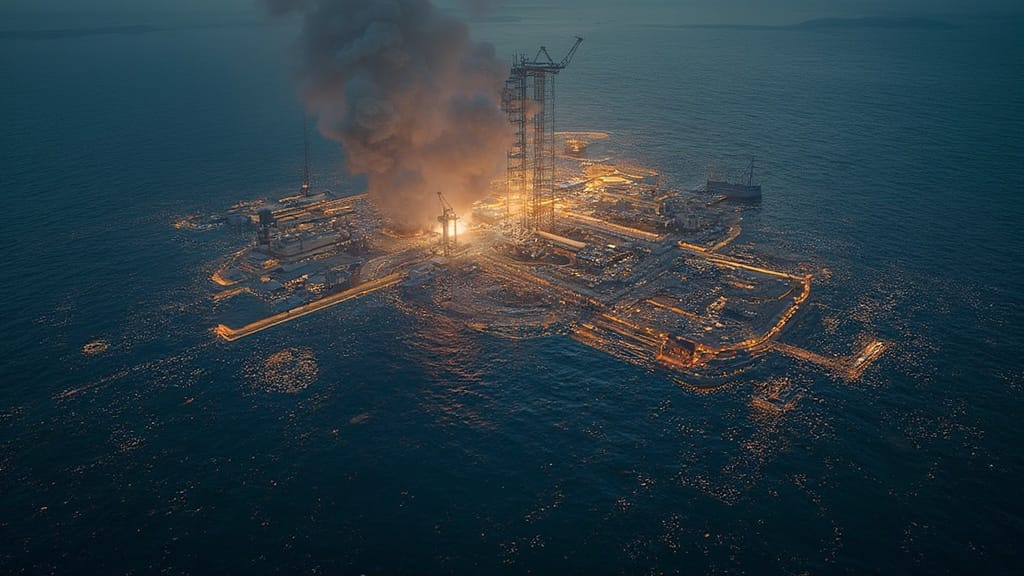
Photo: lyceumnews.com
On Day 14 of the U.S.-Israel military campaign against Iran, President Trump declared the United States had "totally obliterated every military target" at Iran's main oil export hub. The target was Kharg Island — a small, flat spit of land in the northern Persian Gulf through which roughly 90% of Iran's crude exports have historically flowed. If the damage is as extensive as claimed, this is not just a military escalation. It is the single largest deliberate strike against global oil infrastructure since Saddam Hussein torched Kuwait's wells in 1991.
The immediate consequence: the International Energy Agency projects global oil supply will fall by 8 million barrels per day in March — a historic shortfall — and has cut its 2026 demand growth forecast by 210,000 barrels per day for 2026. IEA member countries have agreed to release 400 million barrels from emergency reserves, the largest coordinated drawdown in the agency's history. WTI crude settled Friday, March 13, 2026, at $98.71 per barrel; Brent closed above $103 on Friday, March 13, 2026, the highest close since Russia's invasion of Ukraine in mid-2022. Some sessions have already breached $100 intraday on WTI.
The thesis: Kharg Island's damage — claimed by U.S. officials, though the full extent of destruction remains unverifiable due to Iran's 13-day internet blackout — transforms this from a contained military operation into a structural energy crisis with second- and third-order effects that are only beginning to surface.
What Kharg Island Actually Is

Kharg isn't a refinery. It's a loading terminal — the bottleneck where Iranian crude meets tankers. Pipelines from Iran's massive onshore fields converge there. If the terminal is destroyed you don't just stop exports; you create a backup that can shut in production at the wellhead. Restarting isn't a matter of weeks. Rebuilding deepwater loading infrastructure, if the damage is severe, takes months to years.
Iran's retaliatory posture compounds the problem. Iran's new supreme leader Mojtaba Khamenei has stated the Strait of Hormuz should remain closed as "a tool to pressure the enemy." The Strait — a 21-mile-wide chokepoint between Iran and Oman — carries roughly 20% of the world's traded oil. The IEA describes flows through it as reduced to a "trickle." Reports say Iranian attacks on oil facilities in Iraq, Oman, and Saudi Arabia are reported to have caused tanker fires and shutdowns, and war-risk surcharges on shipping have spiked.
This is claimed: Kharg was damaged. What is contested: the degree of destruction, whether Iran retains any export capacity through alternative terminals (Bandar Abbas, Lavan Island), and whether the Strait of Hormuz is functionally closed or merely constrained. Iran's internet blackout makes independent verification nearly impossible.
The Competing Hypotheses

Hypothesis 1: Controlled escalation with an off-ramp. Under this reading, the U.S. and Israel struck Kharg to eliminate Iran's primary revenue source and force a negotiated capitulation — a maximum-pressure endgame. The 400-million-barrel reserve release is designed to cushion markets long enough for diplomacy to work. China has deployed its Special Envoy on the Middle East for shuttle diplomacy. The UN Security Council issued Resolution 2817, condemning Iran's retaliatory strikes against neighbors — a text Bahrain drafted with record co-sponsors. If Iran's capacity to fund proxy operations collapses with its oil revenue, the logic goes, the war could end faster than markets fear.
Hypothesis 2: Uncontrollable spiral. Kharg's damage removes Iran's incentive to protect Gulf oil infrastructure it can no longer use. A cornered Iran could escalate asymmetrically — closing Hormuz, intensifying strikes on Saudi and Emirati facilities, activating Hezbollah and Houthi networks. The UK's RAF base in Cyprus was reportedly struck by an Iranian drone. Reports cite nearly 1,350 civilian deaths in Iran over 12 days, though verification is limited. The U.S. has evacuated diplomatic missions in Kuwait, Saudi Arabia, and Lebanon. Under this scenario, the reserve release buys weeks, not months, and $100 oil becomes a floor, not a ceiling.
The Security Council vote itself illustrates the divide: China abstained on Resolution 2817, calling U.S.-Israeli strikes unauthorized, while a competing Russian draft resolution was rejected 4-2 with 9 abstentions. The diplomatic architecture is fractured.
The Economic Transmission

The energy shock is already propagating. Airlines are imposing fuel surcharges — India's IndiGo added charges on domestic and international routes effective today. India has announced a 25% emergency increase in domestic LPG output, effective immediately. India's foreign exchange reserves dropped $11.7 billion in a single week as the RBI defended the rupee against a ballooning oil import bill.
In the U.S., the revised Q4 GDP figure came in at just 0.7% annualized for Q4 — half the prior estimate — while the Q4 GDP price index ran at 3.8%. That's the stagflation signature: weakening growth, rising prices. The S&P 500 posted its third consecutive weekly loss, falling to a new 2026 low on the week. Only 31% of S&P 500 components traded above their 50-day moving average as of March 13, 2026 — the narrowest breadth since late 2020. Goldman Sachs has flagged that trend-following funds could mechanically dump $36 billion in U.S. equities next week if selling continues.
As of March 13, 2026, the 10-year Treasury yield was holding near 4.26–4.28%, up 13 basis points on the week — rising even as growth weakens, because markets are pricing an oil-driven inflation pass-through. Brazil's finance minister warned that his country's growth trajectory now hinges entirely on rate cuts that soaring energy prices may delay. Canada shed 84,000 jobs in February, its worst non-pandemic monthly loss in four years.
One speculative but significant signal: reports indicate the U.S. has temporarily eased select Russian sanctions to stabilize oil supply — a geopolitical trade-off that, if confirmed, would represent a remarkable policy reversal with implications far beyond energy markets.
Watch For
- FOMC decision, Wednesday March 18: No rate change expected, but the updated dot plot will reveal whether the Fed sees any room to cut this year. Any explicit acknowledgment that oil-driven inflation is reshaping the outlook would likely lower short-term rate expectations and prompt a sector rotation toward energy and commodity stocks at the expense of long-duration growth names.
- Strait of Hormuz shipping data, rolling: The difference between "constrained" and "closed" is the difference between $100 oil and $120+. A functional closure would force tankers to reroute around Africa, adding tanker days and freight costs, widening physical tightness and pressuring refining and shipping spreads.
- IEA reserve release schedule: The 400 million barrels are committed but not yet fully flowing. The phasing and country-level delivery dates from IEA member states will determine whether spot physical tightness eases or whether the drawdown primarily eases futures curves.
- Iran's alternative export capacity: Can Iran route any crude through Bandar Abbas or overland to China? Early satellite imagery and shipping-data flows will reveal whether meaningful alternative exports materialize — a key determinant of whether the global supply shock is transient or structural.
- Systematic fund flows: The $36 billion forced-selling estimate is mechanical, not discretionary. If systematic selling begins, expect liquidity-driven dislocations in ETFs and futures-basis markets; Monday's opening volume will indicate whether the cascade has begun.
- Fed Chair succession: Powell's term expires May 15, 2026. Uncertainty over his replacement is already embedded in the long end of the yield curve — and an energy crisis would make the next appointment significantly more consequential for term-premium, long-term yields, and the policy response mix.